Tidepool for the M-VAVE FM-1
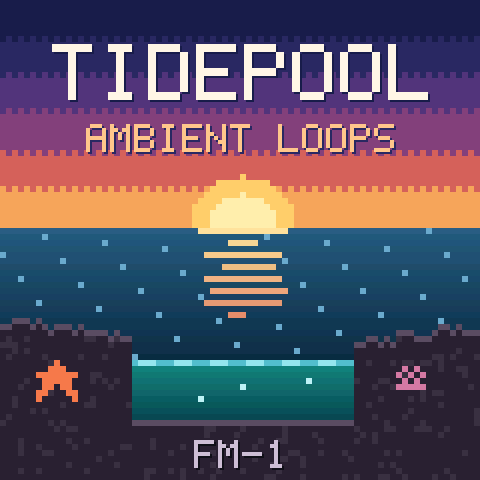
Tidepool is an ambient loop instrument, here as custom firmware for the M-VAVE FM-1 pocket synth. Each bank is a scene with sixteen loops (drones, textures, melodies and beats). Turn them on and off from the keys and they always fit together, in time and in key. You can reshape them with the knobs, change their chords, or hand the whole thing over to autoplay and just listen. A fourteenth bank, the Blank Canvas, is yours to fill: record your own loops on 36 instruments.
Every sound is synthesised live on the FM-1. There are no samples: each note is built from oscillators, filters, envelopes and noise as it plays, so changing the chords takes effect at once.
Unofficial firmware. This is a hobby project, not made or supported by M-VAVE. Installing it replaces the FM-1's own firmware until you put that back (see Going back to the stock firmware). Use it at your own risk.
Install it from your browser (Chrome or Edge, FM-1 connected by USB), or try it in the browser first: the same firmware, with sound, no FM-1 needed.
Quick start
- Install the firmware on your FM-1.
- Turn PRESETS to pick a scene you like the look of, from Shallows through to Cyberpunk.
- Press SEQ (this starts and stops autoplay mode).
- Listen as the music builds: loops come in and drop out on their own, and the chords change now and then.
- Press any white key to bring in, or take out, the loop in the matching pool on the screen.
When you're done, press SEQ again and the music winds down gently to silence.
The scenes
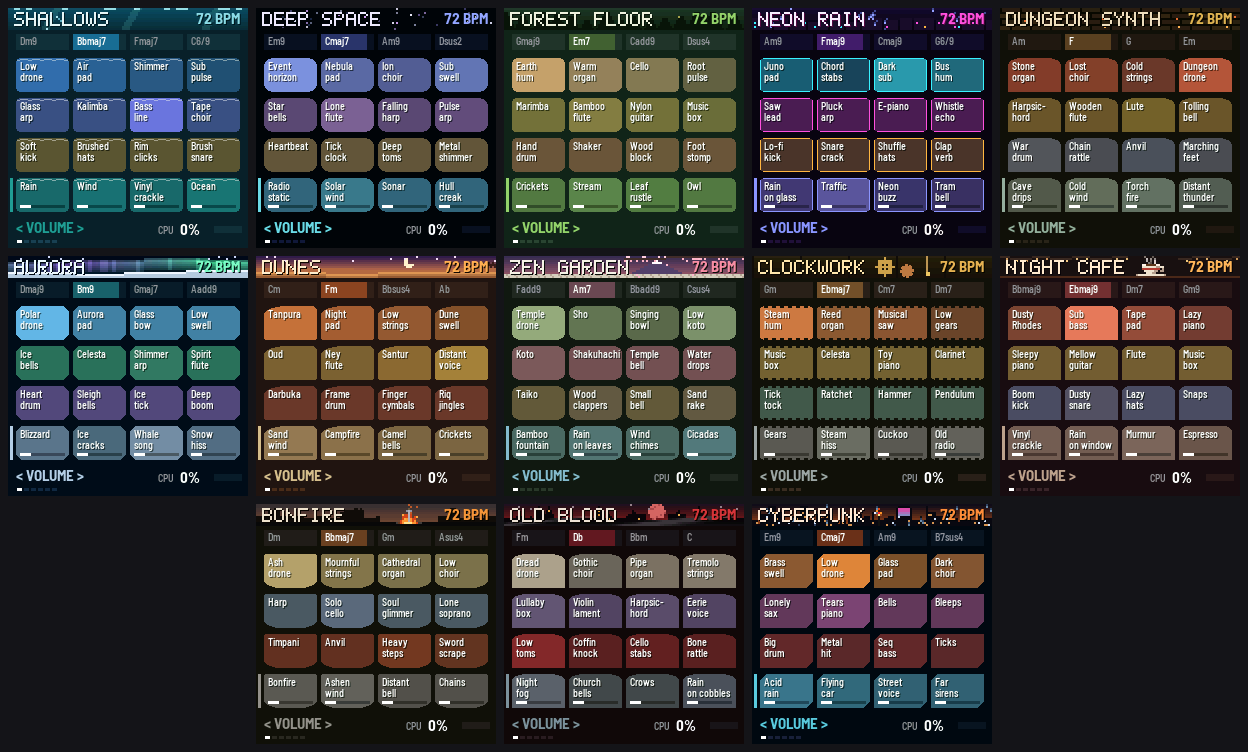
| # | Bank | Mood |
|---|---|---|
| 1 | Shallows | Under the water: a low drone, glass arpeggios, kalimba, rain and ocean |
| 2 | Deep Space | Event horizons, star bells, sonar and a lone flute |
| 3 | Forest Floor | Earth hum, cello, marimba, crickets, a stream and an owl |
| 4 | Neon Rain | A city at night: Juno pads, chord stabs, lo-fi beats, rain on glass and traffic |
| 5 | Dungeon Synth | Stone organ, lost choir, harpsichord, war drums and cave drips |
| 6 | Aurora | The northern lights: glassy pads, ice bells, whale song and sleigh bells |
| 7 | Dunes | Dusk in the desert: tanpura, oud, ney flute, darbuka and a campfire |
| 8 | Zen Garden | Spring rain in a temple garden: sho, koto, shakuhachi, taiko and wind chimes |
| 9 | Clockwork | A workshop of gears: music box, celesta, reed organ, tick-tock and a cuckoo |
| 10 | Night Café | Lofi beats on a rainy night: dusty Rhodes, sub bass, boom-bap drums, vinyl crackle, tape wobble |
| 11 | Bonfire | Dark fantasy among ruins: a cathedral organ, a solo cello, a lone soprano and a fire to rest at |
| 12 | Old Blood | A gothic nightmare: choir, tremolo strings, a warped music box, church bells and crows |
| 13 | Cyberpunk | A megacity in the rain, in the mood of Blade Runner: swelling brass synths, a lonely sax, flying cars and fire |
| 14 | Blank Canvas | Empty: record your own loops |
Each bank has its own colours, an animated pixel-art banner and its own shape of pool. Bonfire, Old Blood and Cyberpunk are written in the mood of Dark Souls, Bloodborne and Blade Runner, but every sound, chord and picture in them is original.
Playing it
When you switch on or change bank, nothing plays yet and the bar counter waits at bar 1. Pick the loops you want on the white keys (they blink, waiting), then press PLAY and they all start together on the first beat. Or press SEQ to let autoplay build the mix for you.
The screen shows the bank's name and tempo, its four chords (the current one lit), and sixteen pools in four rows. Each pool is a loop that glows in its row's colour while it plays.
The keys and knobs
| Control | What it does |
|---|---|
| White keys 1–16 | Turn a loop on or off. Rows, top to bottom: drones, melodies, beats, then textures (rain, wind, fire: the scene's atmosphere). While the music is playing, a loop waits for the next beat to come in, blinking until it does. While it's stopped, a loop you pick blinks until you press PLAY. Keys 1, 5, 9 and 13 glow faintly to mark where each row starts |
| KNOB 1–4 | Adjust the selected row's four loops, one knob each |
| OCT− / OCT+ | Choose what the knobs adjust: Volume, Attack, Decay, Reverb, Echo or Pan (shown bottom left) |
| ALGORITHM | Choose the row the knobs adjust. Pressing a key selects its row too |
| SELECT | Tempo (56–140 bpm) |
| MASTER | Main volume |
| PRESETS | Change bank. Everything fades out, then the new bank waits at bar 1 for you to pick loops and press PLAY (or SEQ) |
| SAVE | Remember the tempo, the bank and every loop's settings in every bank. Lit when there's something unsaved |
Play, chords and autoplay
| Control | What it does |
|---|---|
| PLAY | Start: the loops you've picked come in together, from bar 1. While playing, PLAY stops everything and the counter goes back to bar 1; press it again to bring back the same mix. PLAY blinks when loops are picked and waiting |
| Hold PLAY, turn KNOB 1 | Change the bank's chord progression. 0 is the bank's own; 1–99 are new ones in the same key, each the same every time. The change comes in at the next bar. Hold PLAY for a moment and the screen reminds you |
| SEQ | Autoplay. Tidepool brings loops in and out on its own, once every four bars (faster at higher tempos). It builds up from nothing to about two loops in each row, keeps every row going, changes the chords now and then, and changes the texture only rarely. It works on any bank, the Blank Canvas included |
| SEQ again | End autoplay gracefully. Loops drop out a few at a time, every four bars (the beat first, the drones last), until everything has stopped. SEQ blinks while it ends; press SEQ once more to change your mind |
| Hold HOME for 3 seconds | Surprise me: a random mix with random settings. A countdown shows on screen; let go early and nothing happens |
The Blank Canvas: record your own loops
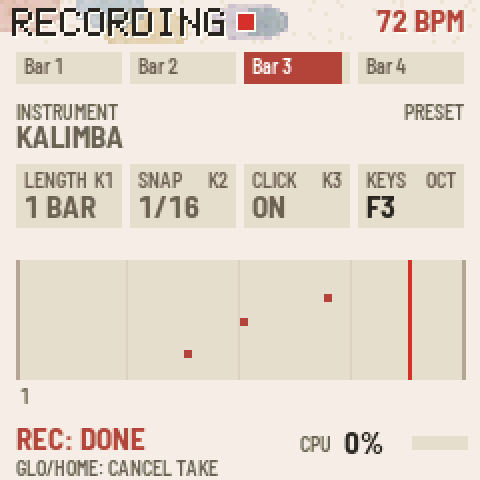
The fourteenth bank starts empty. Its sixteen pools fill with loops you record, and each one keeps its own instrument. Once recorded, they play like any other bank: turn them on and off, adjust them with the knobs, autoplay them.
To record a loop:
- Turn PRESETS to the Blank Canvas, then press GLO to enter recording mode (GLO lights up). The keys now play an instrument, and they respond to how hard you press.
- Set the loop up:
- PRESETS chooses the instrument.
- KNOB 1 sets the loop's length: 1, 2 or 4 bars.
- KNOB 2 sets the snap: off, 1/16, 1/8, or BAR, where each note starts on a bar line and lasts whole bars, for held chords.
- KNOB 3 turns the click on or off.
- OCT− / OCT+ shift the keys' octave.
- Press REC to start a new loop in the next free pool.
- Press REC again. A one-bar count-in starts at the next bar line (straight away if nothing is playing yet), then recording begins.
- Play. The loop goes round and round its length, and each pass adds to what's already there, so you can build it up layer by layer.
- Press REC a third time to keep it. It is saved straight away (no need to press SAVE) and keeps playing, so you can go straight on to record the next loop over it.
GLO during a take cancels it. GLO or HOME takes you back to playback. PLAY starts and stops the mix while you record, so you can record over other loops.
To delete a loop: hold EDIT and tap the loop's key (its pool blinks red), then tap the same key again. Any other key cancels.
The 36 instruments
| Kind | Instruments |
|---|---|
| Keys | Felt keys, Warm organ, Rhodes, Harpsichord, Celesta, Toy piano |
| Plucked and struck | Glass bell, Kalimba, Pluck, Harp, Marimba, Music box, Nylon guitar, Vibraphone, Koto, Oud, Steel pan |
| Strings, winds and voices | Soft pad, Choir, Cello, Flute, Mellow brass, Strings, Shakuhachi, Violin, Muted trumpet, Soprano |
| Leads | Chip lead, Synth lead |
| Bass | Sub bass, Moog bass, Upright bass |
| Bells | Temple bell, Singing bowl |
| Drums | Drum kit and Hand drums: each key plays a different drum (the octave buttons don't change them) |
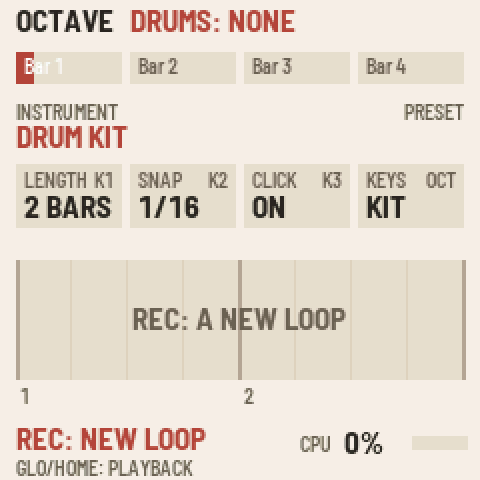
Drum kit, from the lowest key: kick, rim, snare, clap, low tom, closed hi-hat, mid tom, high tom, pedal hi-hat, crash, open hi-hat and ride. From the second F up: deep kick, shaker, brush, tambourine, cowbell and ride. The top keys repeat the main drums.
Hand drums: darbuka (deep and rim strokes), riq, frame drum, taiko and small taiko, wooden clappers, udu, finger cymbals, two agogo bells and shaker, repeating up the keyboard.
Installing
The easiest way is the web installer. Open it in Chrome or Edge, connect the FM-1 by USB, and press Install. The browser asks once for permission to use MIDI: allow it. Don't unplug the FM-1 while it writes. The same page can put M-VAVE's own firmware back.
Your settings and recorded loops survive later updates of Tidepool.
Ask Claude about it
Tidepool comes with a Claude skill. Once it's added, you can ask Claude things like "how do I record a drum loop?", "which bank has a cello?" or "what does ALL 16 LOOPS USED mean?" and get answers from how Tidepool actually works.
-
Claude Code: add this repository as a plugin marketplace, then install the plugin:
/plugin marketplace add pjh-133/tidepool-fm1 /plugin install tidepool-fm1@tidepool-fm1 -
Claude.ai and the Claude desktop app: download tidepool-fm1-skill.zip, then upload it under Settings → Capabilities → Skills. (Custom skills need a plan that includes them; you may need to switch skills on in that page first.)
The skill is in plugin/skills/tidepool-fm1/: it only explains how to use Tidepool,
and needs no access to anything else.
Building it yourself
To change Tidepool or build it from source, you build the firmware, then send it to the FM-1 over USB.
The firmware is built on fm1-base, which is included here as a git submodule. Its README covers the toolchain in more detail.
You'll need:
- Python 3, with
midoandpython-rtmidifor installing (pip install mido python-rtmidi). - JieLi's toolchain for the FM-1's chip, and their AC79 SDK. fm1-base fetches both for you (below).
- On a Mac, Docker: the toolchain is Linux-only, so the build runs it in a container automatically.
1. Get the code and the tools
git clone --recursive https://github.com/pjh-133/tidepool-fm1
cd tidepool-fm1
base/tools/get_toolchain.sh          # JieLi's toolchain, into ~/.jieli/toolchain
base/bsp/tools/get_sdk.sh            # JieLi's AC79 SDK, into ~/.jieli/ac79-sdk
2. Build
AC79_SDK=~/.jieli/ac79-sdk JIELI_TOOLCHAIN=~/.jieli/toolchain python3 base/tools/build.py firmware
This makes firmware/build/tidepool.fwsc.
3. Install
Connect the FM-1 by USB and switch it on, then:
python3 base/bsp/tools/fm1_install.py firmware/build/tidepool.fwsc
It asks before writing. Don't unplug the FM-1 while it writes (about a minute). If an install is ever cut off, the FM-1 waits in update mode: run the same command again and it finishes.
Going back to the stock firmware
Use "Back to the stock firmware" on the web installer, or install M-VAVE's official firmware file from the command line:
python3 base/bsp/tools/fm1_install.py FM-1.fwsc
Try it without an FM-1
The browser version is the quickest. To build things locally, fm1-base's host simulator runs the same firmware on your computer, with no toolchain needed. It's driven by scripts, which take screenshots and record WAV files as they go:
python3 base/tools/build.py firmware --host
firmware/build/host/tidepool_host firmware/tests/newbanks.txt firmware/build/host
The scripts in firmware/tests/ cover each part: the banks, the Blank Canvas, autoplay, the instruments and
settings from older versions.
How it's made
The first five banks are a port of the original Tidepool web app, a browser instrument built on Web Audio, translated into C for the FM-1's chip. The other seven, and the extra instruments, were written for the FM-1 in the same style. The engine, the banks, and how everything was measured and tested are described in docs/DEVELOPMENT.md.
| Folder | What's in it |
|---|---|
src/ | The sound engine and the banks: oscillators, filters, envelopes, reverb, echo, and each bank's sixteen loops |
firmware/ | The FM-1 app: the panel, the screen and its pixel art, saving, the recorder, autoplay, and the tests |
host/ | A Mac benchmark that renders the banks to WAV and estimates their cost on the FM-1 |
web/ | An older browser emulator of the panel (first bank only); the site's is the whole firmware |
firmware/site/, firmware/docs/ | The website's front page and manual |
plugin/ | The Claude skill (with .claude-plugin/ at the top, the plugin marketplace for Claude Code) |
base/ | fm1-base, the platform layer (git submodule) |
Credits and licence
Tidepool's own code is under the Mozilla Public License 2.0.
It's built on fm1-base by Charles Vestal and felucca-bsp by Leo Kuroshita (Hügelton Instruments), both MPL-2.0. They provide the FM-1's hardware layer, screen drawing, saving, USB and the installer. Thanks to everyone in the FM-1 firmware community whose work made custom firmware possible.
M-VAVE and FM-1 are trademarks of their owners. This project is not affiliated with them.