Scintilla
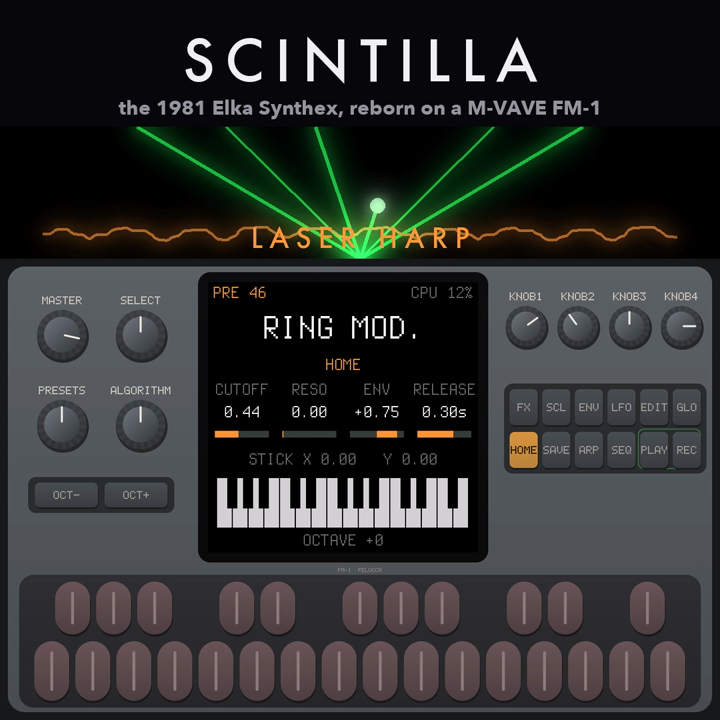
The 1981 Elka Synthex, reborn on the M-VAVE FM-1. Scintilla is the Elka Synthex of synthex-web as an engine for the M-VAVE FM-1 pocket synth: fixed-point C for its JieLi AC791N (pi32v2, no FPU, two 240 MHz cores), checked sample by sample against the browser original and measured on the emulated FM-1 (fm1-emu).
Status: 0.2.0, runs on the FM-1. (What changed.) The engine plays all 80 factory patches (the 40 PRESETS and 40 MEMORIES,
Paul Wiffen's Laser Harp "Ring mod." among them; the PRESETS with the values synthex-web decoded from the
Synthex's own EPROMs) on this computer and on the emulated FM-1, with the same bits on
both. firmware/ makes it a firmware of its own on Dinghy: the keys, the knobs and pages, the screen,
USB and DIN MIDI, USB audio, velocity and aftertouch from the FM-1's own keys (on its SETTINGS page), installable as scintilla.fwsc. Installed and played on a real FM-1 (2026-11-01); every check in the tests runs in
fm1-emu.
The delay is not there yet (see PLAN.md); the reverb is an algorithmic one measured against the app's.
Get it: Install on my FM-1 on its page (over USB, in Chrome or
Edge), or the .fwsc from the latest release, installed with the
FM-1 Firmware Hub or firmware/tools/fm1_install.py scintilla-0.2.0.fwsc (USB-MIDI).
Hold OCT- while switching on for the USB rescue; the hub takes it back to the official firmware. The 0.1.1 release
has a short video of it playing. Scintilla does not read other firmwares' projects or samples: its own 80
sounds are built in, and it keeps only its settings. It reports the identity FM-1_963XYYZZ (0.2.0: FM-1_96300200).
What is in it
engine/ | the synth, integer C with no dependencies: sc_voice.c (one voice: two PolyBLEP oscillators, noise, the zero-delay-feedback filter in five modes, two envelopes, two LFOs, glide, sync, ring and cross mod), sc_synth.c (two layers, poly / mono / unison, split / double, chorus, reverb, limiter) |
engine/sc_presets.h, sc_presets_data.h | factory decoder and generated bank: 25-byte records, expanded on recall |
engine/sc_tables.h | pitch, cutoff, sine, log2 / exp2 tables for 44.1 kHz (tools/gen_tables.py) |
host/sc_render.c | renders a scenario on this computer: one voice as float32, or the instrument as a WAV |
tools/ref_render.mjs | the same scenario through synthex-web's own VoiceCore: the reference |
tests/run.sh | every preset through every scenario in both, scored (tools/score_all.py) |
firmware/ | the firmware: Scintilla on Dinghy 0.3 (firmware/src/scintilla.c), ./build.sh -> build/scintilla.fwsc, tests/emu_test.py on the emulated FM-1. Its README |
fm1/ | the engine as a bare-metal program for the FM-1's CPU: run.py counts its instructions in fm1-emu and checks its output against the host build; listen.py has it play a song into a WAV, checked sample for sample |
How close it is
tests/run.sh renders each of the 80 patches through four scenarios (a held note, a phrase, the joystick, chords)
in VoiceCore and in the C engine: level within 0.1 dB everywhere (median 0.001 dB), spectrum within 0.02 dB
(median). The few with larger spectral differences are within the reference's own floor: VoiceCore seeds one noise
oscillator at random, and hard sync turns a 0.00005-semitone pitch difference into a different waveform, so the test
renders the reference twice (the second nudged by that much) and holds the C engine to that floor.
What it costs on the FM-1
fm1/run.py, instructions per 256-frame block (the 5.8 ms the audio interrupt has), one 240 MHz core, the
FM-1's output bit-identical to the host's:
| patch | voices | % of a core |
|---|---|---|
| Chunky Synth (2 saws, 24 dB) | 8 | 20 % |
| Chunky Synth, both layers | 16 | 37 % |
| Brushed Cymbals (noise) | 8 | 27 % |
| Sync. Harmonic Sweep | 8 | 37 % |
| Ring mod. (the Laser Harp: sync, ring, cross mod, PWM, glide) | 8 | 51 % |
| Fat Sound (OSC2 -> OSC1 PWM: the per-sample path) | 8 | 53 % |
| Metallic (the same, with sync and glide) | 8 | 57 % |
| Landing (the per-sample path, an LFO on the cutoff) | 8 | 56 % |
| Take-off (HP12, its filter envelope sweeping) | 8 | 36 % |
Instructions are a lower bound on cycles (flash loads and divides take longer). FM-1 firmwares aim to stay under half of a core; Ring mod.'s, Fat Sound's, Metallic's and Landing's eight voices go over it (the band-limited sync and the per-sample path's cross-mod).
The table is of chords held after their attacks. An attack costs more where the filter envelope sweeps faster than
half a semitone a sample (the ROM bank's 5 ms attacks of 100+ semitones): the filter's coefficients are recomputed
at nearly every sample of it. Eight voices struck again and again, the heaviest such patches (High Portamento, Bass
Drum - tom-toms) take ~70 % of a core in their attack's block (-Os, as fm1-dock builds it). fm1-dock's module
renders half of the voices on the FM-1's second core (sc_render_split / sc_render_voices on two lanes,
SC_LANES=2; the same samples): its worst factory patch takes ~38 % of core 0 in fm1-emu.
Running it
python3 tools/gen_tables.py                                       # engine/sc_tables.h
node --experimental-transform-types tools/gen_presets.mjs         # engine/sc_presets_data.h (SYNTHEX_WEB=path to synthex-web)
tests/run.sh                                                      # the comparison with VoiceCore
fm1/run.py                                                        # the cost on the emulated FM-1
fm1/listen.py                                                     # a preset tour played by the emulated FM-1 -> build/listen/fm1-emu.wav
fm1/listen.py out.wav --part 36:tests/scenarios/chords.txt         # any preset:scenario parts
cc -O2 -o build/sc_render host/sc_render.c engine/sc_voice.c engine/sc_synth.c -lm
build/sc_render list                                              # the presets
build/sc_render synth 36 tests/scenarios/chords.txt laser.wav     # listen
The factory bank stores 80 records of 25 bytes each. PRESETS use the original Synthex ROM
bit layout; MEMORIES use a software extension with shared exact-value palettes for LFO2,
LP12 and effects. Names and calibrated conversion tables are shared separately. Recall expands
one record into the existing staging patch; rendering still uses the full Q16 patch and both layers.
The raw ROM parameters are in tools/data/synthex_rom.json, copied from synthex-web's
tools/synthex-rom/data/rom_presets_raw.json (the T41 EPROM recall routine's output).
python3 tests/presets_test.py verifies the original 1,000 ROM bytes and the expanded bank
against pre-compression checksums, with address/undefined-behavior sanitizers. Regeneration
also compares every expanded patch byte against a full-size reference from factory.ts and
restores the previous generated data if that comparison fails. Update the standalone bank
checksum only after an intentional sound/name change. Software extension records have a
200-bit limit and currently require identical layers; generation fails if a bank needs a larger
format, rather than dropping settings.
fm1/build.sh needs the JieLi toolchain (~/.jieli/toolchain, as fm1-harbor) and, on macOS, Docker; fm1/run.py
and fm1/listen.py need fm1-emu built from its master of 2026-10-19 or later.
Licence
GPL-3.0-only (LICENSE), as the FM-1 firmware platforms it will join. The engine is a port of synthex-web
(BSD-2-Clause, Joakim Eriksson). fm1/crt0.S and fm1/bench.ld come from fm1-emu's fm1-sid (BSD-2-Clause).
"Elka" and "Synthex" are names of their owners; "M-VAVE" and "FM-1" belong to theirs. Scintilla is not affiliated
with or endorsed by Elka, Generalmusic, Behringer / Music Tribe or M-VAVE.