Phantasmagoria
Hype41/100A spectral shimmer delay and echo chamber for the PedalPCB Terrarium (Daisy Seed). Features reverse delay, pitch shifting, freeze, and tape warble.
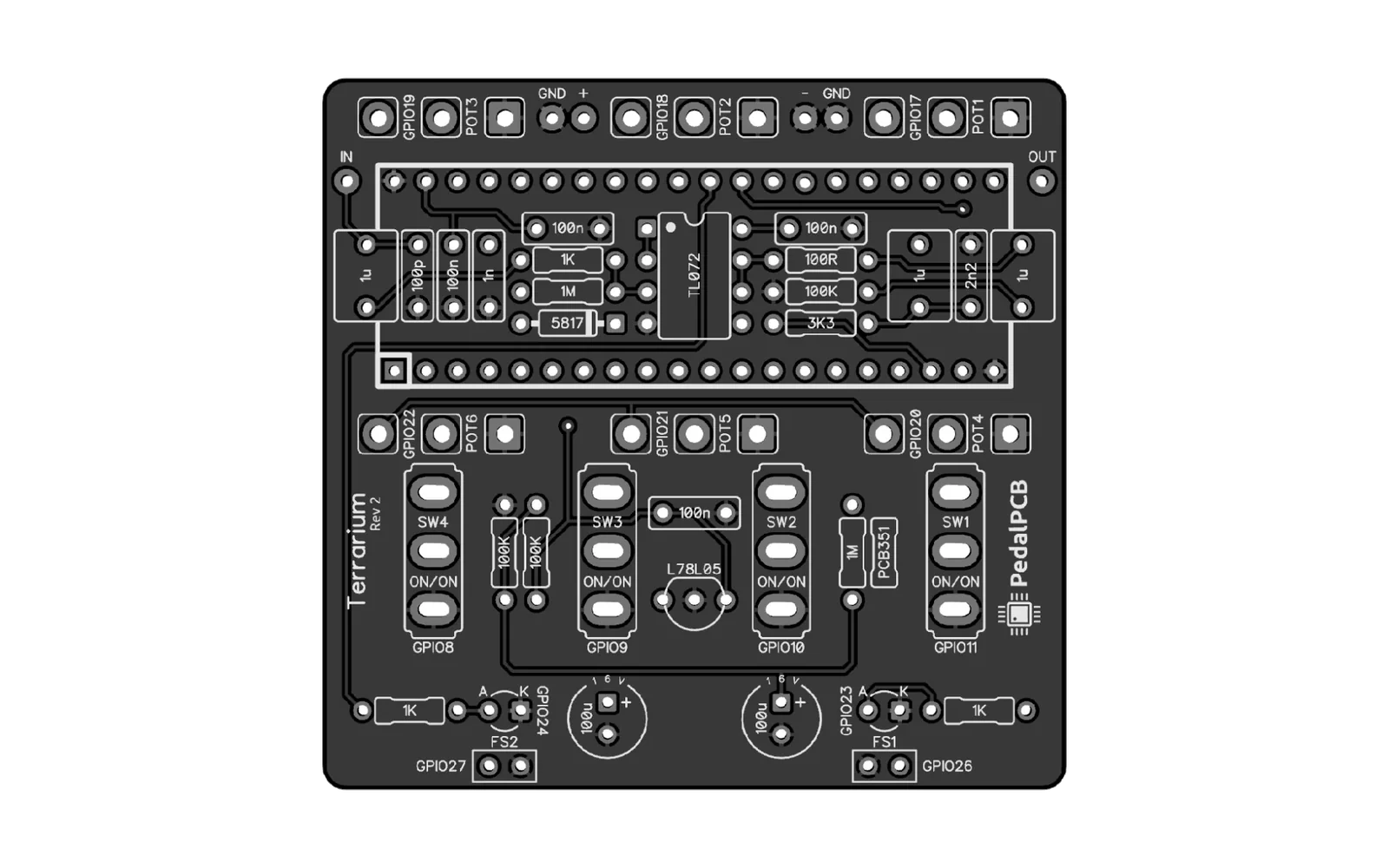
Phantasmagoria is custom firmware for the PedalPCB Terrarium, by @FuzzyLotus. Open source under GPL-3.0, latest release v2.11 (March 2026), 9 stars on GitHub.
forPedalPCB Terrarium·by@FuzzyLotus
Unclaimed. Is this yours? Sign in with GitHub as @FuzzyLotus to claim it.
phantasmagoria.bin· 86 KB
GPL-3.0· FuzzyLotus/Phantasmagoria·downloads come from the creator’s GitHub releases
v2.11V2.11 Smaller release - K4 and K5 now also applies to reverseLatest1 file
Phantasmagoria - Switch System Rework
v2.1tov2.11
Why the rework?
The old switch assignments (fifth down, octave down, shimmer, accumulate) were functional but felt like disconnected add-ons bolted onto the side of the pedal. In actual use, they weren't getting flipped - they didn't change the feel of the instrument, they just added more layers on top.
The goal of the rework was simple:
- Every switch should be clearly audible
- Every switch should feel worth using
- The pedal should feel like one unified instrument, not a base effect with optional extras
The New Switch Identity
Switch Label Role What it changes SW1 REV Time direction Forward vs Reverse delay SW2 ROOM Spatial world Standard delay+reverb vs Chamber memory folds into repeats SW3 HALO Ambient aura Normal wet field vs Detached trailing ghost layer SW4 EVOL Frozen world Stable frozen anchor vs Living, breathing frozen texture Design principle: We're not adding effects. We're changing how the existing system behaves.
Switch Details
SW1 - REV (unchanged)
The core time-direction switch. Remains the most fundamental alternate world of the pedal.
State Behavior OFF Forward delay ON Reverse delay
SW2 - ROOM (new)
The room becomes part of the repeat structure instead of sitting beside it as a separate layer.
State Behavior OFF Standard delay to reverb routing ON Chamber memory folds into the delay world Intended feel: Playing into an active haunted room rather than into a delay pedal with a reverb after it.
SW3 - HALO (new)
Adds a detached late aura behind the wet signal - a trailing ghost layer that lives behind the repeats and reverb.
State Behavior OFF Normal wet field ON Atmospheric after-image trails behind the effect Intended feel: A second shadow of the note, living behind the main effect field. Present but not dominant.
SW4 - EVOL (new)
Controls whether the frozen layer is a stable bed or a slowly evolving living texture.
State Behavior OFF Mostly stable frozen anchor ON Frozen layer slowly lives and moves Intended feel: The freeze becomes alive without turning into obvious pitch wobble or chaotic movement.
What got removed
The old pitch engine (fifth down / octave down / shimmer) was removed from the active switch architecture. Those behaviors didn't help the pedal feel more unified and were replaced by switch roles that better support the core identity.
Other changes in this version
Tape warble now affects reverse delay
K4 (tape depth) and K5 (LFO speed) were only modulating the forward delay read. The reverse grain reader was running on a fixed clock with no warble at all. Both directions now share the same tape modulation, so flipping SW1 to reverse feels like part of the same instrument instead of a completely separate effect.
Freeze survives bypass
Turning the main effect off no longer kills an active frozen layer. Bypassed output is now:
- Freeze inactive: dry only
- Freeze active: dry + freeze
This is intentional - freeze remains musically useful as its own layer even when the main delay is bypassed.
Bypass transition drop fixed
Output routing was reworked so toggling the effect off no longer causes a brief signal dip. The dry path crossfades back in smoothly while the wet path fades out.
K5 control law reshaped
LFO speed control was reshaped so the sweet spot is broader and more usable across the knob travel. The most musical range no longer arrives too early and disappears too quickly.
Output routing cleaned up
Core effect path and freeze path are now treated as separate signal routes. Freeze behavior stays intentional and isn't incorrectly tied to the main bypass state.
The result
The pedal now behaves more like a complete instrument:
Switch Changes... REV the time world ROOM the spatial world HALO the ambient aura EVOL the frozen world The switch section supports the pedal's identity instead of feeling like a set of spare extra features.
v2.1Phantasmagoria V2.12 files
Phantasmagoria - Switch System Rework
v30ctov31
Why the rework?
The old switch assignments (fifth down, octave down, shimmer, accumulate) were functional but felt like disconnected add-ons bolted onto the side of the pedal. In actual use, they weren't getting flipped - they didn't change the feel of the instrument, they just added more layers on top.
The goal of the rework was simple:
- Every switch should be clearly audible
- Every switch should feel worth using
- The pedal should feel like one unified instrument, not a base effect with optional extras
The New Switch Identity
Switch Label Role What it changes SW1 REV Time direction Forward vs Reverse delay SW2 ROOM Spatial world Standard delay+reverb vs Chamber memory folds into repeats SW3 HALO Ambient aura Normal wet field vs Detached trailing ghost layer SW4 EVOL Frozen world Stable frozen anchor vs Living, breathing frozen texture Design principle: We're not adding effects. We're changing how the existing system behaves.
Switch Details
SW1 - REV (unchanged)
The core time-direction switch. Remains the most fundamental alternate world of the pedal.
State Behavior OFF Forward delay ON Reverse delay
SW2 - ROOM (new)
The room becomes part of the repeat structure instead of sitting beside it as a separate layer.
State Behavior OFF Standard delay to reverb routing ON Chamber memory folds into the delay world Intended feel: Playing into an active haunted room rather than into a delay pedal with a reverb after it.
SW3 - HALO (new)
Adds a detached late aura behind the wet signal - a trailing ghost layer that lives behind the repeats and reverb.
State Behavior OFF Normal wet field ON Atmospheric after-image trails behind the effect Intended feel: A second shadow of the note, living behind the main effect field. Present but not dominant.
SW4 - EVOL (new)
Controls whether the frozen layer is a stable bed or a slowly evolving living texture.
State Behavior OFF Mostly stable frozen anchor ON Frozen layer slowly lives and moves Intended feel: The freeze becomes alive without turning into obvious pitch wobble or chaotic movement.
What got removed
The old pitch engine (fifth down / octave down / shimmer) was removed from the active switch architecture. Those behaviors didn't help the pedal feel more unified and were replaced by switch roles that better support the core identity.
Other changes in this version
Freeze survives bypass
Turning the main effect off no longer kills an active frozen layer. Bypassed output is now:
- Freeze inactive: dry only
- Freeze active: dry + freeze
This is intentional - freeze remains musically useful as its own layer even when the main delay is bypassed.
Bypass transition drop fixed
Output routing was reworked so toggling the effect off no longer causes a brief signal dip. The dry path crossfades back in smoothly while the wet path fades out.
K5 control law reshaped
LFO speed control was reshaped so the sweet spot is broader and more usable across the knob travel. The most musical range no longer arrives too early and disappears too quickly.
Output routing cleaned up
Core effect path and freeze path are now treated as separate signal routes. Freeze behavior stays intentional and isn't incorrectly tied to the main bypass state.
The result
The pedal now behaves more like a complete instrument:
Switch Changes... REV the time world ROOM the spatial world HALO the ambient aura EVOL the frozen world The switch section supports the pedal's identity instead of feeling like a set of spare extra features.
Show all 2 filesHide 1 files
Other filesv31Phantasmagoria v31 - Release Candidate1 file
Phantasmagoria v31 - First Public Release
A spectral shimmer delay for the PedalPCB Terrarium guitar pedal, built on the Daisy Seed microcontroller.
Combines reverse delay, pitch shifting (fifth down, octave down, octave up shimmer), freeze with layer accumulation, tape warble, and an echo chamber reverb, all in one pedal.
⚡ Flash to your pedal (no coding required)
- Download
phantasmagoria.binbelow. - Hold BOOT on your Daisy Seed, tap RESET, then release BOOT.
- Open flash.daisy.audio in Chrome or Edge.
- Click the File Upload tab.
- Click BROWSE... and select the
.binfile you downloaded. - Click the FLASH button (this may prompt you to select your Daisy Seed from a browser popup).
- Done!
🪟 Windows Users: Web Flasher Not Working?
If your Windows PC doesn't recognize the Daisy Seed in the browser flasher, you need to replace the default USB driver with WinUSB.
- Put your Daisy Seed in BOOT mode (Hold BOOT, tap RESET, release BOOT).
- Download and run Zadig.
- Go to Options > List All Devices.
- Select DFU in FS Mode (or STM32 BOOTLOADER) from the main dropdown menu.
- Ensure the target driver with the green arrow points to WinUSB.
- Click Replace Driver.
- Refresh the web flasher page and try connecting again.
Controls
Control Function Knob 1 Delay Time Knob 2 Feedback Knob 3 Reverb Mix Knob 4 Tape Warble Depth Knob 5 LFO Speed Knob 6 Dry/Wet Mix SW1 Reverse Delay on/off SW2 Fifth Down on/off SW3 Octave Down on/off SW4 Shimmer (Octave Up) on/off FS1 Bypass FS2 Freeze - tap to toggle, hold to accumulate layers Requirements
- PedalPCB Terrarium with Daisy Seed
- Chrome or Edge browser for flashing
Known good on
- Daisy Seed hardware revision 7
- 48kHz sample rate, block size 1
- Download