
NU//METAL SKRATCHMASTER PRO
A robot turntablist over a mutating 808 beat and a box of toys, for the M-VAVE FM-1. Version 3.1: TOYBOX + DEEP CUTS.
The FM-1 becomes a deck. SAM (the 1982 Software Automatic Mouth) says 27 words onto a virtual record, and you scratch them with the keys and the jog wheel. Or surf an endless record that is generated as you scratch it (SURF mode, new in 3.0, cutting deeper in 3.1). Behind you plays a hard 808 beat that never stops changing, its melody on toys: a toy piano, a music box, a xylophone, a kalimba, a toy organ, and now and then a granular poof (new in 3.1). In RAP MODE the robot is the MC: four bars of verse, where it raps rhyming lines that fit the beat, then four bars of hook, where it shouts the hook in a Melvins-style GROWL.
PRO adds what a turntablist expects from a real setup:
- A real LFO, locked to the tempo (and to MIDI clock), with 7 shapes and 6 destinations, the deck's pitch and the record itself among them
- 17 scratch techniques, each one scored the way TTM notation writes a scratch (the record's motion plus the crossfader's clicks), and COMBO routines that string them together
- HAMSTER switch, crossfader CURVE, turntable motor TORQUE
- TONE PLAY: the keys become a pitch fader, for melodies on a tone, on AHHH or on any word
- AHHH and FRESH, the two classic battle-record sounds
- A bigger sound engine: a vocal chain, a stereo plate reverb, a glue compressor and a soft limiter
- A MIXER page with faders and live meters
- An 808 kit as real samples (new in 2.1), rendered offline in floating point
- MIDI for drummers and visuals (new in 2.1): play the kit from an e-kit on the TRS input, and every drum and the deck itself come out on USB-MIDI
Status: 3.1, runs on the FM-1. Identity
FM-1_926, the same as NU//METAL SKRATCHMASTER 1.0: it installs over it. Installing firmware is at your own risk; M-VAVE's official firmware can be reinstalled at any time.
Install
- In the browser: open the web installer in Chrome or Edge on a computer, plug the FM-1 in with a USB data cable, press Install. It uses Web MIDI, and nothing else needs to be installed.
- From the command line: download
numetal-pro-3.1.fwscfrom Releases (or docs/firmware), thenpython3 tools/fm1_install.py numetal-pro-3.1.fwsc(needspip3 install mido python-rtmidi). - Rescue: hold OCT- while switching on. No sound, only the updater. Install anything from there.
Coming from 1.0, the first start sets everything to defaults (the saved settings grew in 2.0). 2.1 keeps 2.0's settings. 3.0 keeps 2.x settings and sets the tuning to A once. 3.1 keeps 3.0's settings, but the old groove number now picks a toy: turn PRESETS to TOYBOX, and set KNOB3 to about 140 BPM.
What's new in 3.1: TOYBOX + DEEP CUTS
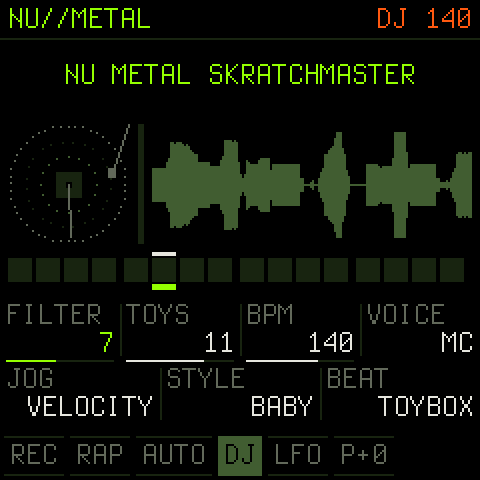
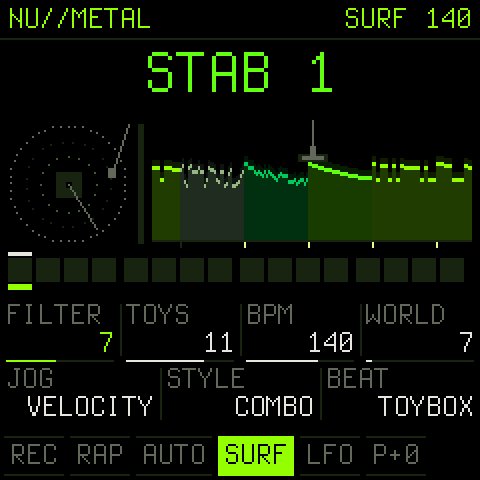
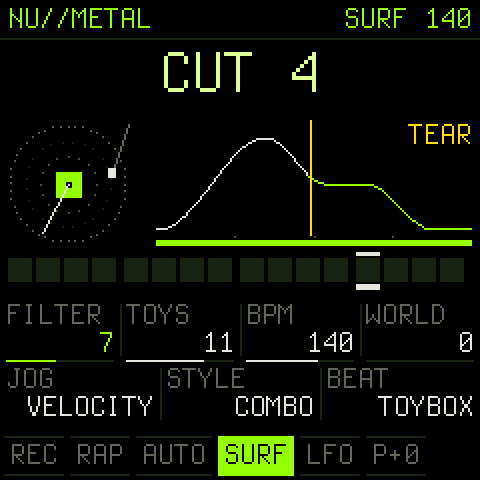
The band is gone. In its place is one hard 808 beat that MUTATES forever. It starts from a home bar: kicks with a long, driven 808 under each one, a clap and a snare stacked on the backbeat, hats with a 32nd roll, and a little toy phrase played twice, the second time a bit different. Then, every bar:
- one or two things change: a kick moves and takes its 808 with it, an 808 holds and slides to a new note, a hat rolls in 32nds, a ghost snare or rim lands, an open hat, a double kick, a toy note changes or echoes;
- each changed step has a chance to drift back home, so it wanders but keeps a groove;
- every 8 bars the home itself moves on: it keeps what it became, or now and then starts somewhere new.
It never plays the same thing twice.
PRESETS picks what plays the melody:
| BEAT | What you hear |
|---|---|
| OFF | drums and toys off, just the deck |
| TOYBOX | the toy changes every 8 bars, and a note now and then goes POOF (the odds drift too) |
| TOY PIANO | struck metal tines: FM at 3.5:1, the brightness dying first |
| MUSIC BOX | two octaves up, a soft 3:1 ping |
| XYLO | a hard 4:1 knock, short |
| KALIMBA | a quick 6:1 plink and a long tail |
| TOY ORGAN | two square waves an octave apart, a little out of tune, held |
| POOFS | every note a granular poof: three grains of the SAM words at a time, pitched to the note, and a breath through a band-pass |
KNOB2 is now TOYS (their level), and on the MIXER the strips read TOY and 808. TUNING (EDIT + KNOB1) sets the key of the toys and the 808. FILL (hold SEQ) rolls the 808 under the snare. The toys sit a little wide (the right side ~9 ms late).
SURF cuts deep:
- Two classic battle-record materials join the seven: STAB, a horn / power-chord hit in drop A (stacked saws, a fifth, a sub, driven), and CUT, a whole word off the bank (AHHH and FRESH most of all) pitched down. Half of every record is now STAB, CUT or AHHH, so every WORLD sounds different from 3.0.
- AHHH sits lower (60-187 Hz).
- A held technique throws the record 1.5x further in SURF (the window follows the stroke, so long strokes stay smooth). The jog throws 4x further a click in SURF, and the hand and the throws reach 32x.
- A low shelf (~+7 dB under 250 Hz) sits under the SURF deck, and fast strokes darken a little sooner, so they growl instead of squeal.
- The landscape glows toxic green: every material its own green, a bright ridge, a haze above it, a glow around the surfer, green SURF chips.
Elsewhere: fast scratches are tamed in every mode (the faster the record, the darker it gets), and the jog is back to the 2.x feel in DJ mode. The first screen says INFINITE MUTATE.
What's new in 3.0: INFINITE SKRATCH
SURF mode (press HOME until the chip says SURF) puts an endless record on the deck. It is never stored. Every stretch is computed from where it is on the record and from the WORLD, so scratching back over a spot plays the same sound again, just like vinyl. The record is cut into zones of 0.74 s. Each one is a sample on a battle record with an attack, a body and a gap of crackle, and each is made in one of seven ways (3.1 adds STAB and CUT, see above):
| Material | What it is |
|---|---|
| AHHH | a vowel built from FOF grains (a pulse every pitch period, three formants ringing off it), gliding, morphing a to o |
| CHIRP | a tone sweeping octaves, or a LASER where the sweep repeats; sine, fat square, saw or sine + octave |
| FM | two operators, the index decaying, rising or wobbling: bells, screeches |
| BYTE | a bytebeat formula (t*(t>>a|t>>b) and friends) read at the record's speed: 8-bit shrapnel |
| DUST | the SAM words shattered into grains, re-pitched, some backwards, two streams overlapped |
| CHAOS | the logistic map with r swept through its bifurcations: a tone splits into two, four, then noise |
| HISS | noise through a resonant filter that sweeps: the record's whistle and its kssh |
- Keys are 27 spots on the record. Tap one to play its zone, hold it to scratch there in the STYLE, and tap again quickly for finger strokes.
- SURF (EDIT + KNOB4, 0..15): a held scratch drifts along the record while it loops (0 = it stays on the spot).
- FLOW (EDIT + KNOB2 in SURF mode, 0..15, default 12): 0 = a battle record, separate sounds with crackly gaps; 10 and up = no gaps, the sounds sustain and each zone crossfades into the next (up to 174 ms), so the record is one continuous landscape.
- WORLD (KNOB4, 0..99): a different record. Each world leans on three of the materials. Turning it while a sound plays morphs the sound under the needle.
- The jog surfs anywhere, far past the keys. Flick it and let go, and the record coasts through zone after zone.
- AUTO in SURF mode = ETERNAL SKRATCH: the robot rides the record by itself. It plays on, scratches where it is, and skips a wave or two, forever, never the same.
- The screen shows the record as a landscape scrolling under the needle: each zone is a mountain in its material's
colour, the 27 key spots are marked in yellow, and a little surfer rides the needle. The big line names the
material and the zone (
CHAOS 12). - REC records SURF spots into the steps like words.
The jog is more sensitive: about 2.5x further a click, 2.5x more again in SURF mode, a snappier hand and easier throws.
A harder band (replaced by TOYBOX in 3.1): the guitar was a 7-string in drop A (the default tuning; KNOB1 with EDIT still goes from F to F). The amp is hotter, with three stages, the last one lopsided like a rectifier, a deep mid scoop, a thump at 100 Hz and a snarl at 3 kHz. Chugs are root + octave and slam shut. New grooves:
- SEASICK: the second guitar plays the open chords a half step sharp and slides down onto the first. Dissonant and woozy, and the bass clanks off the frets.
- DIVEBOMB: whammy dives (an octave down in a quarter second) and a pinch-harmonic squeal with finger vibrato.
- BRUTAL TRUTH (a grind blast, a chromatic tremolo riff) and BAD DAY (half time, seasick) replace BOUNCE and B-BOY.
Riffs can use the new moves in any groove: a..k = an open chord with a dive, ! = the squeal.
MIDI clock over TRS: the FM-1 follows MIDI clock (and Start / Stop) on the TRS input as well as on USB, with SYNC set to FOLLOW.
What's new in 2.1
- TRS MIDI IN works: plug an e-kit (the map is set up for a Roland TD-8) or any MIDI gear into the FM-1's TRS jack. Channel 10 uses the General MIDI drum map, and hits that land together (kick + crash) play together.
- MIDI out for visuals: every drum the FM-1 plays (the band, the pads, the e-kit) goes out on USB-MIDI as a GM note on channel 10, and the deck sends CC 20 (scratching 0/127), CC 21 (crossfader) and CC 22 (platter angle) on channel 1.
- The 808 kit: kick, snare, clap, toms and a long saturated 808 bass, with the hats' and cymbals' aliasing fizz filtered out.
- The guitar is a drop-B take (plucked strings into an oversampled two-stage amp, tone stack and 4x12 cab), double-tracked left and right. The kit and the guitar are 16-bit samples played at TUNE pitch; DECAY 0/1 shortens them.
- The audio load stays about 20 % at peak with the kit hammered.
Play
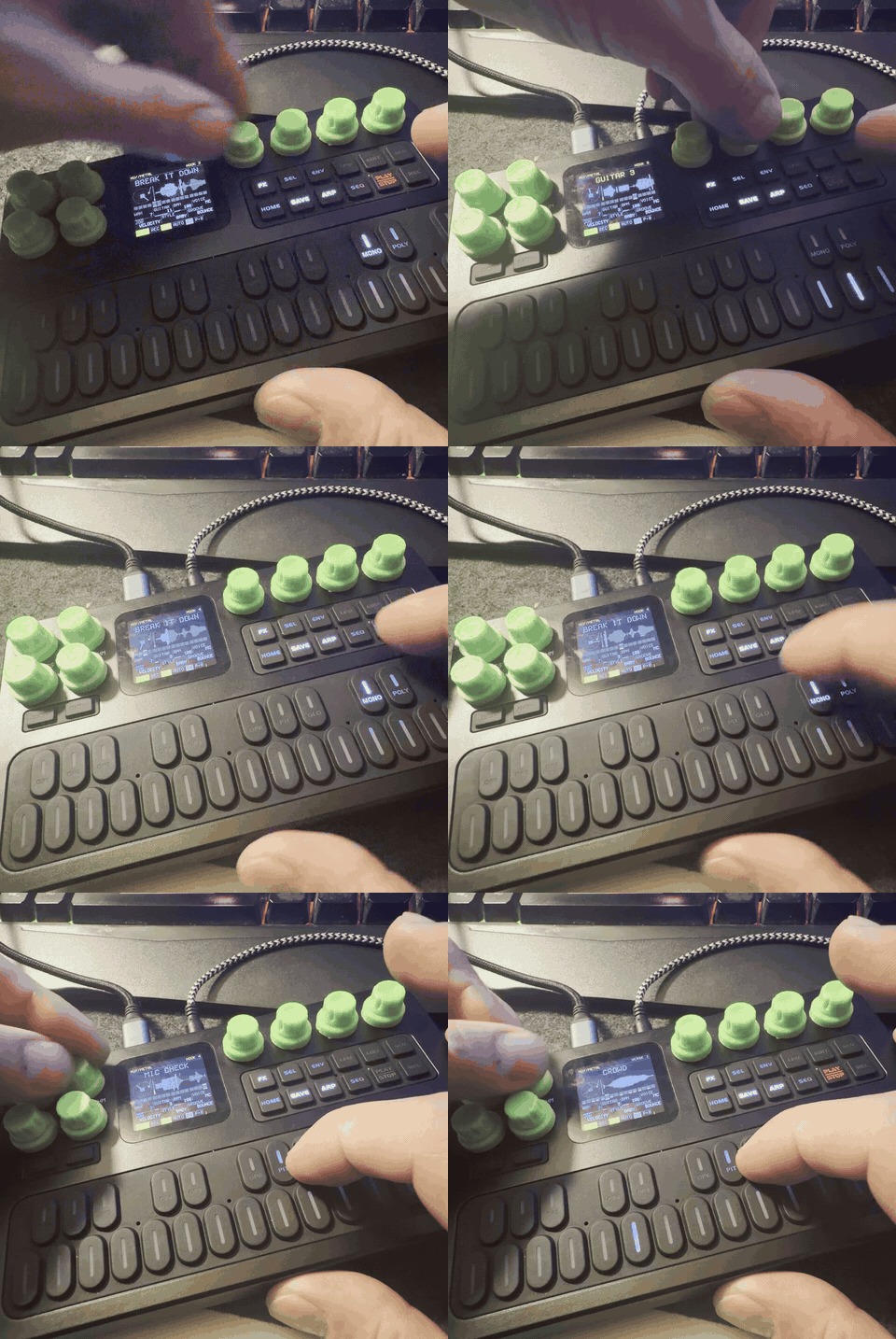
Press PLAY, then press ARP for RAP MODE. Tap a key: the robot says the word. Hold it: the word is scratched in time, in the STYLE. Turn SELECT to scratch by hand; flick it and let go, and the record spins on.
Three buttons open a page while you hold them, and the knobs change meaning while they are held: EDIT (the second layer, and the audio load), LFO (the PRO page) and FX (the MIXER). A quick tap still does what the button always did.
| Key / button | Tap / hold | With EDIT held |
|---|---|---|
| Keys | DJ mode: 27 words (25 = AHHH, 26 = FRESH); tap = say it, hold = a tempo-synced scratch in the STYLE (in RAP MODE the last word you tap becomes the hook). BEAT mode: keys 1-12 = the kit (hold = roll), 13-27 = the first 15 words. TONE mode: the keys are a pitch fader (see TONE PLAY). SURF mode: 27 spots on the INFINITE record (see 3.0 above) | |
| PLAY | start / stop | TAP tempo |
| REC | record into the 16 steps (quantized, see the sequencer) | clear the words, keep the drums |
| SEQ | hold = FILL (snare roll, the 808 rolling, toms) | clear the steps |
| ARP | RAP MODE: verse / hook, the robot MCs | MUTATE the steps |
| GLO | AUTO: the robot scratches by itself (SURF mode: ETERNAL SKRATCH) | HARD: drums driven, the kick ducks the deck |
| FX | tap = next FX, hold = the MIXER | previous FX |
| SEL | hold = DROP (only the hats, then slam back in) | HAMSTER on / off |
| ENV | hold = FREEZE (loop a sliver) | latch FREEZE |
| LFO | tap = LFO on / off, hold = the PRO page | hold = CUT (the crossfader on 32nds) |
| HOME | DJ / BEAT / TONE / SURF | pitch back to 0 |
| OCT- / OCT+ | the deck's pitch, a semitone | BACKSPIN / BRAKE |
| SAVE | save everything now | SYNC: FOLLOW / OFF |
| Encoder | Turn | EDIT held | LFO held: the PRO page | FX held: the MIXER |
|---|---|---|---|---|
| SELECT | JOG: scratch by hand (velocity) | VELOCITY FX: the flick pumps the FX | SPACE (the plate) | VERB |
| ALGORITHM | STYLE (TONE mode: SOURCE) | SWING | fader CURVE | ECHO |
| KNOB1 | the FX's amount | TUNING: the key of the toys and the 808, F .. F (A by default) | LFO RATE | VOX |
| KNOB2 | TOYS level | ECHO (SURF mode: FLOW) | LFO SHAPE | TOYS |
| KNOB3 | BPM 60..180 | KIT DECAY | LFO DEPTH | 808 |
| KNOB4 | SAM VOICE: MC GROWL ROBOT SAM ELF E.T. STUFFY OLD LADY (SURF mode: WORLD 0..99) | DRUMS level (SURF mode: SURF drift) | LFO DEST | DRUMS |
| PRESETS | BEAT: OFF, TOYBOX, TOY PIANO, MUSIC BOX, XYLO, KALIMBA, TOY ORGAN, POOFS (one mutating 808 beat; see 3.1) | REACH | motor TORQUE | WIDTH |
FX: FILTER, CRUSH, MEGAPHONE, DEMON, CRUNCH, STUTTER, REVERSE, WAH, GROWL.
The sequencer: record your own loop
The sequencer is one bar of 16 steps (16th notes) that loops under the beat. It is the row of 16 squares across the middle of the screen: a cyan square says a word on that step, a yellow one scratches it, a pink dot adds drum hits, and the bright mark is the playhead. With SWING up, the odd steps lean late like the beat.
Record a loop
- Press PLAY to start the beat. The sequencer only records while it's playing.
- Press REC. The REC chip, its light and a red dot in the top bar come on.
- Play over the beat. Hits snap to the nearest step, and a hit just before a step lands on that step without
playing twice.
- Tap a key: the word (or in SURF mode, the spot) goes on that step.
- Hold a key: the step becomes a scratch in the current STYLE, on the step where you pressed.
- BEAT mode: keys 1-12 stack drum hits onto the step, on top of the beat's own pattern. Keys 13-27 record words.
- Recording stays on and the loop keeps going round, so you can overdub as you go. A step holds one word (a new one replaces the old) and any number of drums.
- Press REC again to stop recording. The loop keeps playing.
TONE mode isn't recorded. In RAP MODE a recorded word takes over the MC's line on that step.
Clear and change it (hold EDIT, the shift)
| Hold EDIT + | Does |
|---|---|
| SEQ | CLEARED: wipe everything, the words, the scratches and the drums |
| REC | NO WORDS: wipe the words and scratches, keep the drums you recorded |
| ARP | MUTATE: flip a few ghost drum notes, drop in a new word or a scratch, and sometimes take one out |
Clearing only touches your loop; the beat keeps playing (and mutating). To start over: hold EDIT, press SEQ, press REC, and play again.
Saving: the loop is saved with your settings once the beat is stopped and the deck is quiet, or right away with SAVE. It comes back the next time you switch the FM-1 on. (Plain SEQ, without EDIT, is FILL, not the sequencer. The 808 beat's own mutations never touch your loop.)
The techniques
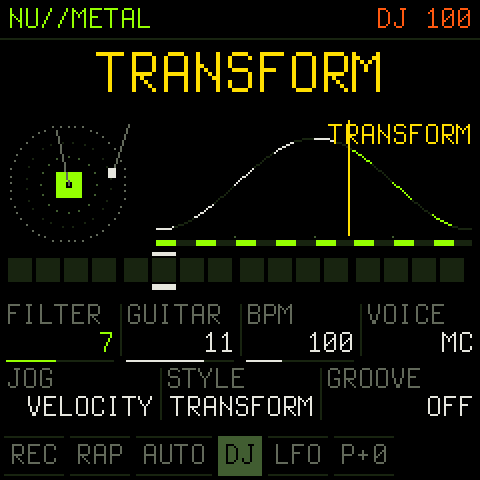
BABY, DRAG, STAB, FORWARD, BACKWARD, CHIRP, TRANSFORM, TEAR, FLARE (1-click), 2-CLICK flare, ORBIT, CRAB, TWIDDLE, TAZER, SCRIBBLE, HYDROPLANE, LASER, and COMBO.
Each technique is a score: key points for the record's motion (eased like a hand, linear, or accelerating) and the stretches where the crossfader is open, 64 ticks a beat, locked to the tempo. Hold a key and the word is scratched with it; while it plays, the screen draws the score with a playhead running over it. Turn STYLE while holding: the next loop plays the new technique. COMBO plays routines, a technique a beat in phrases of four that end on a flourish (AUTO plays whole routines).
HAMSTER reverses the fader in the techniques that click: a chirp keeps only the peaks, and a crab cuts out instead of in. CURVE is the crossfader's cut: SHARP like a battle mixer, MEDIUM, SMOOTH. TORQUE is the motor: LOW winds up like a stock turntable when a word starts, MAX starts at once. It also sets how fast a thrown record settles and how long a BRAKE takes. Fast scratches are anti-aliased (the deck averages what it skips), so a hard tear stays clean.
The LFO
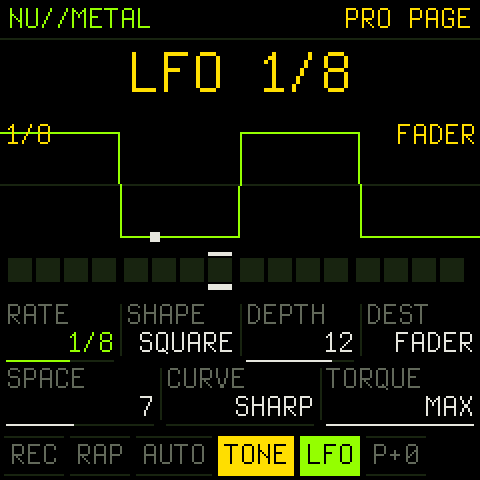
Tap LFO to switch it on; its button pulses with it. Hold LFO for the PRO page:
- RATE 4 BAR, 2 BAR, 1 BAR, 1/2, 1/4, 1/4T, 1/8, 1/8T, 1/16, 1/16T, 1/32
- SHAPE SINE, TRI, SAW UP, SAW DN, SQUARE, S&H, DRIFT (a gliding S&H)
- DEPTH 0..15
- DEST
- FX sweeps the current FX (FILTER and WAH glide smoothly)
- PITCH from vibrato to a +-12 semitone siren
- FADER a tremolo; on SQUARE it is a transformer at the rate
- PAN moves the deck between left and right
- RECORD the LFO's hand on the record: deep, it rocks it back and forth, a baby scratch at the rate
- BAND sweeps a low-pass over the toys and the 808
The LFO's phase is the song's position, so it sits on the grid, follows MIDI clock and restarts with PLAY.
TONE PLAY
Press HOME until TONE. The keys are now a pitch fader: chromatic, with key 13 on the root of the TUNING, so you play in key. Hold a key and the record runs at that pitch with the fader open; let go and the fader shuts. ALGORITHM picks the SOURCE: TONE (a sine), BUZZ (a saw), AHHH, FRESH, YEAH, SCREAM, or the LAST WORD you said in DJ mode. The LFO on PITCH gives vibrato, and the LFO on FADER with SQUARE gives transformed tones.
The sound
- Vocals: the post chain filters the 8-bit record's fizz, adds body under 250 Hz, then a fast compressor puts the voice in front. An exciter adds air, and a doubler makes it wide while staying mono-safe (the copy sits only in the side).
- Toys: made live: FM tines with a ratio per toy, or square waves through a resonant filter, or POOF grains; the right side ~9 ms late.
- 808: a sine driven hard, long, sliding on the ties.
- Drums: an 808 kit, rendered offline as 16-bit samples.
- Space: a stereo plate reverb holds the vocals, snare, claps, toms and the echo, and the RAP hook gets a reverb throw.
- Master: the bus runs into a glue compressor and a soft limiter, never a hard clip.
- Load: hold EDIT to see the audio load; about 20 % at peak with the kit hammered.
The MIXER
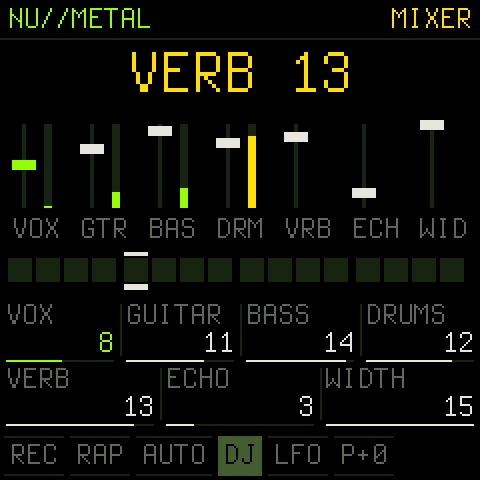
Hold FX and turn: VOX, TOYS, 808, DRUMS, VERB, ECHO and WIDTH (0 = mono: the toys, the doubler and the plate all in the middle). The screen shows seven fader strips with live meters.
Velocity skratch
The keys have no velocity, so it is read from how fast you move. Flick the jog faster and each click throws the record further. Tap the same word again quickly for finger strokes, back and forth. With EDIT held the same moves pump the current FX instead, like a wah pedal.
MIDI
In (USB or the TRS jack): channel 10 plays the kit on the General MIDI drum map (35 808, 36 kick, 37 rim, 38/40 snare, 39 clap, 42/44 hat, 46 open hat, toms 41-50 + 58, 49/55/57 crash, 51/59 ride, 52 china, 53 zap); other channels, notes 48-74 = the 27 words. Out (USB): every drum played as a GM note on channel 10, and the deck on channel 1: CC 20 scratching (0/127), CC 21 the crossfader, CC 22 the platter angle, sent on change. SYNC FOLLOW follows an incoming clock (USB or the TRS input), and Start / Stop / Continue drive PLAY. Send CC 119 and it answers with CC 119 = the audio load in %.
Build it
You need Linux on x86-64 (or macOS with Docker, or Windows with WSL), Python 3 with Pillow, the JieLi toolchain and three files of the JieLi AC79 SDK:
pip3 install Pillow mido python-rtmidi
tools/get_toolchain.sh                      # JieLi's clang for the chip, to ~/.jieli/toolchain
git clone --depth 1 --branch AC79NN_SDK_V1.2.1_2023-12-13 \
    https://gitee.com/Jieli-Tech/fw-AC79_AIoT_SDK.git ~/fw-AC79_AIoT_SDK

tests/run_host.sh                           # on your computer: build/host/dinghy.wav + screen PNGs
tests/run_pro.sh                            # the PRO scripts: techniques, tone play + LFO, the mixer (WAV + frames)
tests/run_v3.sh                             # the 3.0 scripts: SURF, TRS clock (and the old groove scenes)
tests/run_v31.sh                            # the 3.1 scripts: 64 bars of TOYBOX, the toys alone, SURF's deep cuts
python3 tools/render_kit.py                 # re-render the 808 kit into firmware/gen/kit_pcm.h (needs numpy, scipy; the guitar it also renders is no longer used)
./build.sh                                  # -> build/dinghy.fwsc
./build.sh --release 3.1                    # -> build/numetal-3.1.fwsc, "3.1" on the screen
python3 tools/fm1_install.py build/dinghy.fwsc
The whole app is firmware/src/dinghy.c. It is integer-only, because the chip has no FPU.
The platform under it is Dinghy: docs/API.md has every call, and
docs/RULES.md has the chip's rules. The host build (tests/host.c) runs the same code on a computer.
Its scripts can press keys, hold buttons (T hold MASK) and turn encoders (T enc ID DELTA), and it prints the
audio code's cost per frame.
The web installer is docs/index.html, served by GitHub Pages from docs/. Put a new package in
docs/firmware/ and change FIRMWARE at the top of the page's script.
License
GPL-3.0-only, like everything it stands on: you may change and share it, and whoever gets the firmware gets its source. Credits and third-party parts are in LICENSING.md.
NU//METAL SKRATCHMASTER PRO (the app) by Mark Hellar. Built on
Dinghy (zvenson), on the platform of Felucca
(Leo Kuroshita, Hügelton Instruments) as SLOOP (isod89) carries it. The voice is
SAM via ESP8266SAM (Earle F. Philhower III), from Sebastian Macke's
C port of SAM. The web installer's update protocol (docs/fm1ota.js) is Felucca's, by Leo Kuroshita.