NACHTFAHRT for the M-VAVE FM-1
Install (Chrome or Edge, also Chrome on Android or Chromebook; the FM-1 on USB) · Try it in the browser · Manual · Website
What the fahrt?
NACHTFAHRT turns the M-VAVE FM-1 into a generative Berlin School machine, after the 1970s music of Tangerine Dream, Klaus Schulze and Ashra: long, hypnotic pieces, repeating synthesizer sequences, slowly evolving hypnotic textures, a strong sense of space. It plays itself from the moment it's switched on, but you can play with it: the white keys give you the melody, always in the piece's key. It was called BERLIN while it was being built; but NACHTFAHRT (however you want to pronounce it) is just the right name.
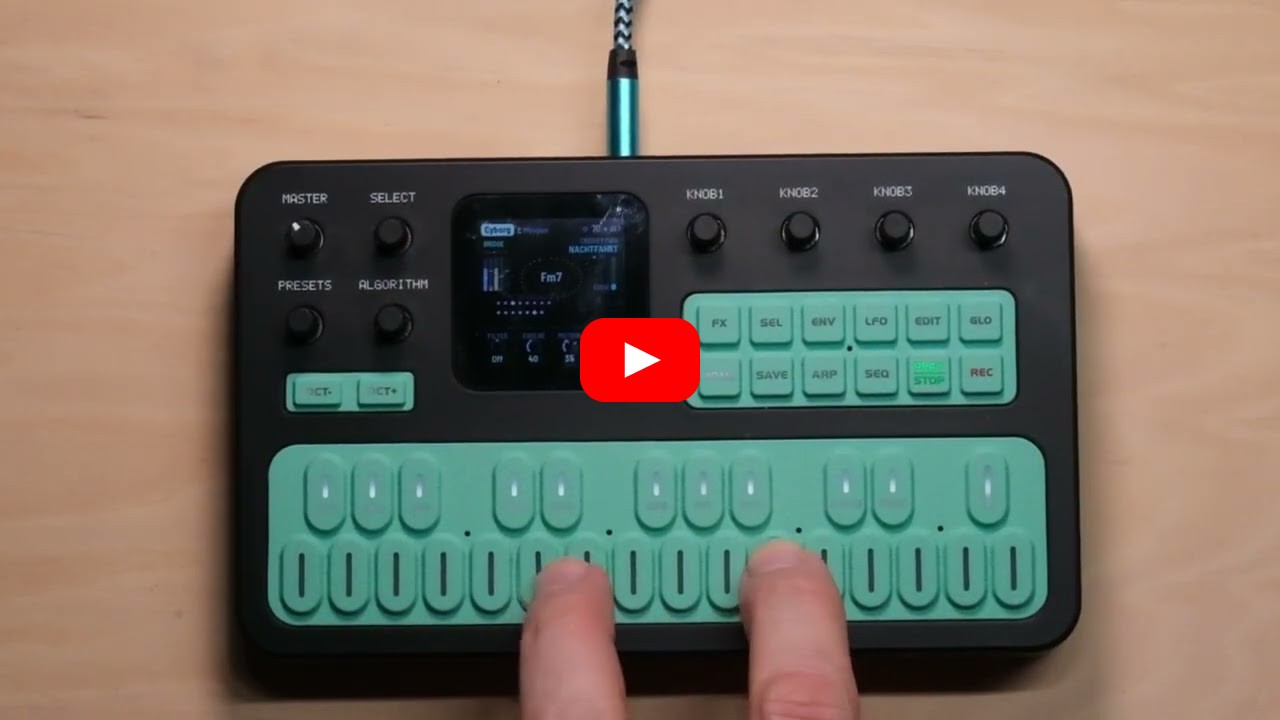
VIDEO (click to play)
Why?
Cranky Man loves this "Berlin School" thing, with all its repetition and echoing, evolving plucks and drones and whatnots, because it puts him to sleep, and if there is one thing that a Cranky Man needs, it is sleep. Lots of it. Usually around 15 hours per week. And now it can put you to sleep, too!
The whole idea behind this music generator is that IF you are NOT put to sleep by the lead sound (which invents its own melody), then when you start playing, it will listen, and then respond to your musical "call" with its own version of the musical phrase.
What it does?
- a Sequence of up to 16 steps on a plucked analog-style voice (2600, Moog, Synthi, Pulse, Glass), a plucked string (Pluck) or one of ten FM voices (fm1_open's recipes: FM Keys, FMMarimba, FM Vibes and more), its filter wandering slowly, its notes repeated at the echo's times (a dotted eighth by default, the classic Berlin School echo), so sparse notes fill in the spaces;
- Sequence 2, often a step shorter, so the two drift apart and meet again, and with Motion an octave up or down now and then, for a section;
- a Drone: a chord on two banks of voices (Organ, Strings, Horn, Saws, Glass, or a Choir whose vowel moves with the Drone's filter) with a pedal under it, a phaser and a slow walk from chord to chord;
- a Lead: one gliding voice (Odyssey, Mini, Flute, Theremin, Synthi, or three FM voices) playing dreamy calls and answers deep in the reverb and the echo; it remembers its motifs and returns to the piece's theme (how much it keeps: Memory). You can also play it on the white keys, in the scale: three notes or more and a pause become its theme, and its next ideas grow out of yours, straying further until they are its own again;
- an Atmosphere: Wind, Surf, Space, Air, Tape, Drops, Hail or Rain (or none);
- an arc: a piece opens from the drone (each layer's filter rising from closed), flows, lets the Lead take over and crosses a bridge in the middle, where the layers' filters part and come together. It never ends by itself: it repeats for ever;
- filter motion: every layer's filter moves on its own clock, always relative to where you've set its Cutoff, so the layers diverge and converge, and you can turn the knob at any moment. The screen shows it.
Listen, and play: let it run for hours, or join in. Play the melody on the white keys over the sequences and the drone, sweep the filters on the black keys, pick a piece, change its key and tempo, thin or fill the sequences, push the echo, mute and solo the layers.
NACHTFAHRT is a fork of DUB-1, itself a fork of AMB-1, Charles Vestal's generative ambient firmware for the FM-1. It keeps their platform, panel, echo, plate and much of the engine.
Status: a test version below 1.0 (see the releases). It runs on the FM-1, installed from the web installer, and in the browser emulator, from the same code.
The pieces
| # | Piece | After | Key, tempo | |
|---|---|---|---|---|
| 1 | Timewind | Schulze, Bayreuth Return | D minor, 96 | Two sequences of 16 and 15, an organ through the phaser, a long opening (the Sequence's filter takes 32 bars to open), a wider reverb |
| 2 | Wahnfried | Schulze, Wahnfried 1883 | B♭ Dorian, 80 | Strings drifting, the roots walking with no home, a faint heartbeat of sequences under them, a theremin lead; the Drone's filter is the main movement |
| 3 | Phaedra | Tangerine Dream, Phaedra | D minor, 149 | A Moog bass line of 16 over a second line of 15, a choir, flutes, much filter movement; the Sequence opens over 16 bars, Sequence 2 is straight in |
| 4 | Rubycon | Tangerine Dream, Rubycon | F minor, 144 | Dark organ, two sequences of 8 (the 2600, two octaves down) and 7 rising out of the drone, the Synthi lead: the Sequence opens over 16 bars, Sequence 2 after it, over 32 |
| 5 | Stratosfear | Tangerine Dream, Stratosfear | E minor, 138 | Brighter and driving, two sequences interlocking, straight in, the Lead forward |
| 6 | Sunrain | Ashra, New Age of Earth | D major, 130 | The most hopeful: sequences of 8 and 7, both echo repeats at full, bright strings, surf; straight in |
| 7 | Mirage | Schulze, Mirage | F♯ minor, 95 | Icy glass sequences of 12 and 11 opening slowly (16 and 24 bars), a deep phaser, a long reverb, sparse |
| 8 | Cyborg | Schulze, Cyborg | C Phrygian, 70 | Early and raw: deep organ drones beating, a quiet sequence (level 20), no Sequence 2; the theremin Lead up front (level 70); the Drone's filter moves widely |
| 9 | Ryokuu | after early-summer rain (緑雨, "green rain") | B♭ Dorian, 80 | Based on Japanese Royal Road progression with calm arps (2600 and Sub, low), strings walking the dorian scale, a theremin gliding like a singing voice, summer rain outside. This is made by Cranky Man as a reminder of the summers in Japan |
NACHTFAHRT is not connected with any of these artists.
In short
| White keys | Play the Lead, in the piece's scale (the key it sounds is lit) |
| Black keys | Eleven effects, each while held (lit; dark while held): Take-off, Supernova, Twitter, Repeat, Shimmer, Freeze, Octave, Return, then Rise, Close, Transpose (in PERFORM: the solos) |
| PLAY · REC · EDIT | Play / rest · a tap: hold (the echo repeats what it holds), held: the effects grid (16 effects on the white keys) · a tap: the Chords page, held: the next chord |
| SEL | PERFORM: the knobs Filter, Wet, Energy, Sweep; white 1–5 mute the Drone, Sequence, Lead, Sequence 2, Atmosphere; black 1–5 solo them; white 6 held: the levels; white 7–11 held: Sweep, Open, Shut, Drop (both sequences out), Echo; the top key (G): the Lead forgets its ideas and its theme. Held: Lock |
| HOME | The Nachtfahrt page (Filter, Evolve, Motion, Drift); again, the Key page (Tempo, Root, Mode, Transpose) |
| ENV | The Drone (Pedal, Reso, Phaser, Attack); again, its sound (Colour, Release, Reverb, Echo); again, its Move page (Width, Time, Rate, Intro) |
| ARP | The Sequence (Density, Octave, Length, Grid); again, its sound (Cutoff, Decay, Reverb, Echo); again, its Repeats (Repeat A, A time, Repeat B, B time); again, its Move page |
| LFO | The Lead (Phrases, Octave, Glide, Vibrato); again, its sound (Tone, Attack, Reverb, Echo); again, its Move page |
| SEQ | Sequence 2 (Chance, Octave, Length, Level); again, its sound; again, the Pattern page (write the steps on the keys); again, its Move page |
| SAVE | The Atmosphere (Density, Width, Drift, Air); again, its sound (Colour, Ring, Reverb, Echo); again, its Move page |
| FX | Space (Echo, Echo time, Feedback, Reverb); again, the Echo page (Blur, Tone, Width, Size) |
| GLO | Setup (Tune, MIDI out, Lights, Save); again, the Arc (Lead in, Bridge, Arc, Memory). Held: save; held on: the piece back to its recipe |
| ALGORITHM | On a layer's page, its voice (the Atmosphere: its character) |
| PRESETS | The piece |
| SELECT | On a layer's pages, its level; on the Nachtfahrt page, Energy (elsewhere nothing) |
| OCT− / OCT+ | On the Sequence's, the Lead's and Sequence 2's pages, its octave (lit while it's above or below where the piece was loaded) |
The manual has the rest.
Building and testing
The toolchain is the same as DUB-1's (see BUILDING.md and EMULATOR.md):
tests/run_tests.sh      # the engine, the platform pieces, the app in a simulator, the web builds
web/emu/build.sh        # the browser emulator: build/emu (serve it, open index.html)
./build.sh              # build/amb.fwsc, for the FM-1
python3 tools/fm1_install.py build/amb.fwsc     # install it over USB
build/host/amb_host SCRIPT OUTDIR runs the whole app on a computer from a script
(tests/scenarios/*.amb), with audio and screenshots coming out; build/host/en_render OUT.wav SECS piece=N
renders the engine alone.
Credits
NACHTFAHRT is a fork of DUB-1, a fork of
AMB-1 by Charles Vestal (GPL-3.0-only): the echo chain, the plate,
the pieces system, the chord walk, the UI and the platform come from there. The reverb is Jon Dattorro's plate
("Effect Design, Part 1", JAES 1997), as in FoMni-1; Shimmer's
octave shifter follows OCT UP and its SHIMMER in Felucca's performance layer
(Leo Kuroshita, Hügelton Instruments; also in Skiff); the Drone's Choir
follows VOICE in Felucca (eng_formant.c, GPL-3.0; Klatt's cascade; its vowel table, after Hillenbrand et al.); the granular
cloud (Freeze) follows the design of CLOUD in JIANT (GPL-3.0); Pluck's
string follows pluck.c in M-VAVE's fm1_open (after DaisySP's String,
Electrosmith and Emilie Gillet; MIT); the FM voices play the demo recipes of app/presets.c in fm1_open (M-VAVE;
GPL-3.0), their envelopes after MSFA (Google's DX7 model; Apache-2.0); Wind's pink and Surf's brown noise and Drops' drops follow NOISE in
Skiff (eng_noise.c, Leo Kuroshita, Hügelton Instruments; GPL-3.0; Paul Kellet's
pink filter); the Tape
atmosphere is DUB-1's crackle, after Bahadirhan Kocer's "Using Resonators in Live". The way the sequence is
played (a root accented, sparse notes, a dotted-eighth repeat as loud as the note, two delays) owes much to
Synth Seeker's videos on Berlin School sequencing. (The Bob Ross of Berlin School) The platform (hardware layer, USB, update loader, storage,
installer) is Felucca's by Leo Kuroshita (Hügelton Instruments), by way
of X0X, FoMni-1, AMB-1 and DUB-1. The idea of running FM-1 firmware
in the browser comes from Groove OS. GPL-3.0-only; see LICENSING.md.
The snoring you hear in your head is Cranky Man himself.
M-VAVE and FM-1 are trademarks of their owners. NACHTFAHRT is not affiliated with M-VAVE or Hügelton Instruments.