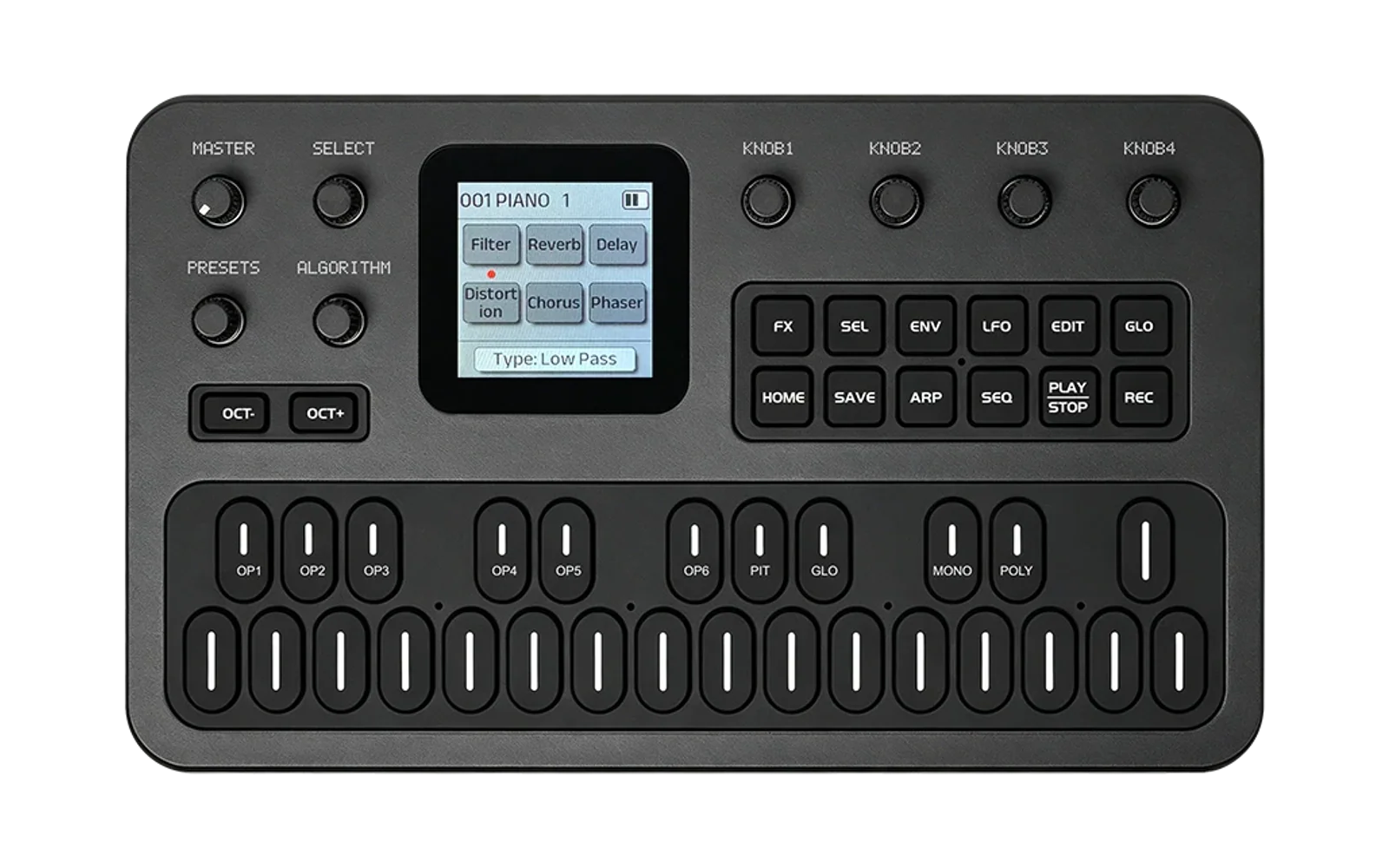
Working FM-1 beta — 26 October 2026. The final candidate has been installed from stock V15 and Felucca 1.6.1, and has successfully switched to Felucca and back. User-reported stress telemetry: peak render 2511 µs, late buffers 0, invalid samples 0. Hardware evidence · Prepared beta release and limitations. Only the hash-pinned final candidate is proposed for release; the original first-install candidate had unsafe audio and must not be used.
Project website source · GitHub Pages build and publishing guide
Guitchordi
Print the one-page A4 controls cheatsheet - labelled control diagram, mode chart, lock and reset shortcuts.
Independent M-VAVE FM-1 six-string instrument simulator. brief.md is the project brief.
Illustrated player manual · Printable PDF
Factory defaults: Nylon Acoustic · Classic Rock · standard EADGBE · 90 BPM · 60% intensity, starting in Strum mode. Strum starts at Down · 1/8 · FREE · 50 ms. K4 offers INSTANT, then 5 ms steps through 250 ms. Saved browser settings override factory defaults. Current performance controls. GLO K3 selects fourteen guitar tunings, with Standard EADGBE as default and the tuning shown above the chord.
Hardware: tested beta on one FM-1. Ordinary entry from V15 and Felucca, outgoing updates, USB identity and playing have been demonstrated. Recovery USB enumeration and a full-flash backup were verified; physical interrupted-write resume and backup restoration remain untested. Current evidence.
The boot screen shows GuitChordi, with green/orange/red wave strings, a striped pick and a subtle retro grid. It runs for 2.2 seconds on a fresh boot; keys, buttons or encoder turns skip it immediately. The first playing key still sounds. The shared C artwork is used by the simulator and experimental device build, with no boot delay or audio-thread animation work. Reload the simulator and Switch on to see it again.
Play in the FM-1 panel simulator
docker compose up --build -d --wait
# Open http://localhost:8769 and click Switch on
npm run smoke:simulator
npm run test:simulator
The new Play in browser simulator has an FM-1-style panel, working screen, knobs, keys and lights. Chords, lock, settings, screen pixels and audio execute in the shared C application compiled to WASM. Hold ENV for three seconds to lock a chord; the padlock closes on the LCD/status strip. The top-right Visuals toggle enables optional note-reactive instrument art and remembers your preference. These effects run only in the browser UI. Drag knobs or use their −/+ buttons; SAVE stores settings in this browser. This is the application host build. An experimental FM-1 target adapter now builds a .fwsc package; normal hardware playing/update paths are tested; recovery restoration remains untested. Simulator controls, build and evidence.
The simulator now has 16 instruments: the original Wood/Wire/Glow, eight additional guitars, harp, bowed violin, pizzicato cello, bass and dulcimer. Choose INSTRUMENT or turn ALGORITHM. All share fourteen voice slots; all patches expose six chord parts with adapted key labels and register. Instrument catalogue · Processor simulation findings.
The simulator includes 50 chord styles: jazz, lo-fi, light/hard rock, Memphis/Chicago/Texas blues, pop, soul and more. Choose CHORD STYLE or turn PRESETS. Every black key has a chord label, with an eleven-chord guide above the keys and on every LCD page. SAVE keeps the style and edited slots. Full style catalogue · Device readiness.
The original instrument workbench remains on http://localhost:8768/. Compose builds and starts both services; docker compose down stops both.
Play in the instrument workbench
From this workspace root:
docker compose up --build -d --wait
# Open http://localhost:8768
npm run smoke
# stop:
docker compose down
Click Enable audio and wait for Ready. The default engine now runs UPSTREAM DSP · Clipper PHYS string: the actual MIT-licensed fixed-point C string model, compiled to WASM and rendered in an AudioWorklet. The Engine menu also offers TEMP WEB AUDIO · original, preserving the lean JS sound you already played. These have independently designed WOOD/WIRE/GLOW experiments; matching tone names do not mean identical sounds. Switching engine silences/suspends the previous one.
Choose a chord, then tap or drag across the sixteen white keys. The zones map to [E A D G B e] [E A D G B e] [D G B e]. A skipped key creates no attack. Muted strings show × and stay silent. All sixteen playing keys remain available with a 14 ringing-voice limit. The oldest voice fades briefly before replacement. Releases leave natural decay, and chord changes affect future presses only. Shared reverb is an effect tail, not another string attack.
Hold the lock button for five uninterrupted seconds to lock/unlock the selected chord. Chord keyboard keys: Q W E R T Y U I O P [. String keys: A S D F G H J K L ; ' Z X C V B. Hold Space with page focus, or Space/Enter while focusing the lock button, for the lock gesture. Repeated keyboard events do not retrigger; release and press again.
Expand Chord slot configuration to reassign eleven slots for the session. For lasting changes, edit web/chords.json, then rebuild. Schema version 1 has eleven slot names pointing to six MIDI pitches in low-to-high string order; null mutes a string. The current upstream adapter accepts pitches 24–96; all supplied voicings fit. Runtime assignments reset on reload. Simulated velocity changes intensity and timbre; it is not measured hardware pressure.
Verify and develop
npm test              # core and original audio allocation/scheduling tests; Node 22+, no packages
npm run test:dsp      # pinned compiler container, native WAVs, sanitizers, WASM/reference tests
npm run smoke         # Docker must be running; HTTP, JS modules, WASM and attribution
The DSP check generates deterministic native audition files in build/audio/phys-strum-{0,1,2}.wav, 6/12/14-voice benchmarks and JSON measurements. DSP feasibility documents exact source boundaries and results. Native and WASM PCM output match exactly for the three reference strums. No FM-1 CPU/polyphony measurement is claimed.
Docker builds WASM from the vendored C source in a pinned Emscripten compiler stage, then serves static assets on 127.0.0.1:8768. Audio executes in the browser. After the initial compiler/server image downloads, builds and playback require no network. There are no remote runtime scripts, fonts or accounts. Secure localhost is needed for AudioWorklet. For deliberate LAN hosting, configure HTTPS and the Compose port binding explicitly.
Optional UI development: npm run serve provides the original Python HTTP server on port 8768 (stop Docker first). Choose TEMP WEB AUDIO there; that simple server does not build or route the WASM artifact. For full upstream-engine development use the Docker rebuild command above. Opening the HTML directly as a file does not support module/chord-bank loading.
Manual smoke:
- Enable audio, select G, tap all sixteen inputs and sweep both ways; only contacted keys should attack.
- Select D: low E and A stay silent in both six-key zones. Change chords while notes ring: no unsolicited attacks or pitch changes to old tails.
- Repeatedly retrigger, leave/re-enter, then switch windows while holding keys. Diagnostics should show no stuck keys.
- Hold lock briefly (no toggle), then over five seconds (one toggle); repeat to unlock.
- Change tones and engines, play again, and use Silence. Old engine audio and reverb should stop. Check touch separately.
Experimental device firmware
npm run setup:fm1, npm run build:fm1, then npm run test:fm1 prepare dependencies, build the actual pi32v2 app/loader/package and exercise simulated update tests. No command accesses a device. The current candidate has physical playing and ordinary update evidence; flash-backed settings are not implemented. Build instructions · Readiness.
Standard EADGBE remains the default. Fourteen tuning presets, including Drop D and Open D/G, are available through GLO K3.
Source and project status
web/core.mjs,web/chords.json: independent input model and voicing source.firmware/app.c: portable C instrument application with inputs, clock, screen, lights and settings;web/emu/: host simulator panel/worklet.dsp/engine.c: independent 14-voice C adapter;dsp/render.c: native renderer/benchmark CLI.third_party/clipper-phys/phys_dsp.c: one unchanged MIT source file from pinned Clipper; source/notice record.web/upstream-audio.mjs,web/phys-worklet.mjs: browser/WASM audio adapter.web/audio.mjs,web/buffer-worker.mjs,web/pluck.mjs: preserved cached original JS backend.- Progress, upstream audit/Melodee findings, DSP evidence.
Clipper/SLOOP/Melodee research archives are isolated in ignored build/research/. The audio model is the audited MIT leaf. The hardware target also vendors a focused, attributed GPL Felucca-derived platform/loader selection; its file hashes and licence record are in third_party/fm1-platform. No upstream sequencer, instrument wrapper, icons or sample assets have been merged; the display uses the separately credited OFL Noto Sans font. Melodee's STRUM/STROKE schedules a chord's notes over time; our independently written Strum/Arp scheduler supplements direct white-key playing. The simulator and experimental target share our instrument application. The target package compiles and passes simulated update tests; physical FM-1 operation is recorded in the hardware test log.
The original extracted starter remains intact in ignored fm-guitomnichord/ beside its original zip. Active development files are at this workspace root. The project is published at https://github.com/stoogs/guitchordi.
Source and licensing
The combined firmware project is GPL-3.0-only; see LICENSE. Third-party components retain their own notices, including the MIT string-model leaf and OFL fonts. See platform provenance. Build dependencies, firmware packages and per-device flash backups stay out of Git.
Credits and release testing
Full licenses, credits and component boundaries · Local testing and Firmware Hub submission gates. The combined project is GPL-3.0-only, with retained MIT DSP, OFL font and Apache-2.0 SDK notices. The Docker website includes a matching source archive and a visible credits link.
Guitchordi does not import stock, Felucca, X0X or other firmware projects, patterns or user samples. SAVE is currently RAM-only on the device; browser SAVE is browser-local. No preservation or automatic conversion of another firmware's flash data is promised. Export that firmware's projects and samples before any switch, and keep a verified recovery image and per-device backup.
The current FM-1_982 package identity is provisional and not reserved with the Hub.
USB identity, real-device entry from V15/Felucca and exit to Felucca are tested.
Physical interrupted-update resume and full backup restoration remain open. The unchanged processor candidate passes boot/note and 343 virtual actions in a
locally patched research emulator; its added semantics are not silicon-validated. See qualification evidence. No Hub submission or release tag has been made.