FMER

Six-operator FM. Virtual Analog. Four-track performance.
FMER is alternative firmware for the M-VAVE FM-1. Design sounds, record patterns, arrange songs and perform on the instrument. FMER Companion keeps instruments, projects and backups organized locally, with a guided firmware installer and an illustrated offline handbook.
This source milestone is firmware 736 / Companion 736 revision 2. FMER keeps its numbered builds while developing toward 1.0. Check the downloads page for the files actually published; a source commit does not publish a release.
Start here
- Downloads: standalone firmware and a portable Windows Companion ZIP with Help, libraries and corresponding source.
- Installation and recovery.
- What changed in 736.
- Offline Help: open locally or from Companion.
- Feedback and problems: include the build and reproduction steps. Companion can export diagnostics for review before you share them.
The release attachments include an actual-screen atlas, illustrated feature guide, shortcut sheet and press pack. Screens are captured from FMER's renderer; illustrative values are not recordings of your instrument.
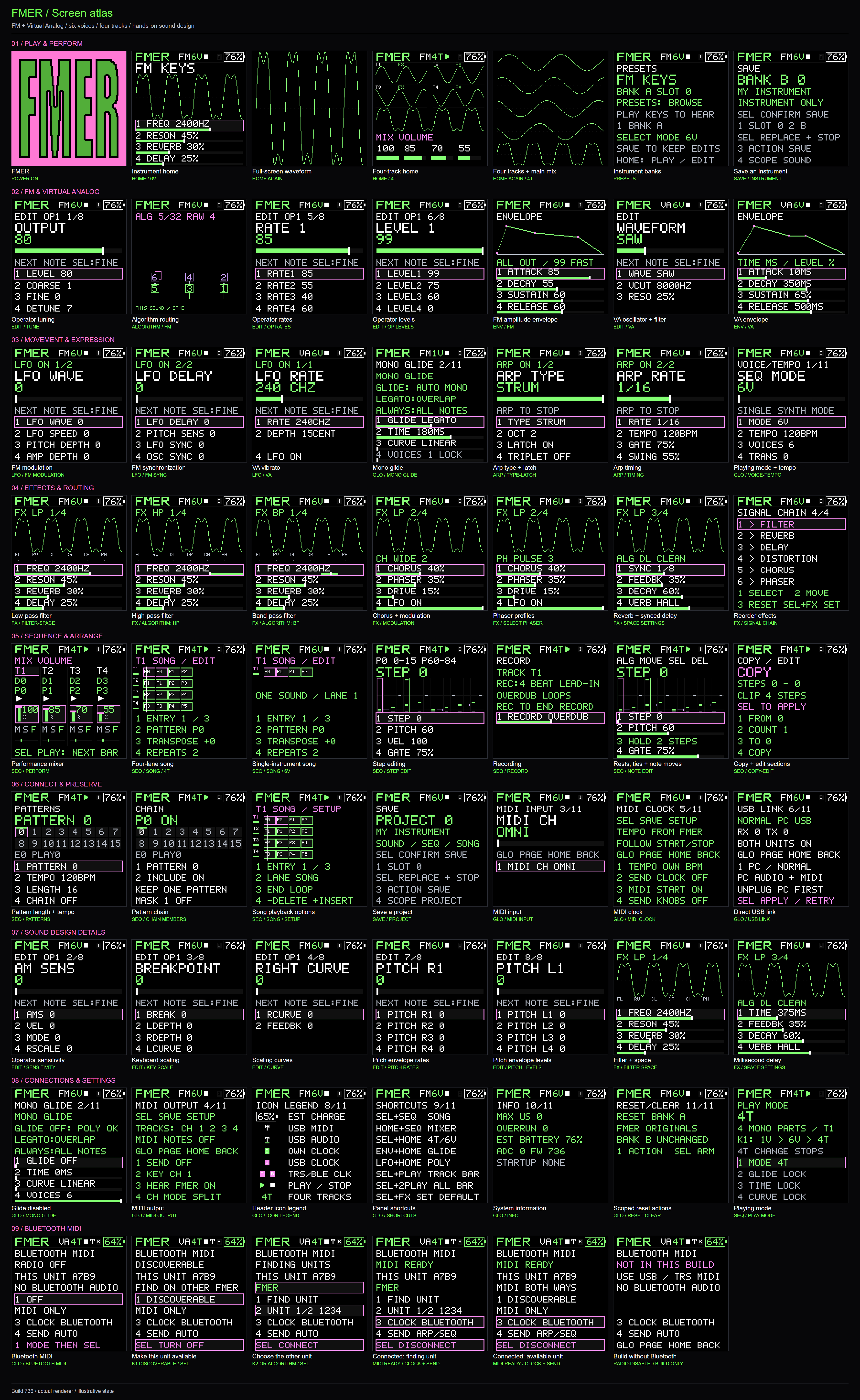
Screen-sheet provenance identifies the exact renderer and captured scope.
On the instrument
- Six-operator FM with DX7-style patch import and a Virtual Analog engine with sine, triangle, saw, square and noise waveforms.
- Six voices for a single instrument, mono glide, or four independent mono tracks. The four tracks share the available effects engine.
- Two editable banks of 64 instruments. The 224-sound Expressions library and five 64-instrument profiles offer Balanced, Leads and Bass, Pads and Ambient, Drums and Percussion, and Arps and Textures collections.
- Reorderable filter, drive, chorus, phaser, delay and reverb. Selectable filter types, modulation-effect flavors, four reverb characters and tempo-synced or millisecond delay. LFO modulation has its own controls.
- Eleven arpeggiator types, including Strum; latch, octave range, swing and gate.
- Sixteen project slots, sixteen patterns per project and up to 64 steps per pattern. Record notes, rests and ties, or edit steps directly.
- A four-track mixer, independently queued patterns and a four-lane song arrangement with up to 32 entries per lane, repeats and transposition.
- USB and TRS MIDI input, USB MIDI output, direct two-unit USB linking and two-FMER Bluetooth MIDI pairing. Clock and note routing are separate settings.
- USB audio capture of the main mix, reactive scopes, live lighting, a high-contrast display and an estimated battery percentage.
- Quiet startup checkpoints for the working instrument and arrangement, separate from named projects. Pending changes still need a completed save before power-off.
Bluetooth carries MIDI, not audio. The supported peer workflow is two FMER units; this does not promise three-unit groups, every computer's Bluetooth stack or compatibility with other firmware. USB audio is the main mix, not four independent track stems. The FM-1's TRS MIDI connector is input-only.
Companion
Companion runs locally on Windows 10/11 x64. Extract the entire ZIP and launch
FMER Companion.exe; no Python installation or hosted service is required. It
opens its local interface in your browser. Use Quit to stop the local service.
The application is unsigned; verify the release checksum and source before
running it. macOS and Linux packages are not provided yet.
Manage and rename instruments, import compatible patches, organize projects, build loadout profiles, assign either 64-slot bank and keep backups for named instruments. Names are your library labels, not proof of hardware identity. Firmware installation checks the connected unit and package before writing. The GitHub link opens published updates; updates are not installed silently.
Original V15 recovery and V16 migration have different constraints. Read the installation guide before changing firmware. Companion does not offer an unguarded erase or universal brick repair.
Current limits
Two-FMER MIDI, received-note USB audio, mixed four-track performance and saved-state recall after power-off have passed the defined hardware checks. The ten-minute combined workload stayed below the unchanged CPU reserve threshold. See the qualification record for exact scope and retained earlier failures.
Bluetooth audio and groups of three or more are not included. Broader radio range, PC/other-firmware compatibility, musical clock jitter, power use and battery endurance still need measurement. Nonzero receive-error counters and small sampled MASTER changes remain recorded; the earlier unexplained gain anomaly is not closed. No constant-gain or every-patch/session guarantee is implied. Keep backups and report reproducible problems.
Source and attribution
Original FMER firmware, Companion, original sounds and owner-supplied artwork are GPL-3.0-only. See LICENSE, LICENSING.md, NOTICE and DEPENDENCIES.md for component-specific licenses and attribution. OEM V15 patches retain their separate notices; V16 patches are not bundled without established redistribution rights.
FMER builds on work from the FM-1 community, including Felucca's hardware and I/O groundwork, the MSFA FM engine and SLOOP-derived components. Their licenses and provenance remain part of the source distribution. No endorsement by those projects or M-VAVE is implied.
Read SOURCE_BUILD to reproduce the exported source.
The 736 revision 2 radio target requires --runtime source --usb-product FMER --bluetooth-midi; the guide provides the complete command and pinned compiler
prerequisites. The builder's radio-off defaults are a different target.
Development evidence and private device backups are not public build inputs.
Feedback is welcome; code-contributor status is reserved. Please read
CONTRIBUTING before proposing code changes. Project direction
and release publication remain with the maintainer.