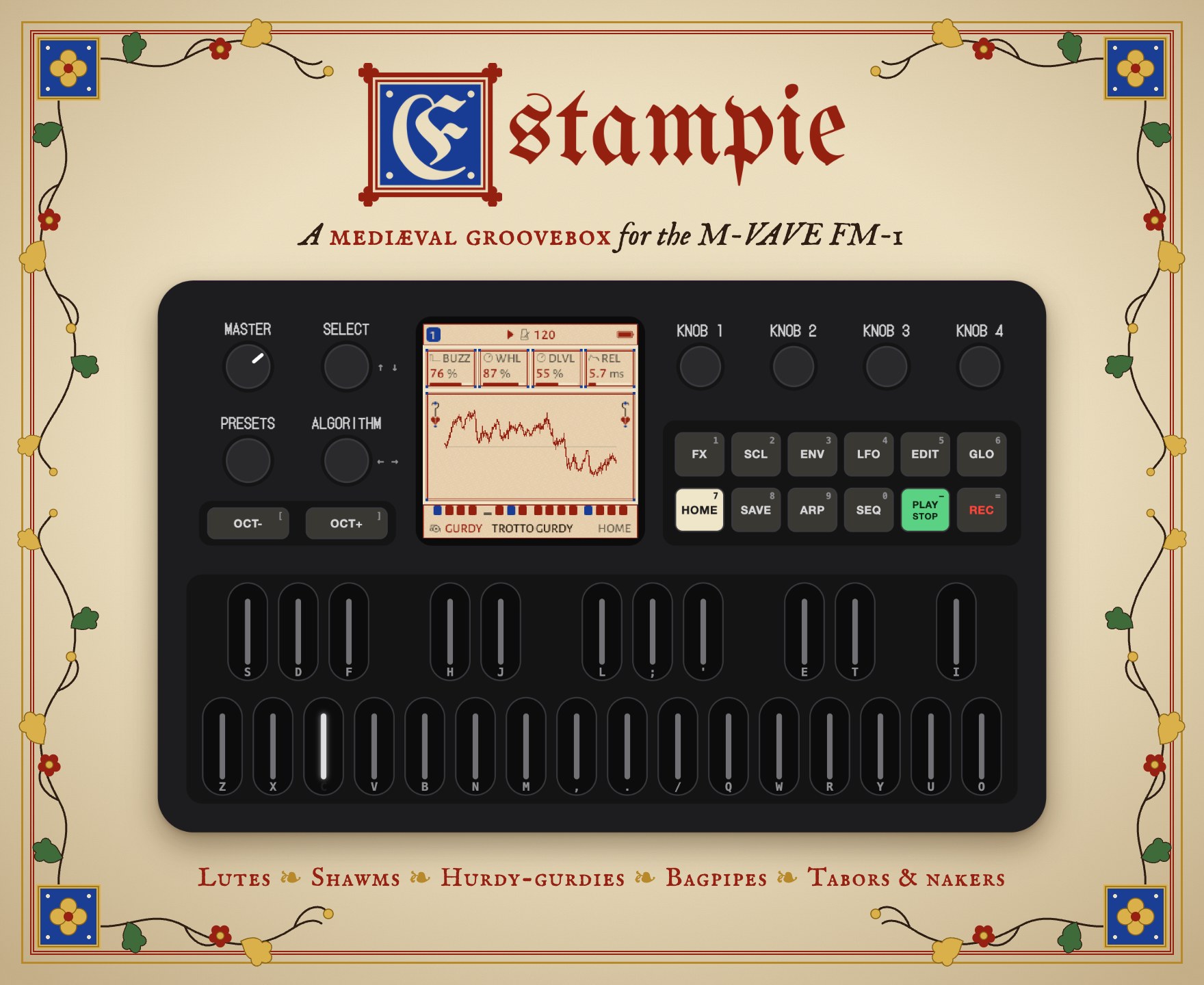
ESTAMPIE: a mediæval groovebox for the FM-1
ESTAMPIE is custom firmware for the M-VAVE FM-1, named after the estampie, a fast dance of the 13th and 14th centuries. It is a groovebox for lively mediæval music: tavern and court dances and celebrations, with plucked lutes and citoles, buzzing hurdy-gurdies, shawms and bagpipes over drones, frame drums, tabors and nakers, chant, and the mediæval modes. This is inspired by the idea of teenage engineering's EP-1320 medieval (but not affiliated with them, and none of their sounds are used).
It started as a fork of GHOULBOX by Jason Persinger, the "dungeon-synth" firmware, which is itself a fork of Felucca by Leo Kuroshita (Hügelton Instruments). Nearly everything here is their work: Felucca's engines, sequencer, effects, editor, installer and tests, and GHOULBOX's hurdy-gurdy, medieval tunings, drone latch, dungeon sounds and browser synth. Thank you both!
ESTAMPIE is on Felucca 1.6.1 (Maybe Felucca's last feature release? Leo says he has stepped back from active
development), with Felucca's ANALOG, LOFI, TRIO, WHEEL and NOISE engines from
Felucca-Engines (MIT) in firmware/engines/. The browser emulator
follows the design of Charles Vestal's X0X, and HOME's chord readout (the
chord or notes you are playing) is ported from Kerem Kilic's Melodee, another
Felucca fork. Felucca's second-core renderer (MENU > SYSTEM > 2ND CORE, a beta, off by default) was contributed by
gospodindilly-ops and builds on X0X, Melodee and zednaked's Jangada. The full
history of both projects is kept in this repository.
Status: 0.3.7, early but ready for use. So far: the VELLUM look (parchment, iron-gall ink, vermilion rubrics, lapis), the screen's type (Alegreya Sans, with Cinzel's Roman capitals for the large text), the illuminated boot screen and the browser emulator page; KEY TOUCH, velocity and aftertouch from the FM-1's own keys (after Charles Vestal's Velo and MONK-1), with a calibration anyone can run; the screen reader; and the web installer, editor and site. The sounds are still mostly GHOULBOX's, with ESTAMPIE's TROTTO scene, DANCE drum kit and mediæval presets. See the screens and ROADMAP.md.
The full site is https://fm-1.drewr.dev/estampie/: play it in the browser, install it, edit sounds and read the guide. This is beside my other FM-1 projects, FM1Kit and FM-SWITCH.
What it does
Thirteen engines (virtual analog, 6-operator FM, phase distortion, chiptune, real recordings, sung vowels, three
oscillators, tonewheel organ, granular, physical models, GHOULBOX's hurdy-gurdy, noise and drums) on four tracks, each
with a 64-step sequencer, an arpeggiator, chord keys, scales and mediæval temperaments (Pythagorean, meantone, just).
The hurdy-gurdy's drones can keep sounding through the sequencer's rests, as a real one's do while the wheel turns
(RING, from GHOULBOX 2.3). KEY TOUCH (MENU › AUDIO, calibrated in MENU › SYSTEM › CALIBRATION) measures how hard 20 of
the FM-1's own keys are pressed, for velocity and aftertouch with no hardware change: Charles Vestal's trick from his
Velo and MONK-1 firmwares
(new, not yet tried widely). A screen reader on the computer can read the FM-1's screen: open Charles Vestal's
FM-1 Screen Reader page with the FM-1 plugged in. Pages, knobs as they
turn, the menu, messages and questions are read, with ESTAMPIE's own words (firmware/words.tsv, published at
/estampie/words/); the browser emulator reads its screen too (fm1-reader).
From Felucca 1.5–1.6.1 (merged into ESTAMPIE 0.1):
- Sound: an INSERT effect on every track (drives, a bit crusher, phaser, flanger, chorus) with a dry / wet MIX; ANALOG's band- and high-pass filter; PHASE's wavefolder; envelopes in note values (ENV SYNC); humanize (MOD VEL and TIME); three more drum kits.
- Sequencer: SEQ › DETAIL (each step's chance, ratchet, nudge and velocity); conditional steps (1:2 .. 4:4) and FILL; a note's length on the piano roll; EUCLID, DOUBLE and HALF; QNT SEQ+T; a roll that follows the playhead.
- MIDI: MIDI LEARN on the device; Program Change; a channel per track; AUTO SELECT; reverb and echo throws.
- The panel: on-screen HELP, SELECT as a page knob, mod wheel or velocity, your own colours, PROJECT ERASE and CLEAN INIT, dimmer INV LEDs, and the chip's second core as an opt-in beta (MENU › SYSTEM › 2ND CORE).
The user guide is docs/guide/guide.html, Jason Persinger's GHOULBOX User Guide reworked for
ESTAMPIE: python3 docs/guide/make_guide.py html OUTDIR builds it as a page (the site has it at guide/), pdf OUT.pdf prints it. tools/guide_shots.sh draws its screenshots with the firmware's own UI code.
Screens
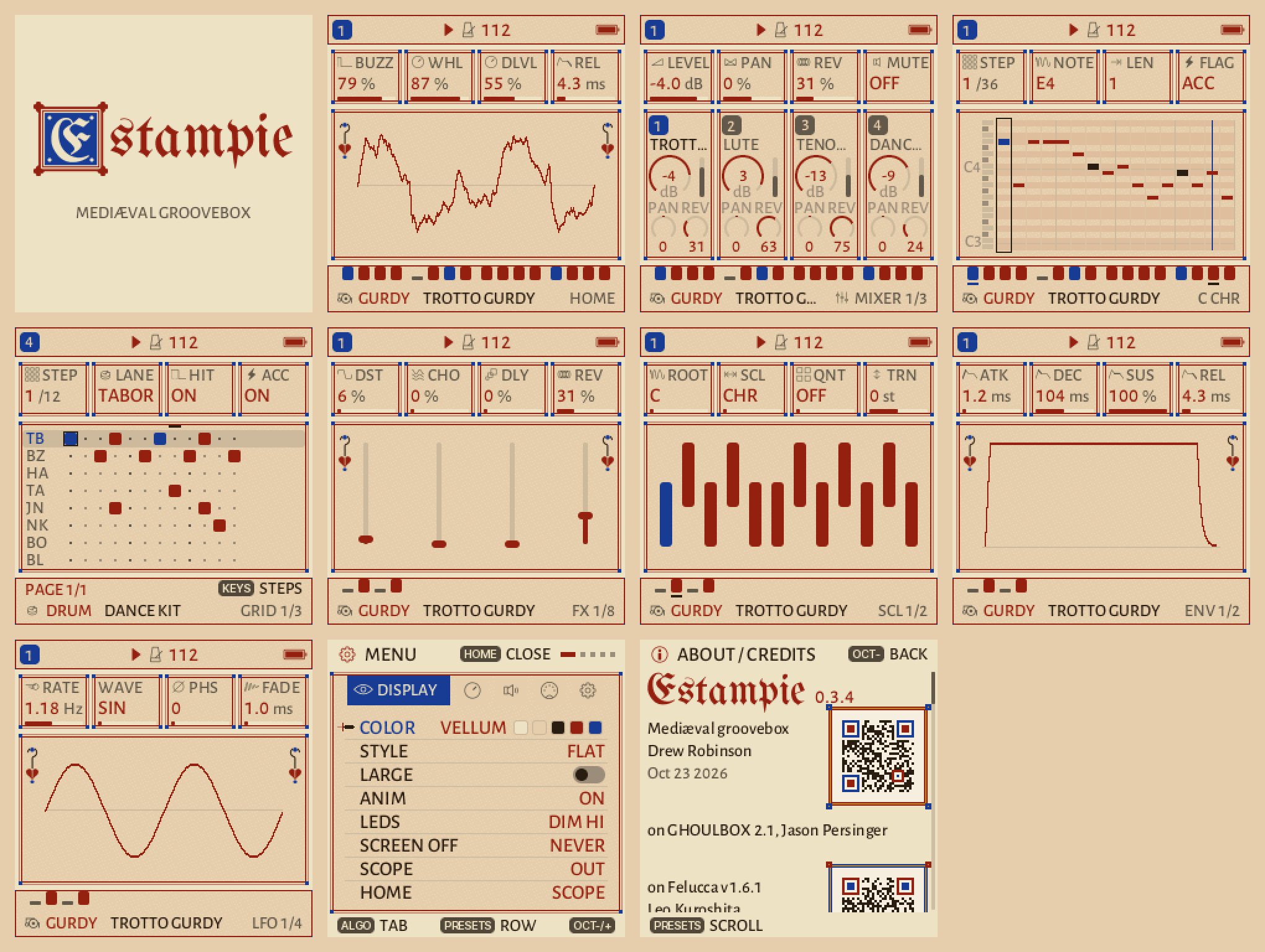
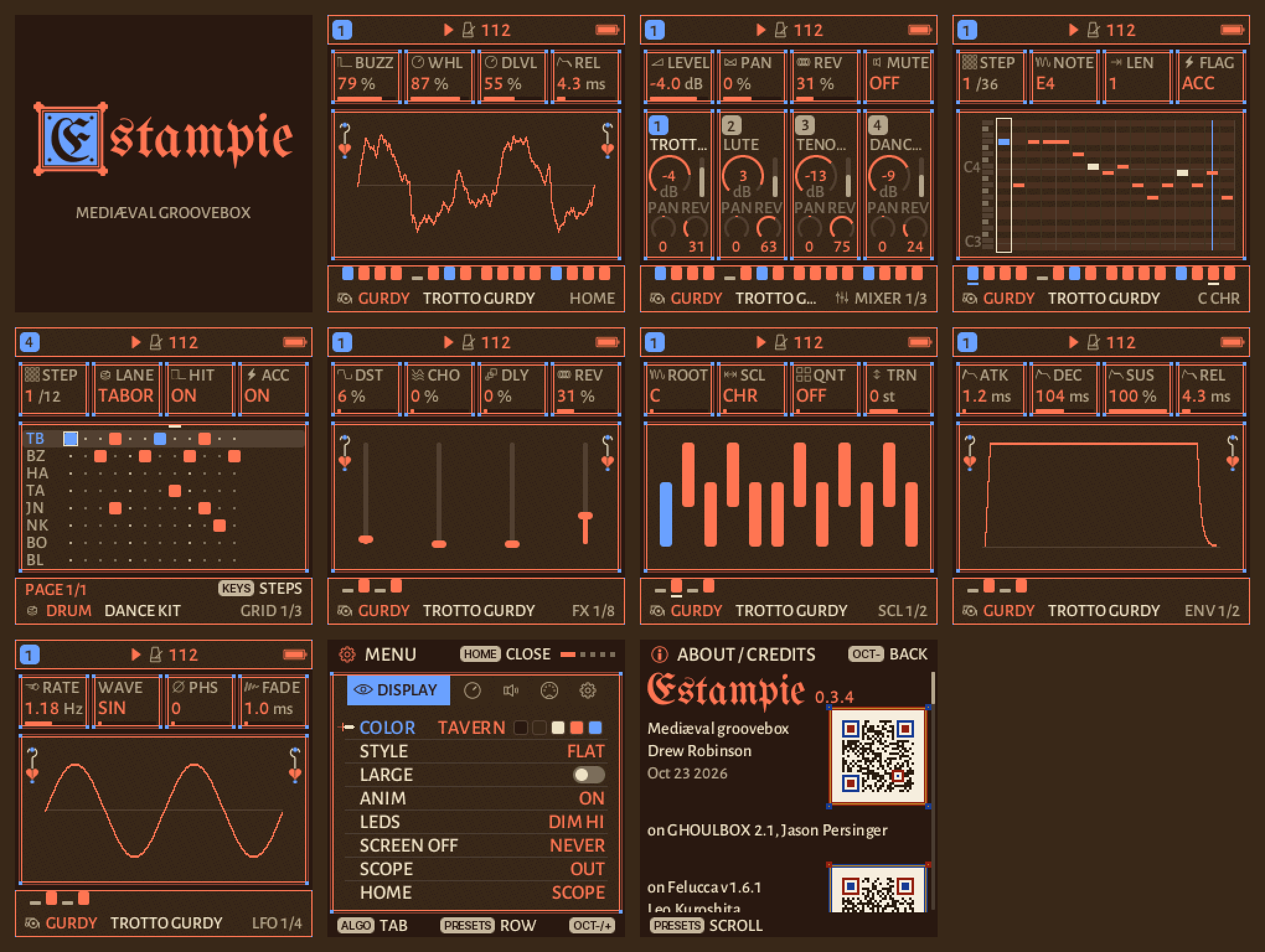
ESTAMPIE playing its TROTTO, in the VELLUM look (parchment) and TAVERN (dark): the boot screen, HOME, the mixer, the
piano roll, the drum grid, FX, SCALE, ENV, LFO, MENU and ABOUT. They are the firmware's own screens, taken in the
simulator by tools/screens.sh. Each one on its own, at 720 × 720: VELLUM ·
TAVERN.
Your projects and other firmwares
ESTAMPIE opens the projects Felucca and GHOULBOX saved. It saves in GHOULBOX 2.3's format, which Felucca and GHOULBOX before 2.3 can't read: a slot holding an ESTAMPIE project shows EMPTY there, but stays in the flash until that slot is saved over. To keep your projects safe when you change firmware, back them up first with the web editor.
Building
Everything the build needs is fetched into the repository (.toolchain/, .venv/, both git-ignored), so
nothing is installed in your home directory. Needs uv, Docker Desktop and git:
tools/setup_toolchain.sh     # every tool, pinned by hash (tools/toolchain.lock); Python 3.14 from uv.lock
tools/osv_scan.sh            # known vulnerabilities in everything the build runs (docs/SECURITY.md)
./build.sh                   # build/estampie.fwsc: the firmware package (Docker runs the JieLi tools on macOS)
sh web/emu/build.sh          # build/emu/: the browser emulator (zig cc to WebAssembly)
python3 -m http.server -d build/emu 8790     # open http://localhost:8790/
Docker Desktop must be running for ./build.sh on macOS.
Testing
Three levels, cheapest first:
- Browser emulator (
web/emu/): the firmware's own C sources compiled to WebAssembly against a simulated FM-1. The quick loop for designing sounds and screens. - Host tests:
tests/run_tests.sh(withAC79_SDK=.toolchain/ac79-sdkand the venv onPATH): golden renders of every sound, the UI's layout lint, CPU budgets and more. The reverb's HALL cost check fails on Apple silicon hosts (it measures host instructions; CI has no counter and skips it); this is inherited. - Emulated hardware:
tools/hw_check.shboots the realbuild/estampie.fwscon an emulation of the AC791N's pi32v2 cores and the board (shcherbakov7/m-wave-fm1-browser-emulator, Rust), and saves the screen tobuild/hw/screen.png. This checks the real image: memory layout, start-up, timing.
Then a real FM-1. M-VAVE's own updater returns it to stock firmware.
AI / LLM disclaimer
ESTAMPIE is developed with the help of LLM coding agents (code, tests, documentation and maintenance). Its idea, design, features, sounds and direction are mine, or the work of the people credited above, and I put as much care and thought into refining and iterating on the design and features as I personally can, and review output as much as possible. See On AI-assisted development, inspired by Leo Kuroshita's note for Felucca.
Licence
GPL-3.0-only, as GHOULBOX and Felucca. The engines in firmware/engines/ are MIT (Felucca-Engines) and the Hügelton
Sample Pack is CC0 1.0. See LICENSING.md for the parts under other licences.
GHOULBOX's own README is kept at docs/GHOULBOX-README.md.
M-VAVE and FM-1 are trademarks of their respective owners. ESTAMPIE, GHOULBOX and Felucca are not affiliated with or endorsed by them.