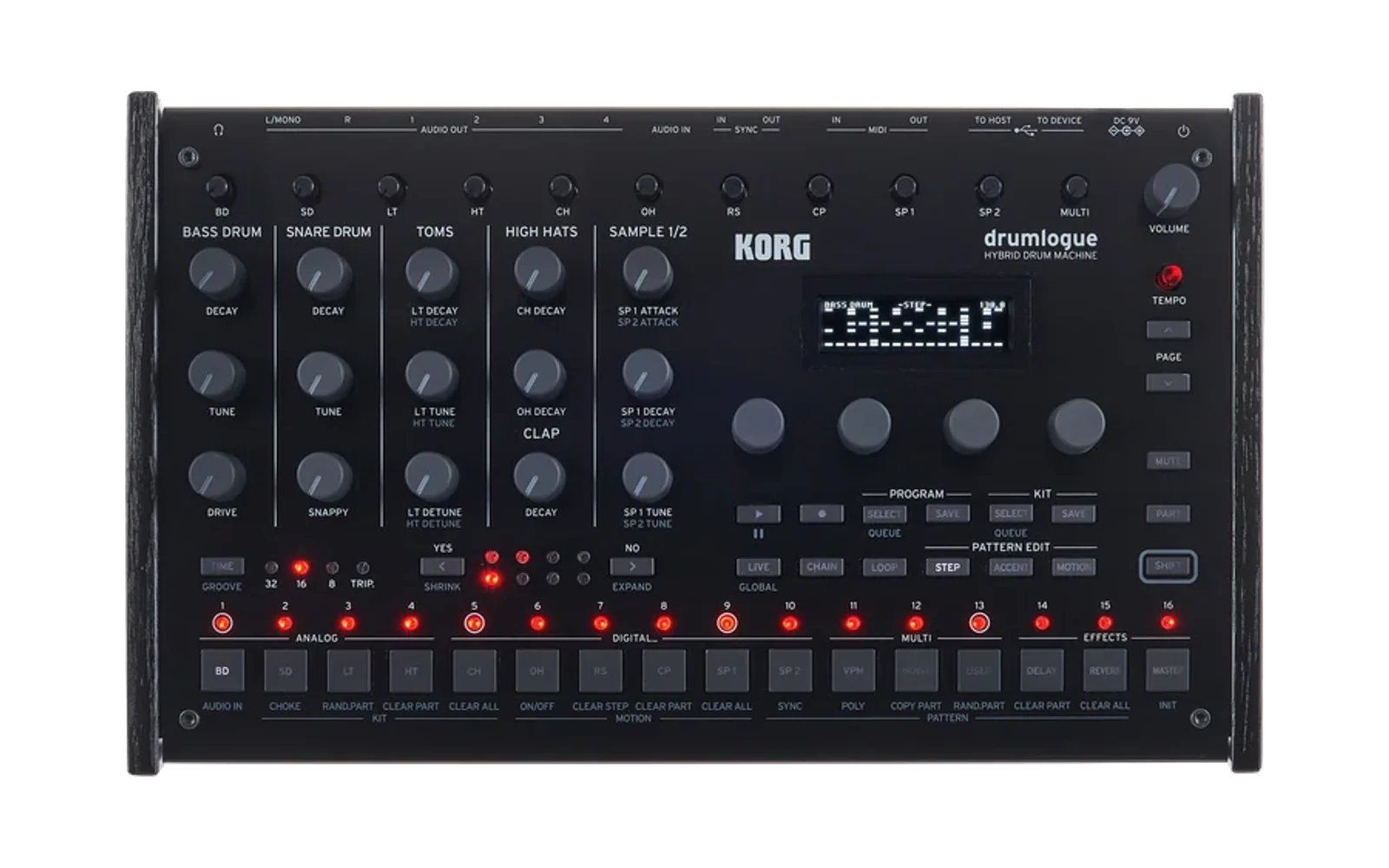
drumlogue-units
Hype15/100Drumlogue Units
drumlogue-units is custom firmware for the Korg drumlogue, by @cldmnky. Open source under Apache-2.0, latest release elementish-synth/v1.4.1 (October 2026), 4 stars on GitHub.
forKorg drumlogue·by@cldmnky
Unclaimed. Is this yours? Sign in with GitHub as @cldmnky to claim it.
elementish-synth-v1.4.1.drmlgunit· 132 KB
Apache-2.0· cldmnky/drumlogue-units·downloads come from the creator’s GitHub releases
elementish-synth/v1.4.1elementish-synth v1.4.1Latest1 file
elementish-synth v1.4.1
Release Notes
v1.4.1
Performance fix release: restores the NEON modal resonator and cuts reverb guard overhead.
Bug Fixes
- NEON modal resonator re-enabled: v1.4.0 shipped without the
ELEMENTISH_USE_NEON_RESONATORdefine, which silently reverted the resonator to the scalar SVF path and lost the NEON speedup introduced in v1.1.0 (~40% on the modal resonator). Release builds now define the opt-in macro again - Reverb CPU cost reduced: the v1.4 per-sample NaN guards ran ~34 bit-pattern checks per sample. Guards now run only where values enter the tank (input, comb/allpass writes, wet output) — the guarded-write invariant makes read checks redundant — and use a single exponent-field compare (NaN/Inf or |x| >= 2^19) instead of the three-condition test
Performance
Measured on the QEMU ARM harness (64-frame buffers, 10 s parameter storm, seed 1234):
Build CPU Usage Real-Time Factor v1.3.1 9.02% 11.08x v1.4.0 16.18% 6.18x v1.4.1 9.11% 10.98x Output metrics are unchanged by the guard rewrite (peak/rms/DC identical). Note: QEMU does not model Cortex-A7 NEON throughput, so the NEON gain is understated in the harness.
Regression Tests
- Full desktop suite (9 phases) passes with a native ARM64 NEON build
--bow-stability-testand--preset-retrigger-testpass with the NEON resonator enabled- QEMU ARM symbol/ABI audit and WAV validation pass
Installation
- Download the
.drmlgunitfile from the assets below - Connect your drumlogue to your computer via USB
- Copy the file to the appropriate
Units/folder:Units/Synth/
- Safely eject the drumlogue and restart it
Documentation
See README.elementish-synth.md for full documentation.
Built from commit: 9a9037ec1e64f3998219e179a41c52020a876040
- NEON modal resonator re-enabled: v1.4.0 shipped without the
elementish-synth/v1.4.0elementish-synth v1.4.01 file
elementish-synth v1.4.0
Release Notes
Elementish Synth - Release Notes
v1.4.0
Review-fix release: note transitions, tuning, and string pickup position.
Bug Fixes
- Tuning is applied to directly played notes: COARSE, FINE and pitch bend
were only applied to sequencer-generated notes;
NoteOn,GateOn, held-note retuning and the preset retrigger now use the fully tuned pitch (ClampedFullTunedNote), so COARSE/FINE/pitch bend work on every note path - All-notes-off / panic cleanup:
AllNoteOff()now clears the held-note state, so a subsequent preset load or retune cannot re-trigger a note after the host requested silence - STRING/MSTRING POSITION control works: the pickup position comb was a no-op (the read position was invariant to the parameter); the position tap is now actually summed into the delay line output, so POSITION changes the string timbre as documented
- Full-mode COARSE retunes a held note (lightweight mode already did); turning COARSE while a note is held now re-pitches it immediately
- Preset switch no longer goes silent with the sequencer: if a note is held while the sequencer is enabled and the new preset disables it (SEQ OFF), the retrigger falls through to a direct note instead of feeding the disabled sequencer
- Preset load / note transition stability: voice runtime state is reset and the held note retriggered on preset switch (sound engine no longer stops mid-note; note-transition distortion reduced)
- Sequencer state leaks: pending notes are dropped on note-off, all-notes-off, panic and preset change; interval-scale quantization no longer wraps to the wrong octave
- Reverb diagnostics:
debug_last_wet_is now tracked on host builds so reverb instability is visible in the render debug log
Regression Tests
--preset-retrigger-test: 56 preset transitions (voice must keep sounding and stay finite after a preset switch while a note is held)--bow-stability-test: repeated bow note transitions stay finite and audible--gate-test: drumlogue pattern-sequencer simulation with correct COARSE transpose mapping- Test CLI fix:
--cutoff/--resonanceconsume their value argument in lightweight builds (previously the value was mis-parsed as the output file)
Presets Editor
- Native presets-editor builds now apply the unit's
config.mkmacros, so the editor loads the same lightweight build that ships on hardware (with the Marbles sequencer) instead of the full filter/LFO build - drupiter-synth can now be built natively on Apple Silicon with its release
macros (
NEON_DCOand friends)
v1.3.1
Preset-transition fix.
Bug Fixes
- Preset load no longer kills the playing voice:
LoadPreset()now resets the voice runtime state (envelope segments, exciter/sample-player state) and retriggers the currently held note with the new preset, so a preset switch while a note is held continues to sound instead of dying out after the stale envelope completes - Blown preset (4) is audible again: its SPACE value was below the blow tube's oscillation threshold, leaving it near-silent; raised to 80
- Quartic attack table ends at 1.0 (the table was truncated at ~0.43, so attack never reached full level)
- Sequencer preset changes now stop active subdivisions and drop pending
notes (voice boundary), matching
LoadPreset
Regression Test
--preset-retrigger-test: holds a note into its decay tail, loads every other factory preset, and verifies the voice keeps sounding with finite output (all 56 transitions)
v1.3.0
Review-fix release.
Bug Fixes
- Sequencer note leak: pending sequencer notes are dropped on note-off, all-notes-off, panic and preset change, so no note can ring out after the host requested silence
- MIDI tuning clamp: tuned notes are clamped to [0, 127] before the uint8_t conversion (out-of-range float casts are undefined behavior)
- Attack envelope: the quartic lookup table was non-monotonic and overshot 1.0; replaced with a correct, monotonic t⁴ curve
- Pitch bend: now bends the currently held note, not just the next one
- Interval-scale quantization: OCT/5TH/4TH/TRI no longer wrap to the wrong octave (e.g. +11 now maps to +12 instead of +0)
- STRING/MSTRING resonator: GEOMETRY now maps to dispersion (STRING) and the Elements chord table (MSTRING); POSITION now controls the string pickup for both models
- BLOW exciter: rewritten as an Elements-style granular sample-player source (noise wavetable scan) instead of plain filtered noise; FLOW sets restart density
- SPACE metaparameter: now drives raw exciter bleed, stereo spread, and a reverb tail (reverb amount and time follow the original Elements mapping)
- FINE tuning: re-exposed on page 6; DEJA VU moved to page 4
- Test CLI: lightweight parameter IDs fixed (--model no longer corrupted by --cutoff/--resonance); added --fine
Page 6 Parameter Changes (Lightweight Mode)
Parameter Description COARSE Coarse tuning (±24 semitones) FINE Fine tuning (±100 cents) SEQ Sequencer preset (0-15) SPREAD Note range (0-127) DEJA VU moved to page 4 (slot after VOLUME).
v1.2.0 (December 2025)
Generative sequencer release with Marbles-inspired note generation.
New Features
-
Marbles-Inspired Generative Sequencer (Lightweight mode only)
- Triggered by drumlogue pattern sequencer or MIDI notes
- Generates tempo-synced melodic subdivisions
- 16 presets combining subdivision rate and scale quantization
-
16 Sequencer Presets
- OFF: Normal note playback
- SLOW/MED/FAST: 1/2/4 notes per beat (chromatic)
- X2/X4: 8/16 notes per beat (extreme subdivisions)
- MAJ/MIN/PENT/CHROM: Scale-quantized 16th notes
- OCT/5TH/4TH: Interval-based 8th notes
- TRI: Triplet feel with triad quantization
- 7TH: 16th notes quantized to 7th chord tones
- RAND: Random scale selection per trigger
-
Déjà Vu Loop Buffer
- 8-step pattern memory
- DEJA VU parameter: 0 = fully random, 127 = locked loop
- Creates repeating melodic patterns from randomness
-
SPREAD Control
- Adjusts note range from unison (0) to ±24 semitones (127)
- Works with scale quantization for musical results
Technical Improvements
- Skip-ahead optimization in Process() - no per-sample iteration
- Note queue (8-deep circular buffer) prevents note loss at high subdivisions
- Gate triggering - works with drumlogue's built-in pattern sequencer
- Bounds checking on preset selection for safety
Page 6 Parameter Changes (Lightweight Mode)
Parameter Description COARSE Base note for sequencer (±24 semitones from middle C) SEQ Sequencer preset (0-15) SPREAD Note range (0-127) DEJA VU Pattern looping (0-127) Build Info
- Binary size: ~124KB
- All 16 sequencer presets validated
- Gate and MIDI triggering tested
v1.1.0 (December 2025)
Performance optimization release with ARM NEON SIMD support.
New Features
- NEON SIMD Optimizations - Significant performance improvements on ARM Cortex-A7
- Modal resonator: ~40% speedup (4-way parallel SVF processing)
- CosineOscillator batch compute: ~2.4x faster amplitude calculation
- Stereo soft clamp: 2x faster output processing
- FastTanh saturation: ~20% speedup (4 values simultaneously)
Technical Improvements
- Structure-of-Arrays (SoA) layout for mode coefficients eliminates scatter-gather overhead in NEON loop
- NaN protection and stability checks in NEON mode processing loop
- Optimized CosineOscillator::Next4() batch method for modal amplitude modulation
- Vectorized stereo output processing using float32x2_t
Internal Changes
- Moved NEON DSP utilities to shared
common/neon_dsp.hlibrary - Added SyncSoAFromModes()/SyncSoAToModes() for efficient coefficient sync
- Coefficient sync only happens when parameters change (not per-sample)
Build Info
- Binary size: ~124KB (minimal increase for NEON paths)
- All 8 presets validated
- All 3 resonator modes (MODAL/STRING/MSTRING) tested
v1.0.0 (December 2025)
Initial release of Elementish Synth for Korg drumlogue.
Features
- Modal Synthesis Engine - Port of Mutable Instruments Elements
- Three Excitation Types:
- BOW: Continuous friction/bowing with adjustable timbre
- BLOW: Granular noise/breath with flow control
- STRIKE: Percussive impacts (5 modes: SAMPLE, GRANULAR, NOISE, PLECTRUM, PARTICLE)
- Three Resonator Models:
- MODAL: Classic 8-partial modal resonator
- STRING: Karplus-Strong string synthesis
- MSTRING: 5 sympathetic strings for rich harmonic content
- 12 Mallet Types: SOFT/MED/HARD/PLEC/STIK/BOW × DK(dark)/BR(bright)
- 8 Factory Presets: Init, Bowed Str, Bell, Pluck, Blown, Marimba, String, Drone
- Full MIDI Support: Velocity-sensitive dynamics, pitch bend (+/- 2 semitones)
- 24 Parameters across 6 pages
- Stereo Width Control via SPACE parameter
Technical Details
- Sample Rate: 48kHz (native drumlogue)
- Processing: Stereo output
- Optimized for Cortex-A7 with NEON disabled in initial release
Credits
- DSP Algorithms based on Mutable Instruments Elements by Émilie Gillet
- Original License: MIT License
Installation
- Download the
.drmlgunitfile from the assets below - Connect your drumlogue to your computer via USB
- Copy the file to the appropriate
Units/folder:Units/Synth/
- Safely eject the drumlogue and restart it
Documentation
See README.elementish-synth.md for full documentation.
Built from commit: c46d9a058dfb96b97e2259f5cd1aab826cac7d3d
- Tuning is applied to directly played notes: COARSE, FINE and pitch bend
were only applied to sequencer-generated notes;
druteus/v0.1.0druteus v0.1.01 file
druteus v0.1.0
Release Notes
Druteus - Release Notes
v0.1.0 - 2026-08-03
Initial release of Druteus, an E-mu Proteus/1 SoundFont synthesizer for Korg drumlogue.
Features
- TinySoundFont SF2 playback with support for files in the drumlogue
Programs/folder - 442 Proteus/1 factory patches across six original ROM volumes
- Dual-layer voice architecture with per-layer tuning, volume, pan, and patch sends
- Per-patch AHDSR envelopes and LFO modulation
- Velocity crossfade and keyboard split modes
- User LFO with five waveforms and three destinations
- State-variable filter with LP12, LP24, HP12, and BP12 modes
- Chorus and Griesinger reverb effects
- Tempo-synchronized trance gate with 1-32 step patterns
- 1-16 voice polyphony with oldest-note voice stealing
- MIDI velocity, pitch bend, and channel pressure support
Improvements
- ARM NEON optimizations for DSP, gain, and stereo interleave processing
- Float-precision TSF lowpass processing for improved drumlogue performance
- Chunked asynchronous SF2 loading in 128 KB blocks to avoid long UI stalls
Bug Fixes
- Disabled production performance-monitor register access that could hang the unit
- Fixed SF2 loading behavior by moving file reads out of the audio render path
Known Issues
- The Proteus/1 SoundFont is not bundled with the unit and must be downloaded separately.
- Audio is silent while a SoundFont is loading at startup or after selecting a new file.
Installation
- Download the
.drmlgunitfile from the assets below - Connect your drumlogue to your computer via USB
- Copy the file to the appropriate
Units/folder:Units/Synth/
- Safely eject the drumlogue and restart it
Documentation
See README.druteus.md for full documentation.
Built from commit: a2d849164421ef411caf2455aeeb30d47bab0507
- TinySoundFont SF2 playback with support for files in the drumlogue
drupiter-synth/v1.2.0drupiter-synth v1.2.02 files
drupiter-synth v1.2.0
Release Notes
Release Notes - Drupiter Synth
v1.2.0 - 2026-02-07
🎛️ MIDI Expression & Bug Fixes
Third release with enhanced MIDI expressiveness and comprehensive stability improvements.
New Features
MIDI Expressiveness:
- Velocity Sensitivity: Notes respond to MIDI velocity for dynamic control of filter cutoff (50% modulation depth)
- Pitch Bend: ±2 semitone pitch bend with smooth per-buffer smoothing (~200ms response)
- Channel Pressure: Real-time pressure modulation of VCF cutoff frequency (+1 octave depth)
- Aftertouch: Per-note aftertouch support for expressive, dynamic control
- Per-Buffer Smoothing: All MIDI modulations use exponential smoothing to prevent clicks and zipper noise
Enhanced Common Library:
- Extended
midi_helper.hwith reusable pressure/aftertouch conversion utilities - Standardized MIDI parameter scaling (0-127 → 0.0-1.0 normalized range)
- New
catchable_value.hutility: Generic knob catch mechanism (±3 unit threshold) - Reusable by all drumlogue units
Improvements
- Extracted mono/poly/unison renderers for clearer DSP flow and easier maintenance
- Added shared voice allocator core in
drumlogue/commonfor consistent note handling - Key-trigger LFO support for tighter Jupiter-8 style modulation
- Q31 wavetable interpolation path for DCO tables
- JP-8 envelope time calibration (attack, decay, release ranges)
- QEMU/perf monitoring fallback timing and stereo widener allocation safety
Technical Improvements
DSP Stability:
- Eliminated dynamic memory allocation in voice allocator (fixes undefined symbols)
- Fixed Q31 fixed-point interpolation with proper PolyBLEP anti-aliasing
- Improved voice allocation in mono/unison modes (last-note priority)
- Fixed mod hub UI page flickering on drumlogue display
Build System:
- Automatic symbol verification in
build.sh - Preserved build artifacts from container for debugging
- Comprehensive build artifact analysis (object files, memory maps, symbol tables)
Testing & Debugging:
- 5 new MIDI tests in desktop test harness (velocity, pitch bend, pressure, aftertouch, smoothing)
- 5 new catchable value tests (basic follow, catch/release, threshold, bipolar, float variant)
- All 13 tests passing (3 voice allocation + 5 MIDI expression + 5 catchable value)
- Complete debug verification checklist per SDK guidelines
Bug Fixes
- Fixed DCO waveform mapping and saw/PolyBLEP edge artifacts
- Reset HPF state on voice trigger to avoid carryover
- Fixed mono/unison last-note priority edge cases
- Resolved VoiceAllocator symbol resolution issues
- Eliminated undefined reference errors from static constexpr members
Knob Catch Mechanism
New Feature: Generic knob catch to prevent audio jumps on preset changes
- Applied to 9 continuous parameters (cutoff, mix, resonance, etc.)
- Fixed ±3 unit threshold for intuitive, consistent behavior
- Transparent support for both unipolar and bipolar parameters
- Reusable across all drumlogue units via new
catchable_value.hutility - Behavior: When knob position differs from preset, DSP holds preset value until knob crosses catch threshold
Performance
- Velocity modulation: 50% depth on VCF cutoff
- Pitch bend: ±2 semitones with smooth vibrato response
- Pressure modulation: +1 octave VCF swell with expressive feel
- All MIDI modulations: Per-buffer smoothing (exponential convergence)
- CPU usage: Maintained <50% on 48kHz buffer processing
Compatibility
- Backward Compatible: All v1.1.0 presets and functionality preserved
- MIDI Enhancement: Optional - MIDI controllers enhance but don't require modification
- Hardware Requirements: Standard drumlogue with MIDI input support
v1.1.0 - 2025-12-29
🚀 Major Feature Update
Second major release of Drupiter, introducing polyphonic capabilities, expanded waveforms, and advanced modulation features.
New Features
Synthesis Modes:
- Polyphonic Mode: True polyphony with voice allocation system
- Unison Mode: Rich ensemble effects with golden ratio detuning and stereo spread
- Mono Mode: Classic monophonic operation (backward compatible)
Expanded Waveforms:
- 5 Waveforms per Oscillator: SAW/SQR/PULSE/TRI/SAW_PWM (previously 4)
- SAW PWM: Pulse-width modulated sawtooth waves for rich, evolving timbral character
- Enhanced Pulse Width Control: Improved PWM implementation for all pulse-based waveforms
Advanced Modulation:
- ENV TO PITCH: Filter envelope can now modulate oscillator pitch (±12 semitones)
- Extended Modulation Hub: 18 modulation destinations including:
- Synth mode switching (Mono/Poly/Unison)
- Unison detune amount
- Portamento/glide time
- Enhanced LFO routing
Performance & Playability:
- Portamento/Glide: True legato detection with exponential glide curves
- Voice Allocation: Intelligent polyphonic voice management
- Enhanced Presets: Expanded from 6 to 12 factory presets covering new features
Technical Improvements
- DSP Architecture: Complete rewrite with modular voice allocation system
- Performance Monitoring: Integrated cycle counting for CPU usage optimization
- QEMU ARM Testing: Enhanced test harness with automatic rebuilding
- Build System: Improved container builds with performance monitoring support
Presets
New Presets (7-12):
- 7. PWM Lead - Pulse-width modulated sawtooth lead
-
- Unison Pad - Rich ensemble pad with golden ratio detuning
-
- Poly Bass - Polyphonic bass with glide
-
- ENV FM - Filter envelope modulating pitch
-
- Stereo Unison - Wide stereo ensemble effects
-
- Glide Lead - Smooth portamento lead sound
Existing Presets (1-6):
-
- Jupiter Bass - Deep, punchy bass
-
- Jupiter Lead - Bright, cutting lead
-
- Sync Lead - Hard-synced aggressive lead
-
- FM Bell - Cross-modulated bell tones
-
- Analog Pad - Warm, evolving pad
-
- Poly Arp - Bright arpeggiator sound
Compatibility
- Backward Compatible: All existing presets and mono mode operation preserved
- Hardware Requirements: No additional hardware requirements
- Firmware: Compatible with all drumlogue firmware versions
Bug Fixes
- Improved parameter smoothing for glitch-free modulation
- Enhanced voice stealing algorithm for better polyphonic performance
- Fixed edge cases in unison detuning calculations
v1.0.0 - 2024-12-18
🎉 Initial Release
First stable release of Drupiter, a Jupiter-8 inspired monophonic synthesizer for Korg drumlogue.
Features
Oscillators:
- Dual DCOs with 4 waveforms each (Ramp, Square, Pulse, Triangle)
- Hard sync (DCO1 → DCO2) for aggressive timbres
- Cross-modulation (DCO2 → DCO1 FM) for complex harmonic content
- DCO-1: octave selection (16', 8', 4')
- DCO-2: octave selection (32', 16', 8', 4')
- Pulse width control for pulse waveforms
- Detune control for DCO2
Filter:
- Multi-mode filter (LP12, LP24, HP12, BP12)
- Self-oscillation capability
- Envelope amount and keyboard tracking
- Resonance control
Modulation:
- Dual ADSR envelopes (VCF and VCA)
- LFO with 4 waveforms (Triangle, Sawtooth, Square, S&H)
- LFO delay envelope for gradual modulation
- LFO rate control
Presets:
- 6 factory presets covering common synth sounds
User Interface:
- 24 parameters across 6 pages
- Hub control system for efficient parameter organization
- Clear parameter naming and formatting /Users/mbengtss/code/src/github.com/cldmnky/drumlogue-units/drumlogue/drupiter-synth/RELEASE_NOTES.md
Installation
- Download the
.drmlgunitfile from the assets below - Connect your drumlogue to your computer via USB
- Copy the file to the appropriate
Units/folder:Units/Synth/
- Safely eject the drumlogue and restart it
Documentation
See README.drupiter-synth.md for full documentation.
Built from commit: 2d470f1232b53c7c99c35bcee97f7f981277c7b2
pepege-synth/v1.1.0pepege-synth v1.1.01 file
v1.1.0 - 2026-02-07
Improvements
- MOD HUB now uses shared HubControl for consistent destination names and value formatting
- MOD HUB values use a 0-100 UI scale with preset migration from the previous 0-127 range
- Updated PPG waveform resource data
- Smoother wavetable morphing response
- Stereo width smoothing uses the current smoothed value per render for stability
- Per-voice mix headroom scales by voice count
Bug Fixes
- Reset HPF state on voice trigger to prevent filter state carryover
- Fix monophonic last-note priority voice allocation bug
- Clamp filter type selection to valid range
drupiter-synth/v1.1.0drupiter-synth v1.1.0 - Polyphonic Synthesis Update1 file
Features
• Polyphonic & Unison Modes: True polyphony with intelligent voice allocation and rich ensemble effects • 5 Waveforms per Oscillator: SAW/SQR/PULSE/TRI/SAW_PWM (expanded from 4) • SAW PWM: Pulse-width modulated sawtooth waves for evolving timbral character • ENV TO PITCH: Filter envelope modulates oscillator pitch (±12 semitones) • Portamento/Glide: True legato detection with exponential glide curves • Extended Modulation Hub: 18 modulation destinations including synth mode switching • 12 Factory Presets: Expanded from 6 with new polyphonic and unison sounds
Technical Details
• Complete DSP architecture rewrite with modular voice allocation system • Intelligent polyphonic voice management and unison detuning • Enhanced PWM implementation for all pulse-based waveforms • Integrated performance monitoring with cycle counting • QEMU ARM testing support for validation
Installation
- Download drupiter_synth.drmlgunit below
- Connect your drumlogue to your computer via USB
- Copy the file to the Units/Synth/ folder on the drumlogue
- Safely eject and restart your drumlogue
clouds-revfx/v1.2.1clouds-revfx v1.2.11 file
clouds-revfx v1.2.1
Release Notes
Clouds Reverb FX - Release Notes
v1.2.1 (December 2025)
Important: Removed preset support due to drumlogue hardware limitation.
Breaking Changes
- Presets removed - Due to a known hardware limitation/bug in the drumlogue firmware, presets are not supported for reverb and delay effects. All preset-related code and documentation has been removed.
- Previously defined presets (INIT, HALL, PLATE, SHIMMER, CLOUD, FREEZE, OCTAVER, AMBIENT) served as usage examples but were never functional on hardware
- All parameters remain accessible and can be saved in drumlogue user patterns/songs
Documentation Updates
- Removed all preset references from README and documentation
- Added note about hardware limitation in features section
- Updated usage tips to remove preset-based instructions
v1.2.0 (December 2025)
Feature and performance release with NEON optimizations and refined presets.
New Features
-
Dual Assignable LFOs - Two independent LFOs with 15 modulation targets each
- Targets: DRY/WET, TIME, DIFFUSION, LP, INPUT GAIN, TEXTURE, all GRAIN params, all SHIFT params
- 3 waveforms: Sine, Saw, Random (S&H)
- Cross-modulation: LFO1 can modulate LFO2 speed
- 8 new parameters on pages 5-6
-
NEON SIMD Optimizations - Significant performance improvements on ARM Cortex-A7
- SanitizeAndClamp: Vectorized NaN removal and output clamping
- InterleaveStereo: Fast stereo buffer interleaving
- FastTanh4: 4-way parallel soft saturation
-
Refined Presets - All 8 presets redesigned for distinct sonic character
- NOTE: These presets were never functional on drumlogue hardware due to a firmware limitation. Removed in v1.2.1.
- INIT: Neutral starting point with balanced parameters
- HALL: Large concert hall with long decay, slightly dark
- PLATE: Classic bright plate with max diffusion
- SHIMMER: Ethereal octave-up with grain sparkle and LFO modulation
- CLOUD: Dense granular with dual LFO (position + density)
- FREEZE: Infinite sustain pad machine
- OCTAVER: Sub-octave thickener (-12 semitones)
- AMBIENT: Evolving wash with dual LFO on texture/density
Bug Fixes
Note about preset bug** (#24): While we attempted to fix preset selector issues, presets are fundamentally not supported on drumlogue hardware for reverb/delay effects. This is a known firmware limitation. All preset code has been removed in v1.2.1.sses
- Fixed preset loading: use
setParameter()to ensure proper DSP state updates - Fixed missing symbol: added
stmlib/utils/random.ccto build
Technical Improvements
- Parameter smoothing prevents zipper noise during preset changes
- Moved shared NEON utilities to
common/neon_dsp.h - Stack allocation optimized (temp buffers moved to class members)
Parameters (6 Pages)
Page Parameters 1 - Main DRY/WET, TIME, DIFFUSION, LP DAMP 2 - Texture IN GAIN, TEXTURE, GRAIN AMT, GRN SIZE 3 - Granular GRN DENS, GRN PITCH, GRN POS, FREEZE 4 - Pitch SHIFT AMT, SHFT PTCH, SHFT SIZE, — 5 - LFO1 LFO1 ASGN, LFO1 SPD, LFO1 DPTH, LFO1 WAVE 6 - LFO2 LFO2 ASGN, LFO2 SPD, LFO2 DPTH, LFO2 WAVE
v1.1.0 (December 2025)
Added dual assignable LFOs for dynamic modulation.
New Features
- Dual LFOs with 15 assignable modulation targets
- 3 Waveforms: Sine, Saw, Random
- Cross-modulation: LFO1 → LFO2 speed
v1.0.0 (December 2025)
First stable release.
Changes from v1.0.0-pre
- Fixed undefined symbol (
stmlib/utils/random.cc) - Validated all presets
v1.0.0-pre (Initial Pre-release)
This is the initial pre-release of the Clouds Reverb FX unit for Korg drumlogue.
Features
- Lush Reverb Engine - Based on the acclaimed Griesinger/Dattorro topology from Mutable Instruments Clouds
- Texture Processing - Post-reverb diffusion for additional smearing and atmospheric depth
- Micro-Granular Processing - Ambient textures with freeze capability for drone and pad sounds
- Pitch Shifter - Shimmer and octave effects with adjustable window size
- 16 Parameters across 4 pages for deep sound design
- 8 Built-in Presets - INIT, HALL, PLATE, SHIMMER, CLOUD, FREEZE, OCTAVER, AMBIENT
- Parameter Smoothing - Zipper-noise-free transitions for live performance
- CPU Optimization - Automatic bypass for disabled effect stages
Parameters
Page Parameters 1 - Main DRY/WET, TIME, DIFFUSION, LP DAMP 2 - Texture IN GAIN, TEXTURE, GRAIN AMT, GRN SIZE 3 - Granular GRN DENS, GRN PITCH, GRN POS, FREEZE 4 - Pitch SHIFT AMT, SHFT PTCH, SHFT SIZE Technical Details
- Sample Rate: 48kHz (native drumlogue)
- Processing: Stereo in/out
- Latency: Minimal (block-based processing)
Credits
- DSP Algorithms based on Mutable Instruments Clouds by Émilie Gillet
- Original License: MIT License
- drumlogue Port: Adapted for Korg logue SDK
Known Issues
- This is a pre-release version for testing purposes
- Please report any issues on the GitHub repository
What's Next
- Full release after community testing
- Potential parameter refinements based on feedback
Installation
- Download the
.drmlgunitfile from the assets below - Connect your drumlogue to your computer via USB
- Copy the file to the appropriate
Units/folder:Units/RevFX/
- Safely eject the drumlogue and restart it
Documentation
See README.clouds-revfx.md for full documentation.
Built from commit: a30116eba88f7497db57c1b49ec8bdc24e5effbc
- Presets removed - Due to a known hardware limitation/bug in the drumlogue firmware, presets are not supported for reverb and delay effects. All preset-related code and documentation has been removed.
drupiter-synth/v1.0.0drupiter-synth v1.0.01 file
drupiter-synth v1.0.0
Release Notes
Release Notes - Drupiter Synth
v1.0.0 - 2025-12-18
🎉 Initial Release
First stable release of Drupiter, a Jupiter-8 inspired monophonic synthesizer for Korg drumlogue.
Features
Oscillators:
- Dual DCOs with 4 waveforms each (Ramp, Square, Pulse, Triangle)
- Hard sync (DCO1 → DCO2) for aggressive timbres
- Cross-modulation (DCO2 → DCO1 FM) for complex harmonic content
- Independent octave selection (16', 8', 4')
- Pulse width control for pulse waveforms
- Detune control for DCO2
Filter:
- Multi-mode filter (LP12, LP24, HP12, BP12)
- Self-oscillation capability
- Envelope amount and keyboard tracking
- Resonance control
Modulation:
- Dual ADSR envelopes (VCF and VCA)
- LFO with 4 waveforms (Triangle, Sawtooth, Square, S&H)
- LFO delay envelope for gradual modulation
- LFO rate control
Presets:
- 6 factory presets covering common synth sounds:
- Jupiter Bass - Deep, punchy bass
- Jupiter Lead - Bright, cutting lead
- Sync Lead - Hard-synced aggressive lead
- FM Bell - Cross-modulated bell tones
- Analog Pad - Warm, evolving pad
- Poly Arp - Bright arpeggiator sound
User Interface:
- 24 parameters across 6 pages
- Hub control system for efficient parameter organization
- Clear parameter naming and formatting
- Velocity sensitivity for VCA envelope
Technical Details
- Sample Rate: 48 kHz
- Monophonic: Single voice
- CPU Usage: Optimized for real-time performance
- Memory: Efficient fixed-size buffers
- MIDI: Full note on/off support with velocity
Known Issues
None at this time.
Installation
- Download
drupiter_synth.drmlgunit - Copy to
Units/folder on drumlogue via USB - Power cycle the drumlogue
- Select "Drupiter" from synth menu
Credits
- Based on Bristol Jupiter-8 emulation
- Developed by CLDM
- Built with Korg logue SDK
For detailed parameter documentation, see README.md. For UI reference guide, see UI.md.
Installation
- Download the
.drmlgunitfile from the assets below - Connect your drumlogue to your computer via USB
- Copy the file to the appropriate
Units/folder:Units/Synth/
- Safely eject the drumlogue and restart it
Built from commit: fec12063383ba02a0705cde45ed50c711a23952e
elementish-synth/v1.2.0elementish-synth v1.2.01 file
elementish-synth v1.2.0
Release Notes
Elementish Synth - Release Notes
v1.2.0 (December 2025)
Generative sequencer release with Marbles-inspired note generation.
New Features
-
Marbles-Inspired Generative Sequencer (Lightweight mode only)
- Triggered by drumlogue pattern sequencer or MIDI notes
- Generates tempo-synced melodic subdivisions
- 16 presets combining subdivision rate and scale quantization
-
16 Sequencer Presets
- OFF: Normal note playback
- SLOW/MED/FAST: 1/2/4 notes per beat (chromatic)
- X2/X4: 8/16 notes per beat (extreme subdivisions)
- MAJ/MIN/PENT/CHROM: Scale-quantized 16th notes
- OCT/5TH/4TH: Interval-based 8th notes
- TRI: Triplet feel with triad quantization
- 7TH: 16th notes quantized to 7th chord tones
- RAND: Random scale selection per trigger
-
Déjà Vu Loop Buffer
- 8-step pattern memory
- DEJA VU parameter: 0 = fully random, 127 = locked loop
- Creates repeating melodic patterns from randomness
-
SPREAD Control
- Adjusts note range from unison (0) to ±24 semitones (127)
- Works with scale quantization for musical results
Technical Improvements
- Skip-ahead optimization in Process() - no per-sample iteration
- Note queue (8-deep circular buffer) prevents note loss at high subdivisions
- Gate triggering - works with drumlogue's built-in pattern sequencer
- Bounds checking on preset selection for safety
Page 6 Parameter Changes (Lightweight Mode)
Parameter Description COARSE Base note for sequencer (±24 semitones from middle C) SEQ Sequencer preset (0-15) SPREAD Note range (0-127) DEJA VU Pattern looping (0-127) Build Info
- Binary size: ~124KB
- All 16 sequencer presets validated
- Gate and MIDI triggering tested
v1.1.0 (December 2025)
Performance optimization release with ARM NEON SIMD support.
New Features
- NEON SIMD Optimizations - Significant performance improvements on ARM Cortex-A7
- Modal resonator: ~40% speedup (4-way parallel SVF processing)
- CosineOscillator batch compute: ~2.4x faster amplitude calculation
- Stereo soft clamp: 2x faster output processing
- FastTanh saturation: ~20% speedup (4 values simultaneously)
Technical Improvements
- Structure-of-Arrays (SoA) layout for mode coefficients eliminates scatter-gather overhead in NEON loop
- NaN protection and stability checks in NEON mode processing loop
- Optimized CosineOscillator::Next4() batch method for modal amplitude modulation
- Vectorized stereo output processing using float32x2_t
Internal Changes
- Moved NEON DSP utilities to shared
common/neon_dsp.hlibrary - Added SyncSoAFromModes()/SyncSoAToModes() for efficient coefficient sync
- Coefficient sync only happens when parameters change (not per-sample)
Build Info
- Binary size: ~124KB (minimal increase for NEON paths)
- All 8 presets validated
- All 3 resonator modes (MODAL/STRING/MSTRING) tested
v1.0.0 (December 2025)
Initial release of Elementish Synth for Korg drumlogue.
Features
- Modal Synthesis Engine - Port of Mutable Instruments Elements
- Three Excitation Types:
- BOW: Continuous friction/bowing with adjustable timbre
- BLOW: Granular noise/breath with flow control
- STRIKE: Percussive impacts (5 modes: SAMPLE, GRANULAR, NOISE, PLECTRUM, PARTICLE)
- Three Resonator Models:
- MODAL: Classic 8-partial modal resonator
- STRING: Karplus-Strong string synthesis
- MSTRING: 5 sympathetic strings for rich harmonic content
- 12 Mallet Types: SOFT/MED/HARD/PLEC/STIK/BOW × DK(dark)/BR(bright)
- 8 Factory Presets: Init, Bowed Str, Bell, Pluck, Blown, Marimba, String, Drone
- Full MIDI Support: Velocity-sensitive dynamics, pitch bend (+/- 2 semitones)
- 24 Parameters across 6 pages
- Stereo Width Control via SPACE parameter
Technical Details
- Sample Rate: 48kHz (native drumlogue)
- Processing: Stereo output
- Optimized for Cortex-A7 with NEON disabled in initial release
Credits
- DSP Algorithms based on Mutable Instruments Elements by Émilie Gillet
- Original License: MIT License
Installation
- Download the
.drmlgunitfile from the assets below - Connect your drumlogue to your computer via USB
- Copy the file to the appropriate
Units/folder:Units/Synth/
- Safely eject the drumlogue and restart it
Documentation
See README.elementish-synth.md for full documentation.
Built from commit: 7845d3ee5461f084b99e7378465886ffaa12baac
-
pepege-synth/v1.0.0pepege-synth v1.0.01 file
pepege-synth v1.0.0
Release Notes
Pepege-Synth - Release Notes
v1.0.0 (December 2025)
Initial release of Pepege-Synth for Korg drumlogue.
Features
-
2-Voice Polyphony - Play chords and harmonies
-
Dual PPG Wavetable Oscillators - Authentic 8-bit character
- 16 wavetable banks (256 waves total)
- Independent octave and tuning controls
- Three PPG interpolation modes: HiFi, LoFi, Raw
- Morphing wavetable position
-
Wavetable Banks
- UPPER: Classic PPG upper harmonics
- RESNT1/RESNT2: Resonant waveforms
- MELLOW/BRIGHT/HARSH: Timbral variations
- CLIPPR: Clipped/distorted waves
- SYNC: Sync-style waves
- PWM: Pulse width modulation
- VOCAL1/VOCAL2: Formant-like vowels
- ORGAN: Harmonic organ tones
- BELL: Metallic/bell sounds
- ALIEN: Strange/experimental
- NOISE: Noise-based textures
- SPECAL: Special effects
-
State Variable Filter - Four filter types
- LP12: 12dB/octave lowpass
- LP24: 24dB/octave lowpass
- HP12: 12dB/octave highpass
- BP12: 12dB/octave bandpass
-
Dual ADSR Envelopes
- Independent amp and filter envelopes
- Full ADSR control for each
-
Global LFO
- Six shapes: Sine, Triangle, Saw Up, Saw Down, Square, Sample & Hold
- Assignable to oscillator morph and filter cutoff
-
MOD HUB - Centralized modulation routing
- 8 destinations with dedicated parameter page
- LFO speed and shape selection
- LFO to wavetable morph (±100%)
- LFO to filter cutoff (±100%)
- Velocity to filter (0-100%)
- Filter key tracking (0-100%)
- Oscillator B detune (±32 cents)
- Pitch bend range (±2/7/12/24 semitones)
-
Stereo Output
- Adjustable stereo width (SPACE parameter)
- NEON-optimized stereo processing
-
6 Factory Presets
- Glass Keys: Bright bell-like plucks
- Dust Pad: Atmospheric evolving pad
- Sync Bass: Aggressive sync lead
- Noise Sweep: Sweeping noise FX
- Pluck: Short percussive plucks
- PWM Lead: Classic pulse lead
Voice Allocation
- Round-robin with oldest-note stealing
- Smooth envelope transitions on voice stealing
- Polyphonic pitch bend and aftertouch
Technical Details
- Built with Korg logue SDK
- Based on PPG wavetable synthesis
- ARM Cortex-A7 optimized
- 48kHz sample rate
- NEON SIMD optimizations for output stage
Controls
Page 1 - Oscillator A
- A BANK: Wavetable bank selection
- A MORPH: Wave position/morphing
- A OCT: Octave transpose
- A TUNE: Fine tuning
Page 2 - Oscillator B
- B BANK: Wavetable bank selection
- B MORPH: Wave position/morphing
- B OCT: Octave transpose
- OSC MOD: PPG mode (HiFi/LoFi/Raw)
Page 3 - Filter
- CUTOFF: Filter frequency
- RESO: Filter resonance
- FLT ENV: Filter envelope amount
- FLT TYPE: Filter type (LP12/LP24/HP12/BP12)
Page 4 - Amp Envelope
- ATTACK: Envelope attack time
- DECAY: Envelope decay time
- SUSTAIN: Envelope sustain level
- RELEASE: Envelope release time
Page 5 - Filter Envelope
- F.ATTACK: Filter attack time
- F.DECAY: Filter decay time
- F.SUSTAIN: Filter sustain level
- F.RELEASE: Filter release time
Page 6 - MOD HUB & Output
- MOD SEL: Select modulation destination
- MOD VAL: Set value for selected destination
- OSC MIX: A/B oscillator balance
- SPACE: Stereo width
Build Info
- Binary size: ~30KB
- RAM usage: ~1KB
- 2 polyphonic voices
- All 16 wavetable banks included
- 6 factory presets
Credits
- Inspired by VAST Dynamics Vaporizer2
- Wavetable techniques from Mutable Instruments Plaits
- PPG wavetable data from Mutable Instruments codebase
Installation
- Download the
.drmlgunitfile from the assets below - Connect your drumlogue to your computer via USB
- Copy the file to the appropriate
Units/folder:Units/Synth/
- Safely eject the drumlogue and restart it
Built from commit: 7845d3ee5461f084b99e7378465886ffaa12baac
-
clouds-revfx/v1.2.0clouds-revfx v1.2.01 file
clouds-revfx v1.2.0
Release Notes
Clouds Reverb FX - Release Notes
v1.2.0 (December 2025)
Feature and performance release with NEON optimizations and refined presets.
New Features
-
Dual Assignable LFOs - Two independent LFOs with 15 modulation targets each
- Targets: DRY/WET, TIME, DIFFUSION, LP, INPUT GAIN, TEXTURE, all GRAIN params, all SHIFT params
- 3 waveforms: Sine, Saw, Random (S&H)
- Cross-modulation: LFO1 can modulate LFO2 speed
- 8 new parameters on pages 5-6
-
NEON SIMD Optimizations - Significant performance improvements on ARM Cortex-A7
- SanitizeAndClamp: Vectorized NaN removal and output clamping
- InterleaveStereo: Fast stereo buffer interleaving
- FastTanh4: 4-way parallel soft saturation
-
Refined Presets - All 8 presets redesigned for distinct sonic character
- INIT: Neutral starting point with balanced parameters
- HALL: Large concert hall with long decay, slightly dark
- PLATE: Classic bright plate with max diffusion
- SHIMMER: Ethereal octave-up with grain sparkle and LFO modulation
- CLOUD: Dense granular with dual LFO (position + density)
- FREEZE: Infinite sustain pad machine
- OCTAVER: Sub-octave thickener (-12 semitones)
- AMBIENT: Evolving wash with dual LFO on texture/density
Bug Fixes
- Fixed preset handling:
getPresetName()now returnsnullptrfor invalid indices - Fixed preset loading: moved preset data to file scope for stable memory addresses
- Fixed preset loading: use
setParameter()to ensure proper DSP state updates - Fixed missing symbol: added
stmlib/utils/random.ccto build
Technical Improvements
- Parameter smoothing prevents zipper noise during preset changes
- Moved shared NEON utilities to
common/neon_dsp.h - Stack allocation optimized (temp buffers moved to class members)
Parameters (6 Pages)
Page Parameters 1 - Main DRY/WET, TIME, DIFFUSION, LP DAMP 2 - Texture IN GAIN, TEXTURE, GRAIN AMT, GRN SIZE 3 - Granular GRN DENS, GRN PITCH, GRN POS, FREEZE 4 - Pitch SHIFT AMT, SHFT PTCH, SHFT SIZE, — 5 - LFO1 LFO1 ASGN, LFO1 SPD, LFO1 DPTH, LFO1 WAVE 6 - LFO2 LFO2 ASGN, LFO2 SPD, LFO2 DPTH, LFO2 WAVE
v1.1.0 (December 2025)
Added dual assignable LFOs for dynamic modulation.
New Features
- Dual LFOs with 15 assignable modulation targets
- 3 Waveforms: Sine, Saw, Random
- Cross-modulation: LFO1 → LFO2 speed
v1.0.0 (December 2025)
First stable release.
Changes from v1.0.0-pre
- Fixed undefined symbol (
stmlib/utils/random.cc) - Validated all presets
v1.0.0-pre (Initial Pre-release)
This is the initial pre-release of the Clouds Reverb FX unit for Korg drumlogue.
Features
- Lush Reverb Engine - Based on the acclaimed Griesinger/Dattorro topology from Mutable Instruments Clouds
- Texture Processing - Post-reverb diffusion for additional smearing and atmospheric depth
- Micro-Granular Processing - Ambient textures with freeze capability for drone and pad sounds
- Pitch Shifter - Shimmer and octave effects with adjustable window size
- 16 Parameters across 4 pages for deep sound design
- 8 Built-in Presets - INIT, HALL, PLATE, SHIMMER, CLOUD, FREEZE, OCTAVER, AMBIENT
- Parameter Smoothing - Zipper-noise-free transitions for live performance
- CPU Optimization - Automatic bypass for disabled effect stages
Parameters
Page Parameters 1 - Main DRY/WET, TIME, DIFFUSION, LP DAMP 2 - Texture IN GAIN, TEXTURE, GRAIN AMT, GRN SIZE 3 - Granular GRN DENS, GRN PITCH, GRN POS, FREEZE 4 - Pitch SHIFT AMT, SHFT PTCH, SHFT SIZE Technical Details
- Sample Rate: 48kHz (native drumlogue)
- Processing: Stereo in/out
- Latency: Minimal (block-based processing)
Credits
- DSP Algorithms based on Mutable Instruments Clouds by Émilie Gillet
- Original License: MIT License
- drumlogue Port: Adapted for Korg logue SDK
Known Issues
- This is a pre-release version for testing purposes
- Please report any issues on the GitHub repository
What's Next
- Full release after community testing
- Potential parameter refinements based on feedback
Installation
- Download the
.drmlgunitfile from the assets below - Connect your drumlogue to your computer via USB
- Copy the file to the appropriate
Units/folder:Units/RevFX/
- Safely eject the drumlogue and restart it
Documentation
See README.clouds-revfx.md for full documentation.
Built from commit: 0ad5e36f931c2e2d2e14b7d1984e6577a6f4a44b
-
elementish-synth/v1.1.0elementish-synth v1.1.01 file
elementish-synth v1.1.0
Release Notes
Elementish Synth - Release Notes
v1.1.0 (December 2025)
Performance optimization release with ARM NEON SIMD support.
New Features
- NEON SIMD Optimizations - Significant performance improvements on ARM Cortex-A7
- Modal resonator: ~40% speedup (4-way parallel SVF processing)
- CosineOscillator batch compute: ~2.4x faster amplitude calculation
- Stereo soft clamp: 2x faster output processing
- FastTanh saturation: ~20% speedup (4 values simultaneously)
Technical Improvements
- Structure-of-Arrays (SoA) layout for mode coefficients eliminates scatter-gather overhead in NEON loop
- NaN protection and stability checks in NEON mode processing loop
- Optimized CosineOscillator::Next4() batch method for modal amplitude modulation
- Vectorized stereo output processing using float32x2_t
Internal Changes
- Moved NEON DSP utilities to shared
common/neon_dsp.hlibrary - Added SyncSoAFromModes()/SyncSoAToModes() for efficient coefficient sync
- Coefficient sync only happens when parameters change (not per-sample)
Build Info
- Binary size: ~124KB (minimal increase for NEON paths)
- All 8 presets validated
- All 3 resonator modes (MODAL/STRING/MSTRING) tested
v1.0.0 (December 2025)
Initial release of Elementish Synth for Korg drumlogue.
Features
- Modal Synthesis Engine - Port of Mutable Instruments Elements
- Three Excitation Types:
- BOW: Continuous friction/bowing with adjustable timbre
- BLOW: Granular noise/breath with flow control
- STRIKE: Percussive impacts (5 modes: SAMPLE, GRANULAR, NOISE, PLECTRUM, PARTICLE)
- Three Resonator Models:
- MODAL: Classic 8-partial modal resonator
- STRING: Karplus-Strong string synthesis
- MSTRING: 5 sympathetic strings for rich harmonic content
- 12 Mallet Types: SOFT/MED/HARD/PLEC/STIK/BOW × DK(dark)/BR(bright)
- 8 Factory Presets: Init, Bowed Str, Bell, Pluck, Blown, Marimba, String, Drone
- Full MIDI Support: Velocity-sensitive dynamics, pitch bend (+/- 2 semitones)
- 24 Parameters across 6 pages
- Stereo Width Control via SPACE parameter
Technical Details
- Sample Rate: 48kHz (native drumlogue)
- Processing: Stereo output
- Optimized for Cortex-A7 with NEON disabled in initial release
Credits
- DSP Algorithms based on Mutable Instruments Elements by Émilie Gillet
- Original License: MIT License
Installation
- Download the
.drmlgunitfile from the assets below - Connect your drumlogue to your computer via USB
- Copy the file to the appropriate
Units/folder:Units/Synth/
- Safely eject the drumlogue and restart it
Documentation
See README.elementish-synth.md for full documentation.
Built from commit: 34ea84bbb7e0719ea42a4fadb6489cfc2fdfb0fa
- NEON SIMD Optimizations - Significant performance improvements on ARM Cortex-A7
elementish-synth/v1.0.0elementish-synth v1.0.02 files
elementish-synth v1.0.0
Installation
- Download the
.drmlgunitfile from the assets below - Connect your drumlogue to your computer via USB
- Copy the file to the appropriate
Units/folder:Units/Synth/
- Safely eject the drumlogue and restart it
Documentation
See README.elementish-synth.md for full documentation.
Built from commit: dfc8655d833287209d8458fb7f212f9e03043cd0
- Download the
elementish-synth/v1.0.0-pre1elementish-synth v1.0.0-pre1Beta1 file
elementish-synth v1.0.0-pre1
Installation
- Download the
.drmlgunitfile from the assets below - Connect your drumlogue to your computer via USB
- Copy the file to the appropriate
Units/folder:Units/Synth/
- Safely eject the drumlogue and restart it
Built from commit: 9ef8397ae8ec5b35ed0349b71d62885e4d764a11
- Download the
v1.1.0clouds-revfx v1.1.0 - LFO Update1 file
Features
- Dual assignable LFOs (LFO1 and LFO2) with independent controls
- 16 modulation targets including:
- Core reverb parameters (dry/wet, time, diffusion, LP damping)
- Input gain and texture
- Granular parameters (amount, size, density, pitch, position)
- Pitch shifter parameters (amount, pitch, size)
- Cross-modulation: LFO1 can modulate LFO2 speed
- 3 waveforms: Sine, Saw, Random (smoothly interpolated)
- Exponential speed mapping (~0.05Hz to ~10Hz) for musical control
- 24 parameters across 6 pages
- Updated AMBIENT preset with LFO modulation example
Technical Details
- LFOs run at control rate (once per audio block) for CPU efficiency
- Parameter smoothing prevents zipper noise during modulation
- Modulation applied additively to base parameter values
Installation
- Download
clouds_revfx.drmlgunitbelow - Connect your drumlogue to your computer via USB
- Copy the file to the
Units/RevFX/folder on the drumlogue - Safely eject and restart your drumlogue
clouds-revfx/v1.0.0-preclouds-revfx v1.0.0-preBeta1 file
clouds-revfx v1.0.0-pre
Release Notes
Clouds Reverb FX - Release Notes
v1.0.0-pre (Initial Pre-release)
This is the initial pre-release of the Clouds Reverb FX unit for Korg drumlogue.
Features
- Lush Reverb Engine - Based on the acclaimed Griesinger/Dattorro topology from Mutable Instruments Clouds
- Texture Processing - Post-reverb diffusion for additional smearing and atmospheric depth
- Micro-Granular Processing - Ambient textures with freeze capability for drone and pad sounds
- Pitch Shifter - Shimmer and octave effects with adjustable window size
- 16 Parameters across 4 pages for deep sound design
- 8 Built-in Presets - INIT, HALL, PLATE, SHIMMER, CLOUD, FREEZE, OCTAVER, AMBIENT
- Parameter Smoothing - Zipper-noise-free transitions for live performance
- CPU Optimization - Automatic bypass for disabled effect stages
Parameters
Page Parameters 1 - Main DRY/WET, TIME, DIFFUSION, LP DAMP 2 - Texture IN GAIN, TEXTURE, GRAIN AMT, GRN SIZE 3 - Granular GRN DENS, GRN PITCH, GRN POS, FREEZE 4 - Pitch SHIFT AMT, SHFT PTCH, SHFT SIZE Technical Details
- Sample Rate: 48kHz (native drumlogue)
- Processing: Stereo in/out
- Latency: Minimal (block-based processing)
Credits
- DSP Algorithms based on Mutable Instruments Clouds by Émilie Gillet
- Original License: MIT License
- drumlogue Port: Adapted for Korg logue SDK
Known Issues
- This is a pre-release version for testing purposes
- Please report any issues on the GitHub repository
What's Next
- Full release after community testing
- Potential parameter refinements based on feedback
Installation
- Download the
.drmlgunitfile from the assets below - Connect your drumlogue to your computer via USB
- Copy the file to the appropriate
Units/folder:Units/RevFX/
- Safely eject the drumlogue and restart it
Documentation
See README.clouds-revfx.md for full documentation.
Built from commit: c2fcab40dafbc709a5f5f3493cedc9ee37a243ee