dx7toFM1
English · 简体中文
Split a Yamaha DX7 32-voice bank (.syx) into individual single-voice .syx files,
each named after the voice it contains, so FM1's third-party firmware can import them
one by one.
Why this exists
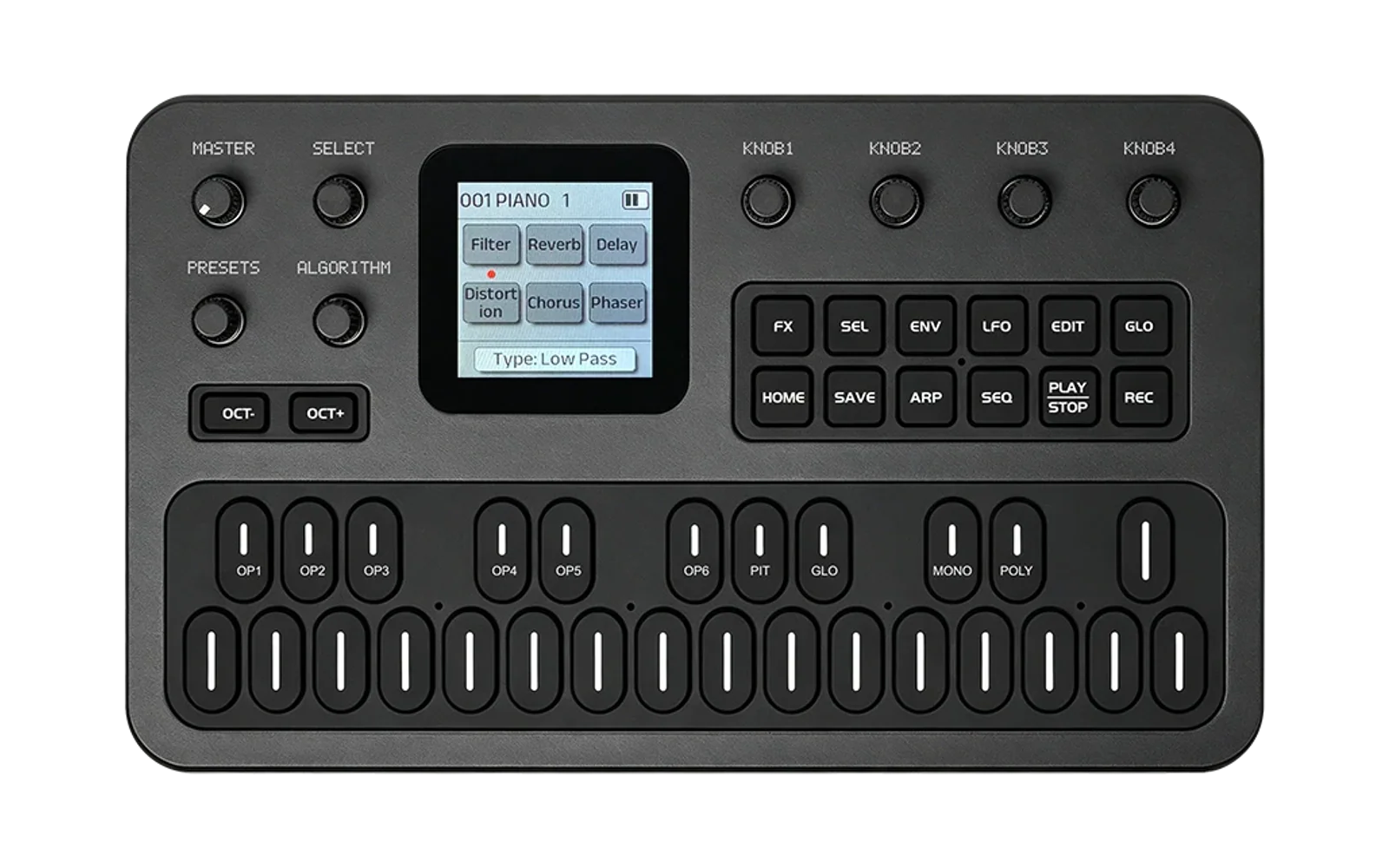
FM1 plays DX7 voices, but its third-party firmware only imports one voice per file — it has no support for banks. What actually circulates online — factory ROMs, cartridge rips, patch collections — is almost always a 32-voice bank dump, which the firmware cannot use as-is:
| DX7 32-voice bank | DX7 single voice | |
|---|---|---|
| Header | F0 43 0n 09 20 00 | F0 43 0n 00 01 1B |
| Payload | 4096 bytes — 128 per voice, packed | 155 bytes, unpacked |
| Total file size | 4104 bytes | 163 bytes |
| FM1 third-party firmware | ❌ cannot import | ✅ imports directly |
The two are not just different sizes: in a bank, each voice is bit-packed into 128 bytes, with several parameters sharing the same byte. A single-voice dump stores one parameter per byte in 155 bytes. So a bank has to be unpacked and re-wrapped in a proper single-voice SysEx message — which is exactly what this tool does, for all 32 voices in one go.
Where to get DX7 patches
Original DX7 patch collections (ROM cartridges and more) can be downloaded here:
https://yamahablackboxes.com/collection/yamaha-dx7-synthesizer/patches/
Grab any .syx bank from that collection, run it through dx7toFM1.py, and you get a
folder of individually named voices.
Requirements
Python 3.8 or newer. Standard library only — no pip install needed.
Quick start
python3 dx7toFM1.py rom1a.syx
rom1a.syx — split: 32 voice(s)
  01  'BRASS   1'    -> BRASS 1.syx
  02  'BRASS   2'    -> BRASS 2.syx
  03  'BRASS   3'    -> BRASS 3.syx
  ...
  32  'TAKE OFF'     -> TAKE OFF.syx

Total: 32 voice(s).
Every file in rom1a_voices/ is a valid 163-byte DX7 single-voice dump that FM1's
third-party firmware can import directly. The filename is the voice name stored inside the bank.
Usage
python3 dx7toFM1.py <bank.syx> [<bank2.syx> ...] [options]
| Option | Description |
|---|---|
-o, --out DIR | Output directory (default: <input>_voices) |
-n, --numbered | Prefix filenames with a two-digit index: 01_BRASS 1.syx |
-p, --prefix STR | Add a fixed prefix to every filename |
-u, --underscore | Turn spaces in voice names into _: BRASS_1.syx |
-l, --list | Only list the voice names, write no files |
-q, --quiet | Do not print the per-voice listing |
--selftest | Run the pack/unpack round-trip self-test and exit |
Examples:
# default: ./rom1a_voices/BRASS 1.syx ...
python3 dx7toFM1.py rom1a.syx

# numbered + underscore names into a chosen folder
python3 dx7toFM1.py rom1a.syx -o voices -n -u

# batch-convert a whole folder of banks (each gets its own subfolder)
python3 dx7toFM1.py *.syx -o voices

# just look at what is inside a bank
python3 dx7toFM1.py rom1a.syx --list
Output
Each written file is byte-for-byte a standard DX7 single-voice dump:
F0 43 0n 00 01 1B | 155 bytes of unpacked voice data | checksum | F7
- The checksum is the standard Yamaha 7-bit checksum,
(-sum) & 0x7F. - The device/channel number
0nis copied from the source bank. - The voice name is taken from the 10 name characters stored in the bank.
File naming rules:
- Trailing padding spaces are trimmed (
BRASS 1→BRASS 1), inner spaces are kept. - Characters that are illegal in filenames (
/ \ : * ? " < > |) become_. - Duplicate names are de-duplicated with a suffix:
BRASS 1.syx,BRASS 1-2.syx, …. - A voice with a blank name falls back to
voice_01,voice_02, ….
How it works
Bank message (4104 bytes):
F0 43 0n 09 20 00 | 4096 bytes | checksum | F7
                     32 voices × 128 bytes, packed
Packed voice (128 bytes) — 6 operators × 17 bytes, then globals, then the name:
| Bytes | Contents |
|---|---|
| 0–16 | OP6 (operator 6) |
| 17–33 | OP5 |
| 34–50 | OP4 |
| 51–67 | OP3 |
| 68–84 | OP2 |
| 85–101 | OP1 |
| 102–109 | Pitch EG rates 1–4, levels 1–4 |
| 110 | Algorithm (0–31) |
| 111 | bit 3 osc key sync, bits 2–0 feedback |
| 112–115 | LFO speed, delay, pitch mod depth, amp mod depth |
| 116 | bits 6–4 pitch mod sens, 3–1 LFO wave, 0 LFO sync |
| 117 | Transpose (0–48, 24 = centre) |
| 118–127 | Voice name, 10 ASCII characters |
Packed operator (17 bytes) — the crowded one, bit fields sharing a byte:
| Byte | Contents |
|---|---|
| 0–3 | EG rates 1–4 (0–99) |
| 4–7 | EG levels 1–4 (0–99) |
| 8 | Keyboard level scaling break point |
| 9 | Left depth |
| 10 | Right depth |
| 11 | bits 3–2 right curve, bits 1–0 left curve (0–3) |
| 12 | bits 6–3 detune (0–14), bits 2–0 rate scaling (0–7) |
| 13 | bits 4–2 key velocity sens (0–7), bits 1–0 amp mod sens (0–3) |
| 14 | Operator output level (0–99) |
| 15 | bits 5–1 frequency coarse (0–31), bit 0 oscillator mode |
| 16 | Frequency fine (0–99) |
Unpacked single voice (155 bytes) — one value per byte:
| Bytes | Contents |
|---|---|
| 0–20, 21–41, …, 105–125 | OP6 … OP1, 21 bytes each |
| 126–133 | Pitch EG rates 1–4, levels 1–4 |
| 134 | Algorithm |
| 135 | Feedback |
| 136 | Oscillator key sync |
| 137–140 | LFO speed, delay, pitch mod depth, amp mod depth |
| 141 | LFO sync |
| 142 | LFO waveform |
| 143 | Pitch mod sensitivity |
| 144 | Transpose |
| 145–154 | Voice name |
The tool implements both directions (unpack_voice() / pack_voice()) and uses the
inverse function as a self-check.
Verification
- All 32 voices of
rom1a.syx:pack(unpack(voice))reproduces the original 128 bytes byte-for-byte — no bits dropped or misplaced. - Feeding
tine-ep.syx(a known good single-voice dump) through the tool produces a file that is byte-identical to the original, checksum included. - Voice names recovered from
rom1a.syxmatch the official ROM1A voice list. python3 dx7toFM1.py --selftestruns 2000 randomised pack/unpack round-trips.
Notes and limitations
- One-way only: it splits banks into single voices; it does not merge single voices back into a 32-voice bank.
- Input that is already a single voice is handled too — it gets re-wrapped and renamed rather than duplicated.
- A file containing several banks back to back is split completely.
- Damaged checksums are reported as warnings rather than aborting the conversion.