TouchVink
A feedback instrument for the Synthux Simple Touch, after the self-regulating tape/ring-mod/reverb patches of Jaap Vink (Institute of Sonology). One knob, one function.
A delayed copy of the output is ring-modulated, reverberated and passed through a VCA that is turned down by the loop's own loudness. That compressor lets the loop run above unity gain without blowing up, so it keeps moving by itself. Pads excite the loop, set the oscillator pitch, pick a distortion, or let the loop "steer" its own oscillator.
Status: v0.2 — compiles for the Daisy Seed, DSP tested on desktop, not yet tested on hardware. See
docs/PLAN.md.
Interactive manual: jonwaterschoot.github.io/TouchVink — the panel drawn live in the browser, with the screen and a manual entry for every control. It plays on its own, or mirrors and plays the device over USB MIDI (Chrome/Edge). Source in webmanual/.
Firmware: download the .bin from Releases and flash it at flash.daisy.audio (Seed in DFU mode: hold BOOT, tap RESET), or build it yourself below.
Signal flow
flowchart LR
    EXT["EXT IN (stereo)<br/>S31 level"] --> MIX
    OSC["OSC<br/>SW1 lfo/steady/drunk"] --> BAL["S30 osc ↔ noise"]
    NOISE["NOISE<br/>SW2 pink/drift/brown"] --> BAL
    BAL --> AD["AD env<br/>P10 att / P11 dec"] --> MIX["S36 source mix"]
    BAL -. carrier .-> RING
    EXT -. carrier .-> RING
    MIX -- excitation --> RING
    DEL["REC loop delay<br/>S35"] --> RING["AC-MUP ring / add<br/>S32"]
    RING --> REV["REV<br/>S33"] --> VCA["V-AMM VCA"]
    VCA --> DIST["DIST<br/>pads, pressure"] --> OUT["OUT<br/>S37"]
    DIST --> ENV["AMD env follower"] -- inverted --> VCA
    DIST -- "× S34 loop gain" --> DEL
    ENV -- "swell (P1 steer)" --> SAH["T-SAH"] --> OSC
Controls
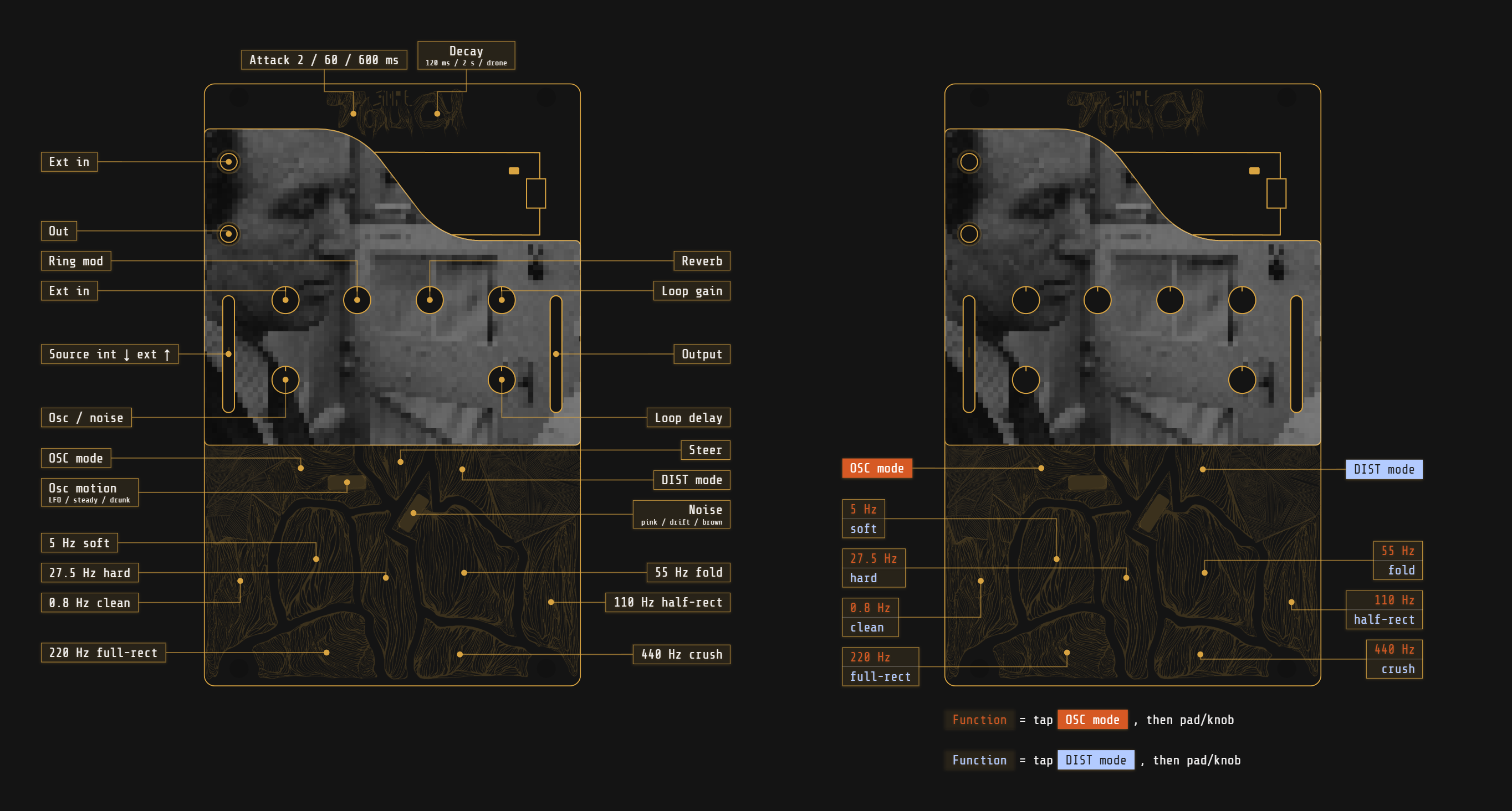
The labels come from simple-touch-labels.json, made with Simple Touch labels; the library shows them in this look and can play TouchVink in the browser.
| S30 | Internal source: osc ↔ noise |
| S31 | External input level (0 → +12 dB) |
| S32 | Ring modulation: loop straight ↔ loop × carrier |
| S33 | Reverb |
| S34 | VCA / loop gain — above ~60 % the loop sustains itself |
| S35 | Loop delay, 2 ms (pitched comb) → 1.9 s (tape echo) |
| S36 fader | Source: internal (bottom) ↔ external (top) |
| S37 fader | Output level |
| SW1 | Osc motion: LFO sweep / steady / drunk walk (pitch and sine↔saw shape) |
| SW2 | Noise: pink / pink↔brown drift / brown |
| P0 | Pads → OSC mode (LED 1 blink) |
| P2 | Pads → DIST mode (LED 2 blinks) |
| P1 | Steering (loop swells re-pick the osc pitch): tap = on/off, hold = momentary. Not a note latch. |
| P3–P9 | OSC mode: pick pitch (0.8, 5, 27.5, 55, 110, 220, 440 Hz) + excite; pressure bends up to +1 oct |
| DIST mode: clean, soft, hard, fold, half-rect, full-rect (octave), crush; pressure = drive | |
| P10 | Attack step: 2 ms / 60 ms / 600 ms |
| P11 | Decay step, tap: 120 ms → 2 s → drone. Hold 0.5 s: back to 120 ms. Drone holds the excitation and freezes pad pressure at its peak |
| P10 + P11 1 s | Recalibrate pads |
Screen, MIDI, web manual
OLED (optional). A 128×32 SSD1306 on I2C at D11/D12 (the pads' bus, address 0x3C), as on TouchPlaited. It plays the TouchVink boot animation, names whatever you touch with its value in real units (dB, ms, Hz, loop gain), draws a bar for the P10+P11 and long-P11 holds, shows a pickup track when MIDI holds a knob, and otherwise shows the pad mode, A/D steps and the pitch or distortion in play. Without a screen fitted nothing changes.
USB MIDI, both ways:
| In | Out | |
|---|---|---|
| ch 1 notes | Osc pitch (the note is the pitch) + excite | |
| ch 10 notes 36–47 | Pads P0–P11, as if touched; poly aftertouch = pressure | Pad touches, with poly aftertouch |
| CC 20–27 | S30–S37; the pot takes over again once turned through the value | Pot moves |
| CC 28–34 | SW1, SW2, pad mode, attack, decay, steer, distortion | Changes made on the panel |
The device also streams its state as SysEx, which the web manual reads. Full map: webmanual/README.md.
Build
To flash a release, you don't need any of this: see Firmware at the top.
git clone --recurse-submodules <this repo>
make libs      # once
make           # build/TouchVink.bin
make program-dfu
make NO_USB_MIDI=1 gives the USB port to serial logging instead. TRS MIDI (D13/D14, modded boards) is opt-in with make TRS_MIDI=1; see midi/midi_io.h for why.
For a release, make release VERSION=0.3.0 writes build/touchvink-v0.3.0.bin. Upload that file, so release assets keep a lowercase, versioned name.
Uses the Synthux fork of libDaisy and DaisySP (with DaisySP-LGPL for the reverb), as submodules.
Listen without hardware
make -C host && ./host/render # run from the repo root, writes host/out/*.wav
Layout
TouchVink.cpp        main: audio callback, pad/knob/switch logic, LED
common/config.h      every tunable number
dsp/engine.*         the Vink loop (portable, no libDaisy)
dsp/blocks.h         small DSP blocks: noise colours, env follower, AD, delay, distortion
hw/simple_touch.*    knobs, switches, MPR121 pads with pressure + velocity (+ MIDI touches)
midi/                USB (and optional TRS) MIDI I/O, SysEx telemetry for the web manual
display/             OLED: screen driver, UI, boot animation
webmanual/           interactive web manual (Vite + TypeScript), deployed to GitHub Pages
host/                desktop renderer for listening tests
docs/SKETCHES.md     notebook sketches translated, with every interpretation marked
docs/PLAN.md         bring-up checklist, tuning, filter options, roadmap
To-Do / Roadmap
In no particular order
- midi controls
- oled screen info
- interactive webmanual
Credits
- Jaap Vink — the original patch and technique
- AudreyTouch (Nick Donaldson / Infrasonic, Synthux Academy) — Simple Touch feedback-synth structure
- TouchString (vincentltm) — MPR121 pressure-sensing approach
- TouchPlaited — MIDI I/O, SysEx telemetry, OLED driver and boot screen, and the visualizer the web manual is built from
- libDaisy (Synthux fork), DaisySP
Licence
The TouchVink code is released under the MIT License.
It builds on:
- libDaisy (Synthux fork) and DaisySP: MIT License.
- DaisySP-LGPL for the reverb (
ReverbSc,USE_DAISYSP_LGPL = 1in the Makefile): LGPL-2.1. The firmware (.bin) and the browser build (.wasm) contain it, so for that part those builds fall under the LGPL. Its source comes with the DaisySP submodule, and this repository has everything needed to rebuild them with a changed version of it (see Build).
Not covered by the MIT License:
- The Simple Touch panel drawing, © Roey Tsemah / Synthux Academy:
img/simpletouchdrawing_blank.svg,webmanual/assets/panel.svg(made from it) and the images that show it (docs/touchvink-controls.png,img/screenshotcontrols_TouchVink.png). - The faceplate,
img/faceplate.jpg: a heavily pixelated photo of Jaap Vink, found at France Musique and in many other places; the photographer is unknown. It is credited here as a tribute and will be removed on request.