TONIC
A Digitone-style FM groovebox firmware for the M-VAVE FM-1
Four-operator FM, virtual analog and a synthesized drum kit, with a 64-step sequencer, parameter locks and twelve
voices, on the FM-1's own keys, knobs and screen.
▶ Try it in your browser · Install · Manual · Releases



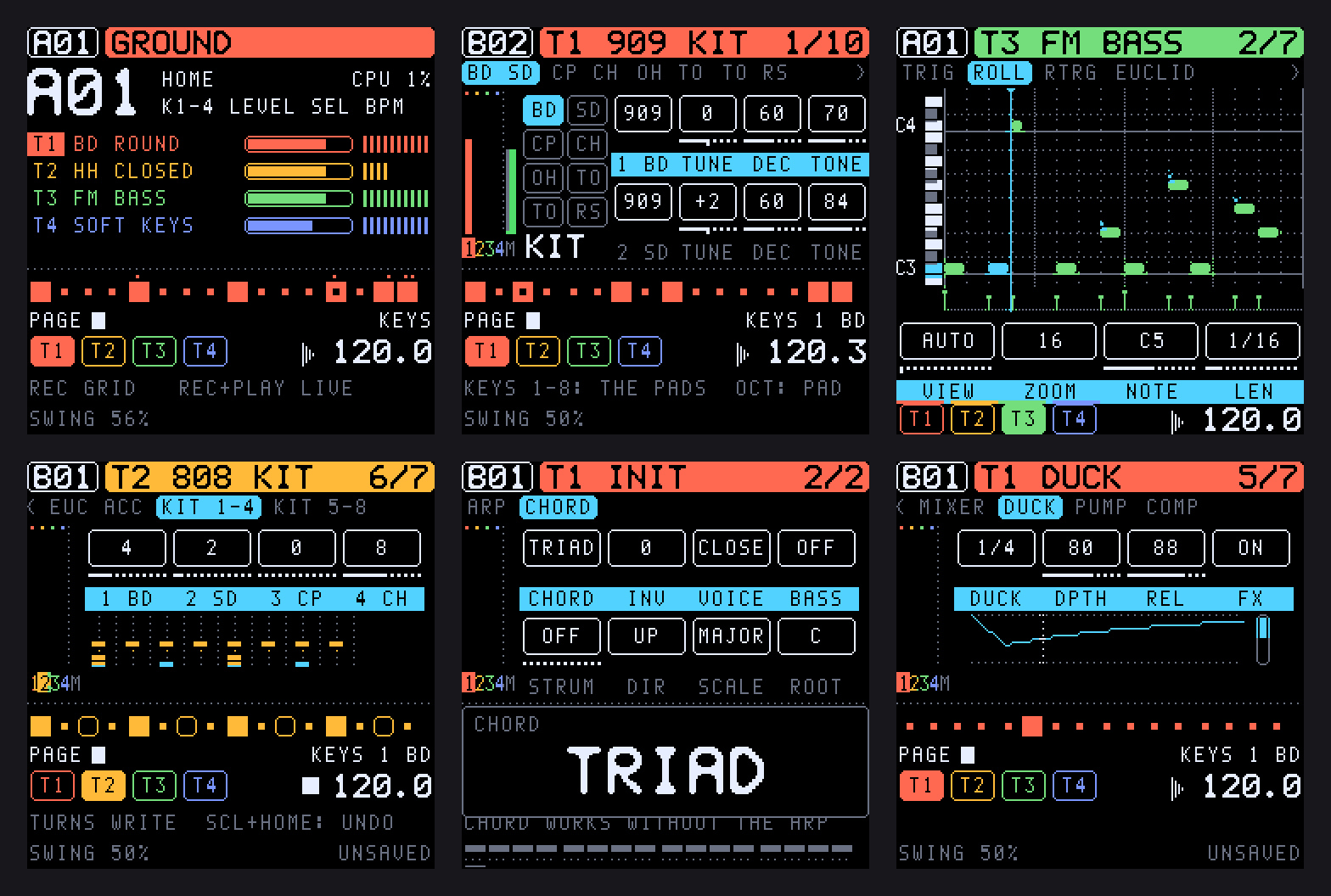
[!NOTE] TONIC runs on the M-VAVE FM-1. Each release is also tested in software: engine tests, a host simulator, the browser emulator and an instruction-level FM-1 emulator that executes the real device binary. It is a custom firmware, so install it at your own risk; the installer can put M-VAVE's own firmware back, and docs/INSTALL.md describes the recovery routes.
What it is
TONIC replaces the FM-1's firmware with a four-track groovebox modelled on the original Elektron Digitone (2018). Its parameters, curves and sequencer follow the Digitone closely, and it adds a good deal of its own. It runs entirely on the FM-1: the 16 white keys are the trig keys, and the 240 × 240 screen shows every page. Projects are saved to the FM-1's flash.
Sound
- Three engines, chosen per sound:
- FM: four operators, the Digitone's eight algorithms, HARM, operator envelopes, feedback.
- Virtual analog: two oscillators with sync, cross-modulation, sub, noise, drift, a wavefolder and ring modulation.
- DRUM: a kit of eight synthesized drums on one track, from 31 models (808/909 kicks, snares, hats, claps, toms, cymbals, FM hats …). Each pad has its own tune, decay, tone, level and pan, plus two controls named by its model (BEND / TICK, SNAP / BODY, NOIS / RESO …).
- Twelve voices, shared by the four tracks, with unison, reserved voices and four voice-stealing modes.
- Per voice:
- overdrive, LO-FI (sample-rate and bit reduction), base-width and multimode filters (LP2, HP2, LP4);
- an insert effect after the filter: overdrive, hard clip, fuzz, rectifier, wavefolder or bitcrusher;
- two LFOs and a modulation envelope, each routable to 80+ destinations;
- velocity, mod wheel, aftertouch, breath and pitch bend routings.
- Effects: chorus, delay (ping-pong) and reverb sends, a master compressor, a DJ filter, and sidechain ducking from a track, a single drum pad or the tempo itself (4/4 volume shaping).
Sequencing
- 4 tracks × 64 steps, each with its own length and speed (polymeters, 3/4×, 2×).
- Parameter locks and sound locks on every step, trig conditions (1:2, FILL, PRE, NEI …), micro timing, retrig and ratchets.
- Live recording, step recording and grid recording, a piano roll, undo, copy and paste.
- Chords on every note, with or without the arpeggiator: 22 named chords, inversions, voicings, bass and strum. Or give a sound a scale: every note snaps to it, and chords follow the scale's degrees (TRIAD, 7TH+, SUS4 …).
- An arpeggiator with six modes (TRUE, UP, DOWN, CYCLE, RANDOM, CHORD), 16 steps and their offsets.
- A euclidean generator: hits, rotation, accents, ghost notes, named rhythms (tresillo, son clave, bossa …), melodies, and every kit pad on one page.
- Chains, song mode (32 rows) and a performance layer: mutes, fills, tap tempo, loop rolls, tape stop, filter sweeps, freeze.
- MIDI: USB in and out, TRS in, MIDI clock, and MIDI tracks for external instruments.
Try it without an FM-1
The browser emulator runs the same code the FM-1 runs, with sound, the whole panel on screen and Web MIDI. It is the quickest way to see whether TONIC is for you.
Install
You need an M-VAVE FM-1, a USB data cable, and Chrome or Edge (or Python 3 for the command line).
- Back up first (recommended). A full flash dump keeps your stock patches; see docs/INSTALL.md.
- Install. Use the web installer (connect the FM-1, press
Install), or the command line:
git clone --recursive https://github.com/RahelPuest/tonic-fm1.git && cd tonic-fm1 pip3 install mido python-rtmidi python3 base/tools/fm1_install.py release/tonic-0.12.1.fwsc - Going back to the stock firmware: the web installer's back to stock button, or
python3 base/tools/fm1_install.py FM-1_015.fwscwith M-VAVE's V15 package.
TONIC comes with 76 factory sounds; on its first start it writes a demo project (four patterns and a sound pool).
[!NOTE] 0.12 saves in a new format. It reads every older project, but older versions cannot read what 0.12 has saved. If you may want to go back, take a USB backup first:
python3 base/tools/fm1_backup.py backup FILE.
Every release since 0.1 stays in release/, with checksums in
release/SHA256SUMS.
Documentation
| Document | |
|---|---|
| Manual | every page, parameter and shortcut, with screens (also on the site) |
| User guide | the short version: controls, pages, recording, saving, MIDI |
| Install | installing, updating, backups, going back to the stock firmware, recovery |
| Features | the Digitone's features one by one, and what TONIC adds |
| Validation | what was tested, how, and what remains uncertain |
| Test environment | running TONIC without an FM-1 |
| Building | building the firmware, the simulator and the emulator |
| Design | how it is built: control map, engine, memory, storage |
| Research | what was learned from the Digitone and how |
Building
git clone --recursive https://github.com/RahelPuest/tonic-fm1.git
cd tonic-fm1/tonic
python3 ../base/tools/build.py . --host     # the host simulator (no toolchain needed)
python3 ../base/tools/build.py . --web      # the browser emulator (Emscripten)
python3 ../base/tools/build.py .            # the firmware (JieLi toolchain: base/tools/get_toolchain.sh)
The details, the toolchain, the AC79 SDK files the package needs and the tests are in docs/BUILDING.md.
Repository layout
| Path | |
|---|---|
tonic/ | the app: engine/ (synthesis, effects, sequencer), core/ (parameters, patterns, tables), app/ (interface, storage, MIDI), tests/, docs/ (the manual) |
base/ | fm1-base (submodule; this repository uses a fork with one extra RAM section): platform layer, build tools, simulator, emulator, installer |
docs/ | the documents above |
release/ | every released firmware, SHA256SUMS, and site/ (the installer, emulator and manual served on GitHub Pages) |
Credits and licence
TONIC is MPL-2.0 (LICENSE, details in LICENSING.md). It is built on fm1-base by Charles Vestal and felucca-bsp by Leo Kuroshita (Hügelton Instruments), and was tested with fm1-emu by Joakim Eriksson.
TONIC is an independent work inspired by the Elektron Digitone. It is not affiliated with or endorsed by Elektron or M-VAVE, and it contains no Elektron code or data. Digitone is a trademark of Elektron Music Machines; M-VAVE and FM-1 are trademarks of their owners.