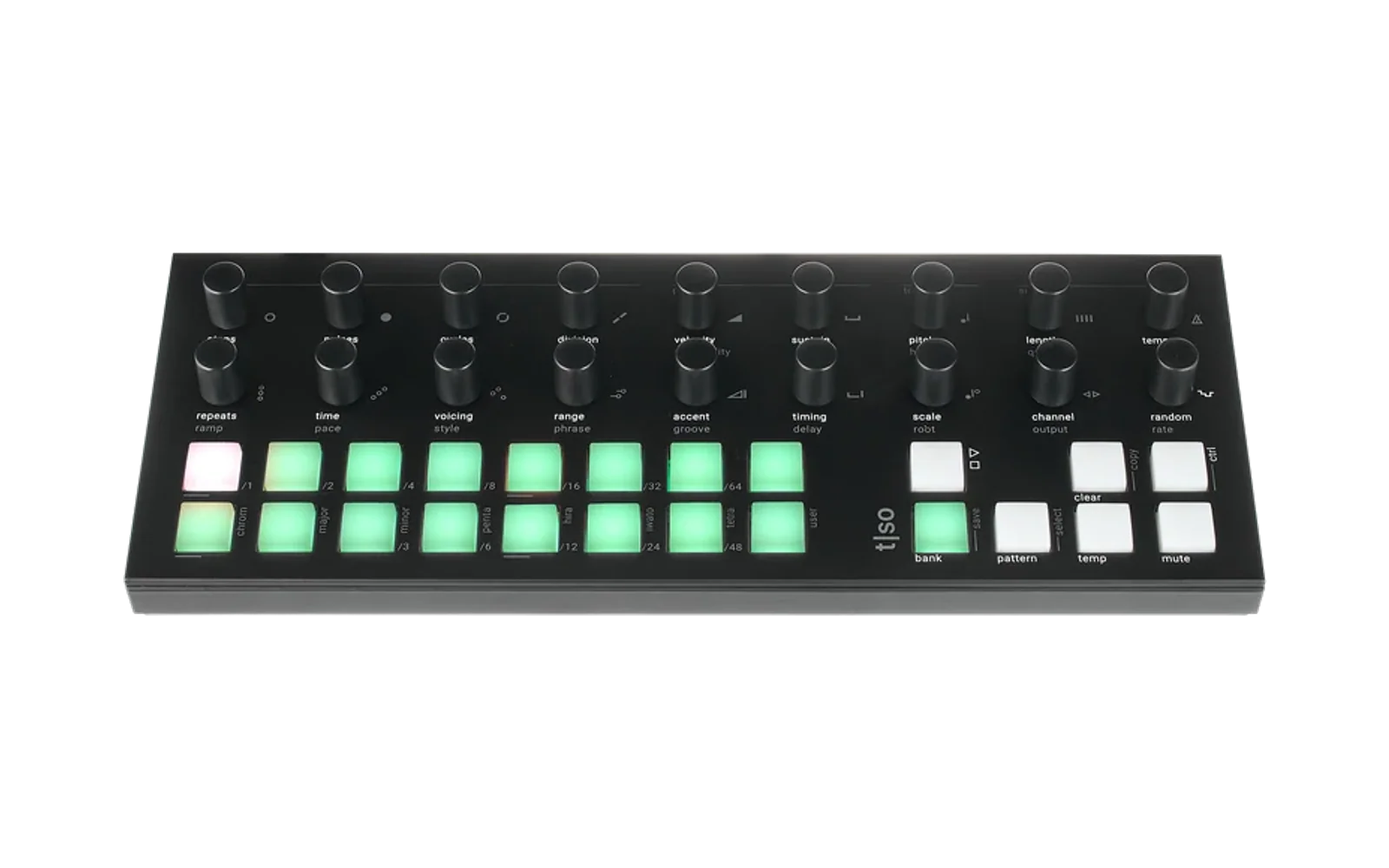
Torso T-1 backup format (.t1) ⇄ MIDI
Reverse-engineering the Torso Electronics T-1 sequencer's backup format so patterns can be exported to and imported from standard MIDI files — and so a bank can be rebuilt from scratch and loaded back onto the hardware.
The format is fully worked out for the musically meaningful fields: every archived device backup in this repo rebuilds byte-for-byte, and synthesized banks (chords, cycles, split drum kits) have been loaded and verified on real T-1 hardware.
Built with Claude Code
This project — the reverse engineering, the byte-map, the tooling, and this documentation — was produced through heavy use of Claude Code (Anthropic). The workflow was collaborative: the hardware owner captured device backups on request (targeted parameter sweeps), and Claude Code diffed them, located the fields, wrote the codecs, and drove the round-trip and on-device verification. It is genuinely an AI-assisted RE effort, not a hand-written library, and the commit history reflects that.
What this is
The T-1 has no documented save format. Its backup is a ZIP whose banks are opaque binary blobs. This repo decodes that blob into a clean data model and back again:
 .t1 bank  ──▶  t1_format.py  ──▶  { patterns: [ [track, …], … ] }   (parse / decode)
    ▲                                          │
    │                                          ▼
 midi_to_t1.py  ◀── .mid files          t1_to_midi.py ──▶ .mid files  (import / export)
    │                                          ▲
    └────────── rebuilds a device-loadable backup zip ──────────────┘
What's decoded (see FORMAT.md for the full byte-map):
- Container layout — bank header, sparse 803-byte track blocks, pattern gaps, trailer, and the two ZIP shapes the device restores (full 8-bank backup / fresh single-bank file).
- Per-step gates, absolute pitch (incl. chords via multi-note pitch locks), velocity and sustain (with the device's real value scales), per-step locks (pitch/velocity/length).
- Track routing (MIDI channel/mask), root, scale, division/timing.
- Cycles — up to 16 per track, with per-cycle pitch/param/step-sequence overrides.
- Steps up to 64, sparse track positions (fixed slots with gaps), and the drum-kit layout.
- Backup-1 parameters — Tempo, per-track Length, Probability, Timing (swing) + subdivision, Delay, Quantize, and the free/fixed-division flag.
The format has no checksum (proven by successful on-device import), which is what makes faithful rebuilding possible.
Repository layout
| Path | What it is |
|---|---|
FORMAT.md | The byte-map — read this to understand the format. Container, lock terminators, cursor/summary, stored-state region, cycles, track positions, backup-1 fields. |
t1_format.py | Parser (parse_bank(path) → data model). |
t1_to_midi.py | Exporter — .t1 → one .mid per pattern. |
midi_to_t1.py | Importer — .mid → a device-loadable .t1 / backup zip. |
t1_cycles.py | Decoder/printer for the steps-to-64 + cycles feature. |
test_roundtrip.py | Self-test: rebuilds every archived bank byte-for-byte. |
t1_annotate.py, t1_blockdiff.py | RE helpers (byte diff / monotonic-sweep field finder). |
make_*.py | One-off builders that synthesize hardware-verification banks/MIDI. |
samples/ | Archived device backups — the experimental record. Each folder decoded part of the format; see samples/README.md. |
hwtest/ | Hardware-verification working set, incl. fromT1/ device-authored ground-truth files. |
decode/ | The "complete decode" campaign — extra tooling, notes, and sweep samples pushing byte coverage toward 100%. |
CLAUDE.md | Project status + working notes (also the guide the AI assistant follows). |
Requirements
Python 3, no third-party dependencies. (MIDI reading/writing and ZIP handling use the standard library only.) A real T-1 is only needed if you want to load results onto hardware.
Usage
Inspect a bank
python3 t1_format.py samples/09_perstep_polyphony/bank.t1
Prints the decoded tracks, per-step locks, cycles, and each track's slot position.
Export .t1 → MIDI
python3 t1_to_midi.py FILE.t1 -o OUTDIR [--bpm 120]
Writes one Type-1 .mid per non-empty pattern at 96 PPQN (the device's resolution). Without
--bpm it uses the bank's stored tempo. Exports gates, per-track division/timing, track pitch +
chords, per-step pitch/velocity/sustain locks, multi-channel routing, root and scale.
Import MIDI → .t1
python3 midi_to_t1.py -o OUT.t1 IN1.mid [IN2.mid …] [options]
Each .mid becomes one pattern; each MIDI channel (or SMF track, with --split-tracks) becomes one
track. Chords and pitch changes become pitch locks; per-step velocity / note-length become
groove locks. Notes are quantized to the step grid (max 16 patterns × 16 tracks).
Common options:
| Option | Effect |
|---|---|
--div N | Grid/playback division (default 16). |
--length N | Loop length in steps, 1–16 (single-cycle mode). |
--split-tracks | Map each SMF track (not each channel) to a T-1 track. |
--drum-split | Explode a drum part into one T-1 track per GM sound on fixed slots (kick=16, snare=15, hats=14/13, clap=12, …). |
--cycles auto|bars|off | Cycle handling. auto (default): a voice spanning >1 window becomes cycles; bars: always map each --steps-window k → cycle k; off: single cycle. |
--steps N | Steps per cycle/track, 1–64 (default 16). |
--tempo BPM | Bank tempo (default 120). |
--track-length, --timing, --delay | Per-track Length / swing / shift (backup-1 fields). |
--zip BACKUP.zip --slot N | Emit OUT.zip by splicing the bank into a real backup (non-destructive). |
--new-backup --slot N | Emit OUT.zip as a fresh single-bank backup (only that bank is touched on restore). |
Two placement helpers: --by-filename derives placement from names like pattern1_track2.mid, and
--plan FILE.json gives an explicit per-pattern/per-track table (the most general form).
Cycles view
python3 t1_cycles.py FILE.t1
Prints per-track cycle count, step-group page, per-cycle track-pitch overrides, and per-cycle step-sequence records (gate + per-step locks).
Loading results onto the T-1
The device restores a backup ZIP via its Backup menu. Two shapes work (both emitted by the importer — no manual zipping):
- Fresh single-bank file (
--new-backup --slot N) — restoring it overwrites only that one bank and leaves the other 7 intact. This is the truly non-destructive path. - Spliced full backup (
--zip REAL_BACKUP.zip --slot N) — replaces one slot inside a real backup you exported; the other banks and settings stay byte-identical.
Every entry must be ZIP_STORED (uncompressed) with the exact ./-prefixed layout the device
expects; the tooling handles this. See CLAUDE.md / FORMAT.md for the exact recipe and rules.
⚠️ Back up your device first. These are unofficial, reverse-engineered tools. A malformed bank is rejected by the device (and can trigger a bank re-initialization), so always keep a known-good backup and prefer the single-bank path while experimenting.
Verifying
python3 test_roundtrip.py # expect: ALL PASS
Rebuilds every archived sample bank byte-for-byte — run it after any change to the parser or to
block/container synthesis. Beyond this, synthesized banks (chords, velocity/sustain, cycles, and
drum-split kits) have been loaded and confirmed on real T-1 hardware; the working set lives in
hwtest/, with device-authored ground-truth references in hwtest/fromT1/.
Status & scope
The musically meaningful format is decoded and hardware-verified in both directions. Remaining work
is polish and edge decoding — e.g. exact tick units for Timing/Delay, MIDI→scale/root mapping
(currently Chromatic/C so absolute pitch plays), and a few interior bytes of the CC-encoder and
modulation records. See CLAUDE.md and decode/ for the current frontier.
License
MIT © 2026 Sebastian Hasinger.
Torso® and T-1 are trademarks of Torso Electronics. This is an independent, unofficial reverse-engineering project and is not affiliated with or endorsed by Torso Electronics.