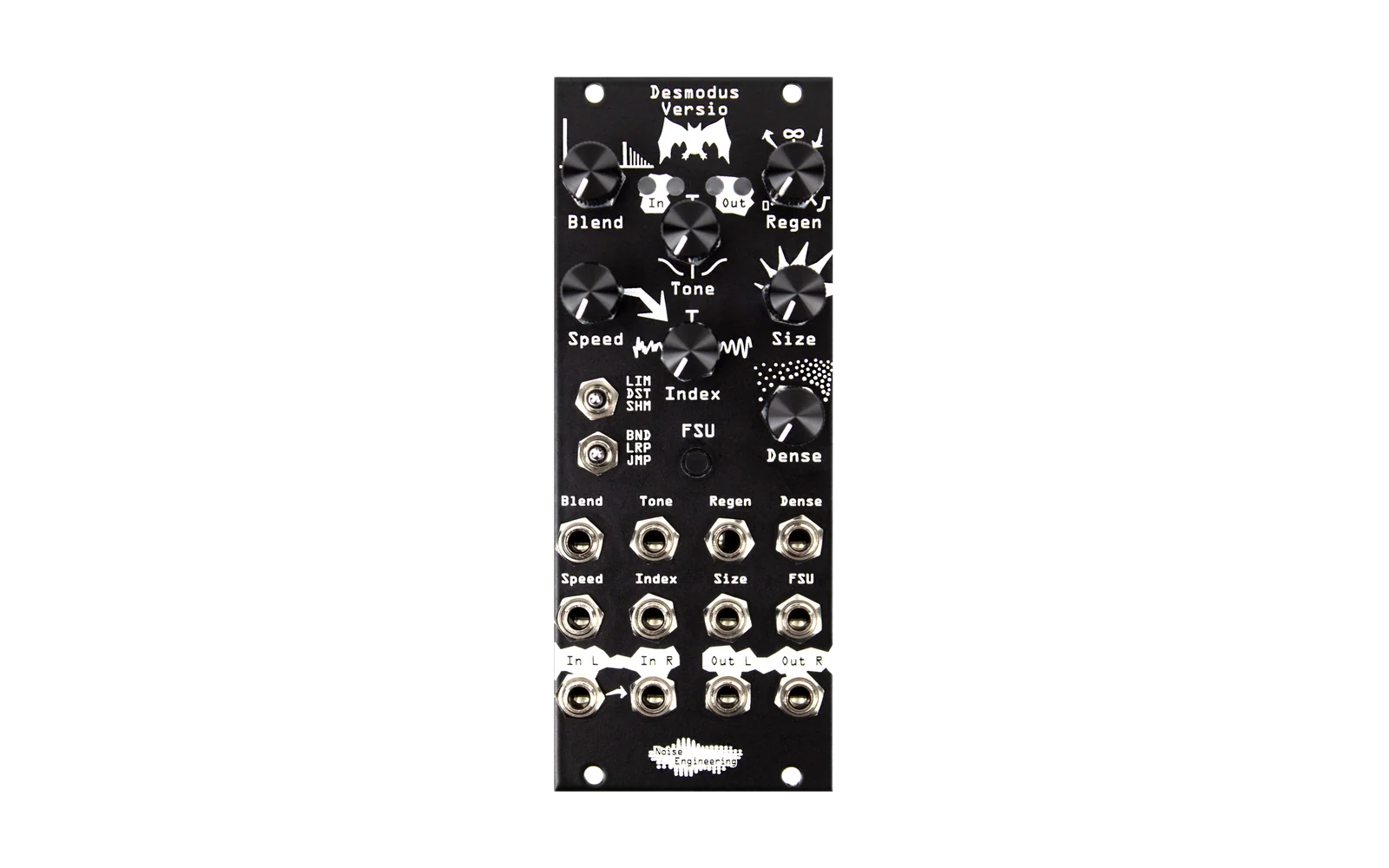
Smack Versio
Live loop capture, sliced and re-ordered, with seeded per-slice glitch. Alternative firmware for the Noise Engineering Versio platform (Daisy Seed).
📖 Operation manual — the panel drawn at true scale from the real hole coordinates, click any control, plus a simulator for the boot-time CPU report.
⬇ Download v0.1.0 — firmware, manual, flashing guide and printable faceplate. Tagged a pre-release, and that is meant literally: see the warning below.
⚠️ This has never run on hardware
It compiles, its memory budget is measured, and everything testable without a module is tested — the clock adapter, the settings layer, the allocator and the DSP engine at 48 kHz all have passing native test suites. But nobody has heard a single sound out of it.
If you flash this, you are performing its first hardware test. Please open an issue and say what happened — especially the boot CPU reading (below). That number is the thing this project most needs.
Not a Noise Engineering product
This is third-party firmware. NE did not write it, did not review it, and cannot support it. Do not contact Noise Engineering about it — if something is wrong, it is wrong here. Installing is fully reversible: flashing any official NE firmware restores the module to stock.
Read DISCLAIMER.md before flashing.
What it does
Audio runs through the module continuously and is always being recorded into a rolling buffer. Press CAPTURE and the last N steps of what you just played become a loop — no arming, no deciding in advance that you wanted it.
That loop is cut into a grid of slices. The slices get re-ordered, and a proportion of them get an effect. Which slices, which effects, and in what order all follow from a single SEED — turn it and you get a different arrangement of the same audio. BLEND crossfades clean against glitched. Everything stays quantised to the rack's clock.
It is a port of Smack, a module for
the Ableton Move: the same C engine, recompiled for seven knobs instead of a
screen and 23 pads. The vendored copy has since picked up three fixes of its
own — see the header of firmware/vendor/smack_core.h before re-vendoring.
Because the Versio has seven knobs and no screen, the Move version's per-slice editing does not come across. What is left is a density-and-seed instrument: you steer the statistics of the mangling rather than editing individual slices.
The boot CPU reading
The one open question is whether the engine fits the CPU budget. You cannot watch a status LED while playing with both hands, so the module measures its own worst-case block load and replays it on the LEDs at the next power-up.
Play hard — FX and ORDER up, short SLICE, long LENGTH — then power-cycle and read the bar across the four LEDs. One LED means it never passed 25%; all four with the last one red means it did not fit.
Building
Needs libDaisy and
arm-none-eabi-gcc.
make -f firmware/Makefile.test          # native tests, no hardware
make -C firmware                        # build the .bin
make -C firmware program-boot           # one-time: Daisy bootloader
make -C firmware program-dfu            # flash
Point LIBDAISY_DIR at your libDaisy checkout if it isn't at
~/tim-os/daisy-sdk/libDaisy.
This is an APP_TYPE = BOOT_SRAM build: the app is ~142 KB and the STM32H750
has only 128 KB of internal flash, so it runs from SRAM via the Daisy
bootloader. That is why the bootloader step exists, and it is reversible.
scripts/make-release.sh assembles a distributable zip.
Layout
| Path | |
|---|---|
MANUAL.md | What the controls do |
firmware/FLASHING.md | Installing, and going back to stock |
DESIGN.md | Why it is built this way — hardware constraints, clock architecture, prior art |
firmware/ | The firmware. vendor/ is the engine, vendored and since diverged |
faceplate/ | Generates a printable panel overlay |
faceplate/MEASURE.md | Correcting the derived panel geometry |
DESIGN.md marks every claim ✅ verified (with a source) or ⚠️ assumed.
That distinction is the most useful thing in the repository — it tells you which
half of the design is real.
Faceplate
Your module's panel says whatever it said before, so faceplate/ generates an
overlay with the right words on it:
python3 faceplate/make_faceplate.py
Print the print sheet at 100% and check the 50 mm ruler on it with a real ruler before cutting — that ruler exists because every way printing goes wrong is invisible except as a ruler that is not 50 mm.
The geometry is derived rather than measured; see
faceplate/MEASURE.md for what is solid (the panel
frame reproduces the Eurorack mounting standard to 0.01 mm), what is not (the
button position), and how to fix it.
Prior art
Two firmwares proved this hardware can do this kind of work, and the design owes a lot to both: WTF! by dubrussell and FRGMNTS Versio by Acidclank.
License
MIT — see LICENSE, which also covers the vendored components and the provenance of the faceplate geometry.