
Grown, not written
Shoal plays melodies you didn't write, but that always sound like you meant them.




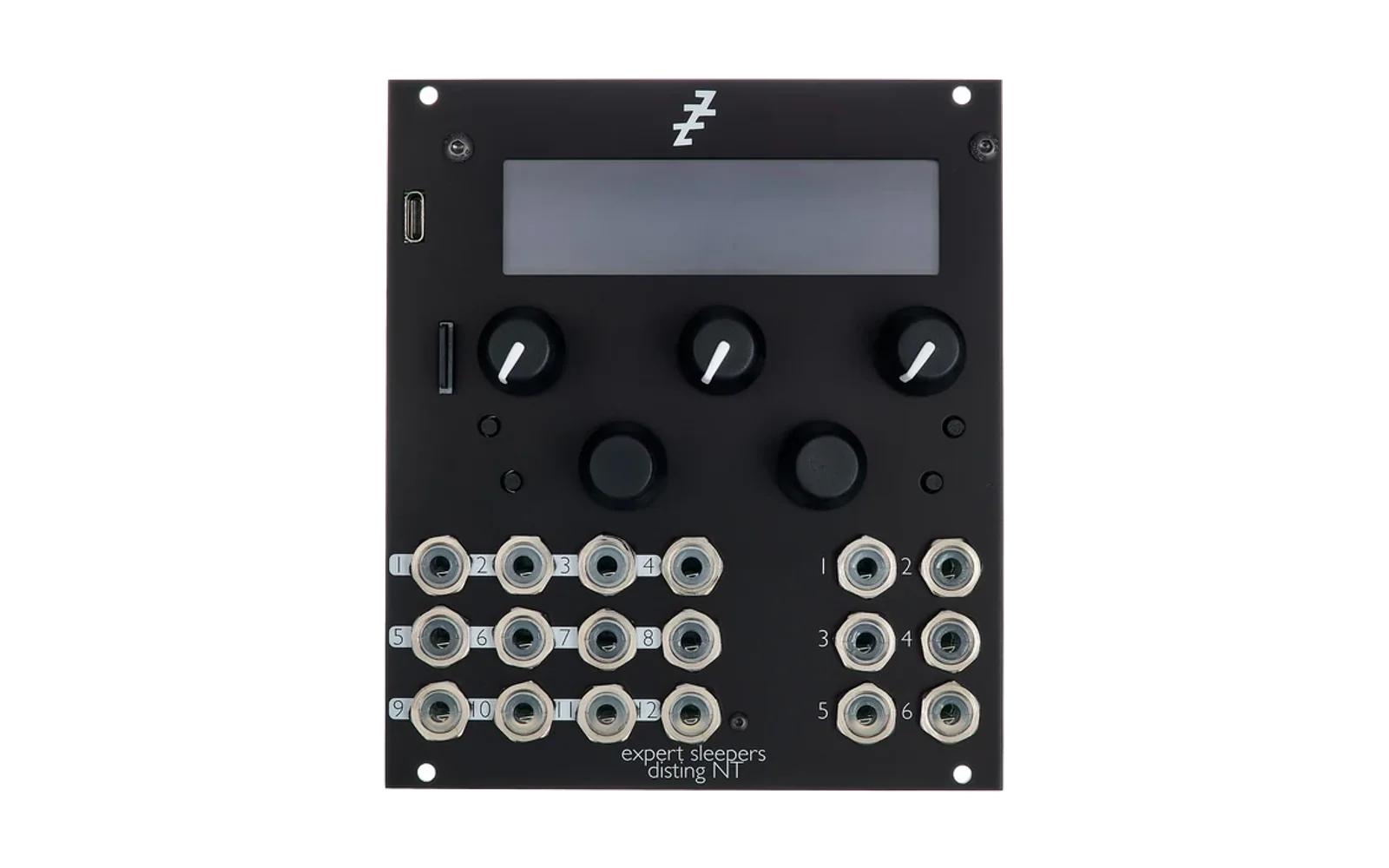
Shoal is an 8-track generative melody sequencer plug-in for the Expert Sleepers disting NT, by Ormer Modular, made in Guernsey.
Each track grows a looping melody from a seed, a number from 0 to 999. The same seed always grows the same melody, so patterns repeat like something you composed, and because the seed is an ordinary parameter your presets recall your exact tunes. Every note is built from a global scale, so nothing is ever out of key.
Patterns are never stored. Every note is worked out the moment it plays, which means nothing you do is destructive. Turn up Note and Oct and the melody strays further from home, more often and further each time; turn them back to zero and the original line returns exactly as it was. You can push a melody as far as you like and always find your way home.
And it moves on its own. Evolve lets a share of steps quietly re-roll themselves on every pass, so at 5% a melody becomes a different melody over ten minutes without your hands on it. Breathe rests whole passes. The fifteen directions change how a pattern is walked rather than what it contains, from plain reverse to tides, shuffles and pools. Weight pulls notes towards consonance when things get too wild. Tracks can follow one another for bass lines and counter-melodies that always agree. And when you want something new entirely you reseed, and the shoal turns.
And it is all shareable: pass on your seed and your settings, and someone on the other side of the world hears exactly what you heard, note for note.
VCV Rack manual · disting NT manual
Installing
Shoal uses disting NT plug-in API v13, introduced in firmware 1.15.0. Use firmware 1.15.0 or newer.
The easiest route is the disting NT Plugin Gallery, via the Plugin Manager in nt_helper. To install by hand instead:
- Download
shoal-plugin.zipfrom the latest release. - Unzip it at the root of the disting NT SD card.
- Restart the module or remount the card so the plug-in folder is scanned, then add Shoal.
The archive installs shoal.o at /programs/plug-ins/ormermodular/shoal.o. No compiler
or development toolchain is required.
On macOS, if the card already has a programs folder, Finder may create a
second folder called programs 2 rather than merging. If that happens, move
shoal.o into the existing programs/plug-ins folder and delete the
leftover.
The algorithm appears in the list as Shoal (guid Shol).
Quick start
- Add the algorithm. It is already ticking: Clock source defaults to Internal at 120 BPM. To sync to your rack instead, set Clock source to External and patch a clock into Input 1, and optionally a reset into Input 2 - or set it to MIDI and clock Shoal from your DAW's transport.
- Give Track 1 outputs. Every output starts as None, so on the Routing 1 page set Gate out to Output 2 and Pitch out to Output 1, then patch to an envelope and an oscillator. Set Scale and Root note on the Global page.
- Reseed until you like it. Tap the right encoder. Each tap grows a new melody, landing at the top of the next loop.
- Add a bass line. On Track 2 set Sample source to Track 1, Octave to -1 or -2, Rate to /2 or /4, and thin it out with Chance.
The manual covers the rest, and there is rather a lot of rest.
Features
- 8 tracks of CV - each with its own 1V/oct pitch output (0V = C3) and gate output, routable to any physical output or aux bus. All outputs default to None, so a track touches no bus until you assign it and you build the shoal one deliberate voice at a time
- Per-track clocks - give any track its own Clock input and it steps on its own pulses, independent of the master clock, so one Shoal can sit in several time worlds at once (None = follow the master, the default)
- Per track - length 1 to 64, clock rate /64 to x64 including the odd ratios (3, 5, 6 and 7, both ways), fifteen playback directions (Forwards, Reverse, Pendulum, Random, Drunk, Pong, Tide, Shuffle, Pools, Stride, Gravity, Converge, Diverge, Skitter, Anchor), pattern Shift (rotate the whole loop; a canon on a follower), Chance, bipolar Note and Oct variation amounts, gate length, tie chance, slop, octave offset, transpose in scale degrees, mute, seed
- Your rack's voltages - per-track gate level (1-10V, default 5V) and pitch CV scale and offset, so low-voltage, vintage and 1.2V/oct gear patch straight in with no external attenuators
- The slow arts - per-track Evolve (steps quietly re-roll themselves each pass) and Breathe (whole passes rest), plus global Freeze (hold the shoal as a chord) and Weight (gravity towards the root, third and fifth)
- Tracks that follow - point one track's Sample source at another and it grows the same material through its own settings, at its own rate and length. Reseed the source and the follower changes with it
- Global scale - chromatic, major, natural and harmonic minor, Dorian, Phrygian, Lydian, Mixolydian, major and minor pentatonic, blues, Hirajoshi, In-Sen, with a root note. Notes are built from scale degrees rather than quantised afterwards, so nothing is ever out of key
- Clocking - internal clock with BPM (the default, so a fresh Shoal runs at 120 out of the box), an external CV clock, or MIDI clock (24 PPQN, with Start/Continue/Stop transport support), with a reset input that realigns every track to step 1
- MIDI note out - per track channel (off by default); velocity and a destination bitmask (Breakout, Select bus, USB, Internal) are global settings shared by every track - Internal routes straight into another algorithm on the same NT, no cabling needed
- Currents - a slow, smooth, seeded 0-10V drift CV per track, "the water the melody swims in" - for filter cutoffs, VCA levels or send amounts. Repeats exactly with the seed, moves at the track's own rate, and a follower generates its own current rather than inheriting its source's
- End-of-sequence - a 5V trigger per track, firing every time it completes a full Length cycle. Counts advances rather than loop origin, so all 15 Direction modes get an evenly-spaced pulse, including Random, Drunk, Pools and Skitter, which have no fixed loop shape of their own
- Clock out - Shoal's master clock as 5V pulses on any bus, in either clock mode, so other algorithms and external gear can ride its grid - and it keeps running through a Freeze (your choice), so synced delays keep their tails while the melody hangs
- Quantised reseeds - a reseed arms and lands when the track wraps to step 1, so new patterns always enter on the grid. Per track, global, and from a dedicated trigger input
- Everything is CV and MIDI mappable - all 241 parameters, through the module's own mapping system. Sequence the Seed for melody switching, breathe Freeze with a slow LFO, CV the Transpose for chord progressions
- The shoal screensaver - leave the controls alone and the display becomes open water: eight fish, one per track, each darting when its track sounds a note. An ambient view of your patch, and kind to the OLED
The performance controls
Buttons 1 to 4 are left to the module's own UI. Shoal claims the pots and encoders:
| Control | Gesture | Action |
|---|---|---|
| Pot L | turn / push | Chance · push toggles home (100%) and your dialled value |
| Pot C | turn / push | Note ±100% (bipolar) · push toggles home (0) and dialled |
| Pot R | turn / push | Oct ±100% (bipolar) · push toggles home (0) and dialled |
| Enc L | turn | select track |
| Enc L | tap / hold | mute · solo |
| Enc L | push and turn | Length |
| Enc R | turn | Rate, /64 to x64 |
| Enc R | tap / hold | reseed track · reseed all |
Pots use soft takeover throughout. The display shows all eight tracks with their patterns, play positions, rates, follow links and mute or solo state, alongside the selected track's detail panel and the live pot assignments.
Parameter pages
- Global - clock source (External / Internal / MIDI), BPM, run, freeze, scale, root note, weight, screensaver, clock and reset inputs, clock out, reseed all, MIDI velocity and destination
- Track 1 to 8 - the per-track controls above
- Routing 1 to 8 - the track's Clock input (None follows the master clock), gate and pitch output busses with add or replace modes (gate listed first), a Current and an EOS out bus (both Replace-only), plus the track's MIDI channel (velocity and destination are global, set once on the Global page)
Every one is a standard NT parameter, so all of them are CV and MIDI mappable and all of them are saved in presets. Changing a track's Seed by any means, including a CV mapping, arms a reseed that lands at that track's next loop start.
Building from source
Prebuilt releases are above, so this is only needed if you want to change
something. You will need the
GNU Arm Embedded Toolchain
(arm-none-eabi-c++) on your PATH.
make api    # clones the distingNT_API headers, once
make        # builds plugins/shoal.o
make check runs a quick syntax check with the host compiler if you do not
have the ARM toolchain installed. make test runs the host tests (parameter
table and pages, clocking, and construction from junk-filled memory),
make verify checks the built object (version stamp, only symbols the NT
exports, no writable statics) and make release packs shoal-plugin.zip.
Repository layout
src/shoal.cpp- the plug-in, a single source filetest/- host tests (no hardware needed)docs/nt/MANUAL.md- the disting NT user manual;docs/vcv/MANUAL.md- the VCV Rack manualMakefile- cross-compiles for the Cortex-M7 witharm-none-eabi-c++
Thanks
Shoal was shaped by a private beta with a small and generous group of testers, whose ideas ended up in the plug-in: the odd clock ratios, the gate-first routing order and a good deal more. Thanks also to Expert Sleepers for the module and the plug-in API, and to Thorinside for the Plugin Gallery and nt_helper.
Licence
MIT. See LICENSE.