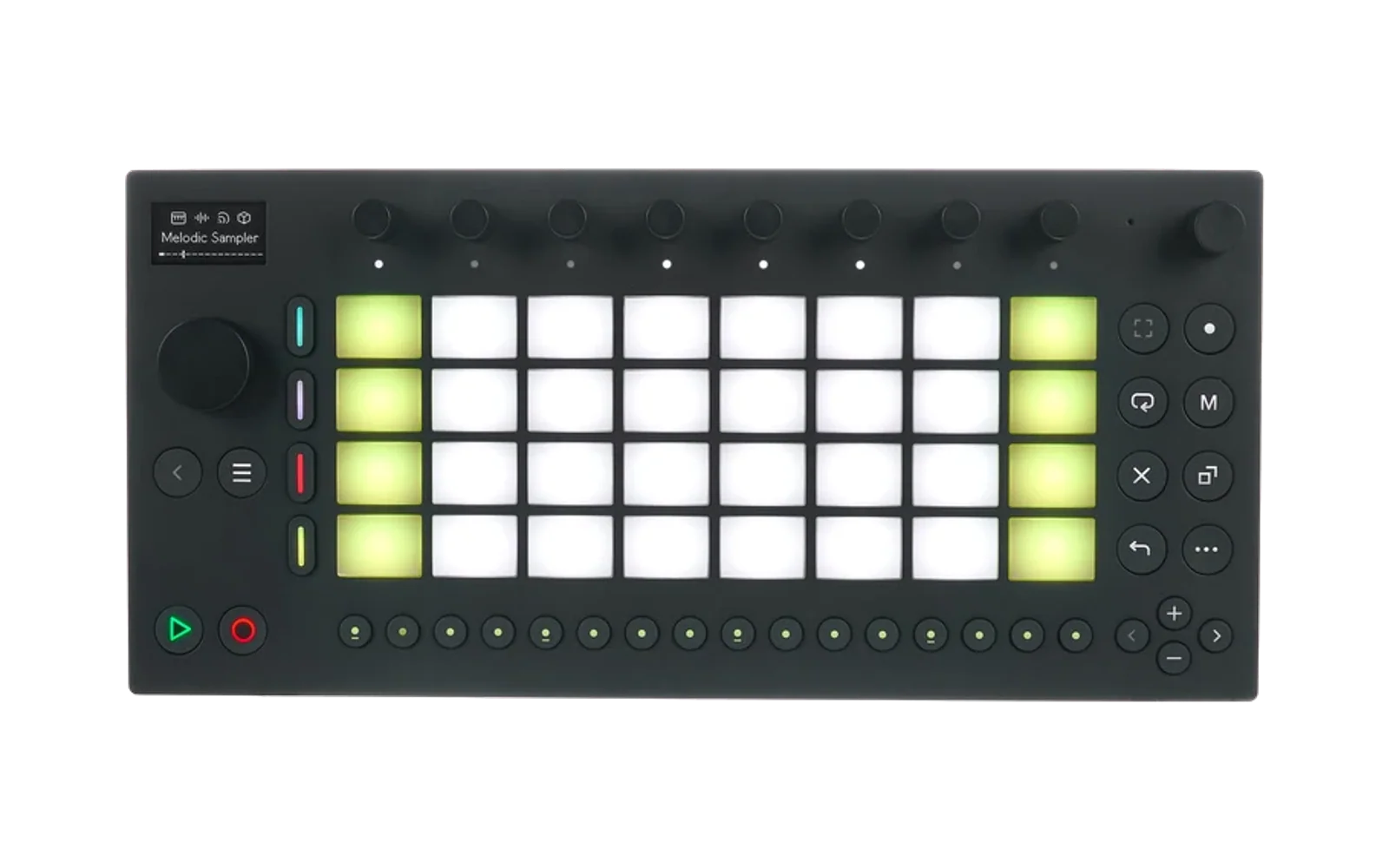
Belt
Live vocal processor for the Ableton Move (a schwung module).
📖 Operation manual: timncox.github.io/schwung-belt
Autotune-style pitch correction, up to four diatonic backing-vocal harmonies, a stereo doubler, and a formant knob — on the Move's own mic, line-in, or USB-C input. Named Belt because it makes you sound like you can.
- Retune 0 = instant hard-tune robot, higher = transparent correction
- Harmony voices 1-4 — scale-aware intervals (3rds, 5ths, octaves…), humanized with per-voice detune and stereo spread
- Doubler — instant thickness, hard-panned corrected doubles
- Formant — deeper or brighter without changing pitch
- HARD pad — momentary or latched T-Pain punch
- Played harmony — hold a chord on the pads, in a clip, or on a keyboard and the four voices sing those exact notes; clip chords keep driving them hands-free while another module owns the surface
- Target mode — the held note becomes the correction target: play the melody, sing approximately, land exactly
- Chord only (LEAD 0) — silence the lead and the dry voice so only the played-harmony voices sound: every note you hold is your own voice re-pitched to it, the Imogen Heap "Hide and Seek" sound (a DigiTech Vocalist on its vocoder setting). Set the harmony intervals Off first so only held notes sing. LEAD is on the Setup page, Shift knob 7 in a chain
- Tuner strip — steps 1-12 show your note (green = in tune); press to set the key
- Flex / Humanize — leave expressive slides alone, keep your vibrato
Two modules
| id | type | where it runs |
|---|---|---|
belt | audio_fx | Signal Chain slots + Master FX (processes whatever is upstream) |
belt-in | sound_generator (audio_in) | standalone slot synth on the hardware input — the live-vocals build |
Both ship the same chain UI and engine. They are built from this canonical repository and published together under one release tag.
Install
In Schwung Manager, search the Module Store for Belt or Belt In. The store resolves both entries from this repository's multi-module release manifest. Schwung's Custom GitHub installer does not yet offer a module picker, so use the dedicated compatibility repository for the form you want:
beltAudio FX:timncox/schwung-belt-fxbelt-inVoice:timncox/schwung-belt-voice
Those compatibility repositories mirror the archives built here; they do not carry separate Belt source.
All source and issue tracking remain in this repository.
Feedback warning: singing into the Move's mic while its speaker is on will howl. Belt In auto-mutes in that state (Monitor pad overrides) — use headphones or line out.
MIDI CC control
Every Belt parameter responds to MIDI CC from a controller plugged into the Move's USB-A port (Launch Control, Faderfox, keyboard knobs — anything that sends CC). The 0–127 CC value scales linearly across each parameter's range.
| CC | param | range | CC | param | range |
|---|---|---|---|---|---|
| 20 | key | C..B | 28 | harm 3 | off..interval |
| 21 | scale | 9 scales | 29 | harm 4 | off..interval |
| 22 | retune | 0–100 | 30 | harm level | 0–100 |
| 23 | amount | 0–100 | 31 | spread | 0–100 |
| 24 | flex | 0–100 | 32 | double | 0–100 |
| 25 | humanize | 0–100 | 33 | formant | -100–100 |
| 26 | harm 1 | off..interval | 34 | wet | 0–100 |
| 27 | harm 2 | off..interval | 35 | hard | ≥64 = on |
| 36 | midi mode | off/harm/target | |||
| 37 | vel sens | 0–100 | |||
| 38 | lead | 0–100 (0 = chord only) |
Channel notes:
beltin a chain or Master FX slot: any MIDI channel works — the host broadcasts external CCs to audio FX regardless of the slot's receive channel.belt-in(sound generator): CCs follow note routing, so set your controller to the same MIDI channel the slot receives on (don't rely on auto channel mapping — it remaps notes, not CCs).
Move's own encoders are internal MIDI and never collide with this map.
Build from source
make test    # native sim tests, no hardware needed
make arm     # Docker cross-compile + module tarballs (see scripts/build.sh)
How it works
One YIN pitch analysis (decimated to 22.05 kHz) drives a shared train of pitch marks; every voice — corrected lead, four harmonies, two doubler streams — is a TD-PSOLA grain stream reading those same marks, so seven voices cost barely more than one. Formant control resamples grain content independently of the pitch ratio. ~26 ms fixed latency, dry path delay-matched. Details in CLAUDE.md.
MIT licensed.