9W9 — Rhythm Composer for Ableton Move
A TR-909 style drum machine for Schwung on Ableton Move. Circuit-modelled kick, snare, toms, rim shot and hand clap; sampled hi-hats, ride and crash — the same split the real TR-909 used.
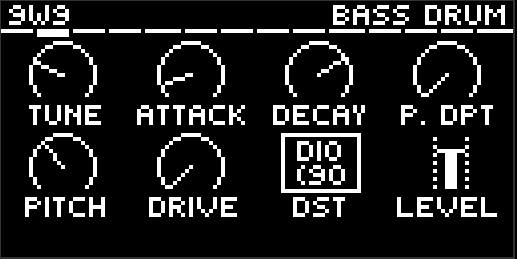
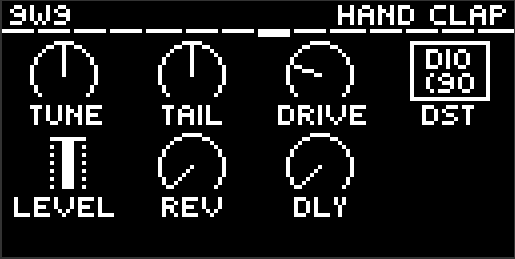
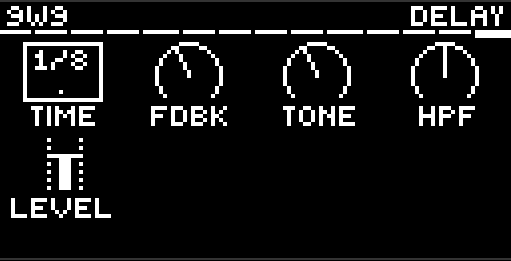
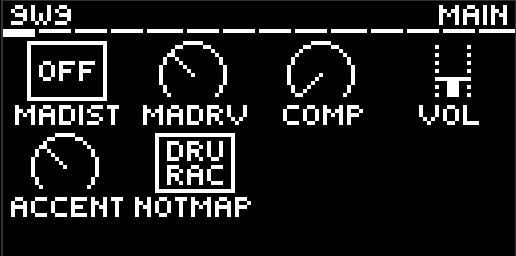
Voices
9W9 models the circuit, then checks the result against hardware recordings; where the two disagree, the schematic wins and the sound is re-fitted.
| Voice | Engine |
|---|---|
| Bass Drum | VCO at a fixed ~49 Hz base with the 909's additive-exponential sweep, 16 ms pitch hold, diode rounding and beater click. Tune is the sweep ladder, exactly as on the panel. Optional Pitch / P.Depth modulation, gated so it does nothing at all until P.Depth leaves zero |
| Snare | Two shells a 1.585 ratio apart off one CV, plus the ENV4 noise channel — 24 ms plateau, accelerated fall, and the VCA's soft cutoff knee rather than a hard gate. Panel is the 909's own: Tune, Tone, Snappy, Level |
| Toms (L/M/H) | Three VCOs per drum at the measured 1 : 1.50 : 2.75 partials, the upper two attack-only. Tune ranges are trimmed so the three toms cannot be tuned onto each other, like the hardware |
| Rim Shot | Trigger pulse shock-exciting two resonators — body "tock" and edge "tick" |
| Hand Clap | Four rising echoes 12 ms apart into a noise band, with the room tail running off the main hit |
| Hats / Ride / Crash | Sampled — the real 909's cymbals are 6-bit PCM, so this is accuracy, not shortcut. Closed and open hat have their own pages and choke each other |
Every voice has Drive and a Distortion type, plus a Master Drive/Distortion across the kit. Seven characters, transparent at the bottom of the Drive range and growing from there:
| Diode | the 909's own back-to-back diode rounding |
| Clip | asymmetric soft clip, even harmonics and all |
| SAT | warm parallel saturation that keeps the transient |
| BFZ | thick fuzz wall |
| PDIST | biased cubic crunch |
| Fold | wavefolder, metallic without hollowing the note out |
| Crush | bit depth and sample rate falling together |
Every continuous control is a 0–127 pot, like the hardware — no Hz, no ms.
Send FX
Two send effects, on their own pages at the end of the list. Every voice except the kick has a Rev and Dly send; the kick stays dry on purpose. The returns join the bus before the master stages, so Master Drive/Distortion and the Comp work on the wet signal too.
- Reverb — four combs and two allpasses with the loop quantised to 12 bits, for the early-rack grain. Decay, Tone (loop damping), HPF, Level.
- Delay — Time is a note division, synced to Move's tempo: 1/32, 1/16T, 1/16, 1/8T, 1/16., 1/8, 1/4T, 1/8., 1/4, 1/2T, 1/4., 1/2, 1/2. The line is slewed, so changing tempo or division warps the echo like tape instead of clicking. Fdbk, Tone, HPF, Level.
Each has an input HPF so low end can be kept out of the wet path.
Master
Master Dist and Drive across the kit, a one-knob Comp for glue (hard bypass at zero, with AutoGain fitted so loudness stays flat as you turn it up), Volume, Accent, Velocity, and the Note Map switch. There is no always-on compressor or limiter anywhere else in the signal path.
Accent is the level a full-velocity hit reaches — the 909's accent bus, and the level this kit plays at from a sequencer. Velocity is how far below Accent a softer hit falls. The knob only ever carves downwards, so turning it up changes the kit's dynamics and never its loudness or balance. At 0 velocity is ignored entirely and everything plays straight at Accent. Turn it up and the range opens: about 2 dB softest-to-hardest at a quarter, 4.6 dB at half, 15.4 dB wide open.
(The hardware accents with a per-step switch — one level under a threshold, another over it — and modelling that literally left a 6 dB cliff between velocity 99 and 100 with flat shelves either side, which is not how anything driven from a sequencer expects to behave. The threshold is gone; Accent remains as the top of the range, so with Velocity at 0 the kit is bit-identical to how it played before velocity existed.)
Workflow on the Move
- Pads (left 4×4) play and select drums; the parameter page follows what
you hit. Shift+Pad selects silently (works during playback).
Mute+Pad mutes that drum (
[M]in the title bar). - The last two pads open Reverb and Delay; the pad after the kit opens Main. These three only switch the page — they never sound.
- Main-page lock: Shift + jog click while on Main locks it (
[L]in the title bar). A plain jog click stays Schwung's — it opens the section list, and activates rows on the My Presets and Module pages. Pads still play and record, but the page stops following them, so the master knobs stay under your hands while you jam. Shift+Pad still selects, and another jog click unlocks. - Knobs 1–8 edit the visible page, drawn with Schwung's stock knob grid (host 0.12.1+): jog cycles pages, Shift+Jog jumps sections, jog click opens the section list, Shift reveals values / fine mode, Mute+knob resets a pot.
- Sequencing: use Move's own sequencer — a drum track with a kit, muted (HiJack), track MIDI OUT on the slot's channel. Each drum is its own lane. Note map: drum rack (36–46, default) or General MIDI, switchable.
Accessibility
9W9 follows Schwung's Screen Reader setting. On hosts with the accessible parameter-list controller (Schwung 1.0+), enabling Screen Reader replaces the eight-cell knob grid with a jog-navigated list: click to enter a page, jog to choose a control, click to edit it, and jog to change its value. Page, control, enum and value announcements come from Schwung's shared parameter controller. 9W9 also announces its own Mute+Pad changes and Main-page lock state.
On Schwung 0.12.1 through 0.13.x, 9W9 keeps the knob grid and announces knob touches and value changes; update Schwung to 1.0 or newer for the navigable screen-reader list.
Remote panel
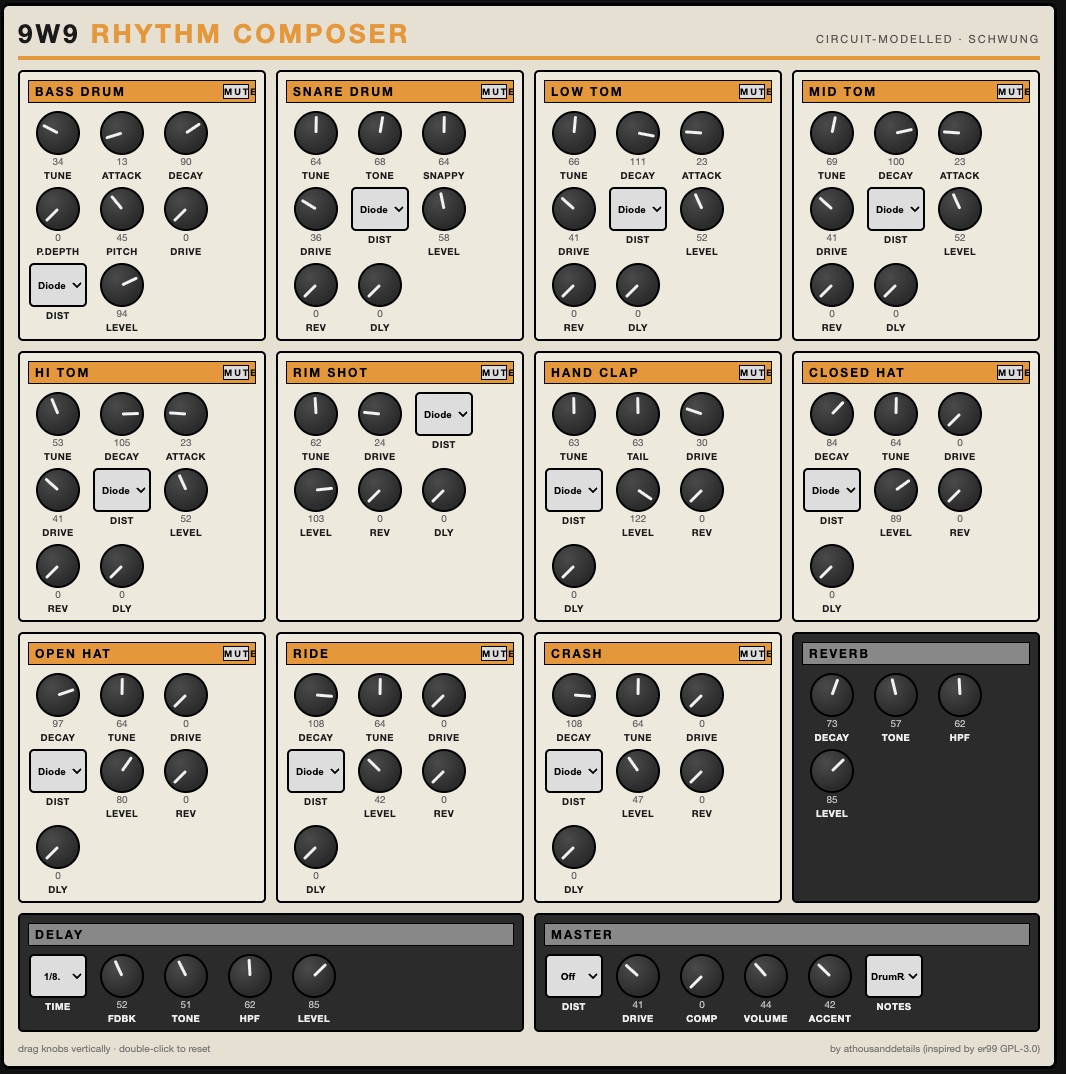
A full 909-style editor in the browser — every drum section with draggable
knobs, per-drum MUTE buttons (synced with Mute+Pad on the device),
distortion selectors, the Reverb and Delay sections, and Master. Open
move.local:7700/remote-ui while 9W9 is the slot's synth.
Install
Requires Schwung 0.12.1 or newer. Via the Schwung Module Store /
schwung-manager, or manually: build, then copy dist/9w9/ to
/data/UserData/schwung/modules/sound_generators/9w9/ on the device.
Building
Requires Docker (cross-compiles for the Move's ARM64, pinned to glibc 2.35):
./scripts/build.sh 9w9           # builds build/dsp.so + dist/9w9-module.tar.gz
./scripts/deploy.sh <host>       # safe deploy (atomic rename, never over a live .so)
scripts/build.sh 9w9_loadtest builds an on-device test that dlopens the real
dsp.so exactly as Schwung's chain host does and verifies parameters, state
round-trip, mutes, the hat choke, channel balance and the send FX end to end.
Credits
Thanks to:
- Schwung by Charles Vestal and contributors — the framework that makes any of this possible.
- The authors of the TR-909 service notes (schematics and scope traces), the Network-909 circuit analysis, Colin Fraser's TR-909 bass drum analysis, and the firstpr.com.au TR-909 sound-mod notes (Pitch / Tune-Depth / Tune-Decay behaviour) — the voices were worked out from their work.
This project was developed with AI assistance (Claude), with human direction and on-hardware verification throughout.
Contributing
Contributions are open to anyone, any time — just submit a PR. Voice tweaks, new distortion flavours, UI improvements, docs, bug reports: all welcome. Please note in your PR which AI tools you used, if any (same policy as Schwung upstream).
License
Copyright (C) 2026 A Thousand Details.
GPL-3.0 (see LICENSE) with additional terms under section 7 (see NOTICE). Anything you ship that contains this code — the module, a fork, a port, a plugin — must credit 9W9 by A Thousand Details with a link back here, in its documentation and wherever it shows credits, an about screen or legal notices. Modified versions must say they were changed.
Disclaimer
Not affiliated with, approved or endorsed by Ableton or Roland. TR-909 and RD-9 are trademarks of their respective owners, referenced only to describe behaviour.