S1Vave — 8-Voice Virtual Analog Tweak Synth for M-VAVE FM-1



S1Vave is an open-source firmware that transforms the portable M-VAVE FM-1 synthesizer hardware (JieLi AC791N 32-bit RISC MCU) into an 8-voice virtual analog tweak synth modeled after the classic SH-101 and S-1 architecture.
Every aspect—from the classic oscillator core and sub-oscillator waveshapes, to the cascaded 4-pole filter with self-oscillation, calibrated ADSR envelope curves, unique OSC DRAW and OSC CHOP sound manipulation, multi-waveform LFO with audio-rate Fast mode, stereo effects suite, and 1:1 MIDI CC implementation—has been modeled and calibrated to provide complete sound engine parity.
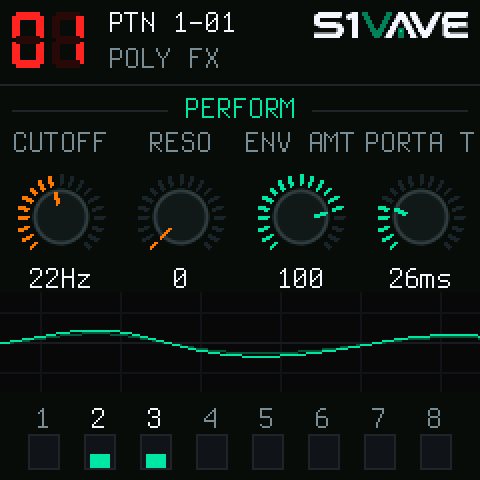
Highlights & Features
1. Classic SH-101 Voice Architecture & Tweak Innovations
- Polyphony & Voicing Modes (8-Voice Engine):
MONO: True SH-101 monosynth with legato glide (auto-portamento).UNISON: 8-voice stacked unison with massive analog lead and bass presence.POLY: 8-voice dynamic polyphony for rich chords and lush pads.CHORD: Programmable chord memory with independent voice shifts (-12 to +12 semitones).
- Oscillator Core:
- Sawtooth: PolyBLEP anti-aliased classic saw.
- Square / Pulse: Wide-range Pulse Width Modulation (PWM) from 50% square down to ~5% needle pulse. Modulated via Manual duty cycle, Envelope sweep, or LFO.
- Sub-Oscillator: 3 authentic octave types:
-2o.A: 2 octaves below, 25% asymmetric duty cycle (signature SH-101 growl).-2oc: 2 octaves below, 50% symmetric square wave.-1oc: 1 octave below, 50% symmetric square wave.
- Noise Generator: Calibrated Pink Noise (analog 12 dB/oct roll-off above 1.8 kHz) and White Noise.
- Unique Wave-Shaping Features:
- OSC DRAW: 16-step wavetable drawing (
STEPmode for raw digital textures orSLOPEfor smooth interpolated waves), with a1.0xto32.0xfrequency multiplier. - OSC CHOP: Harmonic comb slicing (
1.0to32.0repetitions) with overtone depth control (0–200, $>100$ phase inverted) to create metallic overtones and bell-like timbres. - Riser / Downer: Built-in performance transition sweep generator (
SYNC,QUIV, andQV.PANmodes) for sweeping rises, risers, and dropouts.
- OSC DRAW: 16-step wavetable drawing (
2. Cascaded 4-Pole Filter & Calibrated Envelopes
- 4-Pole (24 dB/oct) Cascaded State-Variable Filter:
- Full $20\text{ Hz} \dots 20\text{ kHz}$ calibrated cutoff curve matching the S-1 hardware pot response.
- Smooth analog resonance with self-oscillation and bass retention.
- Keyboard tracking ($0% \dots 100%$) and bipolar filter envelope modulation.
- Dual filter character modes: S-1 Clean Roland ACB and Warm Midnight soft-knee drive.
- Calibrated ADSR Envelopes:
- Precise exponential analog RC attack, decay, sustain, and release curves measured from the Roland S-1 hardware.
- Envelope trigger modes:
GATE,GATE+TRIG(re-triggers on overlapping notes), andLFO(cyclic re-triggering). - Amp envelope mode: Instant
GATE(organ style) or dynamicENV(ADSR shaped).
3. Modulation & Effects
- Versatile LFO Engine:
- 6 Waveforms: Sawtooth, Inverted Sawtooth, Triangle, Square, Random (S&H), and Noise.
- Speed range: $0.05\text{ Hz} \dots 30\text{ Hz}$ in Normal mode, and up to $\sim 100\text{ Hz}$ in Fast audio-rate mode.
- Tempo Sync: Locked to MIDI clock across 31 musical note divisions ($8/1$ to $1/128$ triplets/dotted).
- Key Trigger: Option to reset LFO phase on note-on.
- Stereo FX Suite:
- Stereo Chorus: 4 chorus models (Type 1–4) with Hermite-interpolated delay lines.
- Tempo-Synced Delay: Stereo ping-pong delay with analog tape slewing when changing delay time and feedback tone filtering.
- Plate Reverb: High-density Dattorro figure-of-8 reverberator running at the full 44.1 kHz sample rate (7 room types: Ambient, Room, Hall 1, Hall 2, Plate, Spring, Mod).
4. Sequencer, Presets & USB Connectivity
- Dual-Track 64-Step Sequencer:
- Two polyphonic tracks (A and B) sharing 256 steps with independent length, clock division, swing, and transpose for complex polymeters.
- Step entry with piano roll view, live recording, sub-step ratchets (1–4), per-step probability, and motion recording.
- 8 pattern slots saved directly in flash memory.
- 99 Presets & Instant Recall:
- Programs 1–64 come pre-loaded with authentic factory sounds and patterns; slots 65–99 are available for user programs.
- Startup recall sequence preserves custom OSC DRAW wavetables and OSC CHOP comb masks.
- Direct bidirectional SysEx patch dump & restore support over USB-MIDI.
- Enhanced Arpeggiator & Hold:
- Press and hold
ARPbutton (450 ms) to toggleHOLDlatch mode instantly. - Dedicated Arp page (
Mode,Hold,Type,Rate) and Arp Config page (Note Priority: Low / Last). - Seamless key release and retrigger behavior in latch/hold mode.
- Press and hold
- Dynamic Battery Level Monitoring:
- Real-time SARADC battery tracking with 4-bar hysteresis and visual low-voltage blinking alert in the status bar header.
- S-1 Parity Velocity & Key Follow:
- Dynamic velocity sensitivity scaling for VCA amplitude (~18 dB musical dynamic range).
- True 1V/oct chromatic filter keyboard tracking (scaled to Q8 semitones).
- USB-Audio & Class-Compliant USB-MIDI:
- 44.1 kHz / 16-bit stereo USB Audio with zero-glitch ring buffering.
- Complete 1:1 MIDI Control Change implementation chart.
Hardware Panel Controls (M-VAVE FM-1)
The M-VAVE FM-1 has 4 push-encoders (K1–K4), 8 function buttons, and 16 step keys. Tapping any button brings up its page:
| Page / Button | KNOB 1 (K1) | KNOB 2 (K2) | KNOB 3 (K3) | KNOB 4 (K4) |
|---|---|---|---|---|
| HOME (PERFORM) | Cutoff (FREQ) [CC 74] | Resonance (RESO) [CC 71] | Env Depth (ENV) [CC 24] | Portamento Time [CC 5] |
| EDIT (OSC CORE) | Range (64'..2') [CC 14] | Square Level [CC 19] | Saw Level [CC 20] | Sub Level [CC 21] |
| EDIT (PWM) | PWM Source [CC 16] | Pulse Width / Duty [CC 15] | Square Level [CC 19] | Sub Octave Type [CC 22] |
| EDIT (SUB/NOISE) | Sub Type (-2o.A, -2oc, -1oc) | Noise Level [CC 23] | Noise Mode (Pink/White) | Fine Tune [CC 76] |
| EDIT (OSC DRAW) | Draw Switch (Off/Step/Slope) | Multiply (1.0x–32.0x) | PWM Source [CC 16] | Pulse Width [CC 15] |
| EDIT (OSC CHOP) | Chop Overtone (0–200) [CC 103] | Chop Comb (1.0–32.0) [CC 104] | — | — |
| EDIT (FILTER) | Filter Cutoff [CC 74] | Filter Resonance [CC 71] | Filter LFO Depth [CC 25] | Key Follow (0–100%) [CC 26] |
| ENV (ADSR) | Attack [CC 73] | Decay [CC 75] | Sustain [CC 30] | Release [CC 72] |
| ENV (TRIG/AMP) | Env Trigger Mode [CC 29] | Amp Mode (Gate/Env) [CC 28] | PWM Source [CC 16] | PWM Depth [CC 15] |
| LFO (CORE) | LFO Rate [CC 3] | Waveform [CC 12] | Tempo Sync [CC 106] | Fast Mode [CC 79] |
| LFO (ROUTING) | Pitch LFO Depth [CC 13] | Filter LFO Depth [CC 25] | PWM Depth [CC 15] | Key Trigger [CC 105] |
| LFO (RISER) | Riser Mode (Sync/Quiv/Pan) | Riser Resonance | Riser Shape | Riser Level |
| FX (MIX) | Chorus Mode [CC 93] | Delay Level [CC 92] | Reverb Level [CC 91] | Delay Time [CC 90] |
| FX (DELAY) | Delay Level [CC 92] | Delay Time [CC 90] | Delay Feedback | Delay Tempo Sync |
| FX (REVERB) | Reverb Level [CC 91] | Reverb Time [CC 89] | Reverb Type (Plate..Mod) | Chorus Mode [CC 93] |
| GLO (VOICE) | Poly Mode (Mono..Chord) [CC 80] | Portamento Mode [CC 31] | Transpose [CC 77] | Master Volume [CC 7] |
For the full button layer combinations, arpeggiator operations, and step sequencer instructions, see the Hardware Panel Guide.
Complete MIDI CC Implementation
S1Vave maps parameters 1:1 to the S-1 MIDI specification:
CC 1: Mod Wheel (LFO Depth)CC 3: LFO RateCC 5: Portamento TimeCC 12: LFO WaveformCC 13: OSC Pitch LFO DepthCC 14: OSC Range (64'..2')CC 15: PWM Depth / Pulse WidthCC 16: PWM Source (0=ENV, 1=MAN, 2=LFO)CC 19: Square/Pulse LevelCC 20: Saw LevelCC 21: Sub LevelCC 22: Sub Octave Type (0=-2o.A, 1=-2oc, 2=-1oc)CC 23: Noise LevelCC 24: Filter Env DepthCC 25: Filter LFO DepthCC 26: Filter Key TrackingCC 28: Amp Env Mode (0=Gate, 1=Env)CC 29: Env Trigger Mode (0=LFO, 1=Gate, 2=Gate+Trig)CC 30: Envelope SustainCC 31: Portamento Mode (0=Off, 1=On, 2=Auto)CC 71: Filter ResonanceCC 72: Envelope ReleaseCC 73: Envelope AttackCC 74: Filter Cutoff FrequencyCC 75: Envelope DecayCC 76: Fine TuneCC 77: Key TransposeCC 78: Noise Mode (0=Pink, 1=White) / Riser ModeCC 79: LFO Speed Mode (0=Normal, 1=Fast)CC 80: Poly Mode (0=Mono, 1=Unison, 2=Poly, 3=Chord)CC 89: Reverb TimeCC 90: Delay TimeCC 91: Reverb LevelCC 92: Delay LevelCC 93: Chorus Mode (0=Off, 1..4=Type 1..4)CC 102: OSC DRAW Multiply (1.0x–32.0x)CC 103: OSC CHOP Overtone (0–200)CC 104: OSC CHOP Comb (1.0–32.0)CC 105: LFO Key Trigger (0=Off, 1=On)CC 106: LFO Tempo Sync (0=Off, 1=On)CC 107: OSC DRAW Switch (0=Off, 1=Step, 2=Slope)
For the comprehensive MIDI CC list and value ranges, see the MIDI CC Implementation Guide.
Flashing & Installation
Option 1: Quick Install via Python (Recommended)
Connect your M-VAVE FM-1 via USB-C to your computer:
python tools/fm1_install.py build/s1vave-1.1.fwsc --yes
The script communicates over USB HID, validates checksums, flashes the firmware sector by sector (~2 minutes), and automatically reboots the hardware into S1Vave.
Option 2: Web Installer
You can also install S1Vave with one click via WebUSB / WebMIDI on thefirmwarehub.com.
Browser Simulator & Web Calibration Studio
Experience the firmware directly in your web browser with the WebAssembly simulation:
- Build the WebAssembly binary:
sh web/sim/build.sh - Start the local server:
python3 -m http.server 8737 -d docs/sim - Open
http://localhost:8737/to interact with the virtual LCD, encoders, buttons, and play notes from your computer or MIDI keyboard. - Open
http://localhost:8737/editor/to access the Dual Synth Calibration Studio for side-by-side A/B acoustic comparisons.
Building from Source (Linux / WSL2)
1. Prerequisites
sudo apt update
sudo apt install -y python3 python3-pip git build-essential pipewire alsa-utils
pip3 install Pillow mido python-rtmidi
2. Download Toolchain
cd s1vave-main
./tools/get_toolchain.sh
3. Clone JieLi AC79 SDK
git clone --depth 1 --branch AC79NN_SDK_V1.2.1_2023-12-13 https://gitee.com/Jieli-Tech/fw-AC79_AIoT_SDK.git ~/fw-AC79_AIoT_SDK
4. Compile Firmware Package
./build.sh --release 1.1
The build pipeline enforces strict JieLi AC791N hardware rules (integer-only fixed-point DSP, prohibition of 64-bit software divisions, and ROM collision prevention). The resulting .fwsc firmware binary will be placed at build/s1vave-1.1.fwsc.
Documentation Links
- Technical Handover & Calibration Guide: Deep dive into the DSP equations, fixed-point math, acoustic calibration measurements, volume staging, and USB audio buffer watermarks.
- Hardware Panel & Navigation Guide: Complete guide to all physical knobs, buttons, layers, and sequencer views.
- MIDI CC Implementation Chart: Complete reference of all supported MIDI Control Changes.
- JieLi AC791N Hardware Rules: Architectural and compiler rules for developing firmware on the AC791N RISC MCU.
- Licensing & Credits: Upstream credits, contributors, and open-source licenses.
Credits & License
S1Vave is free software released under the GNU General Public License v3.0 (GPL-3.0-only). See LICENSE and LICENSING.md.
- Parity Sound Engine, DSP Calibration & Visual Branding: Andrew GG
- OberVave Synthesizer & Dinghy Platform: zvenson (original OberVave codebase and Dinghy platform wiring)
- Felucca Base Platform: Leo Kuroshita (@kurogedelic), Hügelton Instruments
- SLOOP Platform Contributions: isod89
- SMK-37 Port: M. Geisler
Roland, AIRA, AIRA Compact, S-1, and SH-101 are trademarks of Roland Corporation. M-VAVE, FM-1, and SMK-37 are trademarks of Shenzhen Sincoo Technology Co., Ltd. S1Vave is an independent community project and is not affiliated with or endorsed by Roland Corporation or Shenzhen Sincoo Technology Co., Ltd.