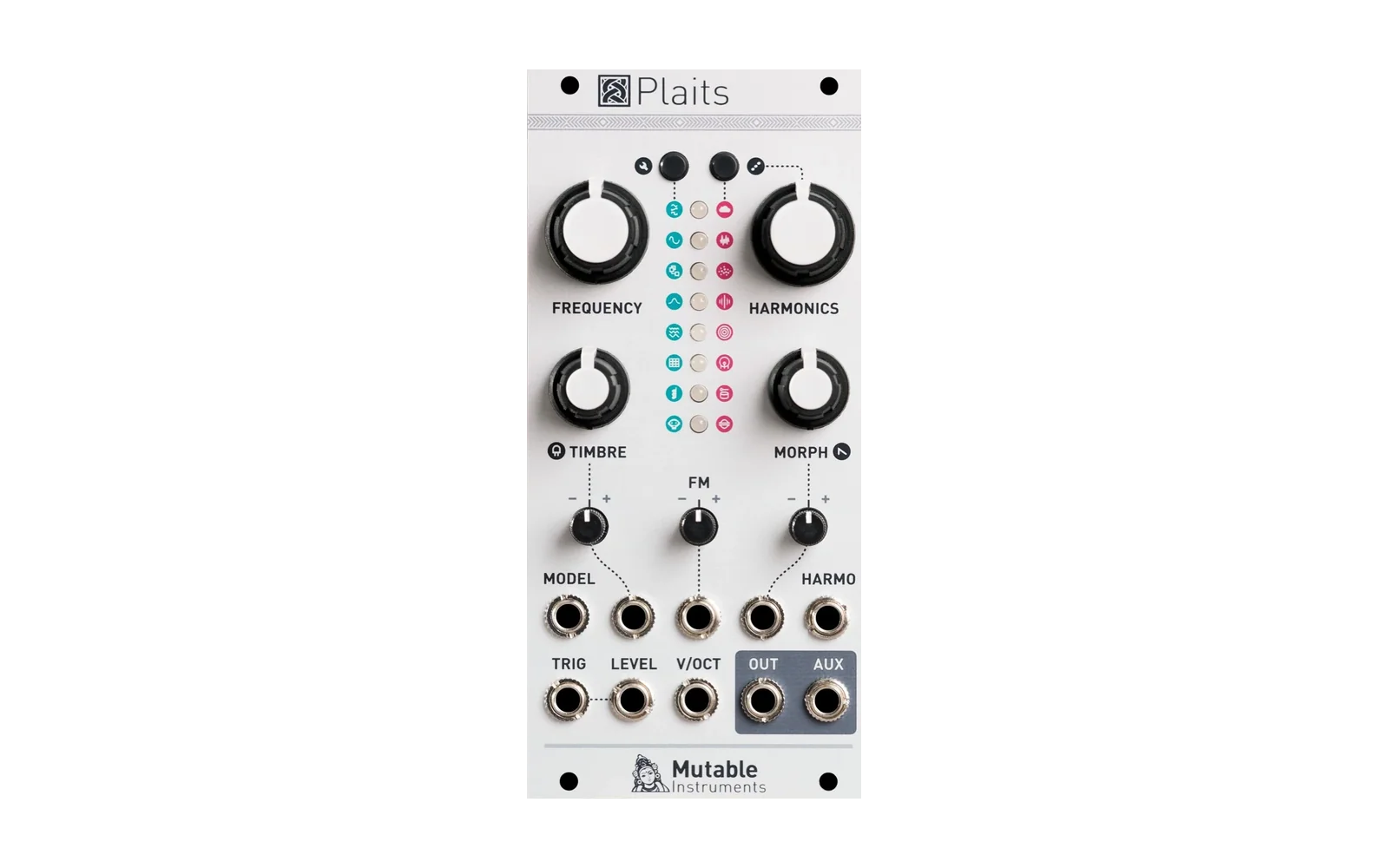
Plaits duo
A firmware for Mutable Instruments Plaits, based on the original firmware v1.1, which adds a duo mode: two voices of the same model, the second one pitched by the LEVEL input, either mixed in stereo on OUT and AUX, or split (one voice on each output). Everything else is the original firmware, unchanged.
This is an independent project, not affiliated with or endorsed by Mutable Instruments.
Try it in a browser: andreasjansson.github.io/plaits-duo runs the firmware itself (compiled to WebAssembly, with a simulation of the module's hardware), with a sequencer playing into its jacks, and offers the firmware update file.
Duo mode
- Press the two buttons together to enter or leave duo mode. Two LEDs move from the center to the edges when entering, and back when leaving.
- Models: the left button cycles through the 8 duo models in the stereo layout (yellow LED, where the original firmware is green), the right button through the same models in the split layout (red LED). In the colour-blind mode (the right button held at power on), the stereo layout is a dim yellow, between the full yellow of the original firmware's green and the faint yellow of its red. The original firmware and duo mode each remember their own selection, which is kept when the module is powered off. The MODEL CV is added to the selected model, with the same volts per model as in the original firmware.
- LEVEL is the pitch of the second voice, at 1V/octave (0V: the same pitch as the first voice). LEVEL was made for 0 to 8V: it reads down to about -0.6 to -0.9V (the converter reads 2.4 to 3.1% high, so it reaches its full scale a little early; this varies between modules), so the second voice goes 7 to 10 semitones below the pitch set by FREQUENCY at most. With nothing patched into LEVEL, there is only one voice. TRIGGER pings the low-pass gate of both voices (as in the original firmware with nothing patched into LEVEL). As in the original firmware, holding the left button shows the low-pass gate settings, and holding the right one the octave range.
- Until it is calibrated, LEVEL reads volts as V/OCT does: the two inputs have the same input stage, and the factory calibration of V/OCT accounts for what they share, such as the gain of the converter (which reads 2.4 to 3.1% high, about 30 cents per octave). What it cannot account for are the tolerances of the resistors of the two input stages (1% parts): typically a few cents per octave, up to about 25.
- Calibration of LEVEL (recommended): in duo mode, hold the two buttons for 2 seconds. The bottom LED pulses green, and OUT and AUX carry two voltages in turn, about 0.5V and 4.4V, 15 times a second (a loud buzz: turn the mixer down). Patch OUT into V/OCT. When the bottom LED flashes green (about a second later: V/OCT has read the two voltages, and its readings have settled), press the left button: the LED pulses yellow. Move the cable from V/OCT to LEVEL, and when the LED flashes green again, press the left button: the LEDs show the model again, and the calibration is saved. With a stackable cable or a mult into both V/OCT and LEVEL, the first press is enough. LEVEL then reads exactly what V/OCT reads, whatever the calibration of V/OCT, so that the two voices stay in tune with each other across octaves. A press before the green flash, or with LEVEL not reading the same voltages as V/OCT (the cable in the wrong place), is rejected: all the LEDs light up red until a button is pressed, and the previous calibration is kept.
- In the original firmware, the two buttons still calibrate V/OCT, with 1V and then 3V. Only V/OCT should be patched: the inputs detected as patched keep the offsets they had (the original firmware measured them again from whatever was patched), and voltages which are not about 2V apart are rejected (the original firmware accepted 1 to 3V apart, which saved a wrong calibration when the voltage was not the one expected).
Models
The models (green 1 to 6 and 8 of the original firmware, with the inharmonic string in place of the chords), and how each one makes its stereo image:
| LED | model | stereo |
|---|---|---|
| 1 | classic waveforms | one saw per channel, slightly detuned (the detuning drifts slowly), and the same square in both |
| 2 | waveshaper | the wavefolder is offset in opposite directions in the two channels (by an amount which breathes slowly) |
| 3 | 2-operator FM | moving diffuser: two different chains of allpass filters, whose delays move slowly (the bass stays in the middle); a few dB quieter than in the split layout, since the diffuser makes its peaks up to twice as high |
| 4 | formant | moving diffuser |
| 5 | harmonic | each harmonic has its own, slowly changing, phase difference between the channels (neighbouring harmonics turn in opposite directions; the fundamental is the same in both) |
| 6 | wavetable | the chorus of the Juno-60 (mode I), followed by a limiter |
| 7 | string | the ensemble of the string machine of Plaits 1.2, with mirrored taps in the two channels |
| 8 | vowel | moving diffuser |
In every model, the two channels have the same level in every frequency band, and the image is centered on average. Nothing reaches full scale: the models whose peaks grow with their stereo processing (FM, wavetable), and the string and vowel models, go through a limiter, which turns the sound down as soon as a peak would go above 0.8 (it rarely has to, except with the string model, as in the original firmware). Some images move: with the classic waveforms, the detuned saws make the image sway slowly from side to side, and the harmonic model does the same when one or two harmonics dominate the spectrum.
In the split layout, each voice is the OUT signal of the corresponding model of the original firmware: the voice pitched by V/OCT on OUT, the one pitched by LEVEL on AUX (with one voice, the same signal on both).
Building and updating the module
git clone --recursive https://github.com/andreasjansson/plaits-duo.git
cd plaits-duo
make firmware TOOLCHAIN_PATH=/path/to/arm-gnu-toolchain-13.3.rel1/
make wav TOOLCHAIN_PATH=/path/to/arm-gnu-toolchain-13.3.rel1/
TOOLCHAIN_PATH is the directory containing bin/arm-none-eabi-gcc (the
Arm GNU Toolchain
13.3.rel1 was used). make firmware writes build/plaits/plaits.bin and
plaits.hex, for a programmer. make wav writes build/plaits/plaits.wav,
the firmware update file: hold the left button while powering the module on,
and play the file into the MODEL CV input (the upper LEDs show the signal
level, the lower ones the progress). It needs Python 3 with numpy
(PYTHON=... to use another Python than python3): tools/qpsk_encoder.py
is a Python 3 version of the encoder of stm_audio_bootloader, which only
runs on Python 2. The tests check that the bootloader decodes the update file
into the firmware.
The settings are compatible with the original firmware: after an update, the model and the calibrations are kept, and going back to the original firmware is possible at any time.
Tests
make test
builds the test tools with the host compiler, including a simulator of the
module, and runs the tests (cctr
0.31 or later). See test/README.md: the original firmware
produces exactly the same output as v1.1; duo mode's buttons, LEDs,
calibration and settings; the split layout matches the original engines;
the stereo image of each model is balanced and centered. With
TOOLCHAIN_PATH and a Python with the unicorn, capstone, pyelftools
and numpy modules (PYTHON), the tests also build the firmware and check
its memory and CPU use, and its update file.
Resources
The firmware has 2832 bytes of flash memory left (of 224kB). The RAM leaves 4.9kB for the stack, of which the benchmarks use at most 2.2kB.
CPU use measured on the module (the rig firmware, see below), in % of the duration of a block of 12 samples (18048 cycles): the most expensive block of each model, with two voices playing a phrase pinged by TRIGGER, TIMBRE rising, as the release firmware runs it:
| model | 2 voices, stereo | 2 voices, split |
|---|---|---|
| classic waveforms | 92% | 79% |
| waveshaper | 95% | 76% |
| 2-operator FM | 97% | 81% |
| formant | 95% | 83% |
| harmonic | 95% | 82% |
| wavetable | 95% | 82% |
| string | 94% | 83% |
| vowel | 64% | 56% |
Two known exceptions: the vowel and speech model decodes a whole word bank at once when HARMONICS moves to another one (as in v1.1), and the wavetable model, in the stereo layout with TIMBRE, MORPH and HARMONICS all modulated at once, can take slightly more than a block when its position moves to a new cell of the wavetable.
CPU use measured on an emulated Cortex-M4 with the timing of the module's
flash memory (make bench, see plaits/test/bench.mk): the most expensive
block of 12 samples of each duo model, with one and two voices, in % of the
budget (the most expensive block of the original firmware v1.1, built from
its own source: the modal resonator, 15268 cycles). The module is slower than
the emulation, and not in proportion (see
docs/device-debugging-workflow.md):
| model | 1 voice, stereo | 1 voice, split | 2 voices, stereo | 2 voices, split |
|---|---|---|---|---|
| classic waveforms | 47% | 41% | 81% | 67% |
| waveshaper | 44% | 37% | 76% | 59% |
| 2-operator FM | 55% | 42% | 87% | 69% |
| formant | 50% | 40% | 76% | 64% |
| harmonic | 54% | 51% | 84% | 76% |
| wavetable | 74% | 62% | 95% | 80% |
| string | 78% | 66% | 80% | 68% |
| vowel | 64% | 56% | 83% | 86% |
To make room for duo mode in the flash memory, the code is built with less
loop unrolling (see plaits/makefile), and the drum models of the original
firmware are optimized for size. The models of the original firmware produce
exactly the same output; the most expensive one, the modal resonator, uses
0.2% less CPU than in v1.1 (15239 cycles), and the others remain below it
(the drums now use 69 to 90% of it).
Web demo
web/ is the page: make -f web/web.mk WASI_SDK_PATH=... BINARYEN_PATH=...
builds it in build/web/ (wasi-sdk 34 and binaryen 133; the firmware's update
file must have been built first, with make wav). Every push to main builds
it and publishes it on GitHub Pages (.github/workflows/web.yml).
Changes to the original firmware
The duo mode code is in plaits/dsp/duo/ and plaits/dsp/duo_voice.cc. The
original code is changed where duo mode needs it, without changing its
output: the user interface and the settings (duo mode, LEVEL calibration),
the voice (shared with duo mode), and the classic waveforms, waveshaper, FM
and formant engines, which duo mode reuses (they can skip AUX, or render in
stereo). git diff upstream-v1.1 shows all the changes.
The calibration code (of V/OCT and LEVEL) is in plaits/ui_calibration.cc,
optimized for size. To make room in the flash memory, the factory test mode
of the original firmware is left out: on a module whose settings were blank,
it took commands from Mutable Instruments' test jig over the serial port of
the programming header, and output a test signal.
Measurements on the module
make rig builds a second firmware, build/plaits_rig/plaits_rig.wav: the
same, with telemetry on AUX (every 2 seconds, for 0.14 seconds: the readings
of the inputs, the calibrations, and the CPU use measured by the processor's
cycle counter). rig/rig.py drives the module's CV inputs with an Ornate
Criminal, records OUT and AUX, and measures LEVEL against V/OCT (the two
voices given the same voltage through a mult), the lowest voltage LEVEL
reads, the calibration of LEVEL, the CPU use of every model, and the sound
against the simulator. rig/rig.py --virtual runs the same against the
simulator of the rig firmware. See
docs/device-debugging-workflow.md.
License
MIT, as the original firmware: see LICENSE.