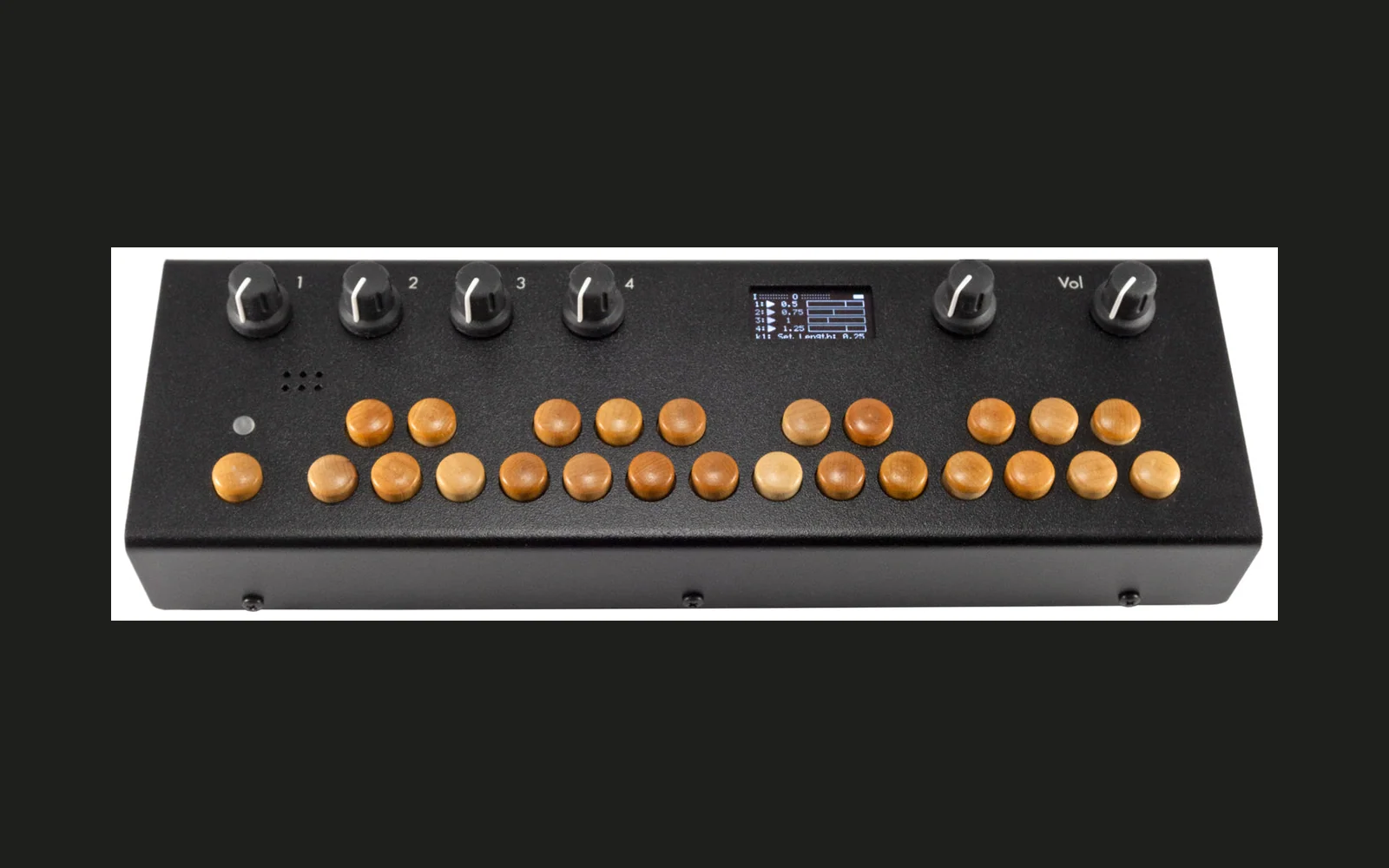
Organelle OS
This repository contains the core operating system software for the Critter & Guitari Organelle music computer. The Organelle OS provides a menu interface for patch management, hardware control, and system functions.
Overview
The Organelle OS is a C++ application that serves as the bridge between the hardware controls (encoders, keys, knobs, OLED display) and the audio patches (e.g. Pd patches) running on the system. It provides:
- Patch Management: Browse, load, and organize patches
- Hardware Interface: Control encoders, buttons, knobs, keys, and OLED display
- System Functions: WiFi setup, MIDI configuration, storage management
- OSC Communication: Real-time communication with patches and system scripts
Architecture
Core Components
main.cpp: Main application loop handling hardware events and OSC messagesMainMenu.cpp/h: Menu navigation and patch loading systemAppData.cpp/h: Global application state and configuration managementOledScreen.cpp/h: OLED display rendering and graphics functions
Hardware Abstraction
The system supports multiple hardware platforms through a hardware abstraction layer:
hw_interfaces/: Platform-specific hardware interface implementationsCM3GPIO.h- Organelle M (direct GPIO on Raspberry Pi CM3)CM4OG4.h- Organelle 4/S2 (Raspberry Pi CM4)SDLPi.h- SDL-based interface for development/testing
System Scripts
fw_dir/: Core system scripts and utilitiesscripts/- System configuration scripts including many of the functions in the System menumother.pd- Main Pure Data patch coordinator- Configuration files and utilities
Platform-Specific Files
platforms/: Platform-specific configurations and overridesorganelle_cm/- Unified platform for CM3 (Organelle M) and CM4 (Organelle 4/S2) based devices- Each contains
rootfs/(system files) andfw_dir/(for script overrides)
Build System
The project uses Make with platform-specific targets. The organelle_cm platform supports both CM3 and CM4 hardware with a unified codebase:
# Build for different platforms
make organelle_cm3      # Organelle M (CM3) binary
make organelle_cm4      # Organelle 4/S2 (CM4) binary
make organelle_cm_splash # Boot splash screen
make sdlpi              # SDL development version

# Deploy to device (builds both binaries and copies files to system locations)
make organelle_cm_deploy
Unified Platform Architecture
The organelle_cm platform creates a single disk image that boots on both CM3 (Organelle M) and CM4 (Organelle 4/S2) hardware:
- Both
mother_cm3andmother_cm4binaries are deployed to the device - Platform detection at runtime (
/proc/device-tree/model) launches the appropriate binary - Shared system scripts and configurations with platform-specific optimizations where needed
- Conditional boot configuration in
config.txthandles hardware differences
Build Configuration
Platform-specific features are controlled via preprocessor defines:
CM3GPIO_HW- Use CM3 GPIO interface (Organelle M)CM4OG4_HW- Use CM4/OG4 interface (Organelle 4/S2)BATTERY_METER- Enable battery monitoringMICSEL_SWITCH- Enable mic/line input selectionPWR_SWITCH- Enable power switch supportSTORAGE_INDICATOR- Enable USB storage indicator (CM4 only)OLED_30FPS- Run OLED at 30fpsFIX_ABL_LINK- Apply Ableton Link timing fix
Object Files
Build artifacts are organized in separate directories to allow parallel compilation:
obj/
├── cm3/          # Organelle M build objects
├── cm4/          # Organelle 4/S2 build objects
├── splash/       # Splash screen build objects
└── sdlpi/        # SDL development build objects
Communication
OSC (Open Sound Control)
The system communicates via OSC on multiple UDP ports:
- Port 4001: Receives messages (main application input)
- Port 4000: Sends to Pure Data patches
- Port 4002: Sends to auxiliary programs/scripts
Key OSC message types:
/oled/*- Display control and graphics/knobs- Knob position data/key- Key press/release events/encoder/*- Encoder turn and button events- System control messages for patch loading, configuration, etc.
Hardware Events
The main loop continuously polls hardware and processes:
- Encoder rotation and button presses
- Key presses (25-key keyboard)
- Knob/potentiometer changes (6 analog inputs including footswitch / expression pedal input)
File Structure
/
├── main.cpp              # Main application entry point
├── MainMenu.cpp/h        # Menu system and patch management
├── AppData.cpp/h         # Application state management
├── OledScreen.cpp/h      # Display rendering
├── hw_interfaces/        # Hardware abstraction layer
├── fw_dir/              # Core system scripts and files
├── platforms/           # Platform-specific configurations
│   └── organelle_cm/    # Unified CM3/CM4 platform files
├── OSC/                 # OSC message handling library
├── obj/                 # Build artifacts (gitignored)
└── Makefile             # Build configuration
Development
Prerequisites
- C++11 compatible compiler
- Make build system
- Target platform SDK (for cross-compilation)
- wiringPi library (for hardware targets)
Building for Development
The SDL interface allows development and testing on desktop systems:
make sdlpi
./fw_dir/mother
Hardware Interface Development
To add support for new hardware:
- Create new interface class in
hw_interfaces/ - Implement required methods:
init(),poll(),updateOLED(), etc. - Add platform define and build target in Makefile
- Create platform-specific files in
platforms/
Hardware Compatibility
- Organelle M: Raspberry Pi CM3 with direct GPIO control
- Organelle 4/S2: Raspberry Pi CM4 with enhanced features including USB storage indicator
- Battery monitoring and power management on both models
- Mic/Line input switching on both models
- Unified software with runtime platform detection