OP-XY SDK
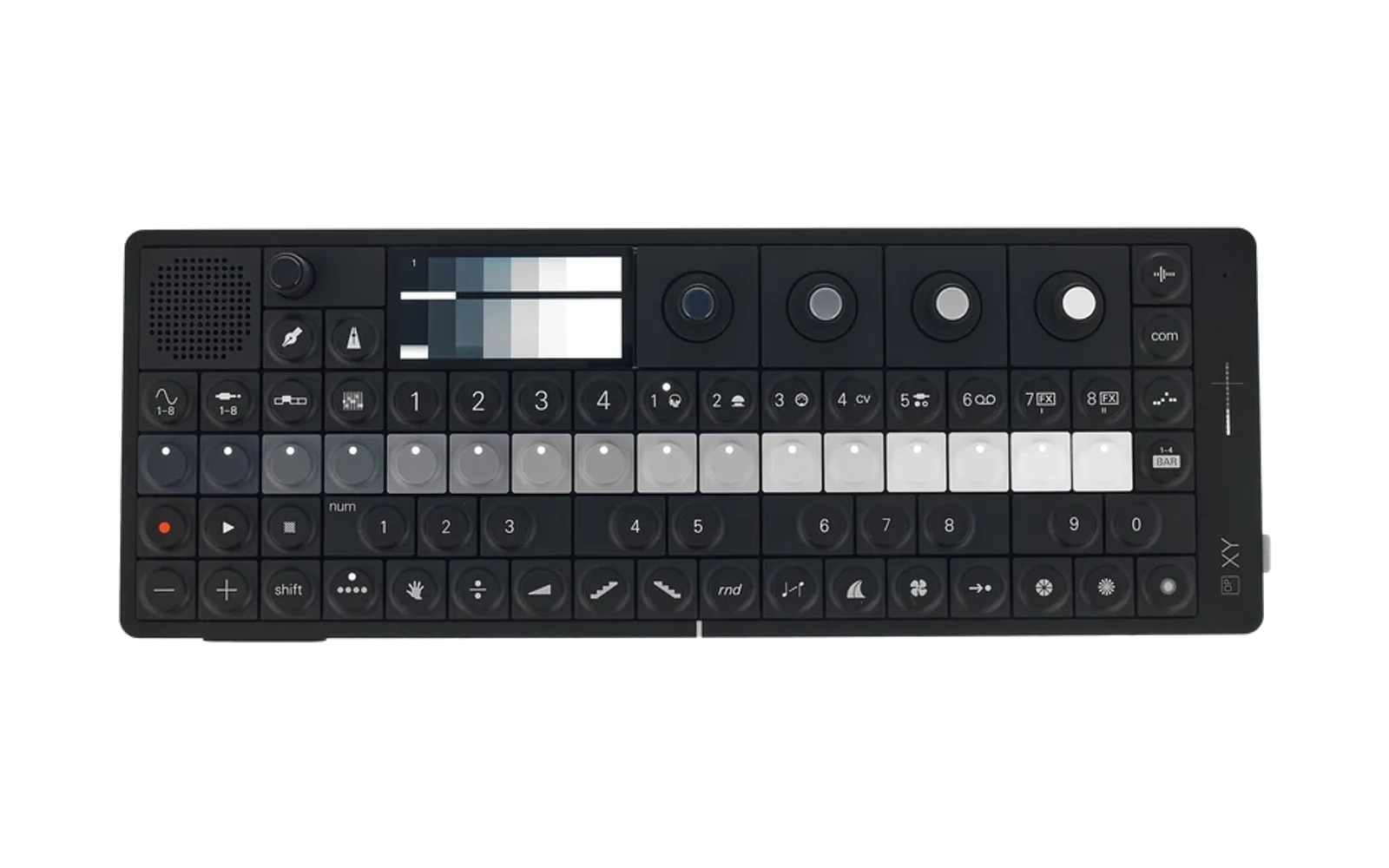
Write an instrument in C++, audition it in a browser, and build it into firmware for an OP-XY running OS 1.2.1. The same sound and display code compiles to WebAssembly for previews and to Blackfin for the device.
This repository is the SDK and the catalog of published machines; it holds no machines itself. Every machine lives in a repository of its own. Open-XY's own machines are in open-xy-core-machines: synths 2op FM, Macro Osc (a port of Mutable Instruments Braids) and Karplus, the Timestretch sample engine, and the Ring Mod and Ping Pong send effects, and the Chords note player. Read them as examples.
Open-XY, the browser builder at open-xy.com, lets OP-XY
owners pick from the catalog's machines and download firmware made from their
own stock os.ldr, without installing anything.
Contributing? Start feature branches from staging and open pull requests
against staging. It is the development branch; main receives reviewed
releases from staging or a release/<version> branch cut from it, and machine submissions (catalog-only PRs) go to main. See the contributor workflow.
With Retrospective capture enabled, firmware keeps a live-note ghost pattern for the selected instrument track. Double-tap Record to insert the performance at its original loop positions; captured confirms insertion. Stop preserves a partial take, while starting playback again clears it. Changing tracks, patterns, projects, track length, scale or quantization clears the ghost pattern. Notes survive loop wraps and silence; later playing replaces nearby same-pitch notes as in stock recording. It holds up to 120 notes, with stock collision and pattern-capacity limits. The first Record tap snapshots the take; the second confirms capture.
This is an unofficial, experimental SDK. A build statically links a curated collection of machines into exact stock OS 1.2.1; arbitrary engine installation and dynamic loading are not implemented. Native code is not sandboxed, and build checks cannot guarantee recovery from a faulty image. Browser previews work on any OS; firmware builds need Windows x86_64, Apple-silicon macOS or Linux x86_64.
Try an example
Commands say python; on macOS use python3. Requires Python 3.11+,
Node 22.12+, NumPy 2.3.5, Clang++ with wasm32/wasm-ld, and a recent Chrome or
Edge. Firmware and Blackfin tools are not needed.
Follow Check your tools to set up an
isolated Python environment and verify WebAssembly support. Clone the core
machines next to this repository, then run:
git clone https://github.com/etcetc000/open-xy-core-machines ../open-xy-core-machines
python sdk.py preview --machine ../open-xy-core-machines/machines/fm2op --out local/preview-001
python tools/serve_harness.py --preview local/preview-001
Open http://127.0.0.1:8917/ and play a key or click Play phrase; audio starts automatically. Use
machines/macroosc or machines/karplus for another synth. The
preview guide covers iteration, patches and automation.
Write a machine
Start with Your first machine: check the prerequisites, create a custom C++ machine, play it in the browser and make an audible edit. The core machines are the worked examples. Create a repository-ready starter directly from the SDK:
python sdk.py new --repository --id mymachine --name "My Machine" --out ../mymachine
Synths start with four controls and the stock header. Choose --controls 5,
6, 7 or 8 when the sound needs more controls; these use the shared
two-page header. Unused second-page columns repeat the same control from page 1.
It includes source, tests, README, agent instructions, licence and CI. Use
--kind effect for a send effect; omit --repository when adding just a machine
folder to an existing repository. Follow the generated instructions through
audition, hardware profiling and
catalog submission.
A machine is a folder of source: machine.json, which declares its kind (each
build gives its stock numbers), controls in definition.json, and C++ for its kind: a synth's
sound (engine.cpp) and display (display.cpp and artwork), a sample engine's
sample.cpp or an effect's fx.cpp. The SDK supplies adapters, storage,
previews, firmware builds and packaging.
- Machine API: platform rules, schemas, callbacks for each kind, buffers and ownership.
- Firmware extensions: shared controller events, callback order and exclusive commands.
- Display API: retained drawing frames and asset constraints.
- Machine UX: the conventions machines share for controls, pages, screens and motion.
- Build your own firmware: toolchain, stock files, adding a machine, build and install.
- Open-XY builder: using the builder, web development and kit export.
- Hardware CPU profiling: measure your machine and publish the required catalog readout.
- Port to a new OS release: move the profile and platform layer to a new stock OP-XY OS, test it and compare CPU.
- Catalog: machines published from their own repositories, pinned by commit.
- Project companions: the
.oxyfile recording which machine each project number meant. - Contributing: code ownership and checks.
Repository layout
| Path | Owns |
|---|---|
sdk/ | C++ interfaces, adapter templates and browser runners |
builder/ | The Open-XY browser builder |
harness/ | The local preview workbench |
tooling/ | The Python behind sdk.py: definitions, builds, firmware container checks and packaging |
profiles/, linker/ | The firmware profile and the memory layout |
catalog/ | The machines the builder ships, each pinned to a commit of its own repository (catalog) |
tests/ | SDK contracts and infrastructure tests |
tools/ | Standalone scripts: the preview server, browser and firmware checkers, and compiler build and release scripts |
local/ | Ignored non-firmware development outputs and tool binaries |
python sdk.py check checks the SDK; python sdk.py test --machine <folder>
checks a machine, including the sound tests in its own tests/. Adding an
instrument does not add tests or Python modules to the SDK.
The SDK is MIT (LICENSE, Open-XY contributors). Each machine
carries its own licence in its repository. Timestretch, in the
core machines, includes Capicola-derived analysis under the
AGPL-3.0; the SDK carries no copyleft code, but firmware and builder kits that
include Timestretch are distributed under the AGPL-3.0. No firmware is included: all firmware comes from the user's own
device. The one stock file in this repository is the instrument catalog every
build extends, op1_factory.json,
kept for development; the builder distributes it too. The
toolchain release ships its GPL sources.