octatrick-modules
Six firmware modules for the Elektron Octatrack (OS 1.40C, MKI and MKII),
written for sambanks/octabam's build
system. This repository is the source of truth for the modules: octabam
consumes it as a git submodule (modules/<name>/upstream, pinned to a tag),
and the ready-to-build fork below does the same.
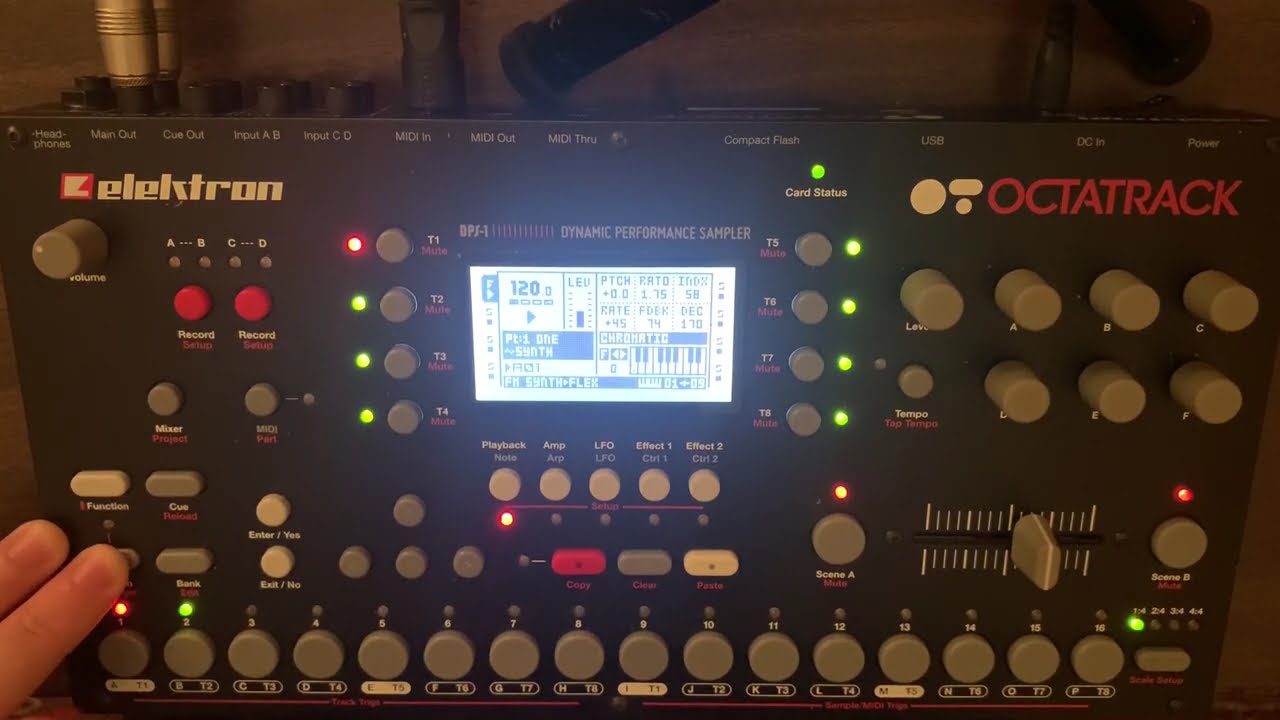
Demo video: Octatrick running on a real Octatrack MKI (YouTube) -- the FM synth, scale quantizer and direct jump in use. Click the picture to watch.
The modules
synth/(keySYNTH MACHINE) -- a two-operator FM synth machine: FM SYNTH is a machine of its own in the track's machine list (since 2.10: FUNC + SRC, or SELECT MACHINE TYPE -- no sample or marker file needed; see "Selecting FM SYNTH from the machine list" in synth/README.md; until 2.14 a FLEX track whose sample was named FMSYNTH*.wav or SYNTH*.wav also became a synth -- since 2.15 that marker file is a sample like any other, and the machine list is the way in), with its own PLAYBACK page (PTCH RATO INDX FINE FDBK DEC: PTCH in semitones, -64..+63, FINE in cents -- 0c the moment a track becomes a synth track), and on PLAYBACK SETUP VOIC (1 = mono, 2..4 = paraphonic: the most voices the track sounds at once, keys and chords alike) and CHRD (32 chord shapes as four-note voicings in priority order, in Syntakt order since 2.8 -- the triads MIN MAJ SU2 SU4, the sevenths and adds, the rest, the two-note intervals last (a CHRD byte saved by 2.7 names another shape) -- each at four detents -- the root position and three inversions (MIN MIN1 MIN2 MIN3 MAJ ...): VOIC 2 / 3 / 4 plays 2 / 3 / 4 notes of any shape, a new chord replaces the last; lockable per step, snapped to SCALE); a voice is 1/sqrt(VOIC) of the mono voice, equal power; since 2.9 there is no limiter (a full 4-note chord sits about 6 dB above a single note and never clips). A chord fingered on the CHROMATIC keys or over MIDI IN during live recording (VOIC 2..4, CHRD "----") is recognised and recorded as locks on the first key's step -- keys within a rolling 150 ms of each other, at any tempo; PTCH the bass, CHRD the shape AND its inversion (an exact voicing match first, the pitch classes second), VOIC the voices that were heard; a legato hand-over (the earlier key lifted within 50 ms) records single notes instead; two keys in one panel scan both sound; and one key is one voice: a second START for a held key (a bounce, the recorder's own copy under the finger) no longer doubles the note. The CHROMATIC keyboard of a synth track spans octaves -4..+4 (FUNC + LEFT/RIGHT). The engine is a DRAM unit in octabam's sample-RAM reserve (10 MB off the sample pool); the page is a DRAM unit too (since 2.21; a pinned ROM cave at0x400d24d0until 2.20), whose FM SYNTH descriptor is a runtime clone of the stock FLEX record, built in the unit's RAM on first use -- the repository carries no byte of the stock record. The AMP SETUP page (FUNC + AMP) of every audio track has a sixth box, LEG -- the legato switch, a Part byte saved with the project (a stock Part reads OFF; set MONO for the legato GLIDE used to give): OFF / MONO on a sample track (MONO: a key over a held key changes the pitch without a retrigger, and since 2.8 a FLEX or STATIC track with LEG MONO and GLIDE SLIDES every pitch change -- a legato key, a trigless trig's PTCH lock, the knob, an LFO -- over the GLIDE time, a sample trig starting at its own pitch), OFF / MONO / POLY on a synth track: MONO is legato at VOIC 1, POLY at any VOIC -- a key played over a held chord slides the sounding chord to its new voicing (or, with no shape, the newest voice), no retrigger, recorded as a trigless trig; GLIDE is the slide time only, everywhere. In GRID RECORDING, a placed trig held + FUNC + DOWN / UP moves that step's PTCH lock an octave down / up (every held trig; clamped -64..+63; a step without a lock starts from the Part's PTCH), the page showing the new value; with no trig held FUNC + UP / DOWN is still the trig-mode selector, as it is on every sample track. Since 2.11 the rows after PICKUP are a table the remix fills (FM SYNTH always, SY DRUM when the remix has it) and SELECT MACHINE TYPE scrolls when there are more than six rows. Since 2.12 a machine change resets the track's machine parameters (PLAYBACK, PLAYBACK SETUP, AMP, LFO and their SETUP pages) to the new machine's init; step and scene locks are kept, as in the stock firmware; FX slots are kept. This applies to a change to or from FM SYNTH or SY DRUM (either list; until 2.14 also a marker file); a stock machine's init is a new project's; a change between stock machines is stock's. Since 2.15 a guard keeps a Part within what the unit's processor can play; since 2.16 it is one load budget per Part (two FM SYNTH tracks fit, the FM voices capped beside SY DRUM tracks; at most 2 FM SYNTH tracks and 2 SY DRUM tracks, not two of each) -- both lists and copy / paste refuse more, with a message (limits from PROCESSOR LOAD readings on the author's MKI).synth/README.md.sy-drum/(keySY DRUM, since 2.11; requiresSYNTH MACHINE) -- a drum machine in the machine list, the row after FM SYNTH: a two-oscillator percussion voice with a sweep, a filter opened by the decay, six modes (PTCH MODE WDTH SWEP SPED DEC, stock p-locks, LFOs and scenes) and a dedicated LFO / S&H on its PLAYBACK SETUP page (LSPD LDEP WAVE S&H), each of the four lockable per step: hold a trig in GRID RECORDING and turn, or turn while LIVE RECORDING; the locks follow copy / paste / clear / shift and are saved in companion files beside the project's banks (sylockNN.work/.strd, the author's development builds' format, so a project moves between them with its locks). One voice a track, at most two SY DRUM tracks in a Part (since 2.15); no sample or marker file. It runs on SYNTH MACHINE's engine (one DRAM unit beside it, a 2 MiB lock table in the platform reserve, 53 stock hooks of its own).sy-drum/README.md.quantizer/(keySCALE QUANTIZER) -- a SCALE row in PROJECT > CONTROL > SEQUENCER (24 scales): the PTCH knob, parameter locks and CHROMATIC trig keys snap to the scale; a GLIDE row, the synth's slide time (the legato switch is the track's LEG setting on every audio track: the quantizer's key hooks ask the synth engine); live recording on synth tracks writes the played note length as an AMP HOLD lock and hands every recorded key to the synth engine, which records fingered chords; on synth tracks the quantizer works in the synth's semitone units and gives the CHROMATIC keyboard its -4..+4 octaves. SCALE and GLIDE live in the unit's battery-backed RAM (0x100b14ec/0x100b14ed), so they survive a power cycle like the stock project settings do (since v10; before, they came back OFF at every power-on although SAVE had written them to the project file). Since Octatrick 2.9 a ROOT row (C..B,0x100b14ee) under SCALE: the scale is built on the root -- knob, locks, keys and the synth's chord snap all read one root-rotated mask, and key 1 of the CHROMATIC keyboard sounds the root -- and the unit itself is a DRAM unit of the platform runtime: only a 192-byte core (the boot clamps, the defaults, the mask) and the two pinned stubs stay in the OS image. Since 2.13 the MIDI tracks follow SCALE and ROOT too: the NOTE knob and NOTE locks step through the scale, and the MIDI CHROMATIC keyboard plays the scale from the root. Since 2.15 what a MIDI track plays follows the scale as well -- the chord notes NOT2..4, TRAN and the arpeggiator's notes are snapped to the nearest scale note on their way out (the offsets stay semitones; two chord notes that land on one note sound once) -- and rows MIDI 1 SCALE .. MIDI 8 SCALE (ON / OFF) take a MIDI track out of the scale, for a drum machine (battery RAM0x100b14ef; MIDI IN thru and the auto channel's direct play stay stock). Since 2.22 the per-track switches (MIDI and, since 2.19, AUDIO) are two rows: TRACK picks the track (AUDIO 1..8, MIDI 1..8; not saved, AUDIO 1 at power-on) and FOLLOW is its ON / OFF, the same bits and project-file lines as before.quantizer/README.md.direct-jump/(keyDIRECT JUMP) -- CHAIN AFTER gains a DIRECT option (option 2 of the list): a pattern chosen while the sequencer runs starts at the next step, at the step count the old pattern had reached. One ROM cave on the pattern-queue setter, two pokes.direct-jump/README.md.tuner/(keyTUNER) -- hold UP and press TEMPO: a tuner window for the current audio track (note, octave, a +-50 cent needle, Hz) from the track's post-FX pre-fader audio, detected on the ColdFire (McLeod NSDF + YIN refine, integer only) in the UI task; TEMPO, YES, NO or the chord close it, and TEMPO alone, FUNC + TEMPO and UP alone stay stock. One DRAM unit, three detours, no ROM cave.tuner/README.md.processor-load/(keyPROCESSOR LOAD) -- how busy the ColdFire is making audio, in the stock TEMPO popup:47%, the mean share of real time spent in the audio frame interrupt over the last quarter second, timed on the stock DMA timer 3;!from 70 %,--%while there is no fresh reading, and with FUNC heldW112, the longest single block of the quarter second in % of a block's 362.8 us. Standalone (no USB, no other module); it conflicts with octabam's CF METER and TEMPO BUS. One DRAM unit, four detours, one poke.processor-load/README.mdsays what the number means, what it cannot see (the DSPs, the UI, the card, USB) and its limits.
Each directory is one octabam module: manifest.py (the declaration, in
octabam's tools/remix/schema.py vocabulary), the GNU-as .s sources, and
a README that says what was measured and what was inferred. The manifests
derive their source paths from their own location (_HERE), so the same
file serves at modules/<name>/ and at modules/<name>/upstream/<name>/.
No stock bytes. The sources carry no byte sequence of Elektron's OS
beyond the displaced instructions at each hook site (octabam's
CONTRIBUTING.md, "The one rule"): tools/stock_scan.py --stock <octabam>/out/raw/section_3_MAIN_OS.bin looks every data directive, hex
constant and assembled unit up in your own stock image and lists what
matches (the hook-site replays and a few call idioms the assembler shares
with the stock compiler; no data). The manifests hold no stock bytes at
all: every displaced span and every poke's stock value is read from your
OS through stock_guard(site, length) and asserted before anything is
written. The READMEs describe each hook site in words (its address, its
length, what the displaced code does) and quote no stock bytes or stock
instructions.
No code at an odd address. A ColdFire stops with an address error when
it fetches an instruction from an odd address, and neither GNU as (code
after an odd-length string or byte table) nor the emulators complain. After
make bus or make image, run from the octabam checkout
.venv/bin/python3 modules/synth/upstream/tools/align_check.py [--remix NAME] [-v]
(the remix of the last build by default). It assembles every linked unit and source cave of the remix again with line rows, checks that they link to the bytes the image carries, and fails if any instruction -- any code symbol -- of them sits at an odd address, or if any detour, symbol ref, cave hook or poke writes an odd target (or a jump into a unit that is not the start of an instruction). Exit 0 = clean, 1 = an odd address (listed), 2 = cannot check. Run it on every image before flashing.
Using them
In octabam (merged 30 Sep 2026, sambanks/octabam PR #526): the module
folders modules/synth, modules/quantizer, modules/direct-jump and
modules/tuner are thin wrappers whose upstream/ is this repository
(tag v2.9). Clone octabam with --recurse-submodules (or git submodule update --init), follow its build guide (docs/guide/BUILDING.md: make setup, make os and make recon with your own OS 1.40C), and
make image REMIX=octatrick BUILD=1 VERSION=OCTATRK2.9
builds the one octatrick remix: the four modules with markandrus's USB
MIDI and 20-channel USB audio out, Bryan T's USB audio in (the computer's
audio onto inputs A-D) and the stock effects less SPATIALIZER (its DSP
words hold the USB input). The author's own images have been built from
octabam's main since 30 Sep 2026.
PROCESSOR LOAD is not one of octabam's wrappers yet: copy (or link) this
repository's processor-load/ to modules/processor-load/ in an octabam
checkout (the manifest serves at either path) and add "PROCESSOR LOAD" to
a remix's modules.
SY DRUM is not one of octabam's wrappers yet either: copy (or link) sy-drum/
to modules/sy-drum/ the same way and add "SY DRUM" to the remix's modules
beside "SYNTH MACHINE" (it needs the SYNTH MACHINE of the same tag). The
author's 2.11 test image was built this way on octabam's main of 9 Oct 2026.
Standalone: the manifests import remix.schema from octabam's tools/
and the build runs from octabam's repo root, so this repository is not
built on its own; it is linked into an octabam checkout.
Status
octatrick-usb at tag v9.1 (the OCTATRICK9 state; hardware-confirmed
again as OCTATRIK10 with the FM SYNTH page built at run time) was flashed
and in use on the author's Octatrack MKI (26 Sep 2026): the synth, the
quantizer and direct jump work, and USB audio works on the MKI on all 20
channels. Every test build since -- 2.3 .. 2.8 and the 2.9 line up to the
build before its last two fixes -- was flashed and tested on the same MKI
from the author's tree
(timhastie/octatrick, the same
wrappers over the same submodule); at 2.9 ROOT, the quantizer as a DRAM
unit, FINE 0c, the engine-owned AMP envelope and the limiter's removal ran
there, the held-chord crackle and the live-key pops gone, by ear; the tuner
(UP + TEMPO) works there too (29 Sep 2026). The last two 2.9 fixes (a sequencer trig on a sounding note, the index ramp) are
emulator-verified and not yet flashed; so is FM SYNTH in the machine list
(2.10, 8 Oct 2026). 2.15 (the selection guard, the MIDI tracks' scale)
was flashed on the author's MKI (18 Oct 2026) and works there. 2.16 ..
2.20 were builds on the way to 2.21 and are not tagged here (see Tags).
2.16 (the load budget and the former LFO SETUP V/C column) ran on the
author's MKI on 22 Oct 2026: the voice cap was not shown and the V/C
column's VOIC dial could run past the valid voice range, which 2.17
answers (LFO 3 back, VOIC and CHRD on PLAYBACK SETUP with their own step
and scene locks). 2.17 and 2.18 ran there on 24 Oct 2026; 2.18's fix for
the first chord after PLAY worked there, and so did a step-1 lock edited
while stopped; the SY DRUM PLAYBACK SETUP page not redrawing while SCENE A / B
was held is fixed in 2.19. 2.19 and 2.20 were emulator-verified and not
flashed on their own; what they changed is in the 2.21 image but was not
tested there item by item. 2.21 was flashed on the author's MKI (29 Oct
2026) and works there: after a power off and on, the first chord the
sequencer plays on step 1 is a chord, not one note, in an unsaved project
and after SAVE PROJECT, and later passes and STOP / PLAY play as before. The
chromatic-key chord fix and the setup-values fix were checked there on the 2.21 test builds of
27 and 28 Oct 2026, which carry the same code for them: with SCALE set, a
chord played on the chromatic trig keys of an FM SYNTH track gives the same
notes on every press, and edited FM SYNTH and SY DRUM PLAYBACK SETUP values
come back after a power-off, with and without SAVE. 2.21's move of the FM
SYNTH page into DRAM (the stock DELAY's table tail stock again) is
emulator-verified. 2.22 was flashed on the author's MKI (1 Nov 2026) and works
there: an SY DRUM track's level stays put when a sample is loaded into its
slot, an FM SYNTH track with FOLLOW OFF plays plain semitones beside a
track that follows the scale, and a project saved on 2.21 with SCALE rows
OFF loads with those tracks reading FOLLOW OFF. The FM SYNTH level, the
TRACK and FOLLOW rows and TUNER's DC case were tested the same day on the
Modwerk builds of the same code.
Every feature was verified in an
emulator before flashing (the companion repository
timhastie/octa-panel has a
real-time build of octabam's emulator and a virtual front panel). Read
octabam's flashing notes first, power-cycle the unit after an OS upgrade,
and SAVE or SYNC TO CARD after changing project settings.
Combining with other modules: since 2.21 the FM SYNTH page is a DRAM
unit; of the second free gap (0x400d24d0) the synth only checks that the
16 bytes the stock DELAY reads there are stock (until 2.20 the page was
pinned there). The synth engine shares the sample-RAM
reserve with the other DRAM modules (USB, MIDI SCENES) inside one runtime.
PROCESSOR LOAD declares conflicts with octabam's CF METER (the same two
frame-interrupt sites) and TEMPO BUS (the TEMPO popup), and runs beside
everything in the octatrick remix.
Tags
Only tagged versions are releases; the numbered builds between two tags (2.3 .. 2.7 on the way to 2.8, the 2.9 builds before the tag) were test builds on the author's unit and were never tagged. 2.16 .. 2.20 were builds on the way to 2.21 and are not tagged here either; their entries below say what each brought, and 2.21 releases all of it.
-
2.22 (tag
v2.22, 1 Nov 2026): FIVE CHANGES ON 2.21. (A) SCALE QUANTIZER: the sixteen per-track SCALE rows become two SEQUENCER rows, TRACK (AUDIO 1..8, MIDI 1..8; picks the track, not saved) and FOLLOW (that track ON or OFF); the bits and the project-file lines are 2.21's, so a saved project keeps its switches. (B) FM SYNTH: a track whose FOLLOW is OFF reads the scale as OFF, so its keys, chords and ROOT are left alone while the other tracks keep the scale (before, only ROOT was skipped and the keys were still snapped). (C) FM SYNTH and SY DRUM: a synth track's level is the engine's; the GAIN attribute of the slot the track is assigned to is ignored, so loading a sample into that slot (or CLEAR SLOT, +12 dB) no longer moves the level on the sounding note; a FLEX track on the same slot still gets the slot's gain. (D) TUNER: the ring's mean is taken off before the analysis, so a track whose effects leave a DC offset larger than its swing reads instead of holding. (E)poly.sexports the engine state the quantizer's panel transaction reads whenever SYNTH MACHINE and SCALE QUANTIZER are built together, not only with SY DRUM. Details:quantizer/README.md(TRACK and FOLLOW),synth/README.md,tuner/README.md. -
2.21 (tag
v2.21, 29 Oct 2026): THE FIRST RELEASE SINCE 2.15 -- TWO FIXES FROM THE AUTHOR'S MKI, AND 2.16 .. 2.20. By the build that brought it:- 2.21. (A) On an FM SYNTH track with SCALE set, a chord played on the
chromatic trig keys could give different notes on repeated presses
(seen with E PHRYGIAN and four keys across the octave). Keys pressed at
nearly the same instant, in one scan of the keys, took a recovery path
that left out the scale ROOT the direct key path adds, so those notes
sounded the ROOT's distance too low; and a key's identity could be
paired with another press's pitch. The ROOT is added on that path too,
and each key's identity and pitch are now published and taken once,
together (the synth and SCALE QUANTIZER share the hand-over). (B) After
a power off and on, the first chord the sequencer played on step 1
sounded as one note, saved project or not; later passes were right. At
power-on the stock queues each track's step 1 while the project loads,
before that bank's lock table is ready, so the step lost its VOIC and
CHRD locks. A step queued so is now marked and its locks are read when
the stock plays it, once the table is ready; SY DRUM's step locks take
the same path and have the same fix. The lock source check also compares
the bank the UI shows (a consistency fix; alone it did not cure B).
(C) A VOIC / CHRD edit could come back after a power-off without SAVE
as the value from before the edit: a migration checkpoint still pending was
replayed over the newer edit. Edited FM SYNTH and SY DRUM PLAYBACK
SETUP values now survive the power-off, with and without SAVE. (D) The FM
SYNTH page is a DRAM unit linked into the runtime, as the engine is:
until 2.20 it sat at
0x400d24d0, and the stock DELAY reads the 16 bytes there past its own table (found and fixed the same way by Jannik Aßfalg in Modwerk #895); they hold their stock values again. On the author's MKI: B on 29 Oct 2026, unsaved and after SAVE; A and C on the 2.21 test builds of 27 and 28 Oct 2026, which carry the same code for them; D and SY DRUM's share of B are emulator-verified. - 2.20 (25 -- 26 Oct 2026). Following Jan Kolkmeier's report and fix
(Modwerk #883 / #884): an FM SYNTH track's AMP envelope follows LFOs
and scene locks on ATK, HOLD and REL, as on a FLEX track (until 2.19
only the knob value and a trig's lock counted), and an LFO on PTCH
moves an FM SYNTH track's pitch 0.2 semitone per unit of depth, as on
FLEX (until 2.19 five times as far; FLEX stops at +-12.8 semitones, an
FM SYNTH track goes further). And the whole tree is free of stock bytes:
every hook and poke reads the instructions it displaces from the
builder's own OS through
stock_guard(site, length), each module with its own copy of the reader; the FM SYNTH page is ratified by its length and sha256; comments and READMEs describe the hook sites in words. Those changes build the same bytes. - 2.19 (24 Oct 2026). What an audio track's sequencer plays follows
SCALE and ROOT: the PTCH a trig resolves (the step's lock or the Part's
value; FLEX, STATIC, FM SYNTH and SY DRUM tracks) is snapped to the scale
as the trig fires, nothing stored changes, and LFOs and scenes on PTCH
stay continuous by design. Rows AUDIO 1 SCALE .. AUDIO 8 SCALE (ON, the
default, / OFF; PROJECT > CONTROL > SEQUENCER, saved with the project)
take an audio track out of the scale. The FM SYNTH and SY DRUM PLAYBACK
SETUP pages redraw on the SCENE A / B press and release (the 2.18
finding on the unit). With octabam's Mute Modes in a remix, FM SYNTH and
SY DRUM obey its trig-mute modes (DT-T and OTFX-T: no new note on a
silenced track; OTFX-T cuts a sounding one; STOP ends them); that code is
assembled only when Mute Modes is in the remix, and the
octatrickremix has none. Details:quantizer/README.md,synth/README.md. - 2.18 (24 Oct 2026; on the author's MKI the same day). The FM SYNTH
PLAYBACK SETUP page loses the LEN, RATE, TSTR and TSNS boxes (knobs C-F
edit nothing there); VOIC, LEG and SY DRUM's MODE step as the stock
few-valued boxes do, VOIC's 1..4 spread over the dial; a scene on VOIC
or CHRD sweeps every value between the two sides with the crossfader
(2.17 switched at the midpoint); the first trig after PLAY no longer
has its HOLD gate stretched by the time the sequencer was stopped (the
first chord after PLAY could sound wrong); the track key pressed twice
on an FM SYNTH or SY DRUM track opens the machine list, not an empty
slot list; SY DRUM's PLAYBACK SETUP controls (LSPD LDEP WAVE S&H) are
scene targets swept by the crossfader and LFO destinations (PMTR
30..33). SCALE QUANTIZER: an audio track's CHROMATIC keyboard marks the
note a key sounds, not the key's own place, and a MIDI track's NOT2..4
step so that NOTE + offset is the next scale note. Details:
synth/README.md,sy-drum/README.md,quantizer/README.md. - 2.17 and 2.16: their entries below.
TUNER, DIRECT JUMP and PROCESSOR LOAD build the same code as at 2.15 (2.20 changed only how their manifests read the stock bytes, and comments); 2.22 changes TUNER (its entry above).
- 2.21. (A) On an FM SYNTH track with SCALE set, a chord played on the
chromatic trig keys could give different notes on repeated presses
(seen with E PHRYGIAN and four keys across the octave). Keys pressed at
nearly the same instant, in one scan of the keys, took a recovery path
that left out the scale ROOT the direct key path adds, so those notes
sounded the ROOT's distance too low; and a key's identity could be
paired with another press's pitch. The ROOT is added on that path too,
and each key's identity and pitch are now published and taken once,
together (the synth and SCALE QUANTIZER share the hand-over). (B) After
a power off and on, the first chord the sequencer played on step 1
sounded as one note, saved project or not; later passes were right. At
power-on the stock queues each track's step 1 while the project loads,
before that bank's lock table is ready, so the step lost its VOIC and
CHRD locks. A step queued so is now marked and its locks are read when
the stock plays it, once the table is ready; SY DRUM's step locks take
the same path and have the same fix. The lock source check also compares
the bank the UI shows (a consistency fix; alone it did not cure B).
(C) A VOIC / CHRD edit could come back after a power-off without SAVE
as the value from before the edit: a migration checkpoint still pending was
replayed over the newer edit. Edited FM SYNTH and SY DRUM PLAYBACK
SETUP values now survive the power-off, with and without SAVE. (D) The FM
SYNTH page is a DRAM unit linked into the runtime, as the engine is:
until 2.20 it sat at
-
2.17 (23 -- 24 Oct 2026; not tagged; ran on the author's MKI on 24 Oct 2026, and what he found there is fixed in 2.18): LFO 3 is restored on FM SYNTH. VOIC and CHRD move to PLAYBACK SETUP and have separate step and scene locks in
fmlockNN.work/.strd. The voice cap uses--1and mono CHRD uses----, and legacy voice/chord defaults and locks migrate out of LFO storage at project load. Scene selection switches at the crossfader midpoint (a sweep since 2.18). VOIC and CHRD are also FM LFO destinations, as native PMTR values 30/31, with private application and note-start latching. PMTR retains native Part-byte storage and is not trig-lockable. Existing VOIC/CHRD step locks feed the LFO offset. Seesynth/README.md. The synth owns the shared lock-hook dispatch; SY DRUM keeps its existing independent storage and handlers. The quantizer reads effective VOIC through the synth's existing published reader. Other modules are unchanged. Detours at 2.17: synth 119, SY DRUM 2, quantizer 24, tuner 3, processor-load 4; synth also has 3 symbol references and 1 source cave, direct-jump 1 source cave. The setup / LFO and GRID-lock persistence checks are emulator-verified; a garbled CHRD label in the first build is fixed by the 23 October formatter fix. Live recording and the physical crossfader retain the limits described insynth/README.md. -
2.16 (18 Oct 2026; not tagged): THE LOAD BUDGET -- TWO FM SYNTH TRACKS IN A PART -- AND THE LFO SETUP PAGE NAMES LFO 3'S COLUMN V/C ON AN FM SYNTH TRACK. 2.15's guard counted tracks (one FM SYNTH track at most). 2.16 replaces its three counting rules with one price per Part: an FM SYNTH track costs by the voices that may sound on it (4 / 9 / 10 / 12 points at a voice cap of 1 / 2 / 3 / 4), an SY DRUM track 11, 15 are paid once when the Part holds any of the two and 13 once when it holds FM SYNTH, and the Part must fit 54 -- points of PROCESSOR LOAD's worst block above an empty project, fitted to twelve readings on the author's MKI (18 Oct 2026, 2.14, every synth track playing four-note chords); the ceiling is the worst block of about 88 the author has run on his unit. The engine then CAPS the FM voices so the Part fits: the largest cap in 4, 3, 2, 1 whose cost fits, and every FM SYNTH track plays min(VOIC, cap) voices -- VOIC 2, 3 and 4 act as the cap (the shape's first notes, the same stealing order and level per voice), the VOIC shown stays the one set. What a Part may hold: two FM SYNTH tracks at four voices each (2.15 refused the second); two FM SYNTH and one SY DRUM, both FM mono; one FM SYNTH and two SY DRUM, the FM mono; one FM SYNTH, with or without one SY DRUM, unchanged at four voices; two SY DRUM unchanged. Refused, with the message: a third FM SYNTH track (
FM SYNTH: 2 MAX), a third SY DRUM track (SY DRUM: 2 MAX), and two FM SYNTH with two SY DRUM (FM+SY DRUM: LIMIT). Both lists, COPY / PASTE TRACK, the PLAYBACK page's paste, the Part paste, their undo and the FLEX preview apply the one rule; a project saved by an older build with more loads and plays as saved, every FM SYNTH track mono. The cap is cached per Part in the synth unit and checked at every voice START against the Part's own machine bytes and marks (about 50 instructions), so a machine change, a paste, a Part or pattern change, PART RELOAD, a bank change or a load is seen at the next note with nothing hooked for it. The weights and the budget are one table (synth/machine_limits.inc) and can be retuned after a reading on the unit.AND: on an FM SYNTH track the third LFO is muted and its SPD / DEP bytes are the track's VOIC and CHRD (the LFO page already prints them so), but the LFO SETUP page (FUNC + LFO) still showed an "LFO 3" column whose SPD and DEP dials turned VOIC and CHRD over the stock 0..127 without saying so. Now, on an FM SYNTH track, the LFO SETUP page's third column reads V/C, its SPD box is VOIC (1..4, as the LFO page's) and its DEP box is CHRD (the chord-shape names); the two LFO columns stay LFO 1 / LFO 2, the LFO designer is unchanged, and on SY DRUM tracks, stock tracks and MIDI tracks the page is byte-identical to 2.15 (the V/C label is drawn by the FM track's own page draw over the stock's; no string of the OS is renamed or repointed, so no other page can show it). The four LFO-only boxes (PMTR / WAVE / MULT / TRIG) are left as stock there (LFO 3 does nothing on an FM track). This is a display and naming change of one page: storage, the step and scene locks, the LFO destination list, the engine and the renders are untouched.
Hooks at 2.16: SYNTH MACHINE 62 detours (58 at 2.15: four more for the LFO SETUP window's descriptor) and 3 symbol refs (as 2.15), SY DRUM 53, SCALE QUANTIZER 24 detours + 3 tables
- 1 poke, TUNER 3, PROCESSOR LOAD 4 + 1 poke, DIRECT JUMP its cave; the stock instructions every detour and poke displaces were checked against OS 1.40C (148 sites, 144 at 2.15). SY DRUM, SCALE QUANTIZER, TUNER, DIRECT JUMP and PROCESSOR LOAD are 2.15's. Emulator-verified; it ran on the author's MKI on 22 Oct 2026, where the voice cap was not shown and the V/C column's VOIC dial could run past 4 (2.17 answers both). Known: with the cursor on the DESIGN row of LFO SETUP (or in the designer) the third row reads LFO 3, not V/C, until the cursor moves; the label only (2.17).
-
2.15 (tag
v2.15, 16 Oct 2026): A SELECTION GUARD FOR FM SYNTH AND SY DRUM, AND MIDI TRACKS THAT PLAY IN THE SCALE. FM SYNTH and SY DRUM render their sound on the main processor; with too many of them it runs out of time and the unit freezes. Both machine lists now refuse a choice that would take the active Part past 2 SY DRUM tracks, 1 FM SYNTH track, or FM SYNTH with more than 1 SY DRUM track, and say why in the firmware's message box (SY DRUM: 2 MAX,FM SYNTH: 1 MAX,FM+SY DRUM: LIMIT); the track keeps its machine and nothing is written. The limits are final: they come from PROCESSOR LOAD readings on the author's MKI running 2.14 (everything the guard allows stays at or below a worst block of about 85 % in an empty project, leaving about 15 points for a real one). Copy / paste that carries a machine is guarded the same way -- COPY TRACK / PASTE TRACK, the SRC page's paste, the Part paste and their undo: a paste past the limits is refused whole, nothing written, the clipboard kept. The 2.10 marker file (FMSYNTH*.wav/SYNTH*.wavon a FLEX track) selects nothing any more -- it plays as a sample, and FM SYNTH is chosen in the machine list -- so every FM voice is one the guard counted. A project or Part saved with more (2.14 and before had no limit) loads and plays as saved; choosing a stock machine is always allowed. Every Part writes what 2.14 writes and survives a power-off without SAVE as in 2.14. SY DRUM's recovered-locks message now fits the message box (SY LOCKS RECOVERED; the 31-character line before was never drawn). On the MIDI tracks, what a track plays now follows SCALE and ROOT: the chord notes NOT2..4, TRAN, and the arpeggiator's notes and RNGE octaves are snapped to the nearest scale note where the sequencer sends them (the offsets stay semitones; two chord notes that land on one note sound once; the note-off is for the note sent, so nothing hangs), and so is the chord GRID RECORDING previews with a [TRIG] key + YES. Rows MIDI 1 SCALE .. MIDI 8 SCALE (ON / OFF, PROJECT > CONTROL > SEQUENCER, saved with the project) take a MIDI track out of the scale, for a drum machine; with SCALE OFF, or a track's row OFF, the track is stock. MIDI IN thru and the auto channel's direct play stay stock. Hooks at 2.15: SYNTH MACHINE 58 detours (52 at 2.14: six more on the paste stores, their undo and the FLEX preview), SY DRUM 53 (unchanged), SCALE QUANTIZER 24 detours (22: the note stage and the preview), three grown row tables (3 + 11 entries) and one poke, TUNER 3, PROCESSOR LOAD 4 and one poke, DIRECT JUMP its cave; the stock instructions every detour and poke displaces were checked against OS 1.40C (144 sites, 136 at 2.14). TUNER, DIRECT JUMP and PROCESSOR LOAD are 2.14's. Flashed and in use on the author's MKI (18 Oct 2026). -
2.14 (tag
v2.14, 12 Oct 2026): SY DRUM ONLY -- ITS STEP LOCKS SURVIVE A POWER-OFF WITHOUT SAVE. From the author's test of SY DRUM on his MKI: PLAYBACK SETUP locks (LSPD LDEP WAVE S&H) edited while the pattern played came back without those edits after a power-off with no SAVE PROJECT, while the PLAYBACK locks always came back. Stock keeps the current bank in battery-backed memory and writes its own working files only while the sequencer is stopped; the step locks' working files (sylockNN.work) were written by that same save, so a power-off while playing, or within about a second of STOP, found them behind. They are now written while the sequencer plays too, at most once every 60 UI ticks (1.2 s) and only while a lock edit is unwritten (one hook more, on the UI tick's transport test: 53). A lock edited less than about 1.2 s before a power-off can still come back without that edit; SAVE PROJECT closes that. And the step-lock files are now read whenever a project loads: before, one stock bank file of the project that was missing, cut short or damaged (stock shows its message, starts that bank empty and loads the project) left every bank without its step locks. The synth, SCALE QUANTIZER, TUNER, DIRECT JUMP and PROCESSOR LOAD are 2.13's;v2.13stays the release of the quantizer on MIDI tracks and the one Modwerk's FM Synth 0.1.5 is built on. -
2.13 (tag
v2.13, 12 Oct 2026): SCALE QUANTIZER ON MIDI TRACKS. With a scale on, a MIDI track's NOTE knob steps to the next note of the scale built on ROOT (as PTCH does on an audio track), NOTE locks do the same (a held trig in GRID RECORDING, and LIVE RECORDING), and the MIDI CHROMATIC keyboard plays the scale from the root -- key 1 sounds the root, every key the nearest scale note, the number beside the keyboard reads the root's name ("A 3"); the note-off, the arpeggiator's input and the live recorder take the same note. NOT2..4, TRAN, the arpeggiator's own notes and MIDI IN are stock in this version (an option for them to follow the scale, and a per-track switch that exempts a MIDI track from it, came in 2.15; program a drum track with SCALE OFF on 2.13 / 2.14); SCALE OFF is stock; no new setting, projects unchanged. A FIX FOR EVERY TAG SINCE 2.9: entering CHROMATIC mode on a MIDI track froze the unit (2.9 .. 2.12: the keyboard drawer's octave hook sat where stock's MIDI branch jumps into it); the hook now sits at the drawer's common push, the form Modwerk's bundled quantizer has carried since it found the bug (Modwerk #264; thanks to the Modwerk contributors). tools/align_check.py checks builds on current octabam again (the modules bound to the remix's settings,registry.bound). The NOTE knob's hook sits just before the knob's store, not on it, so octabam's MIDI SCENES (which hooks that store) can be built into one remix with the quantizer. The synth, SY DRUM, TUNER, DIRECT JUMP and PROCESSOR LOAD are unchanged. -
2.12 (tag
v2.12, 11 Oct 2026): two fixes from the author's test of 2.11 on his MKI (as Modwerk's FM Synth 0.1.4). THE METRONOME NO LONGER CUTS A HELD NOTE: a held note no longer cuts out at every metronome click; the engine had taken the click word for a STOP. With the metronome on and the sequencer playing, a held CHROMATIC key or chord on an FM SYNTH (or SY DRUM) track was released at the next click as if it had been let go -- at REL INF cut within 5 ms -- and every sequencer note at the first click after it. Since 2.9 the engine had hooked the metronome's click word; the hook is gone, 0x4000b2c8 is stock, the click still sounds, and STOP still ends the voices at the stock voice kill. A MACHINE CHANGE RESETS THE TRACK'S MACHINE PARAMETERS TO INIT: a machine change to or from FM SYNTH / SY DRUM resets the track's machine parameters to the new machine's init; step and scene locks are kept as in the stock firmware; FX slots are kept. When a track's machine changes to or from FM SYNTH or SY DRUM -- in SELECT MACHINE TYPE, SRC SETUP or through a marker file -- its PLAYBACK and PLAYBACK SETUP pages, AMP and AMP SETUP, the three LFOs and LFO SETUP (FM SYNTH: VOIC 1, CHRD off) take the new machine's init, the values a new project gives a track (read from the OS's own page records); FX1 / FX2 stay. No machine parameter inherits from the machine before (2.11 kept the FM values in the FLEX page and every AMP and LFO setting). The step locks, scene locks and SY DRUM's lock rows stay with the pattern and the Part, as stock keeps its locks at a machine change. A change between stock machines is unchanged, and so is a project load: 2.10 / 2.11 projects load as they were saved. GRID STEPS AND PLAYED NOTES, THE SAME LEVEL (no level changed): a grid trig, a held key and a live-recorded trig of the same note at the same VOIC were measured equal (within 0.01 dB RMS and peak); steps sound softer only by design -- through AMP HOLD (it gates sequencer trigs, not held keys), VOIC (a voice is 1 / sqrt(VOIC) of the mono voice, so a single step at VOIC 4 is 6 dB below a played four-note chord) or a same-pitch repeat at VOIC 2..4 summing with its own release tail -- explained in synth/README.md. Everything else plays as on 2.11 (the FM harnesses' PCM, the click cards and SY DRUM's renders are unchanged; the machine lists show the same rows). Emulator-verified, not yet on hardware. -
2.11 (tag
v2.11, 9 Oct 2026): two new modules and the machine list they share. THE MACHINE LIST for more than one machine: the rows after PICKUP are a table filled per remix (FM SYNTH, then SY DRUM), the six row-count / row-bound pokes became detours that read the row count, and SELECT MACHINE TYPE scrolls (its six visible rows show the seventh). With FM SYNTH alone every list behaves as 2.10's and the engine (synth/poly.s) is byte for byte 2.10's, with 2.10's 6 dB of headroom (VOL 0 the reference, VOL up to about +6 clean); SYNTH MACHINE declares the conflict with ANALOG BD (the same chooser sites). SY DRUM (sy-drum/, requires SYNTH MACHINE): a drum machine in that list; the quantizer treats a SY DRUM track as a synth track (semitone PTCH, the keys), mono. Projects saved by 2.10 load unchanged (the FM SYNTH mark is the same three bytes). SY DRUM's PLAYBACK SETUP controls (LSPD LDEP WAVE S&H) lock per step as on the author's development builds -- GRID and LIVE RECORDING, the held-trig display, copy / paste / clear / shift -- with the same companion files (sylockNN, version 2), written only for banks that hold a lock; SY DRUM declares the conflicts with KITS and PLOCKS P2 (the same stock sites) and with STEM REC (the platform reserve does not hold both modules' buffers). With no SY DRUM track in the Part its per-frame work is a test, the SETUP controls' read and the LFOs' phase (they keep running, as with a SY DRUM track). FM SYNTH has no setup controls on this line and is unchanged. PROCESSOR LOAD (processor-load/): the ColdFire's audio-interrupt load in the TEMPO popup (the TEMPO meter of the author's diagnostic test images, made standalone: its own UI tick, started by the stock startup flag, no USB; FUNC held shows the longest block); it declares the conflicts with CF METER and TEMPO BUS. Both are emulator-verified, not yet on hardware. -
2.10 (tag
v2.10, 8 Oct 2026): FM SYNTH in the machine list, four synth changes and three fixes. FM SYNTH is the sixth row of SRC SETUP (FUNC + SRC) and of SELECT MACHINE TYPE on every track: it plays with no sample and no marker file (the chooser adapted from Modwerk's FM Synth module, MIT); the marker files still work. A stock or older build reads such a track as a plain FLEX track: choose FLEX or STATIC before downgrading. The quantizer of the same tag is needed for CHROMATIC keys on such a track. The DEC knob puts HOLD at 127, the last position on the right (the index holds); 0 is the shortest decay (prints0) and 1..126 are unchanged. A saved DEC 0 (was HOLD) now decays at once; a saved 127 (was 2.0 s) now holds. The note-start click is gone: every attack lasts at least one carrier period and is S-shaped (attacks below C3 are slower: C1 reaches full level in 31 ms, C3 in 9.4 ms), a pitch change on a sounding mono note crossfades, a stolen voice fades over a period, and a chord-memory or stolen voice that must move UP fades out first and starts its note cold (that note starts up to one period of the old note late). LFO SETUP's destination list on a synth track names the FM SYNTH page's parameters (PTCH RATO INDX FINE FDBK DEC ...) and steps over SPD3 / DEP3 (VOIC / CHRD). A held CHROMATIC key sustains and releases at the key-up; HOLD gates sequencer trigs only. The fixes, after the author's test of the first 2.10 build on his MKI: a note restarted while it still sounds (a quick re-press, a trig on its own tail) no longer clicks at a short DEC (the index envelope restarts and the index ramps over at least one carrier period, where DEC 0 dropped it within a frame); a second key inside a paraphonic voice's fade no longer drops the first key's note; a live-recorded legato phrase no longer goes silent at its first trigless step on playback. And the engine leaves 6 dB of headroom (the author's decision, 8 Oct): the mono voice and each paraphonic voice are 6.02 dB lower, so VOL 0 is the reference and VOL up to about +6 stays clean (not Modwerk 0.1.2's 18.06 dB). -
v2.9-- Octatrick 2.9 (29 Sep 2026): a ROOT row under SCALE (the scale is built on it; battery RAM0x100b14ee); the quantizer as a DRAM unit (a 192-byte core stays in the OS image); FINE 0c the moment a track becomes a synth track; no limiter; the engine owns the AMP envelope (no pops, no crackle; a voice is never cut); a sequencer trig on a sounding note delivered in the panel key's form; the index envelope ramps at a warm START. The line up to the build before the last two fixes ran on the author's MKI; the last two fixes are emulator-verified. -
v2.8-- Octatrick 2.8 (28 Sep 2026): MIDI IN on synth tracks, chord recording with inversions, LEG legato modes, sample-track glide, step transpose, the TUNER module, SCALE / GLIDE in battery-backed RAM, the tuning system (PTCH in semitones, FINE in cents),tools/stock_scan.py. Flashed and tested on the author's MKI through the test builds 2.3 .. 2.8. -
v9.1-- the OCTATRICK9 state with the FM SYNTH page built at run time (no stock bytes in the repository; hardware-confirmed as OCTATRIK10), the manifests' source paths location-independent. The history starts here: no commit carries stock OS bytes.
Credits
- Sam Banks -- octabam: the build system, the ledger, the DRAM platform, the emulators and the gates these modules are written against; and the CF METER probe, whose two frame-interrupt sites and DMA-timer-3 method PROCESSOR LOAD's measurement uses.
- Maxolydian -- octamax, the reverse engineering of the OS format, memory map and parameter tables that made any of this reachable.
- Bryan T (bryantysinger) -- the EMAC
notes in octabam's firmware documentation (the
objdump -m m68k:cfv4eroute for the EMAC regions radare2 cannot decode,docs/remixer/ TOOLING.md), which the synth's EMAC rate arithmetic was written against. - markandrus -- USB MIDI and USB
AUDIO, carried in the
octatrick-usbremix. - Modwerk contributors (repeat98/modwerk,
MIT) -- the FM SYNTH machine chooser: the sixth machine row in SRC SETUP and
SELECT MACHINE TYPE, the
FM, 1 Part signature, the Part-validator guard and the sample-free START / source path, adapted from Modwerk's FM Synth module (derived from its Analog BD chooser hooks, Sam Banks' MIT notice) and ported to this repository's manifests; and the CHROMATIC drawer fix for MIDI tracks (Modwerk #264: the quantizer's octave hook at the drawer's common push), taken into the quantizer at 2.13. Their notices are in LICENSE.
Unofficial
Not affiliated with, endorsed by or supported by Elektron. No firmware is distributed here: every image is built on your machine from your own copy of OS 1.40C, and modifying your unit's firmware is outside Elektron's licence terms and warranty. Back up your projects before flashing.
License
MIT, Tim Hastie 2026, for this repository's own code and
documentation. The FM SYNTH machine chooser (synth/machine.s and its parts of
synth/poly.s, synth/page.s and quantizer/quantizer.s) is adapted from
Modwerk's FM Synth module under its MIT notices (Copyright (c) 2026 Modwerk
contributors; Copyright (c) 2026 Sam Banks), reproduced in LICENSE.
It does not extend to Elektron's firmware, nor to octabam, which is Sam
Banks's under its own MIT licence.