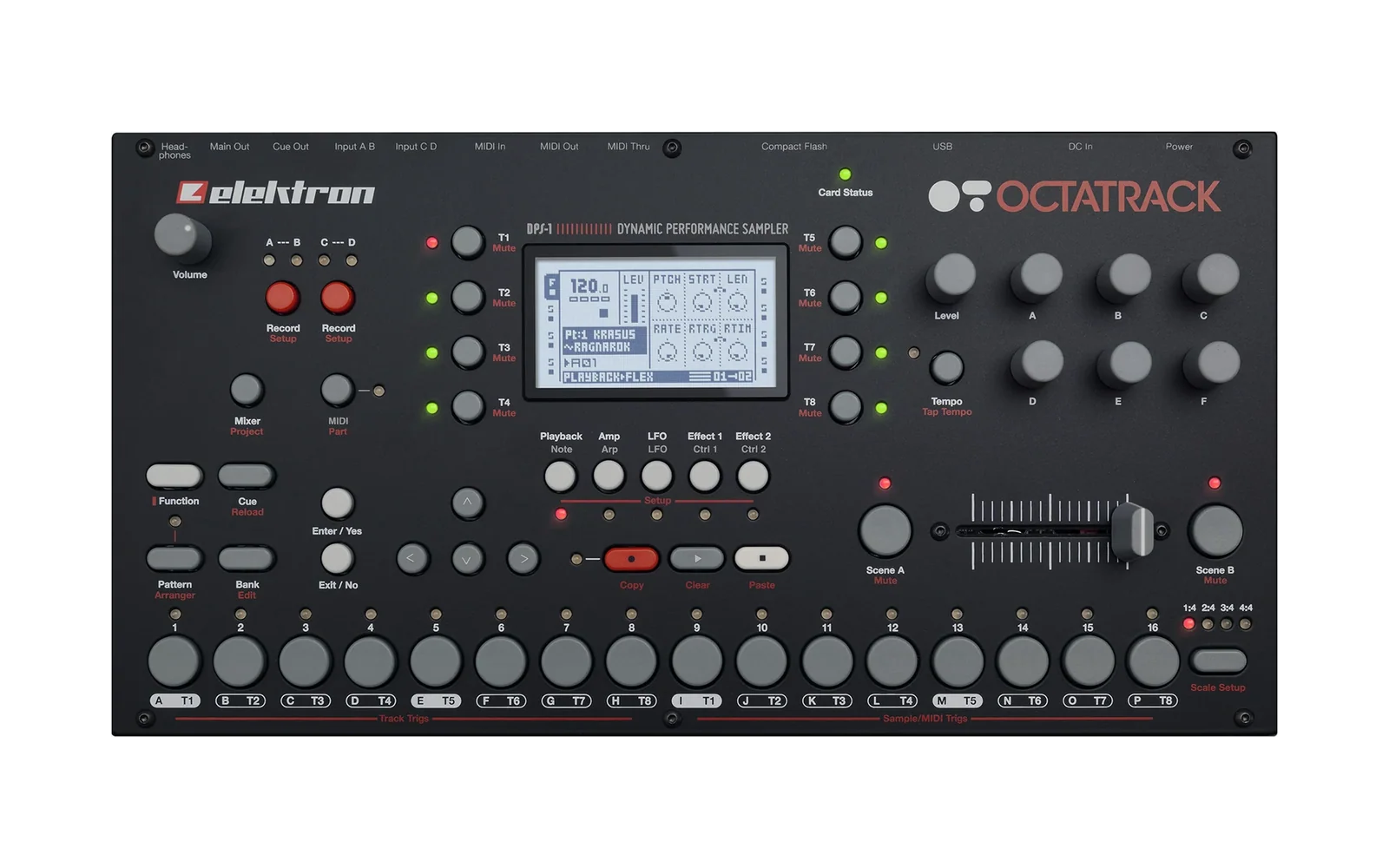
Octaplay
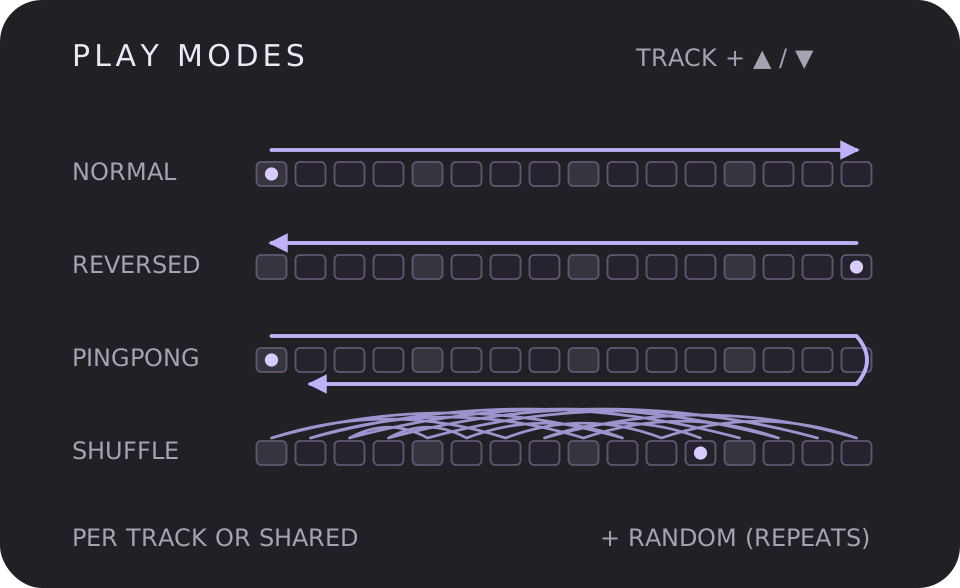
Playhead modes for the Elektron Octatrack: run the sequencer normal, reversed, pingpong (two kinds), random or shuffle, shared by every track or set per track (audio T1–T8 and MIDI M1–M8). A firmware module for original OS 1.40C, built with the octabam / octamod remixer.
Status: experimental. Played on an MKII in test images; not stress-tested. Back up your projects and keep a stock OS file at hand. Flashing modified firmware is at your own risk.
What it does
| mode | 16 steps play as |
|---|---|
| NORMAL | 1 2 3 … 16 (stock) |
| REVERSED | 16 15 14 … 1 |
| PINGPONG | 1 … 16 15 … 2, 1 … 16 …: the end steps play once |
| PINGPONG 2 | 1 … 16 16 … 1, 1 … 16 …: the end steps play twice |
| RANDOM | any step each time; a step can repeat |
| SHUFFLE | every step once per pass, in a new order every pass |
- Hold [TRACK] + [UP]/[DOWN] to change the mode; a popup shows it
(
ALL PINGPONG,T3 REVERSED,M2 SHUFFLE). - SCALE MODE NORMAL: one mode for all tracks, moving together. PER TRACK: each track its own mode, length and scale.
- Each step's trig, trig condition, micro-timing, swing bit and p-locks move with it. The trig LEDs, live recording and lock editing follow the step you hear. Tempo, lengths, pattern changes and chains stay stock.
- PLAY and pattern changes start every track from its first step again.
- Every pattern keeps its own modes. They are saved with the project
(
#PLAY_MODES=lines inproject.work, carried toproject.strdby SAVE), survive a power cycle and go along with pattern copy / paste; clearing a pattern resets them. (Not combinable with PLOCKS P2.)
Full description, controls and limitations: playmodes/README.md.
Building a test image
You need an octamod (or octabam) checkout that already builds images: the
m68k-elf toolchain, the vendor tools (make setup) and your own original
OS 1.40C (make os / make recon, or your existing out/raw and
downloads/extracted). No firmware is included here or should ever be
committed.
# 1. host tests, then the ColdFire unit
python3 playmodes/verify.py
python3 playmodes/generate.py

# 2. into the remixer (paths relative to octamod's sdk/octabam)
cp -R playmodes/ <octamod>/sdk/octabam/modules/playmodes/
mkdir -p <octamod>/sdk/octabam/remixes/playmodes-test
cp playmodes/test-remix.py <octamod>/sdk/octabam/remixes/playmodes-test/remix.py

# 3. build
cd <octamod>/sdk/octabam
make image REMIX=playmodes-test BUILD=<n>
Flash out/OCTATRACK_OCTABAM<n>.bin from the card (or the .syx over
SysEx) as with any octabam image.
How it works
The stock sequencer keeps counting its steps; Octaplay replaces the step number at the two places the sequencer turns it into "play this step" (audio and MIDI), at the rebuild that runs after edits, and at the UI's "which step is this track on" query. Three more detours read and write the project file's lines, and twenty pattern-copy sites carry the modes along. Every answer is a pure function of (mode, length, pass, step, seed), so look-ahead readers and what the sequencer prepares while stopped agree with what then plays. Thirty-five guarded detours in total; each refuses to build if the stock bytes at its site differ. Details and every address with its source: playmodes/INVESTIGATION.md.
Repository layout
| path | what |
|---|---|
playmodes/ | the module: source, manifest, tests, docs, thumbnail |
playmodes/investigate.py | probe of your own 1.40C: --os <path>/section_3_MAIN_OS.bin, writes to out/ (Elektron code: never commit it) |
Credits and licence
By devilfish707, MIT (LICENSE). Built on the reverse-engineering and tooling of octabam (Sam Banks), SCALE QUANTIZER and DIRECT JUMP (Tim Hastie), the KYOTI firmware notes (Zac-Kyoti) and OctaKit (June Kiff). Octatrack is a trademark of Elektron; this project is not affiliated with Elektron, and contains no Elektron code, tables or images.