PassOS
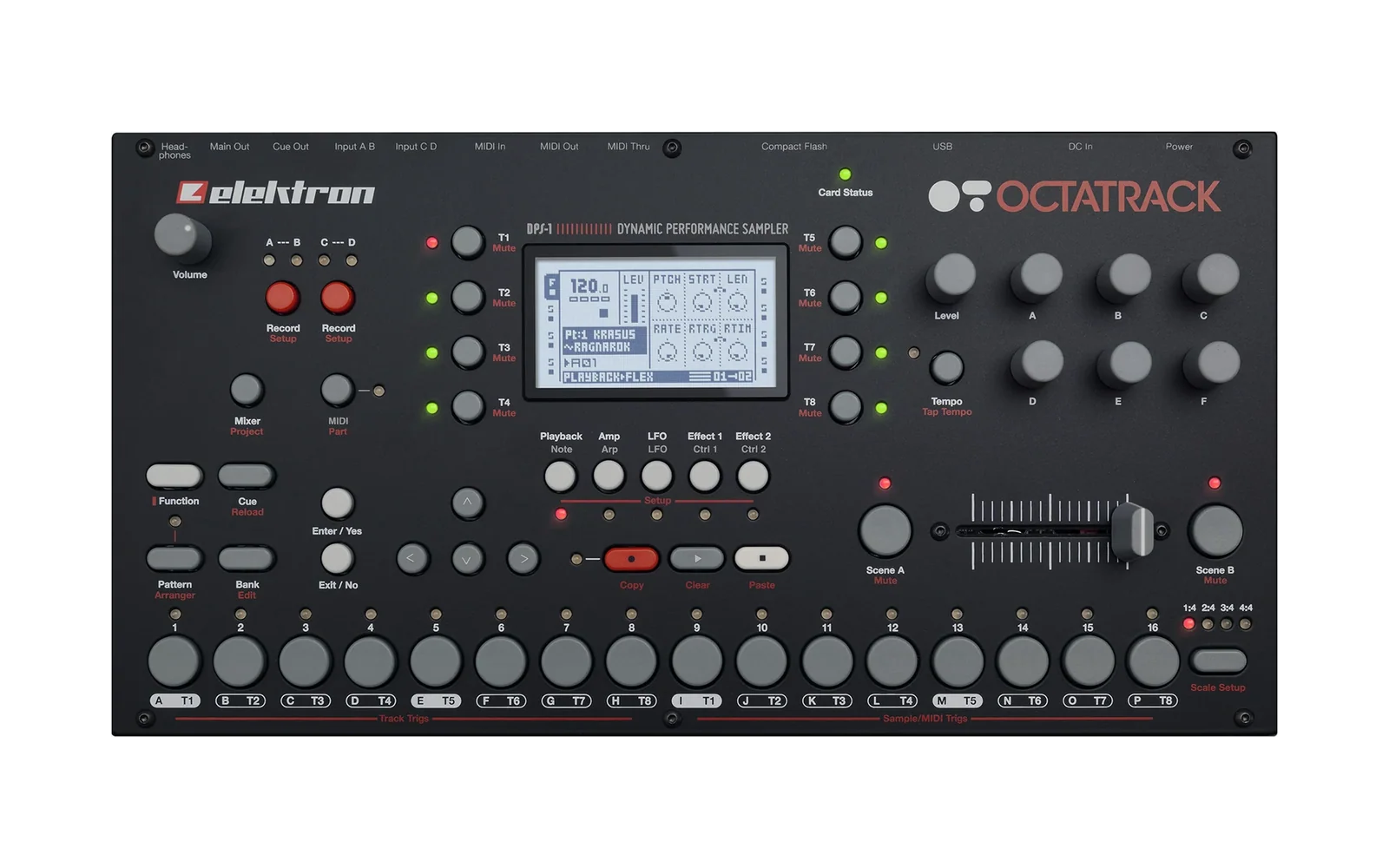
Custom firmware for the Elektron Octatrack MK1 — the passenger mod.
A scale system and a STOP guard, on top of stock OS 1.40C. Every one of the fourteen stock FX2 effects is untouched and nothing is placed on the DSP, so the unit sounds exactly as it always did.
PassOS 1.0 is running on hardware.
Built on octabam by Sam Banks, which composes a firmware image out of your own copy of Elektron's OS 1.40C. Octabam's own README is kept here as OCTABAM.md — read it for how the remixer works, what a module is, and how to write one.
Two rules
No one gets a built image. An image contains Elektron's OS. Share this repository; everyone builds their own from a copy of 1.40C they downloaded themselves. That is the whole design of octabam and it is not negotiable here either. There will never be a firmware download on the releases page.
No Elektron byte in the repository. No image, no slice, no .syx, in a
commit or on an issue. out/ and downloads/ are gitignored for this
reason — check before you add anything.
What it does
The scale system
MIDI NOTE SETUP's two empty cells become SCL and ROT: the Digitone II's thirty-six scales against twelve roots, in Appendix E order, with CHROMATIC at 0 as the off state. The blank box to the left of the row draws the scale's name over a keyboard, a dot on every note of the scale and a tick under the root.
The NOTE page's four note cells then reach only notes of that scale. NOT2–4 are offsets biased by 64 from the track's own NOTE, so they snap the note they sound, and an offset of zero stays reachable as OFF. Changing SCL or ROT moves those four onto the new scale.
Every note the track emits is snapped at emit time as well, so trigs written before the scale was chosen play in it without being rewritten — their stored notes are left alone on purpose, because no change of scale could give them back.
The ARP page's KEY selector is switched off: the decode it fed now reads SCL and ROT, so it changed nothing, and a control that changes nothing is worse than no control.
Scale derivations are checked against the Digitone II's own behaviour by
modules/scales/dn2_scales.py --check, which asserts mode-family closure for
every family and, note for note, nine scales read off a real DN2.
RiDylan mode
A new PERSONALIZE row. Ticked, with this unit running as clock master, STOP and PLAY ask before they stop the sequencer. The setting survives a power cycle.
Building
You need your own 1.40C, the toolchain, and a CompactFlash card. Read
OCTABAM.md and docs/remixer/FLASHING.md first — then:
make setup
make os
make image REMIX=the-passenger BUILD=<n>
which writes out/OCTATRACK_PassOS1.0.bin and the matching .syx. The panel
reads PASSOS 1.0; the boot font carries no lowercase glyphs, which is why
the on-device string is upper case while the file name is not.
Read docs/remixer/FLASHING.md before you write either to hardware, and have
a 5-pin DIN MIDI interface working before you flash anything. USB-MIDI to
the Octatrack's own port does not work for OS upgrades, and it is the only
recovery path if a flash goes wrong.
The modules
modules/scales/ | the thirty-six Digitone II scales, self-checking, and NOTES.md — the running research record |
modules/note-scale/ | SCL and ROT, the box, the NOTE-page locking, the quantiser |
modules/stop-guard/ | RiDylan mode |
remixes/the-passenger.py | the remix that is PassOS |
Credit
octabam is Sam Banks', MIT licensed, and its README invites exactly this:
fork it and run it as your own project. OCTABAM.md is his, unedited.
The arpeggiator research that started the scale work is Maxolydian's (octamax). Nothing here is copied from it — octamax carries no licence at all, so every fact used was reimplemented from documented behaviour.
modules/scales/NOTES.md is the honest version of how this was found,
including the measurements that turned out to be wrong and why.