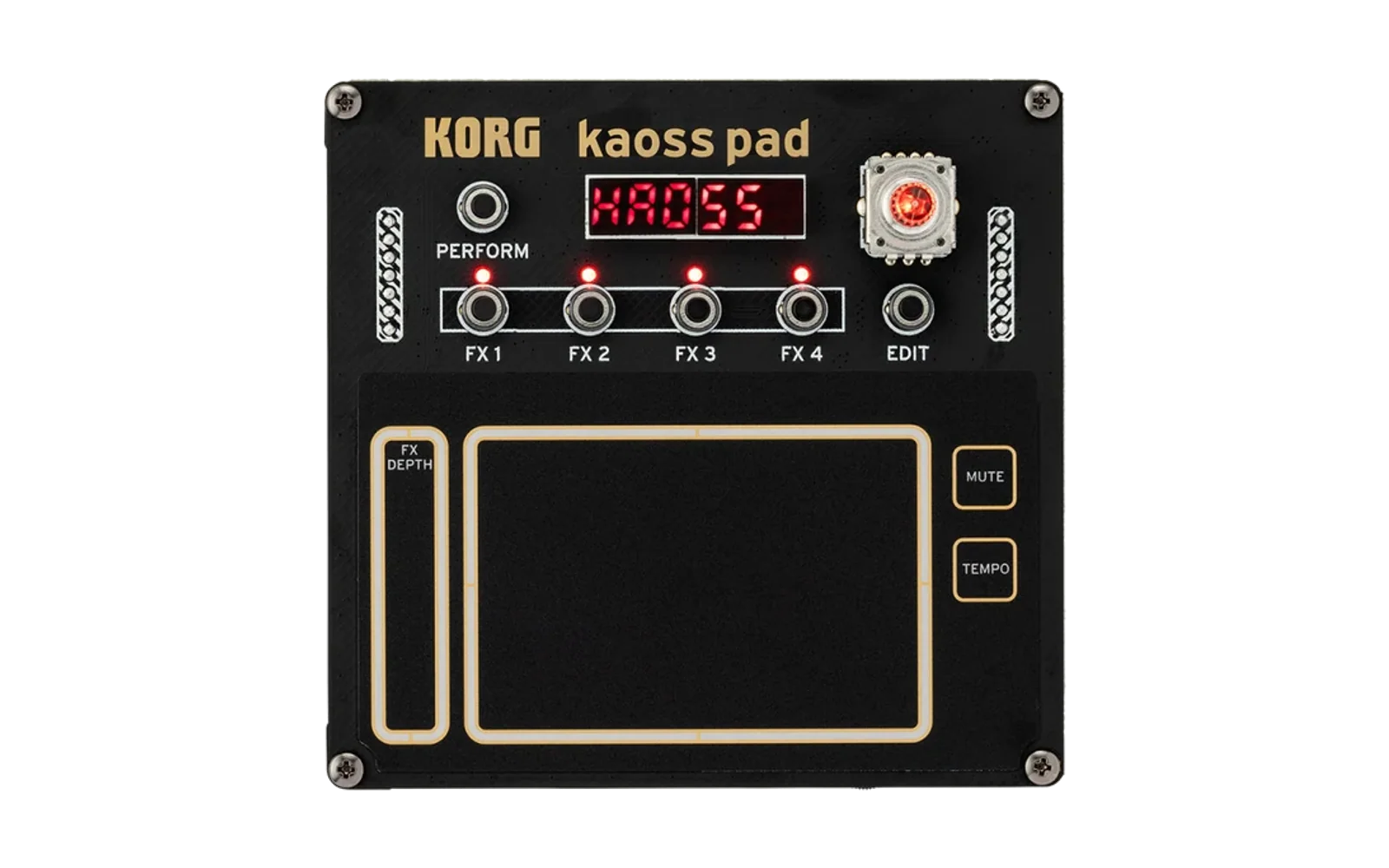
nts3-mutable
Mutable Instruments DSP running as user effects on the KORG NTS-3 kaoss pad kit. The MI code (third_party/eurorack, MIT) is vendored with a short list of changes, each documented in third_party/eurorack/README.md: its memory layout for the NTS-3, Warps at 48 kHz for Meta Mod, Clouds' window alignment search spread over render calls, and two upstream undefined behaviours pinned to the results ARM gives. Each unit adds the glue for the pad.
How the NTS-3 runs an effect (measured on the device, and in the SDK's headers): it calls the effect all the time and always adds its output, and the pad only routes the input. Touching the pad crossfades the input from the dry path to the effect; letting go crossfades it back over the program's Release Time. So an effect that makes sound from silence (Warps' oscillator, Clouds' buffer) mutes its own wet signal while it is off, and Texture records the firmware's raw input meanwhile, as the module records its input all the time. Switching the module off (its FX button) stops the calls altogether. Selecting a unit loads it afresh; the firmware never calls unit_reset() in use (tools/probe, firmware 1.04), so the units only reset their glue there.
Units
Resonator (Rings)
| Control | Parameter |
|---|---|
| Pad X | Note, C2 to C6 in semitones |
| Pad Y | Structure |
| Depth | Mix (dry/wet) |
| Params | Brightness, Damping, Position, Model, Polyphony (1/2/4) |
Models: Modal, Sympath (sympathetic strings), String, FM Voice, Chords (sympathetic strings tuned to the chord picked by Structure), String Rvb.
Touching the pad strums a new voice, and so does sliding to a new semitone. With audio on the input, the input excites the resonator and its transients strum too. With nothing on the input, the internal exciter plucks on touch, so headphones are all you need. Rings is mono in, stereo (odd/even) out.
Texture, Texture Lo-Fi, Texture Stretch, Texture Loop (Clouds)
One unit per Clouds playback mode: granular, stretch (WSOLA) and looping delay, plus Texture Lo-Fi: granular in Clouds' mono 8-bit quality (mu-law samples, a 16 kHz internal rate, about 7 s of buffer).
| Control | Parameter |
|---|---|
| Pad X | Position |
| Pad Y | Size |
| Depth | Mix (dry/wet) |
| Params | Pitch (±24 semitones), Density, Texture, Feedback, Reverb |
Touching the pad fires Clouds' trigger and holds its gate. Clouds keeps recording while the pad is up, so a touch plays from the last second of audio at once; Hold (PERFORM) keeps the effect on. Mix starts at about 75% wet. In granular mode, Density at noon means no grains, so each tap plays one. Outside granular mode, Density sets the diffusion and Texture the filter, as on the module.
Clouds runs at its native 32 kHz between 48/32 kHz resamplers (flat to 13 kHz, at least 83 dB down from 17 kHz, aliases included: host/test_resampler.cc; about 2.6 ms of latency on the wet signal only). The dry signal stays at 48 kHz and passes untouched. Quality is 16-bit stereo with the module's 1 s buffer (mono 8-bit for Texture Lo-Fi), stereo spread at 50%. The spectral mode is not built: it does a whole FFT frame in one call, which a render callback cannot absorb.
Meta Mod and Freq Shifter (Warps)
Meta Mod is Warps: X morphs through its algorithms (cross-fade, cross-folding, diode and digital ring modulation, XOR, comparator, then the 20-band vocoder at the top), Y sets their timbre, Depth the dry/wet. The internal oscillator is the carrier (Note, Carrier shape) and the input is the modulator; with Carrier set to Input L, the left input is the carrier and the right input the modulator. Mod Drive and Carrier Drive are Warps' level knobs. The effect sounds while it is on (pad touched, Hold, the release time after): off, it fades back to the dry input in about 0.1 s, so the internal oscillator does not keep sounding.
Freq Shifter is Warps' easter egg: X shifts every partial by the same number of hertz (center: none, up to about 2 kHz either way, on Warps' own curve), Y is feedback, Depth the dry/wet, and the up and down sidebands come out on the left and right.
Meta Mod runs Warps at the NTS-3's own 48 kHz, with its vocoder bands and oversampling filters redesigned for that rate (third_party/eurorack/README.md). Freq Shifter runs Warps at its native 96 kHz between 2x resamplers, so its Hilbert filters work as designed.
Build
ARM units build on a machine with the logue SDK and its pinned toolchain
(~/src/logue-sdk, tools/gcc/get_gcc_10_3-2021_10_linux.sh):
scripts/build.sh            # all units, results in dist/
scripts/build.sh resonator
NTS3_BUILD_HOST picks the SSH host (default pc).
Load dist/*.nts3unit with KORG KONTROL Editor: drag the file onto the user
effects list and press SEND.
Web page
web/ is a static page that plays the units in the browser: an XY pad with
the live output spectrum, the unit's knobs (built from its own header), test
loops synthesized in the page, your own file or live input, meters, and
recording to WAV. Each unit is compiled from the same sources to standalone
WebAssembly (web/glue.cc, about 60 KB) and runs in an AudioWorklet, so the
page needs no special server headers and works on any static host or in an
iframe.
scripts/web.sh # builds web/units/*.wasm, serves http://localhost:8791/
URL parameters: unit (resonator, texture, texture_lofi, texture_stretch,
texture_loop, metamod, freq_shifter),
p (parameter values joined with dots), src (beat, chords, plucks, noise,
silence), file (an audio file on the same site, played in place of a loop;
web/local/ is git-ignored for files of your own) and embed=1 (no header or
footer, for an iframe). The address bar
always holds the current sound, so it doubles as a preset link.
host/webtest.mjs drives the page in a muted headless Chrome: it starts audio,
plays the pad on every unit, reads the meters and saves screenshots.
KORG's browser simulator
scripts/sim.sh resonator # builds with emscripten on the build host
serves http://localhost:8790/ (index of the built units): KORG's websim page with an XY pad, sample loops and a test keyboard, running the unit's code. The page starts at volume 0.05.
Offline tests
host/ builds a unit natively and drives it through the same unit_* entry
points as the firmware:
cd host && make UNIT=resonator
build/resonator/harness -i in.wav -s script.txt -l 8 -o out.wav
Input is 48 kHz WAV (16-bit or float). Script lines are
<seconds> param <id> <value> or <seconds> touch <began|moved|ended>.
The harness prints peak/RMS per second and the render time.