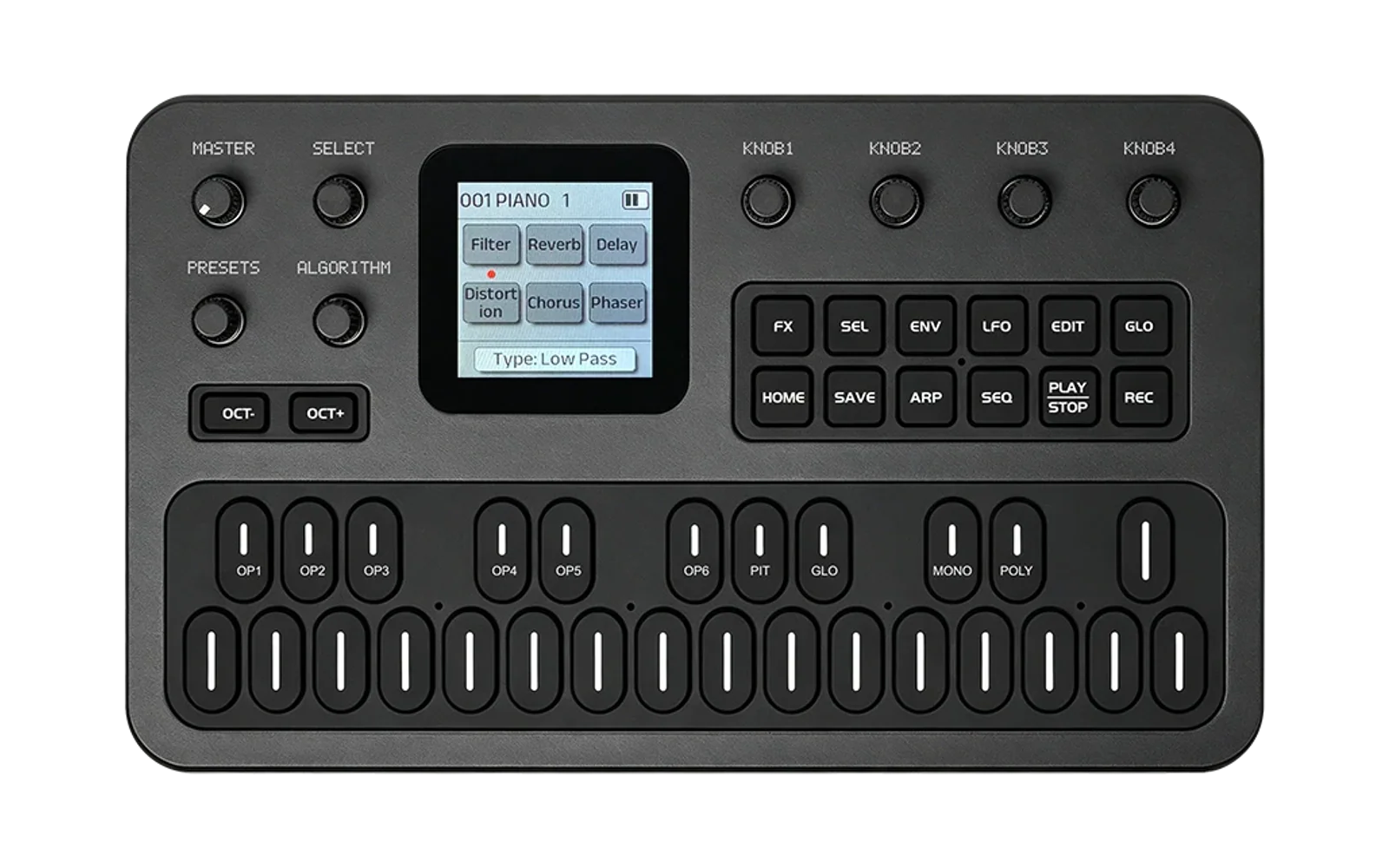
Felucca — MPE fork

A fork of hugelton/Felucca 1.6.1 that adds MIDI Polyphonic Expression (MPE) to the M-VAVE FM-1: per-note pitch bend, pressure and timbre from an MPE controller such as a LinnStrument. Felucca's engines, sequencer, effects and every other UI page are untouched — the full host test suite passes on byte-identical golden renders — MPE is an additional MIDI IN routing on top.
The MPE work lives on the mpe branch (the repo's default branch).
MPE mode
Select MENU > MIDI > MIDI IN → MPE (appended to CH1-4 / SEL / CH5-8 / CH9-12 / CH13-16 / TRACK;
value 6). On the same page the T1 CHANNEL row becomes BASE CH in MPE mode: it sets the lower zone's first
member channel, CH1…CH16, default CH2. Both settings are live (a reboot returns BASE CH to CH2).
MPE follows the spec's single lower zone: the master channel (1) stays outside, every member channel from BASE CH upward plays one instrument on the MPE part's voice pool. MPE takes over — the MPE part owns the whole voice budget (NVOICE, 8 by default) in this route.
Per note, per MIDI channel (each channel bends/pressures/timbres only its own voices):
| Dimension | MIDI | What happens |
|---|---|---|
| Pitch | Pitch Bend | per-note bend, RPN 0 range 0..96 semitones, applied without smoothing |
| Pressure | Channel Aftertouch | per-note brightness (the voice's filter cutoff) |
| Timbre | CC74 | per-note brightness via the engine's cutoff / MLVL; on FM6 an extra per-voice 1-pole low-pass |
Notes pass 1:1 to the MPE part — chord, arp and live recording are bypassed. Reset All Controllers (CC121) and any route or BASE CH change that moves a channel out of the zone release its notes and recentre its bend, pressure and timbre.
Playing MPE
Put an MPE controller in a single-zone layout on consecutive channels (e.g. a LinnStrument covering channels
2..16), set MIDI IN = MPE, leave BASE CH at CH2, and play: hold a chord and bend one note — the others
stay put. Most MPE controllers send RPN 0 = ±48 at configure time; it is honoured over the full 0..96 range.
Browser emulator (MPE in the browser)
The firmware compiles to WebAssembly, and Web MIDI input is wired into the real firmware MIDI path
(web_midi → midi_enqueue), so MPE is fully exercisable with no FM-1 and no cable:
./build.sh                  # build/gen tables first (once)
web/emu/build.sh            # needs Emscripten (emcc); → build/emu/felucca.wasm
python3 -m http.server -d build/emu 8790   # then open http://localhost:8790 in Chrome/Edge
Click Switch on, allow MIDI access, choose the controller, and set MIDI IN = MPE on the virtual panel
(hold HOME to open the menu; ALGORITHM steps the tabs). Notes: the emulator runs one core (the FM-1's
second core is not emulated); USB audio out, the editor protocol, firmware updates and TRS MIDI are not emulated.
Load an FM6/DX7 bank with the Load FM6 bank button below the panel, or by
dragging the file onto the page (a 4096-byte bank, or the 4104-byte sysex-framed
dump most sites host): the firmware's own staged-bank flow commits it to flash
0xE7000, so FM6 SLOT B1..B32 pick the voices at once — the same file the FM-1's
web editor later flashes. The loaded bank is kept with the emulator's saved flash
across reloads.
The DX7-bank MPE shortlister
A host tool that reads a standard DX7 bank — the 4096-byte bank the web editor sends (or the 4104-byte sysex-framed dump most sites host) — scores every voice's fit under MPE (per-note pitch bend, pressure, CC74 timbre), and can assemble a new bank from the top picks — so a large DX7 archive collapses to a shortlist to audition:
python3 tools/dx7_mpe_bank.py BANK.syx [--top 24] [--json]   # score one bank
python3 tools/dx7_mpe_bank.py scan DIR [--top N] [--json]   # a whole tree, deduped
python3 tools/dx7_mpe_bank.py make OUT.syx DIR [--top 32] [--fill]   # a new bank from the top (--fill: one per category)
Signals: LFO pitch-mod depth (built-in vibrato fights per-note bend), fixed-vs-ratio
operators (ratio chords bend in tune), carrier envelope shape → PAD / E.PIANO /
PLUCK / BELL / BASS / OTHER, feedback, output levels. The scoring is conservative
guidance (weights calibrated by listening — see the project plan), and its unit
tests run with the host suite (tools/test_dx7_mpe_bank.py in tests/run_tests.sh).
The end-to-end flow: get the curated DX7 library (sysexFinal.zip, MiniDexed
discussion #456), scan it (a few seconds — ~36k unique voices), make OUT.syx <tree> --top 32 --fill for a category-balanced bank (a plain greedy top
collapses to EP ties on the EP-heavy corpus), then drop the bank on the browser
emulator above — or flash it to the FM-1 later via the web editor's FM6 tab.
Voice budget
NVOICE (8 by default) is a build-time override: NVOICE=12 ./build.sh (or 16) raises the shared voice pool.
Rendering the higher voice counts across the FM-1's two cores is a separate work item (see the project plan).
Building and installing
Building needs the JieLi pi32v2 toolchain and the AC79 SDK — see BUILDING.md. On macOS the
Linux-only toolchain runs in a Docker container; the project's BUILD-NOTES.md documents the environment
quirks (DOCKER_CONFIG, a venv for Pillow/fontTools).
Install a built package over USB:
python3 tools/fm1_install.py build/felucca.fwsc
or through a web installer in Chrome/Edge. Note: upstream Felucca's installer and editor serve that project's own releases — use them only to return to stock Felucca; for this fork, build and flash from source (or a release here).
If an install fails and the FM-1 no longer starts, recovery needs FM-1-transporter.
Upstream, credits and licence
Fork of Felucca 1.6.1 by Leo Kuroshita (@kurogedelic), Hügelton Instruments
(upstream · wiki).
Free software: GPL-3.0-only; the Hügelton Sample Pack is CC0 1.0; the engines in firmware/engines
are MIT (Felucca-Engines); the bundled fonts and ported DSP keep
their own licences (LICENSES/, LICENSING.md). Thanks to everyone whose work is in
it: CREDITS.md. The MPE additions are the fork authors' work, GPL-3.0 like the rest.
AI-assisted development: like upstream, this fork is developed with the assistance of AI coding agents; no generative AI is used for music, icons or artwork.
M-VAVE and FM-1 are trademarks of their respective owners. This firmware is not affiliated with or endorsed by them.
Copyright (C) 2026 Leo Kuroshita (@kurogedelic), Hügelton Instruments; MPE additions © 2026 the fork authors.