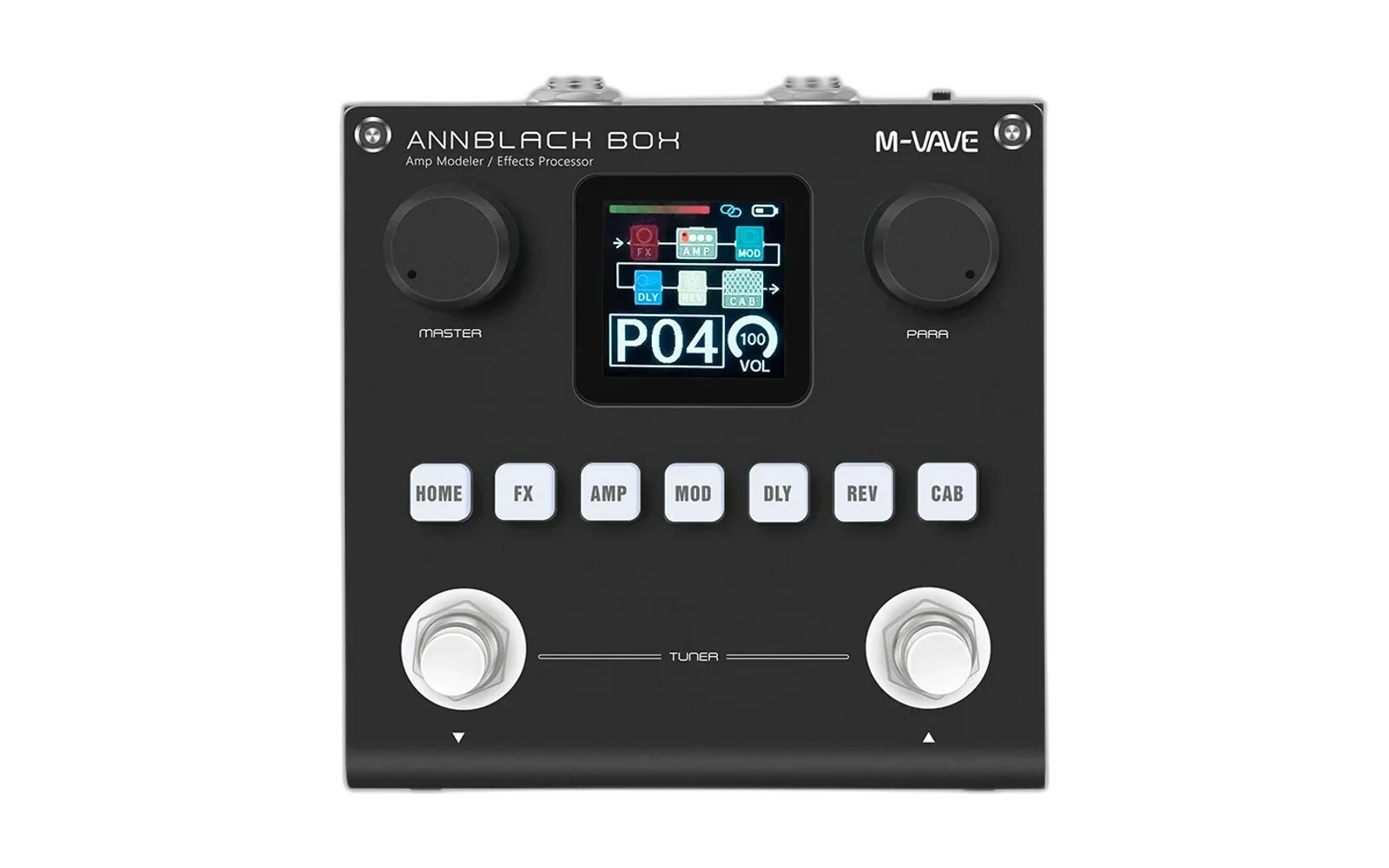
M-VAVE ANN BlackBox reverse engineering
Independent, community-oriented documentation and read-only tooling for the M-VAVE ANN BlackBox. This project investigates the device firmware, runtime layout, USB Audio implementation, BLE/M-EFCS protocol, OTA behavior, and audio/DSP architecture using reproducible evidence.
The repository is not limited to one modification or firmware version. It is intended to grow as new firmware, protocol findings, hardware observations, and independently reproduced results become available.
[!WARNING] This project does not ship M-VAVE firmware, decrypted images, APKs, or modified firmware. The tools inspect files you already obtained lawfully. No firmware image produced during the investigation is recommended for flashing.
[!NOTE] This is a research archive maintained on a best-effort basis. Individual technical support, device troubleshooting, and response-time guarantees are not provided. Findings may be corrected as the analysis progresses.
Start here
- Research status: current coverage, confidence, and open questions across the project.
- V20 address map: image landmarks and application to runtime address translation.
- Complete V20 structural map: whole-image decoder coverage, generated call map, strings, pointers, and remaining semantic work.
audio_devand runtime lists: device objects, handles, callbacks, and intrusive-list lifecycle.- DAC client census: complete V20 backend census, registration templates, callbacks, and current identity limit.
- DAC handle propagation: where returned handles survive and whether stock M-EFCS can observe them.
- USB Audio: playback/capture endpoints and formats.
- BLE/M-EFCS protocol: observed framing, commands, transports, and access limits.
- OTA observations: updater behavior and safety boundaries.
- MaskROM/UBOOT1.00 entry: retained boot marker, reset paths, callers, and stock reachability.
- Methodology: evidence levels and reproducible workflow.
- Selective local-monitoring research: one active audio-routing investigation and its rejected approaches.
Current technical baseline
- V20 application offsets map to runtime addresses with
runtime = app_offset + 0x02000120. - The V20 image has a reproducible whole-image structural map: 222,490 decoded instructions cover 94.2426% of 655,712 bytes, with 2,169 candidate function entries and 12,152 resolved direct call sites.
- The
audio_devstring is at application offset0x5BC1A(runtime0x0205BD3A). Its immediate load begins at0x43328;0x4332Alies inside that six-byte instruction and is not an instruction boundary. - USB Audio endpoint
0x02 OUTcarries host-to-device playback and endpoint0x83 INcarries device-to-host capture. Both descriptors specify stereo, 24-bit, 44.1 kHz audio. - Task entries at application offsets
0x40530and0x41EC6are associated withaudio_encoderandaudio_server, respectively. The former uses intrusiveLIST_A; the DAC renderer uses a separate per-client list. - The DAC renderer at
0x4A698uses the client list at0x01C0DC3C. Two registration templates were recovered at0x409DAand0x418E0, but V20 does not statically bind their runtime instances to USB playback and local DSP as two distinct identities. - DAC-open handles remain in their heap-owner fields and owner lists. No copy
into a stock-readable
DEV/M-EFCS family, UAC speaker object, or fixed identity field was found. - V20
DEVreads expose specific bounded families, including a patch snapshot and a one-byte Computer Loopback state. They do not expose arbitrary SRAM. - BLE and USB expose related M-EFCS messaging through different transports; observed commands do not yet provide a complete control map.
- V20 contains an exact retained-marker writer equivalent to
nvram_set_boot_state()at0x93932, but it has no static caller or pointer reference. The reachable USB-HID OTA reset follows a different normal-update path; no stock software entry to UBOOT1.00 was found.
These statements summarize the present evidence, not a finished semantic map of the firmware. The linked documents separate verified results from strong inferences, hypotheses, and rejected interpretations.
Research areas
| Area | Current coverage | Status |
|---|---|---|
| Firmware V20 | Whole-image structural pass, calls, strings, pointers, gaps, reviewed landmarks | Structurally mapped; semantic naming active |
| Runtime architecture | Task identities, objects, DAC client census, handle propagation, bounded DEV reads | Structurally reconstructed; two runtime identities unresolved |
| USB Audio | Endpoint direction, descriptors, formats, host observations | Core facts verified |
| BLE/M-EFCS | Framing, transport behavior, selected commands and memory spaces | Partial protocol map |
| OTA/updater | Package behavior, retained boot marker, normal OTA reset path | Stock UBOOT1.00 route not found; not recovery-safe |
| Audio/DSP routing | Output/capture structures and lifecycle candidates | Active research |
| Selective local monitoring | Separate DSP-local contribution while retaining both USB paths | Open question |
| Tooling | Read-only inspection and synthetic regression tests | Available |
Selective local monitoring is one application of the broader architecture research. Its detailed target, evidence matrix, and current next steps live in the dedicated research note, rather than defining the scope of the repository.
Repository layout
| Path | Purpose |
|---|---|
docs/ | Architecture, protocol notes, research threads, and status |
analysis/v20/ | Reviewed seeds and generated non-byte-bearing structural map |
tools/ | Read-only firmware inspection utilities |
tests/ | Synthetic tests containing no vendor data |
Reproduce
Run from the repository root:
python3 tools/blackbox_inspect.py path/to/BlackBox_app_decrypted.bin
python3 tools/blackbox_inspect.py --json path/to/BlackBox_app_decrypted.bin
python3 -m unittest discover -s tests -v
python3 tools/check_repo.py
The inspector never writes to the input image. It reports hashes, known ASCII landmarks, USB Audio endpoint descriptors, and application/runtime address translations.
The full mapping pipeline and the required local-only PI32v2 decoder workflow
are documented in analysis/v20/README.md.
Evidence policy
Technical statements use four confidence levels:
- Verified: reproduced from bytes, logs, or controlled device tests.
- Strong inference: multiple observations agree, but identity or semantics remain incomplete.
- Hypothesis: a useful lead requiring a discriminating test.
- Rejected: contradicted, unsafe, or too broad for the intended operation.
No claim is made that this project is affiliated with or endorsed by M-VAVE, JieLi, Sinco Audio, or their partners. Product names are used only for identification and interoperability research.
Contributing
See CONTRIBUTING.md. Do not submit copyrighted firmware, APKs, device serial numbers, private logs, credentials, or instructions to flash unreviewed images.
License
Original documentation and tools in this repository are released under the MIT License. This does not grant rights to third-party firmware, applications, trademarks, or other vendor material.