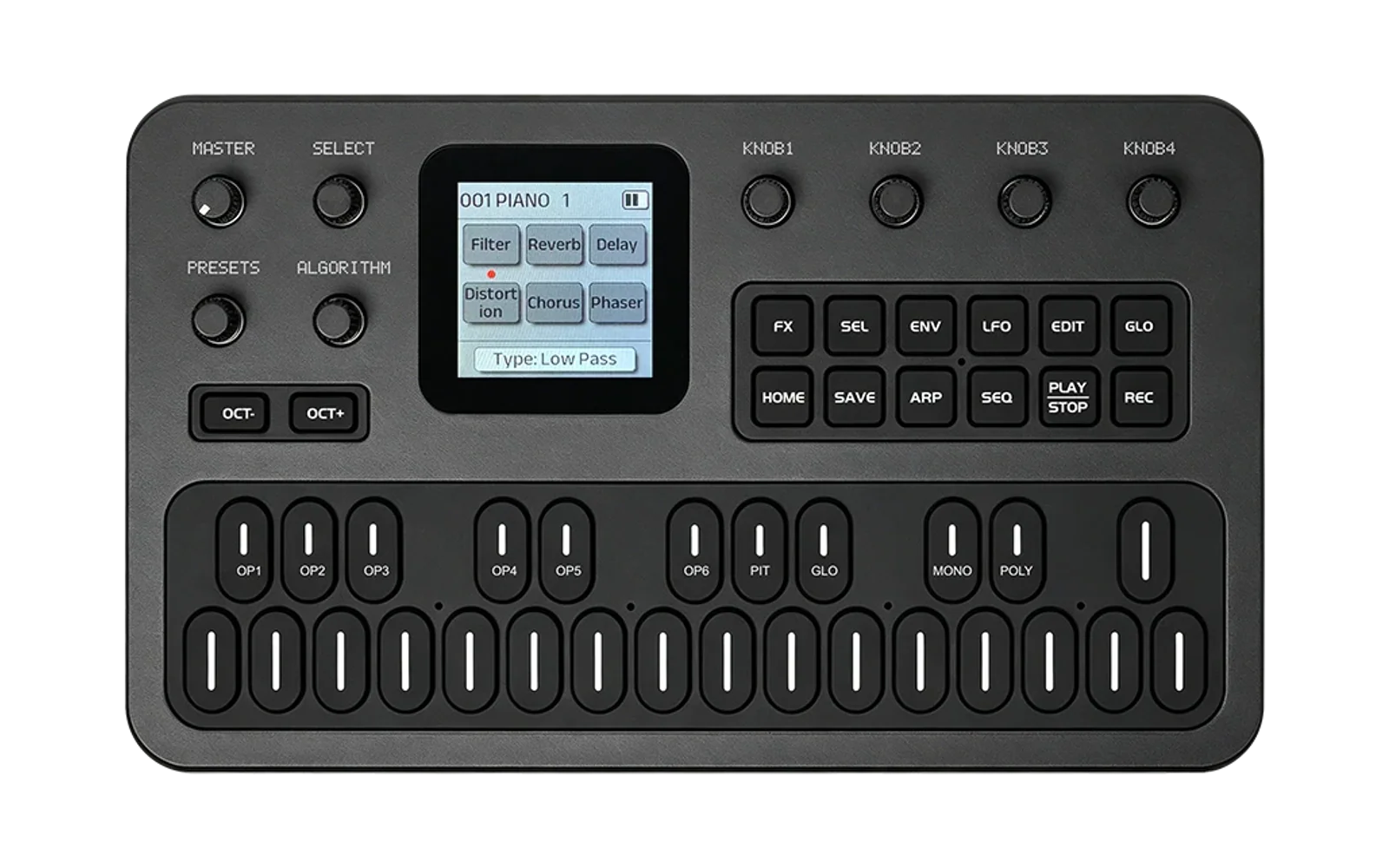
Monohull
A monosynth firmware for the M-VAVE FM-1: one voice with no per-voice compromises, on the FM-1's 240 MHz pi32v2. Analogue-modelled oscillators and five filters (transistor ladder, diode ladder, OTA cascade, Sallen-Key, state-variable), unison, chorus, delay and reverb, with a scheduler that spends whatever CPU the patch leaves over on the extras. The design, its references and its measurements are in docs/spec.md.
Status: tested on a real FM-1, and it runs in fm1-emu and in Harbor (an FM-1 emulator for Android). Felucca's README says how to recover a unit whose update was cut off.
Install
The update package, monohull.fwsc (identity FM-1_928), is on the releases page. Load it into
Harbor or fm1-emu, or install it on an FM-1 over USB with Felucca's installer:
git clone --recursive https://github.com/markterm/monohull
pip install mido python-rtmidi
python ext/Felucca/tools/fm1_install.py monohull.fwsc
Over USB it is a class-compliant MIDI device, "FM-1 Monohull" (identity FM-1_928), so a computer
can play it, and the installers (Felucca's web installer, the Firmware Hub, fm1_install.py) install
another firmware over it as they do over Felucca. If that ever fails, hold OCT- and OCT+ for 3 s
for the FM-1's own USB update mode; three failed boots in a row start it too.
Monohull keeps nothing in the flash: no saved patches yet, and it never reads, changes or erases another firmware's projects or samples (the only part of the flash it may write is the update's staging area).
Layout
dsp/                 the synth in C99: no HAL, no allocation, no libm in the audio path
  mh_synth           the engine: patch, notes, glide, mod matrix, unison, the signal path
  mh_osc             saw / pulse / triangle / sine morph, BLEP / BLAMP corrected, sync, TZFM, sub
  mh_ladder          the transistor ladder: TPT stages, Newton (High) or cheap solve (Efficient)
  mh_svf             the 12 dB state-variable filter
  mh_diode           the diode ladder (the 303's)
  mh_ota             the OTA cascade (Roland's IR3109), on the ladder's solver
  mh_k35             the Sallen-Key (Korg's KORG-35), Pirkle's model as Surge ships it
  mh_delay           the ping-pong delay
  mh_reverb          Mutable Instruments' reverb (Rings), ported to the bit
  mh_env, mh_lfo     RC-shaped ADSR, LFOs
  mh_chorus          Juno BBD chorus (I, II, I+II) and a tri-phase ensemble
  mh_resample        HIIR-style polyphase halfbands
  mh_params          every patch parameter by name, with range and MIDI CC
  mh_tables          generated: BLEP / BLAMP tables, halfband coefficients
host/                the same C built for the host (MSVC via cargo): tests, references, demos
firmware/            the FM-1 firmware: main.c (panel, pages, scheduler, core 1), presets.h
  usb_ota.c          USB-MIDI and the update path: Dinghy's platform code (plat/, hal/), by zvenson
                     after Felucca, SLOOP and OberVave (GPL-3.0)
ext/                 sources the ports are checked against (Mutable's, Surge's, Open303's) and
                     Felucca (a submodule: its hardware layer, startup and update loader)
tools/build_fw.py    builds the firmware and its update package
tools/gen-tables/    writes dsp/mh_tables.{h,c}
Building
git submodule update --init
python tools/build_fw.py                  # build/fw/monohull.fwsc
build_fw.py needs JieLi's pi32v2 toolchain (Windows: C:/JL, or set JIELI_PI32; see the
spec's §11) and Pillow, which draws the LCD font from Cascadia Mono (Windows' copy, or set
MONOHULL_FONT). It downloads the three files of JieLi's AC79 SDK (Apache-2.0) the
package needs into ext/ac79sdk and checks their hashes.
The DSP also builds for the host (Rust with MSVC or any C compiler cc-rs knows), for tests and renders:
cd host
cargo test --release -- --nocapture       # the spec's tests, with their measurements
cargo run --release --bin render          # demo WAVs in host/out (24-bit, both qualities)
cargo run --release --example selfosc     # self-oscillation pitch per note and resonance
cargo run --release --example audit       # every factory patch: loudness, peaks, drive, low end
cargo run --release --example demo        # every factory patch dry, then wet (out/presets-demo.wav)
cargo run --release --example compose     # a short piece on RING BELL, PWM CHORUS, FAT BASS
cargo run --release --manifest-path ../tools/gen-tables/Cargo.toml   # from the repo root
Licence: GPL-3.0 (the firmware builds on Felucca's GPL-3.0 HAL). Borrowed designs and their licences are credited in the source and in the spec's references.