MNM-1

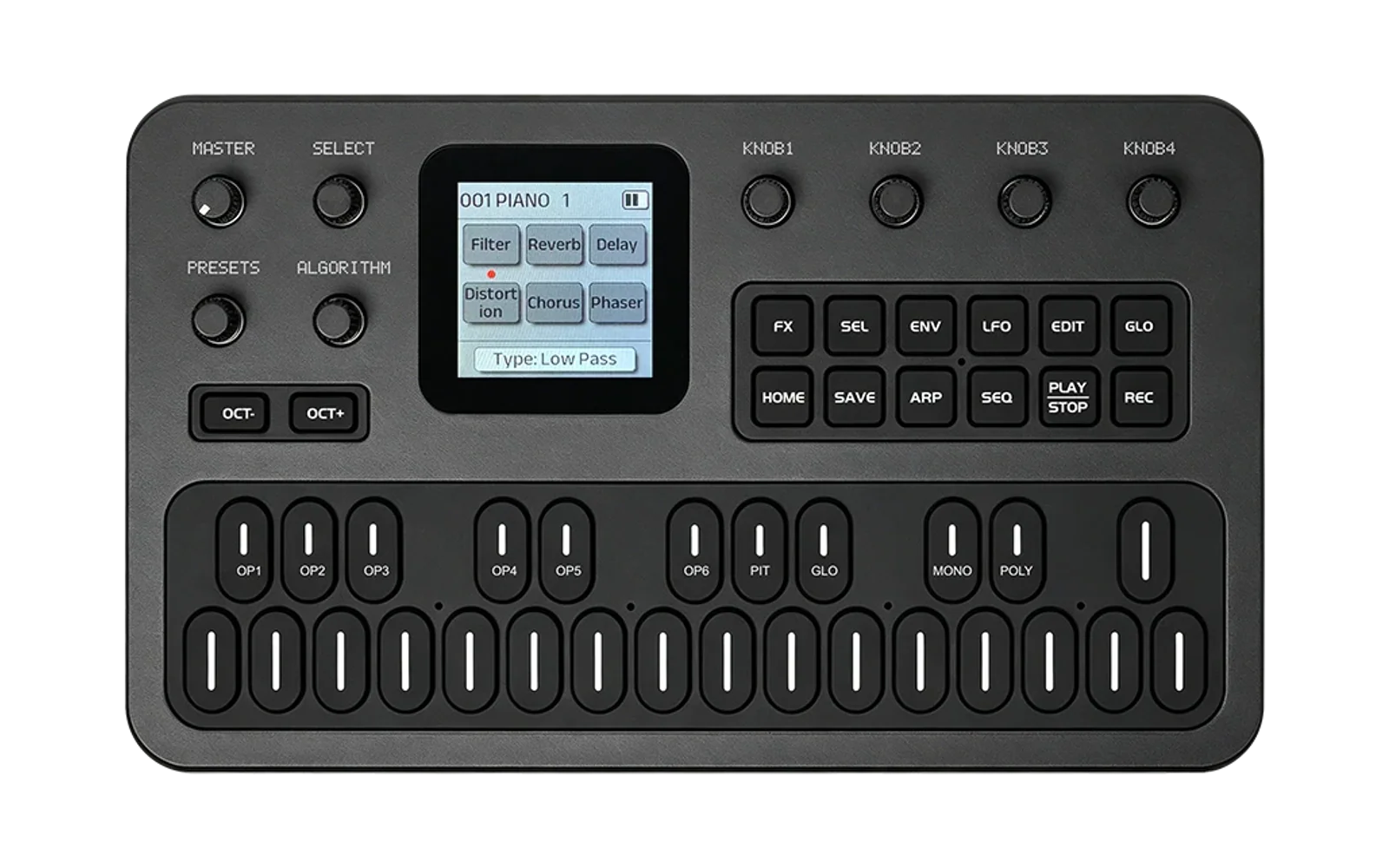
A six-track synth firmware for the M-VAVE FM-1. Six monophonic tracks of synth and FX machines, pages of eight knobs, a resonant HP/LP filter and a tape delay on every track, three LFOs a track, parameter locks and parameter slide, all on the FM-1's own keys, knobs and screen.
MNM-1 is inspired by and forked from Hortator by DEADACTIVE (0.23.3), which is built on Felucca by Leo Kuroshita (Hügelton Instruments). Hortator's sequencer, project storage, screen, PERFORM effects and compressor carry over; the tracks, machines and pages are MNM-1's own. Calibrated audio algorithms and 120 complete sounds are ported from MONO2K by Inigo Hernandez (GPL-3.0-only).
- Play it in your browser: https://galfaroth.github.io/mnm1/. The page runs the real firmware, compiled to WebAssembly, on an FM-1 you can play with the mouse, a touch screen or the computer keyboard.
- Install it on your FM-1: https://galfaroth.github.io/mnm1/webapp/installer/, in Chrome or Edge, over the
FM-1's USB cable. Or from a terminal:
python3 tools/fm1_install.py mnm1-1.0.1.fwsc --port FM-1 --yes(needsmidoandpython-rtmidi). - What comes next: docs/ROADMAP.md.
- What changed: CHANGELOG.md.
Beta. MNM-1 has been tested on one FM-1 only. You install it at your own risk: the author accepts no responsibility if your FM-1 is damaged or misbehaves. M-VAVE's own updater takes you back to the official firmware (below).
What it does
- Six tracks, one machine each. Synth machines: SWSAW, SWPLS (SuperWave), SID, FM+, DPRO, GND, VO-6. FX machines: THRU, REVRB, CHRS, DYNMX, RING, PHASR, FLANG. Any machine on any track.
- Calibrated machines: G-SIN, GPRC, SID2, FMST, FMDYN, SAW2, ENS, WAVE, VOX2, FMPAR, PUL2, CHO2,
RING2, DYN2, NOISE, DKICK, DSNAR, DHAT and DCYMB. These keep their own complete audio chain and parameter laws;
the original models remain available for saved projects. VOX consonant/switch controls marked
n/aare not implemented. - More effects: STRNG, PIPE, CHORD and MODAL machines; the LOFI page adds tape, adaptive crunch, hiss/dust and drive. REVERB TYPE adds STEREO. Calibrated tracks also expose DESTROY and MOD FX pages.
- Routing. An FX machine takes the previous track (NEIB) or a bus (AB, CD, EF) as its input, as an insert or a send and return. Each track's OUT picks its bus, or none.
- 8-knob pages. SYNTH, AMP (ATK HOLD DEC REL / DIST LVL PAN PORT), FILTER (BASE WDTH HPQ LPQ / ATK DEC BOFS WOFS), EFFECTS (EQF EQG SRR DTIM / DSND DFB DBAS DWID), LFO 1-3 (PAGE DEST TRIG WAVE / MULT SPD INTL DPTH). Two rows of four on the FM-1's four knobs.
- Filter: a resonant high-pass into a low-pass, each with its own Q, tracking the note, with an AD envelope.
- Tape delay on every track: tempo-synced, ping-pong or stereo, feedback up to self-oscillation.
- Three LFOs a track: any knob of the track, another LFO, or pitch; FREE, TRIG, HOLD, ONE, HALF; eleven waves.
- Parameter locks: a lock lasts until the next trig; up to 240 a project, recorded live or set in LOCK mode; parameter slide glides locked values to the next lock.
- Presets: 330 factory sounds: 210 existing/extended presets, 24 complete sounds in SOURCE and 96 in ARCHIVE. The PRESETS knob steps through them; hold EDIT for the list. Audition/cancel restores the complete sound. Calibrated sounds have separate AMP VOL and mixer LEVEL, and LFO target/phase controls. The existing 128 USER slots store complete sounds after expanded-library migration; unmigrated storage retains its legacy format.
- Calibrated live input: channels 1–6 play the corresponding calibrated track chromatically; held keys feed its arpeggiator. The original drum-channel mapping stays available.
- From Hortator: up to 64 steps per track with its own length, PROB and A/B conditions, ratchets, accents, a per-track arpeggiator, live recording, mutes, SONG, the COMP sidechain compressor, PERFORM (live master effects), MIDI and clock over USB and TRS, MIDI LEARN, and compatible legacy project loading.
- Expanded library: eight patterns, eight independent kits and 128 full user sounds after explicit migration. The library replaces sample slots 2 and 3; sample slot 1 remains. See the storage plan.
- Sequencing: independent AMP/FILTER/LFO trig lanes, note-off and trigless events; swing masks, fractional speeds, KEY/SID/ADD arpeggiation with a 16-step rhythm, and track/pattern transpose.
On the panel
| Button | What it does |
|---|---|
| EDIT | SYNTH (the machine's 8 knobs), then AMP, then TRACK (MODEL, NOTE, OUT, IN, GATE, sends). Press again for the next row or page |
| ENV | FILTER |
| FX | EFFECTS, SLICER, REVERB, CHORUS, LOFI; calibrated tracks also DESTROY and MOD FX. Hold for PERFORM |
| LFO | LFO 1, 2, 3 |
| ARP | existing ARP, then ARP MODE, ARP TRIG and ARP RHYTHM |
| SEQ | STEP, PATTERN, MOTION, SONG, SWING MASK and TRANSPOSE |
| HOME | a tap: TRACKS (levels, lengths, pans) or HOME (the scope; SELECT on to COMP). Hold: the menu |
| GLO | a tap: global settings; held: the white keys mute tracks |
| SAVE | patterns (save, load, name), tools and independent KIT slots |
| SCL (SEL) | KEYS on / off: the keys play the selected track (on at power-on); OCT- / OCT+ set the octave |
| REC | arm recording; on STEP, stopped, with KEYS on: step record |
| PLAY | start / stop |
ALGORITHM picks the track. SELECT changes the track's machine on the 8-knob pages, turns pages elsewhere, and sets the tempo on TRACKS. KNOB 1-4 edit the lit row.
Steps and locks
- On STEP, tap a white key to turn a step on or off; OCT- / OCT+ change the bank of 16.
- STEP knob 2 chooses ALL, AMP, FILTER or LFO. Hold a step and turn SELECT to choose its trig type.
- Hold a step: KNOB 1 its chance (PROB), KNOB 2 ratchets, KNOB 3 accent, KNOB 4 SLIDE.
- LOCK mode: hold a step and press EDIT, ENV, FX or LFO. The page opens with the keys still the steps; hold any
step and turn a knob to lock that value there (inverted on screen,
LOCK S5). Hold OCT- and turn a knob to clear only its lock; tap OCT- to clear the held step's locks on release. SEQ leaves LOCK mode. - Press REC while playing and turn knobs to record locks live.
Timing and live arpeggiation
ARP MODE selects LEGACY (the existing ARP page), KEY, SID, ADD or OFF. PLAY chooses TRUE, UP, DOWN, CYCLE or RND; SPD 6 is a sixteenth note, RNGE is one to four octaves. ARP TRIG controls OJMP and the AMP/FLT/LFO switches for subsequent notes; the first audible note triggers all three. ARP RHYTHM chooses length, step, enable and note offset.
SWING MASK sets the pattern amount (50–80), step number and that track's enable bit. A value of 0 retains the old global/track swing controls. TRANSPOSE sets track amount, scale, key and the pattern amount. FIX ignores the pattern transpose; MAJ and MIN choose the nearest scale note, ties downward. Stored step notes remain unchanged.
Building
The firmware builds with JieLi's pi32v2 toolchain and the AC79 SDK (Linux x86-64), see BUILDING.md:
JIELI_TOOLCHAIN=... AC79_SDK=... DRUM_PACKAGE=1 ./build.sh
The host tests run on macOS or Linux with any C compiler: tests/run_drum_tests.sh.
The web simulator and site (docs/SIMULATOR.md) need Python 3 with Pillow, Node 18+ and
emscripten (a native emcc, e.g. brew install emscripten, or Docker):
tools/build_sim.sh --preview --package dist/mnm1-1.0.1.fwsc
cd build/sim/preview && python3 -m http.server 8001
Back to the official firmware
M-VAVE's updater, M-UPGRADE, puts it back: from m-vave.com/download, Downloads → PC Software → M-UPGRADE, with PC Firmware → FM-1 V15. If the FM-1 stops answering, see docs/RECOVERY.md.
Licence and credits
MNM-1's code is GPL-3.0-only, as Hortator's and Felucca's; see LICENSE and LICENSING.md for the assets and third-party parts (Mutable Instruments' Plaits, Streams and Grids ports, DaisySP, CC0 samples, the Terminus font, the JieLi SDK files in the package under Apache-2.0).
- Hortator by DEADACTIVE: the firmware this is inspired by and forked from (https://deadactive.github.io/hortator/).
- Felucca by Leo Kuroshita (@kurogedelic), Hügelton Instruments.
- M-VAVE and FM-1 are trademarks of their owners; MNM-1 is not affiliated with M-VAVE.
Firmware identity and releases
MNM-1 1.0.1 and later use the stable package/USB identity FM-1_61000100.
The firmware version is reported separately in ABOUT and the USB console.
Older MNM-1 packages used the shared FM-1_900; the ordinary installer upgrades
those devices too. The unchanged, pinned update loader still identifies itself
as ota-FM-1_900 while writing; this is not the running firmware's identity.
Download the .fwsc from GitHub Releases.
Screen capture, 240 × 240 PNG
shows FM+ playing with its audio waveform in the firmware oscilloscope.
This identity-only update keeps MNM-1 1.0 project/settings formats. Compatibility with arbitrary projects from other firmware is not guaranteed. It does not perform the optional expanded-library migration or replace user samples.