
MD-One
A Mutable-derived drone machine for the M-VAVE FM-1 — a pocket six-operator FM synthesizer built on a JieLi AC791N with the proprietary pi32v2 CPU. MD-One replaces its firmware with four Braids oscillators, tuned combs and a modulation system, delivering into a DAW over USB audio.
MD = Mutable Droner. The working directory is still fm1-laboratory/; the
instrument is MD-One.
It runs on hardware. First flashed 2026-10-22 to the development unit; the second unit stays boxed as a known-good reference. It boots, sounds, reports 42% CPU (peak 45%) on its own HOME page, and the rescue path has been walked end to end on the device — see docs/FIRMWARE_SAFETY.md.
That line above about delivering into a DAW is the premise of the whole instrument, and it was asserted for most of this project's life without ever being tested. It is now measured: the FM-1 presents a capture endpoint, and 2 s recorded from it reads −3.2 dBFS peak, 99.6% non-zero, genuinely stereo, identically across MME, WASAPI and WDM-KS. The engine reaches a DAW as digital audio with no analogue round trip.
Two things that cost real time and are worth knowing up front. The audio you hear through a mixer may be the analogue jack, which proves nothing about the USB path — they are separate, and ours was silent over USB for days while sounding perfectly through the jack. And the capture stream can enter a state where it streams digital zero until the device restarts; see docs/BUILD_AND_TEST.md.
Host-side numbers in docs/ come from the fm1-emu
emulator, which is trustworthy for logic and 1.92× optimistic on timing —
every timing claim is now checked against the device.
Licensing is GPL-3.0-only, inherited from Dinghy, with dsp/ deliberately
MIT and free of GPL code so the engine stays reusable — see
LICENSING.md.
Status
| Layer | State |
|---|---|
| pi32v2 toolchain | verified — compiles and disassembles |
| Firmware build | verified — reproduces Dinghy 0.3 byte for byte |
| Emulator | verified — runs stock and our own builds, with audio and screen |
| Host DSP harness | verified — 5 tests pass, target rule check clean |
| Braids port | verified — all 48 shapes build for pi32v2, in tune at 44.1 kHz |
| Drone engine | working — 4 voices, two filters, two insert slots, EQ, patchbay |
| Our firmware | running on the device — 9 menus, every parameter reachable |
| Physical hardware | flashed and playing — 42% CPU, peak 45%, measured on the unit |
The instrument we are building is a drone machine using Mutable Instruments'
Braids engines: several always-on voices with detune and slow spectral
evolution, keys latching notes in and out. See docs/BRAIDS_PORT.md.
The three layers
Each is independently testable and catches a different class of bug. Hardware, when it arrives, becomes a fourth layer that confirms rather than discovers.
dsp/            the mathematics            < 1 s     no device, no firmware
dinghy host     the firmware's C natively  ~2 s      real app code, WAV + screens
fm1-emu         the whole device           ~4 s      CPU, audio ISR, SPI display
Quick start
# references + toolchain (once)
.\scripts\clone-references.ps1
.\scripts\fix-line-endings.ps1 -Force
wsl -d archlinux -- bash scripts/setup-wsl-toolchain.sh
wsl -d archlinux -- bash scripts/verify-toolchain.sh

# emulator
cd references\fm1-emu; cargo build --release -p fm1-emu -p fm1-live; cd ..\..

# build everything and RUN it -- the gate before any commit
wsl -d archlinux -- bash scripts/check-all.sh
check-all.sh builds the DSP tests, the chip-rule check, the host renderers,
the three target probes and the firmware, then loads the firmware into the
emulator and asserts it boots and makes a sound. Compiling is not verifying:
three consumers of the parameter table sat broken for days because nothing
built them together.
Exact commands and their real output: docs/BUILD_AND_TEST.md.
Layout
Start with docs/ROADMAP.md for what the instrument is
and where it stands, and docs/UX_DESIGN.md for the
control surface. docs/BRAIDS_SHAPES.md is the
player's reference: what TIMBRE and COLOR do on each of the 48 oscillators,
derived from the vendored renderers.
docs/          roadmap, UX design, environment, repo map, hardware,
               build+test, safety, licences, platform survey, Braids port,
               shape reference, MIDI spec, drone engine, open questions,
               SIGNAL_FLOW.html -- the diagrams, open in a browser
references/    upstream clones, read-only, pinned (gitignored)
firmware/      our firmware -- empty, deliberately
dsp/           shared/ (integer, ships) + host/ (float reference) + target/ + tests/
scripts/       setup, verification, fetch, run, analysis
artifacts/     builds, downloads, rendered audio, screenshots (gitignored)
tools/         empty -- toolchains live outside the tree, see tools/README.md
What the bootstrap established
The toolchain is real. JieLi's clang 4.0.1 with the pi32v2 backend
compiles C to ELF32-pi32v2 (e_machine 0xf1) and the vendor objdump
disassembles it. The ISA is Blackfin-style algebraic assembly with
scaled-index addressing and multi-register push/pop.
The build pipeline is exact. Our Dinghy 0.3 build matches the author's published release byte for byte:
4e907044a7bda340317fc910d33a0e006eb4d587e08d8980de74d7edcca3ca8e
Compiler, SDK revision, flags and packaging all match. This is the strongest validation available without hardware.
The emulator closes the loop. Holding note keys 7 and 11 produced 261.5 Hz and 329.1 Hz — C4 and E4, a major third, matching the 4-semitone spacing — and the rendered panel agrees:
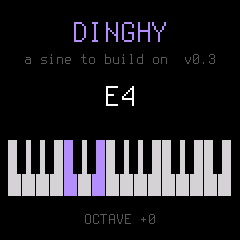
Our own build runs there too, so edit → build → emulate → listen works today.
The DSP harness respects the real chip. No float, no 64-bit division,
enforced by compiling dsp/shared/ with the actual target compiler. Tuning
holds to 0.0009 cents; fixed point tracks a double reference at 84.5 dB.
Two decisions already forced
1. Licence. Dinghy is GPL-3.0-only, so our firmware will be too, and
everyone we hand a build to is entitled to the complete source. If the engine
must ever be proprietary, that has to be decided now — the alternative is
writing the USB stack, update path, rescue mode and HAL from scratch.
docs/LICENSE_REGISTER.md.
dsp/ is kept MIT and free of GPL code so the synthesis engine stays reusable.
2. Flashing, and how to come back. Single flash bank, no recovery button, no test pads, no debug header, and updates authenticated by CRC-16 with no signature. One SysEx byte separates "upgrade" from "mask-ROM download mode".
This section used to say "No flashing" and list the gate that had to be
satisfied first. That gate has been satisfied and the device has been flashed
many times since. What replaced it is a rescue reachable from a running
firmware — OCT− and OCT+ held for five seconds — walked end to end on the
device: running → rescue → flash → running. A build that boots but
misbehaves is provably recoverable; a build that does not boot at all rests on
a path nobody here has exercised. docs/FIRMWARE_SAFETY.md has both.
The Braids vertical slice
docs/BRAIDS_PORT.md has the detail. The three results that matter:
- Braids is the one MI module that fits. It was written for a 72 MHz
STM32F1 with no FPU and contains zero
floattokens in 8,019 lines. Plaits, Rings, Elements and Clouds assume an FPU and would need full fixed-point rewrites. - It compiles for pi32v2 — 48 shapes, ~97 KB, no soft-float, no 64-bit division — and renders in tune at 44.1 kHz via a constant pitch offset of 13.47 semitones, with no regenerated tables. Measured: MIDI 36/48/60 → 65.1 / 131.1 / 261.5 Hz.
- CPU is not a constraint either. Measured on the emulated pi32v2, one voice costs 1.1%–3.2% of the 256-frame audio budget depending on shape (15,129–45,139 cycles of 1,393,152). Four voices of the most expensive shape is 12.9%.
- Memory is not the constraint. The device has 512 KiB of RAM, of
which Dinghy uses ~42 KiB, leaving ~390 KiB across
.bss(84 KiB) and the.poolregion for big buffers (306 KiB). FourMacroOscillatorvoices is 68.6 KiB — and four voices is already twelve oscillators, since theTRIPLE_*shapes are three detuned oscillators each.
Why Dinghy, checked rather than assumed
Dinghy came into this project as an outside suggestion, so it was surveyed
against nine other firmwares (docs/PLATFORM_SURVEY.md):
- No shipped firmware uses Dinghy as a base — of 49 catalogued firmwares, 20 declare a lineage: Felucca 10, SLOOP 7, X0X 2, Dinghy 0.
- But there is only one FM-1 platform. 9 of 10 repos share the identical layout, and all 17 of Dinghy's HAL files exist in every one of them.
- Dinghy's HAL matches the ecosystem majority on all 17 files — it is a minimal cut of the common platform, not a stale fork.
- Its
platform.cis unique and three weeks old, which is the real risk. Mitigated: our build reproduces the release byte-for-byte, and obervave and zp12 (same author, shipped) are the fallback. - Dinghy has no MIDI CC parsing, so the parameter layer will be modelled
on obervave's
pdef_ttable instead of invented.
Recommended first milestone
A single harmonic-spectrum oscillator with a desktop reference renderer.
Concretely: extend scripts/gen_sine_table.py to synthesise a wavetable from a
list of partial amplitudes, add fm1_osc_table() alongside the existing sine,
and render sine / saw / square from their harmonic series.
It is the right next step because:
- every later goal — the Operator-style spectrum editor, FM with non-sine operators, wavetable morphing — is this plus interpolation;
- it needs no new infrastructure: the generator, the Q15 oscillator, the WAV renderer, the SNR test and the target rule check all exist and pass;
- it is measurable. A band-limited saw from 32 partials can be checked against its analytic spectrum, so "is it right?" has a numeric answer;
- it will immediately produce the one number we are missing — what a table
oscillator costs per voice — which feeds Q2 and Q7 in
docs/OPEN_QUESTIONS.md.
Not a firmware rewrite. The firmware stays unmodified Dinghy until the oscillator sounds right on the host.
Open questions
Ten, in docs/OPEN_QUESTIONS.md. The two that could cost real time:
- Q1 — the toolchain download is unpinned; archive
~/.jieli/before depending on a build. - Q2 — we have no cycle-accurate target cost model, only host-relative
timing.
fm1-emu's--traceand PC histogram may give one without hardware.