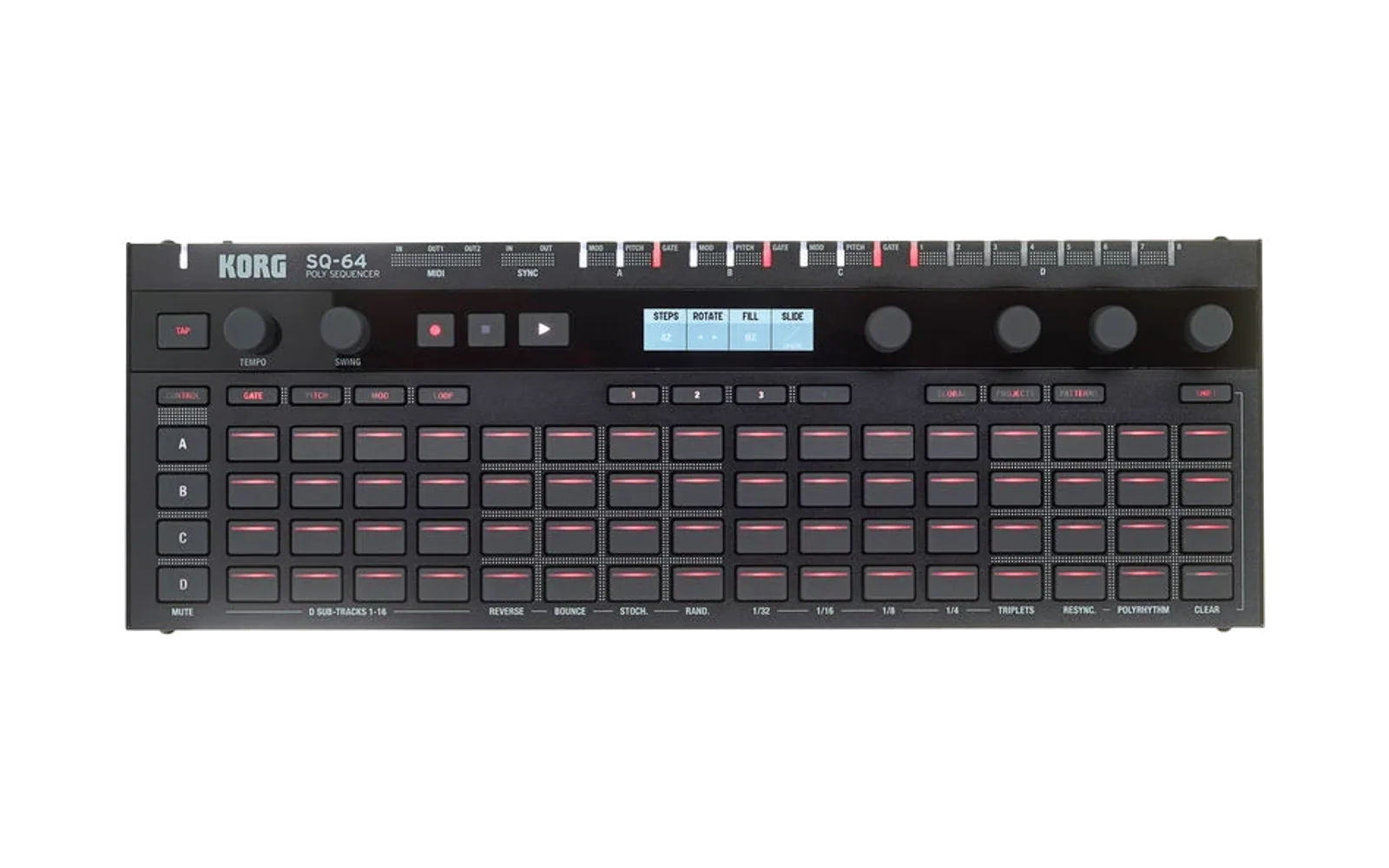
Independent SQ-64 firmware specification

Version 0.8.0 defines 88 requirements, 389 named execution/review cases, seven executable image checks, a machine-readable emulator interface, independent update and backup validators, evidence reporting, and five executable continuous runtime watch rules. The code, documentation and fixtures are original; no Korg firmware or decompiled functions are distributed.
The software contract and validation tooling are usable now. Physical hardware conformance remains incomplete: exact board parts/wiring, protected storage ownership, electrical limits and worst-case timing still require independent measurements. A passing software report does not guarantee that arbitrary firmware will work on a physical SQ-64.
Run
Python 3.10+; no runtime dependencies. From this directory:
python -m unittest discover -s tests -v
python -m sq64_spec candidate.VSB --profile image
python -m sq64_spec candidate.VSB --profile software --evidence-template --output evidence.json
python -m sq64_spec candidate.VSB --profile software --declaration candidate.json --evidence evidence.json --artifact-root captures --output report.json
python -m sq64_spec candidate.VSB --profile image --transcript update.json --output transfer-report.json
python -m sq64_spec --backup backup.json --readback after-restart.json
python -m sq64_spec --catalog
python -m sq64_spec --board-contract
python -m sq64_spec --watch-rules
python -m sq64_spec --watch-fixtures
python -m sq64_spec --watch-session observations.json --output watch-report.json
Install with python -m pip install . to use sq64-conformance from any directory. The wheel includes the requirement catalog, model contract, watch interpreter, rules, shared fixtures and example violation.
| Profile | Requirements | Meaning of a passing report |
|---|---|---|
image | 7 | Full-system package geometry, identity, version, checksums and reset vectors |
software | 68 | All applicable named cases have qualifying candidate evidence against the bounded software interface |
application-only | 74 | Software evidence plus a pinned baseline, recovery policy, complete write captures and recovery/interruption cases; missing evidence is rejection |
hardware (default) | 78 | Requires device measurements and a completed board contract; release-gated in this revision |
korg-compatible | 82 | Hardware contract plus strict declared compatibility; release-gated in this revision |
Exit codes are 0 pass within the selected scope, 1 failure/malformed input and 2 incomplete coverage. Command-line usage errors also use argparse's exit code 2 and produce no conformance report. Standalone archive checks have their own artifact report and never imply candidate execution. Template/catalog exports exit 0 without running conformance checks. Offline watch replay has separate exits: 0 active after the supplied observations, 1 detected violation, 3 monitoring/tooling error. An active replay report is not a safety certificate.
Reports bind image results to the exact VSB SHA-256 and include hashes of successfully parsed input documents. A supplemental transcript or archive failure fails the overall report; a successful supplemental check does not replace a whole firmware requirement. A transfer checks every payload byte and the begin-update version, but does not prove programming completion. An archive comparison checks logical contents, but cannot itself establish that shutdown or restart occurred.
Developing custom firmware with Codex
AGENTS.md provides Codex with project instructions for original firmware development, build setup, emulator testing, candidate evidence and recovery restrictions. It uses OpenAI's repository instruction format.
Start a new Codex session in this checkout. For example:
Use AGENTS.md and this spec to create an original SQ-64 sequencer in a new firmware/ directory. Start with a minimal emulator-targeted firmware, a reproducible build, VSB packaging and image validation. Identify the available toolchain and emulator, then implement and test the first milestone. Keep unexecuted conformance cases marked not-run.
Replace the example destination and feature request with your own. If this spec is a dependency inside a separate firmware repository, add an instruction to that repository's root AGENTS.md to read this file and the relevant contracts; Codex's startup discovery follows the path from the project root to its working directory, so a nested dependency's instructions are not automatically included when starting above it. Keep firmware build commands in the firmware project's own guidance.
Contract and evidence
- Normative requirement catalog: required cases, profiles, evidence kinds and quantitative obligations.
- Image, memory, panel, power and wire contracts, with machine-readable model facts.
- Peripheral register interface for firmware authors: the modeled register addresses, DMA stream assignments, clock rate and programming sequences a custom firmware drives.
- Evidence and candidate declaration format, including migration from v1 and the physical test campaign.
- Application-only restrictions and emulator critical results.
- Runtime watch API, event schemas and deterministic predicates, with native/browser integration handoff.
- Public-source provenance.
Generate a checklist, fill in the declared features and acceptance bounds, run the named cases, then attach observations and artifact hashes. The validator rejects stale identity, missing cases, failed cases hidden under a pass, invalid measurements and artifacts escaping the capture root. Tool hashes and observations remain supplied assertions; verifying an artifact's bytes does not independently reproduce its experiment. Diagnostic probes are useful model tests but cannot satisfy candidate execution requirements.
software can credit emulator observations; hardware cannot. No evidence file can remove the board release blockers. Custom sequencers declare their own supported behavior. Strict korg-compatible reports additionally require documented layout and sequencing compatibility; intentional deviations are disclosed and do not count as waivers.
Maintaining the specification
requirements.json is the normative catalog. Regenerate its documentation with python tools/render_requirements.py; --check detects drift. Changes to board.json change the hash required by emulator evidence. Change the spec revision when altering acceptance obligations and collect matching evidence. Tests use synthetic non-deployable VSB data, independent wire vectors, populated first/last project slots and both update protocol versions. They do not constitute hardware trials.
watch-rules.json owns runtime predicates and normalization constants. Run python tools/render_watch_rules.py and python tools/build_watch_fixtures.py after changing it; both support --check. Generated critical.json retains legacy hazard-result polarity. Runtime monitoring starts before the first instruction, is independent of static image validation and debugging, and requires complete emulator instrumentation. A violation or monitoring error ends the session permanently while retaining diagnostics and export. The emulator integration is a separate implementation task; passing the reference tests alone does not establish complete observation or pre-side-effect stopping.