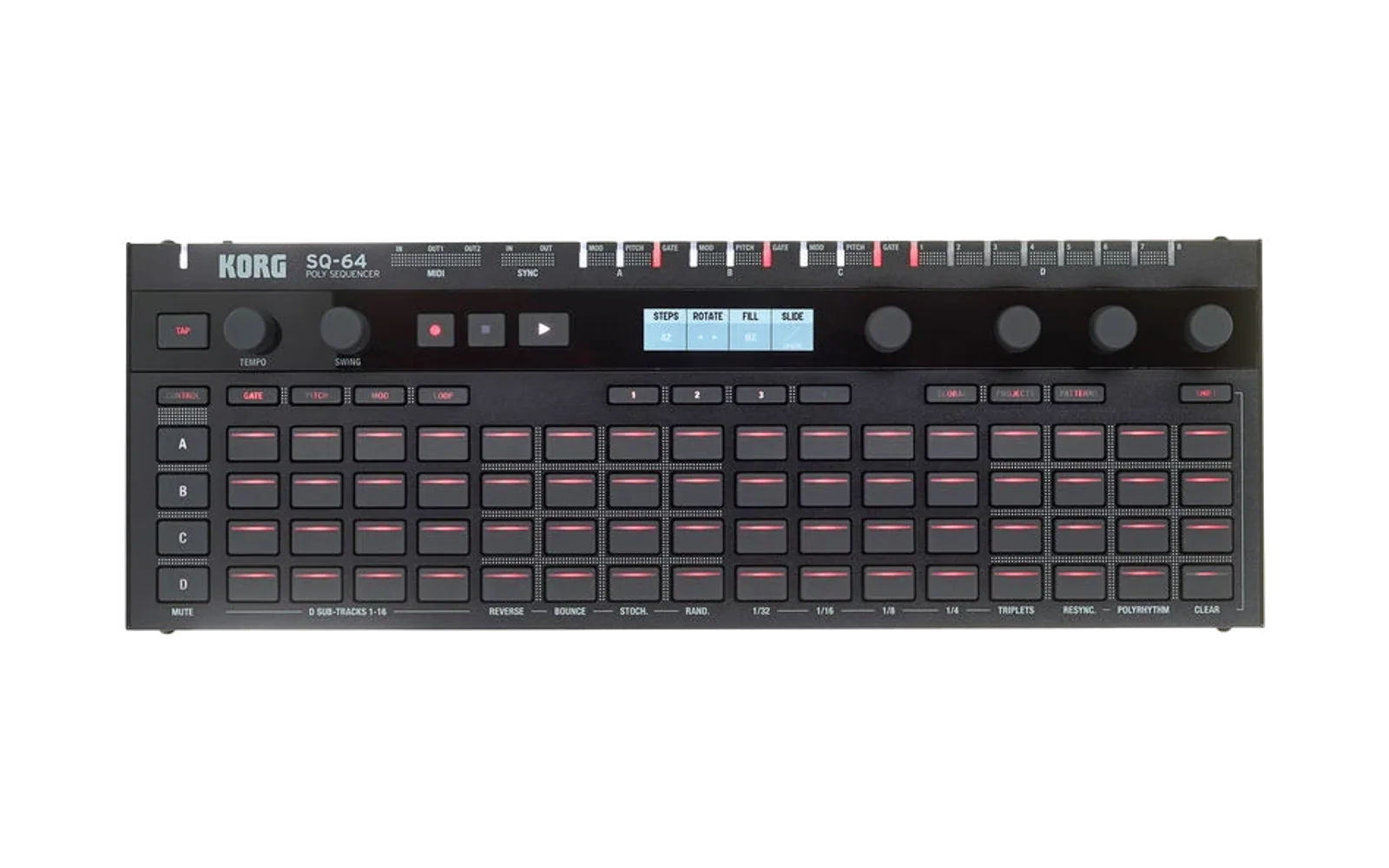
AV aggregate — original SQ-64 firmware

A from-scratch firmware for the Korg SQ-64 hardware sequencer that aggregates both Aleph Void firmware feature sets into one image: each of the four tracks runs either a Euclidean rhythm sequencer lane (as in the sibling euclidean firmware) or a tempo-synced LFO (as in the sibling lfos firmware), toggled per track at any time with SHIFT + its track button. It is written entirely from the interface facts published by the independent SQ-64 firmware specification and exercised against the independent SQ-64 emulator. It contains no Korg source code, no decompiled vendor functions, no vendor assets and no bytes copied from stock firmware.
Hardware warning. The specification's board contract is explicitly incomplete: exact MCU part, wiring, electrical limits and protected-storage ownership remain unverified release blockers. This image passes the spec's
imageprofile and runs in the emulator; that is not a certification that it is safe on a physical SQ-64. Flashing real hardware is at your own risk, and power loss while internal flash is being programmed is not guaranteed to be recoverable (spec VUP-008). If you accept that, the sibling euclidean firmware's HARDWARE.md documents the identical install / operate / restore procedure (all three images use the same container, updater and storage map).
One transport, two engines
Everything hangs off a single shared 24 PPQN transport position, so sequencer steps and LFO phases stay locked to the same beat and to each other. The position advances from the internal tempo clock (20–300 BPM, tap tempo, MIDI clock out while playing) and follows incoming MIDI clock automatically when one is present — the header flips from INT to EXT with the measured BPM, every lane locks to the external ticks (the Euclidean engine gains external sync it did not have standalone), and a second after the ticks stop it falls back to the internal clock. PLAY resyncs everything from zero and starts the sequencer lanes; STOP silences the sequencer lanes while the LFOs keep free-running, phase-locked. MIDI start/stop in are honored.
By default tracks A/B boot as sequencer lanes and C/D as LFOs; any mix is a SHIFT+track press away, and the mix persists with the rest of the settings.
Feature sets, as in the originals
Sequencer lane (per track in SEQ mode): Euclidean pattern E(pulses, length) with rotation, 1–64 steps in four bars of 16, polymetric against the other lanes; per-track note, gate length, mod CV level and velocity; swing 50–75 % across all sequencer lanes. Lanes A/B/C drive their gate jack, pitch CV, mod CV and MIDI notes on channels 1–3; lane D drives trigger jack 1 and MIDI channel 10. Pad LEDs show the selected bar of the pattern with a moving playhead (outside the edit modes, which repaint the rows with the edited parameter).
LFO lane (per track in LFO mode): six waveforms — sine, triangle, rise, fall, square, sample & hold — sixteen synced rate divisions from 8 bars to 1/32 including dotted and triplet values, per-LFO depth, phase offset and MIDI CC number streamed on channels 1–4 (USB and DIN, rate-limited, sent only on change). LFOs A/B/C can drive their mod CV, pitch CV and gate jacks (gate = square-thresholded LFO), routed inside the PITCH / GATE / MOD edit modes; LFO D pulses trigger jack 1 once per cycle. Pad LEDs are a live level bar (in the PITCH edit mode, the phase-offset pad) and the display shows a waveform preview with a phase cursor.
The spec's panel-key requirements (TRACK/MODE/LOOP/BAR/TAP/TEMPO/ SWING-001): A–D select the edited track; the PITCH, GATE, MOD and CONTROL keys each toggle an edit mode scoping the pads and param encoders to that mode's documented parameters on the selected track — on a sequencer lane one pad-edited parameter (note, gate %, mod CV level, velocity), on an LFO lane that destination's routing on the Param 1 encoder plus its companion parameter (phase offset, depth, or the MIDI CC number in the CONTROL mode). Keys 1–4 select which 16-step bar the pads, pad LEDs and display lanes address; LOOP loops step playback over the selected bar of the selected sequencer lane's pattern (refused on an LFO lane or when the bar lies beyond the pattern, clipped or cleared if a later edit moves the pattern end), and clearing it resumes the free-running step counter. The tempo encoder moves one BPM per detent across 20–300, the swing encoder one percent across 50–75 (50 = unswung), both clamped without wraparound. Track selection, mode entry/exit, bar keys, loop toggles and taps alone never change stored data.
Settings persist to SPI flash (GLOBAL commits; the power button saves and shuts down cleanly through the PB7 power hold), and the PROJECT manager drives the full project lifecycle over the 64 documented saved-project slots — new, load, save and delete, with empty and invalid slots reported and the workspace left unchanged on rejection (spec PROJECT-001..004) — see Projects. Boot chords per the spec: hold GLOBAL at power-on for version mode, GLOBAL+PATTERN for update mode. In version mode the PLAY indicator is lit, and pressing PLAY continues the normal boot sequence to the ready state (BOOT-004). Update mode carries the same complete VUP self-updater as the sibling firmwares (protocol 1, 1024-byte packets, full validation before a RAM-resident installer programs anything).
A boot splash is declared (spec SPLASH-001): entering normal mode draws the Aleph Void name for the first 2.4 s — through the ordinary framebuffer primitives and the same DMA display path as every other frame — while the engines, pad LEDs and panel input already run underneath, so the declared ready state is reached and the startup-mode chords (sampled before normal mode starts) are honored regardless of the splash.
Controls (normal mode)
| Control | Action |
|---|---|
| PLAY / STOP | Start from step 0 (or the loop start) with all LFO phases resynced / stop (sequencer notes off, LFOs keep running) |
| TAP | Tap tempo |
| A B C D | Select the edited track |
| SHIFT + A B C D | Toggle that track between sequencer lane and LFO |
| PITCH / GATE / MOD / CONTROL | Toggle that edit mode (same key again leaves it) |
| 1 2 3 4 | Select the bar the pads address (pad n = step (bar−1)×16+n) |
| LOOP | Toggle a loop over the selected bar of the selected sequencer lane's pattern |
| Pad n (row of track t) | SEQ: set pulses to the selected step · LFO: set rate division n (1=8 bars … 16=1/32) — or the active edit mode's parameter |
| SHIFT + pad n | Outside the edit modes only — SEQ: set length to the selected step · LFO: set waveform (1=sine 2=tri 3=rise 4=fall 5=square 6=S+H) |
| Tempo encoder | BPM 20–300, one per detent, clamped |
| Swing encoder | Swing 50–75 %, one per detent, clamped; 50 = unswung (sequencer lanes) |
| Param 1–4 encoders | SEQ: pulses, length, rotation, note · LFO: waveform, rate, depth, phase — or the active edit mode's parameters |
| GLOBAL | Commit settings to SPI flash |
| PROJECT | Open / close the project manager (pads become the 64 slots) |
| Param 2 / Param 3 encoders (project manager) | Edit the project name: character at the cursor / cursor position |
| SHIFT + PROJECT | New project: reset the workspace to the declared defaults |
| Power button | Save and shut down |
Declared SHIFT combinations (spec SHIFT-001): SHIFT+track (engine toggle), SHIFT+pad outside the edit modes (length on a sequencer lane, waveform on an LFO lane), SHIFT+pad in the project manager (save) and SHIFT+PROJECT (new project). SHIFT alone, and SHIFT with any other control — including pads inside the edit modes — has no effect.
Edit modes
The PITCH, GATE, MOD and CONTROL keys each toggle a documented edit mode over the normal surface (spec MODE-001). The active mode is reported on its key LED and named on the display; pressing the same key leaves, pressing a different mode key switches directly. The pad LEDs follow the mode too: every row whose pads edit a parameter in the mode (sequencer rows in all four modes, LFO rows in PITCH) lights the single pad whose press sets that track's current value — dark when the value lies off the pad scale, such as an encoder-set note outside the pads' 36–51 range — while rows whose pads are inert in the mode (LFO rows in GATE/MOD/CONTROL) keep their live level bar. Leaving the mode restores the pattern/playhead view. Entering or leaving a mode changes no pattern, workspace or settings data, and all edits inside a mode go to that mode's documented parameters on the selected track only. What a mode edits follows the selected track's engine:
| Mode | Sequencer lane (pads 1–16) | LFO lane (Param 1 / Param 2 / pads) |
|---|---|---|
| PITCH | Note 36+n−1 | Pitch-CV routing on/off (right/left; A–C) / phase offset / pad n = n−1 sixteenths of phase |
| GATE | Gate length 5+(n−1)×6 % | Gate routing on/off (A–C; on D the cycle trigger) / — / — |
| MOD | Mod CV level n−1 | Mod-CV routing on/off (A–C) / depth 0–100 % / — |
| CONTROL | Velocity (n−1)×8+7 | MIDI CC number 0–127 / — / — |
On a sequencer lane the param encoders keep their normal assignments inside
every mode. LFO D has no pitch/mod jacks: the PITCH and MOD modes report
NO JACK ON D there and route nothing. Controls marked — are documented
inert in that mode.
Projects
A project is the workspace's musical content in both engine modes: each
track's engine selection and both of its engine configurations — the
sequencer parameters (pulses, length, rotation, note, gate, velocity, mod
level) and the LFO
parameters (waveform, rate division, depth, phase, CC number, destinations) —
plus the tempo, swing and a 12-character name. Loading a project therefore
restores a track in
either mode with the other engine's setup intact behind the toggle. The
edited-track selection stays in the settings sector. The 64 saved-project
slots follow the spec's documented catalog at SPI 0xC0000 + n × 0x3D000;
this firmware's record occupies the first 4 KiB sector of its slot (magic
AGP3, FNV-1a checked) and the rest of the slot region is never written.
(Records from builds before names, magic AGP2, are reported INVALID.)
Press PROJECT to open the project manager. The 64 pads become the 64 slots (bank A pad 1 = slot A1 … bank D pad 16 = slot D16), lit when populated and blinking for the current slot; the display shows the workspace name, the catalog grid and a status line that reports every operation. Both engines keep running throughout — browsing slots silences nothing.
The project name is edited here, the way stock firmware's save flow does it:
the Param 3 encoder moves the cursor (a bright underline on the name,
over a dim baseline) and the Param 2 encoder steps the character at the
cursor through the character list — space, A–Z, 0–9, then
!?#$%&'()*+,-./:;<=>@ (the stock order, reduced to what the uppercase 5×7
font renders distinctly) — both clamped at their ends without wraparound.
Names are a fixed 12 characters, space padded; a new project (and a first
boot) is named INIT PROJECT, as in stock. The name is workspace data like
any other edit: saved into the slot's record by SHIFT+pad, restored by a
load, reset by SHIFT+PROJECT, and committed with the settings by GLOBAL or
the power button.
- Pad — load that slot into the workspace. An empty or invalid slot is
reported (
EMPTY/INVALID) and the workspace is not changed. - SHIFT + pad — the explicit save operation: write the workspace to that
slot. Only that slot is modified, and
SAVEDis reported only after the committed record reads back from flash. - RECORD + pad — the explicit delete operation: erase that slot's record sector, leaving it observably empty. Deleting an empty slot is accepted and performs no flash write. Every other slot, the workspace and the settings are untouched.
- SHIFT + PROJECT (in any mode) — new project: the workspace returns to the declared defaults (the same mixed A/B-sequencer, C/D-LFO setup a first boot shows). No saved slot is modified and nothing persists until an explicit save.
- PROJECT again leaves the manager.
Saved projects persist like settings: they survive power-button shutdown and
a cold restart. An interrupted save or delete leaves the previous record, the
complete new record, or an erased sector that is reported as empty/invalid on
load — never undefined data in the workspace. Re-saving identical content
performs no erase/program cycle (wear bounding, spec STORE-007). The firmware
sizes the catalog from the SPI flash's JEDEC density byte and only addresses
slots whose region physically fits: on the native emulator's 1 MiB model one
slot is available, on the 16 MiB browser model (and the presumed real part)
all 64; out-of-range slots report NO SLOT and are never addressed.
The display and the param encoders always follow the selected track's engine
— the active program. Only that engine's lanes are drawn (pattern cells
with a playhead on a sequencer program, wave/rate/CC with a live level bar on
an LFO program); a track running the other engine keeps playing and keeps its
pad-LED feedback, but its display row is just a dim SEQ/LFO tag until a
track of that engine is selected. The screen is never a mix of both engines'
idioms.
Build
Requires the GNU Arm toolchain (arm-none-eabi-gcc) and Python 3.
make            # build/aleph-void-custom-fw.elf, .bin and .vsb
make check      # run the spec's seven image-profile checks on the VSB
make test       # headless + browser-engine behavioral tests (see below)
The code is compiled as the ARMv6-M subset so it runs on both emulator
engines (the native engine's stock Unicorn build cannot deliver interrupts
inside IT blocks); make ARCH=-mcpu=cortex-m7 builds Thumb-2 instead.
tools/make_vsb.py wraps the 64 KiB binary into a spec-conformant VSB,
filling unused payload with 0xFF and balancing the four region checksums.
Run it
Browser workbench (recommended): in ../../emulator/web, npm ci && npm run dev, open the printed URL, load build/aleph-void-custom-fw.vsb in Browser
emulator, and run. The C/D pad rows animate as LFO level bars from the
moment the panel comes up (select track C or D to bring the LFO program onto
the display); press PLAY to run the Euclidean lanes. Importable demo scripts for the
workbench's UI scripts panel live in scripts/;
they walk through every major function (mixed-engine transport, editing both
engine types, the edit modes with bar selection and the loop, the
SHIFT+track engine toggle, MIDI remote start/stop, external MIDI clock sync,
persistence, project management, version mode and a full self-update).
Native headless:
python -m pip install -e ../../emulator
make smoke      # 2M instructions, report in build/smoke.json
Tests
tools/headless_test.py(native engine): boot with the mixed defaults, tick interrupts, LFO MIDI CC streaming while stopped (and no clock or notes), MIDI start driving sequenced note-ons plus clock with CCs continuing, external-clock following without re-emission, version and update boot chords (including the lit PLAY indicator in version mode and PLAY continuing the boot to the ready state, BOOT-004), VUP discovery / version / begin, ordered packets, and rejection of out-of-order packets, wrong blocks, and installs outside update mode — with zero flash writes. Project mode runs against this engine's 1 MiB SPI model: the JEDEC capacity probe keeps every access inside the part, slot 0 saves / loads / deletes, and the unavailable slot 1 is refused without a flash write.tools/browser_update_test.mjs(browser WASM engine): full end-to-end installation — update-mode boot via the panel chord, USB MIDI enumeration, all 224 packets through the firmware's own updater under the workbench's installation context, then byte-exact verification of internal flash and the three installed SPI regions, with no critical hazard tripped.tools/browser_panel_test.mjs(browser WASM engine): DMA panel scanning, both engines' pad LEDs and outputs, the SHIFT+track engine toggle in both directions (including track D's trigger lane and channel-10 notes), the spec panel-key requirements on both engine types — the PITCH/GATE/MOD/ CONTROL edit modes (storage-silent entry/exit, audible pitch/velocity/mod edits on a sequencer lane, CC reassignment and gate routing on an LFO lane), bar selection windowing the 64-step pattern space, and the loop (pinned playback, clearing, refusal on an LFO lane and beyond the pattern bounds) — MIDI note and CC output, transport, GLOBAL commit, the full project lifecycle (the encoder name editor driven closed-loop against the rendered name field, save to first and last slots with untouched-slot and settings guards, new-project defaults without flash writes, exact load-back of both engine modes including the name, empty/corrupt-slot rejection with the workspace unchanged, delete to an observably empty slot), power-button shutdown, and settings plus saved-project persistence across a cold restart.
Storage map
| Region | Use |
|---|---|
| Internal flash 0x00200000 + 64 KiB | This firmware (VSB payload 0x00000) |
| SPI 0x00000–0x30000 | Installed-image regions; written only by the updater during a host-initiated installation |
| SPI 0x40000 (one 4 KiB sector) | Committed settings (magic AGG3, FNV-1a checked); rewritten only when contents change |
| SPI 0xC0000 + n × 0x3D000 (first 4 KiB sector of each of the 64 documented slots) | Saved projects (magic AGP3, FNV-1a checked); written only by the explicit save and delete operations |
| Everything else | Never written |
Provenance
Original work. Interface facts (container format, update protocol, panel
wiring, peripheral behavior) come from the sibling spec's board.json,
contracts.md and the emulator's independently authored board model — see
src/board.h for the consolidated register map. The hardware-interface
modules and both engines are shared with the sibling
euclidean and lfos firmwares by the same authors;
the per-track engine switching, the unified transport and the tests for the
combination are new. This firmware's display driver additionally drains the
panel scan from inside long framebuffer draws (display_set_breather) so
encoder detents are never lost to a redraw — the combined two-engine UI
redraws continuously, where the originals could afford to redraw rarely.
Licensed under the MIT License (see LICENSE).
Known limits
- The stock backup/restore SysEx transport is not implemented; settings and the saved-project catalog are this firmware's only persistent data.
- The analog sync jack is not used; external sync means incoming MIDI clock.
- External clock below ~2.5 BPM-equivalent tick spacing (more than one second between ticks) is treated as absent.
- MIDI input notes are ignored; the sequenced notes and LFO CC/CV outputs are the product.
- Swing applies to the sequencer lanes only; LFO phases follow the unswung transport grid.
- LFO lanes have no step grid: the bar keys and the loop act on sequencer lanes (the pads still edit an LFO lane's rate/waveform in every bar), and the pads are documented inert in an LFO lane's GATE, MOD and CONTROL modes.
- The PATTERN key has no normal-mode function; patterns-per-track as in the sibling lfos firmware are not implemented. PATTERN participates only in the GLOBAL+PATTERN update-mode boot chord.
- Quantitative timing claims (jitter, latency) require hardware measurement and are not made.