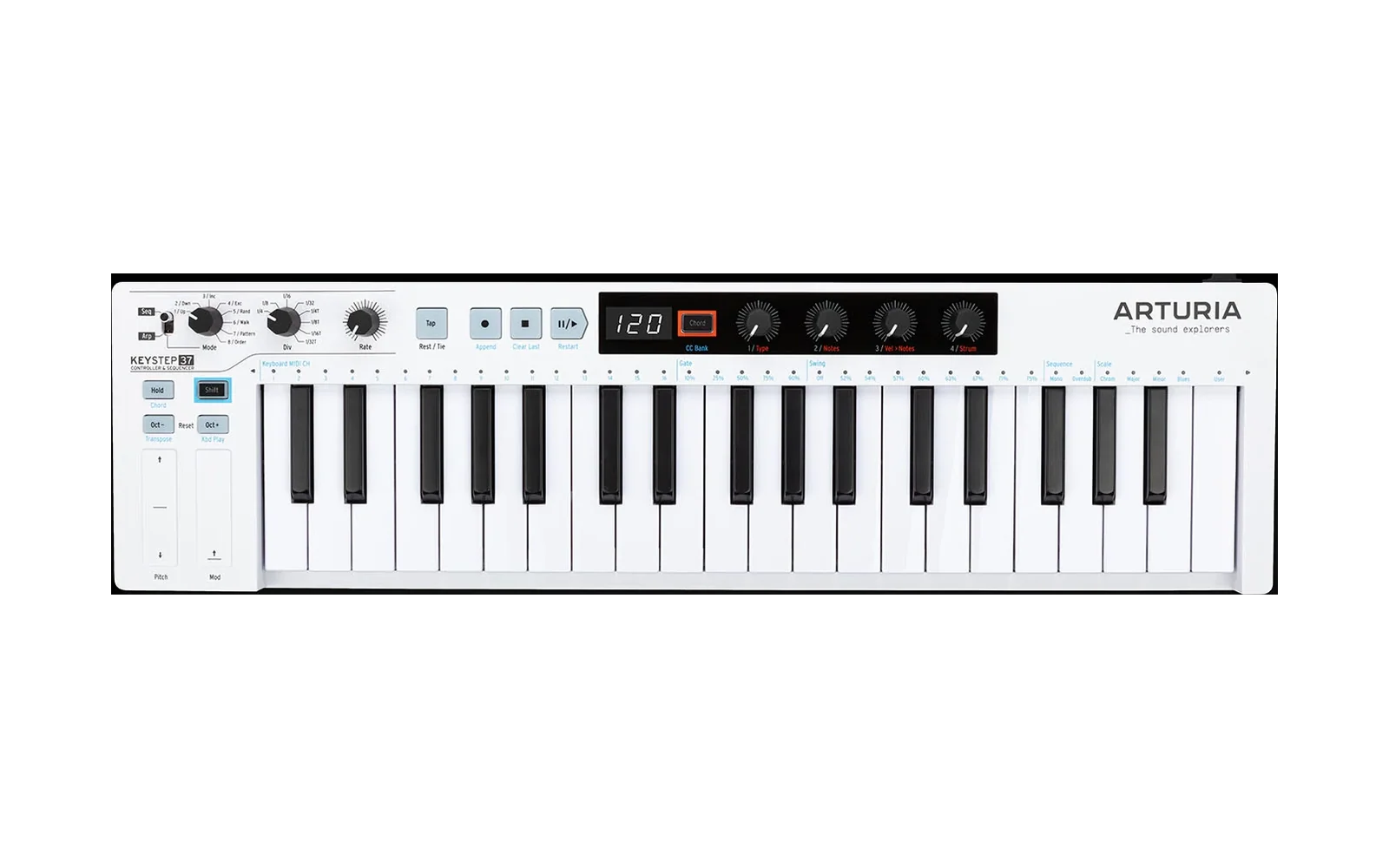
KeyStep 37 — firmware 1.1.6 notes
Derived reverse-engineering notes for the stock Arturia KeyStep 37 application firmware 1.1.6.579. Not Arturia’s firmware, not a replacement image, and not something you flash from this repo. The notes and scripts here are MIT; Arturia’s firmware is not.
Vendor .led files, the stripped flash extract, official manuals, and
update captures are not published. They stay local (see
.gitignore). Everything here is addresses, dumps,
narratives, and tools that operate on a copy you already have.
If you came here for a custom firmware: there isn’t one.
Start here
| File | What it is |
|---|---|
firmware-re/notes/address-catalog.md | Named flash/RAM addresses. This is the map. |
firmware-re/notes/stock-shift-map.md | Every panel gesture and its Test-20 control ID. |
firmware-re/notes/scans/tickets.md | Ticket list A–BA and what each one asked. |
firmware-re/notes/flash-map.md | MCU, app range, unused fill. |
firmware-re/notes/led-header.md | How a .led is framed (Huaxin segments + checksums). |
docs/ARTURIA-FIRMWARE-RE-GUIDE.md | How the notes were built (wire constant → cmp → callers). |
Catalog tags:
- P — live protocol or occupancy ID matches an immediate in code
- S — structure from disassembly or Unicorn
- H — hypothesis (including claims not re-traced here)
- X — ruled out
A ticket is a scan dump plus a model write-up. Scans live in
firmware-re/notes/scans/. Narratives and
proposed catalog rows live in
firmware-re/notes/model/. The catalog is
the accepted subset.
Tickets A–AS are modeled and copied into the catalog. Scans AT–BA are on disk and not modeled yet.
firmware-re/notes/findings-2026-09-20.md
is a chronological lab log. Mid-file “not yet” paragraphs are stale;
prefer the catalog. model/synthesis.md still has a “Top open leads
(post Round-2)” list; treat the sections below as current.
Coverage
App Thumb 0x08004000–0x0801F400 is about 109 KB. recreate.py names
roughly 85 function starts. The catalog has about 270 unique flash
addresses and 75 RAM addresses; about 30 rows are P, about 150 are
S. A C++ STM32 app this size usually has high-hundreds of functions,
so by count this is perhaps 10–15%. That is an order-of-magnitude guess,
not a measurement.
Function count undersells the hot path. Mapped end to end: boot and the
ctor sweep, the main loop and IRQs, the three input buses, the tick
object and tempo, the swing table, the 8-way mode TBH and its builders,
play_time_step, the step layout (8 voices × 2 bytes), the rest/tie
emission gate, the CC21 mapping, and the full panel occupancy. For
“clone a mode and change what it emits,” that is most of what matters.
As a map for adding one arp mode: perhaps two thirds of the way there. The remaining gaps are a reliable step-gating model and a free gesture to switch the mode. As a complete reading of the firmware: a small fraction, and deliberately so.
Deliberately out of scope
The bootloader (0x08000000–0x08003FFF), the USB stack body, and the
ST HAL were left alone for safety. That is about a fifth of the image
unexamined by design. It caps what “full” can mean.
Still open
- The trigger that commits a RAM slot to flash
- Which GPIOD pin on
0x20004f00is the sync jack and which is a DIP (Arturia’s docs say the rear DIP selects clock source and needs a reboot; the firmware object we have is the jack path) - USB vs DIN identity on
0x20001d60(DIN slot is confirmed; USB is a separate site) - The family selector in
param_field_dispatch - About a dozen ctor objects that exist but have no role
- Case 5 of
seq_step_store - The hold-length-clear gesture (Shift+Oct−+Oct+)
- Named handlers for Shift secondaries — every Shift+key combo is taken, so a spare gesture for a new mode has to come from these
- Scans AT–BA: on disk, not modeled
The Shift-handler gap matters most if the goal is a new mode toggle.
The Euclidean hear-tests are a caution on the tick model. The same
flashed e0b image gave a steady 1,2,2, then ~90% every-step, then
3-in-8. Hearing Walk vs Pattern while looking at the wrong TBH case
(panel CC21 is 1-based; internal is minus one) explains some of that.
Results that
change on one image also suggest a second entry into play_time_step
(EXTI0 → 0x08011ff0) that is not pinned down. Get that reproducible
before trusting the tick model for a chord generator.
Related work
These are host-side or family notes, not another 1.1.6 address catalog.
- sysex-controls — Linux
MCC stand-in. KeyStep 37 pages use the same
0x41xxglobal params asKeyStep37.json. It writes as well as reads. It does not dump sequencer banks. - midi-control, Arturia v2
— family verbs:
01query,02= device report and host write. That is why there is no SET TBB. Ancestor: untergeek on BeatStep. - Arturia sync FAQ — clock source is the rear DIP; reboot after a change.
- Daniel Gruss, original KeyStep and auduchinok’s 1.1.6 LED gist — Huaxin / octave-LED baseline used here.
- KeyStep 37 mk2 manuals are a different product. Do not mix them into 1.1.6.
What the application looks like
STM32F1. Image base 0x08000000. App Thumb 0x08004000–0x0801F400.
Addresses in the catalog are flash VAs on the stripped extract, not
file offsets into a framed .led.
Boot. Reset_Handler copies .data, zeros .bss through
0x20005eac, then a ctor sweep builds on the order of fifty objects
(knobs, tick, ports, debounce, sequence blocks).
Loop and IRQs. One forever loop. SysTick, TIM2, USART1 (DIN MIDI), a USB ISR thunk, and EXTI0 (GPIOD pulse into the step/play path). TIM2 does not itself walk the tick object.
Three input buses.
- Keys go through
0x0801b750. - Buttons use a compact ID table (
Hold/Shift/Oct−/Oct+/Tap/Rec/Stop/Play, else Chord). Shift held is RAM0x200010d2. - Analog kinds 1–4 map to Type / Notes / Vel / Strum (
0x62–0x65); kind 0 and ≥5 map to Rate (0x66).
Time. Tick object 0x20002bec: step at +0x38, length at +0x10,
tempo halfword at +0xe (clamped 3000–24000, then TIM2 ARR). Time Div
is a byte on 0x20001000. Swing values are a nine-byte flash table at
0x0801ec64; the panel write lands at sequence-slot +0x401.
Voice out. A step plays only if voice-0 pitch is not a rest/tie
(0x81/0x82) — that check is the emission gate, not seq_step_gate
bit 7 (retention). Key notes leave on DIN via USART1. USB MIDI out is a
separate call site, not a slot on the DIN/display object. Pattern mode
is engine +0x10 == 6 (panel CC 21 = 7).
Protocol. App-mode GET is mapped. Host SET is Arturia v2 verb 02
— the same 02 00 41 <id> <value> shape as the GET reply. There is no
sibling SET TBB in the app.
Persist. Slot flash can be loaded into RAM. The STM32 FLASH_KEYR
unlock sequence is identified. The application trigger that commits a
slot is not.
Clock / sync. A four-pin GPIOD object (0x20004f00) is read through
IDR bit tests and can gate TIM2 disable and MIDI-Start. Arturia’s docs
say the rear DIP selects Internal / USB / MIDI / Sync In (reboot after
a change). Which of the four pins is the jack vs a DIP is still a
hypothesis.
Panel occupancy. Shift+keys 1–16 are Keyboard MIDI channel, not
free. Shift+Tap is tempo. Chord-then-Rec lights Rec. The map is
stock-shift-map.md.
Ghidra names for confirmed function starts only:
firmware-re/ghidra/recreate.py.
What’s in the tree
firmware-re/notes/address-catalog.md   accepted addresses
firmware-re/notes/scans/               raw Capstone dumps (A–BA)
firmware-re/notes/model/               narratives + proposed rows (A–AS)
firmware-re/notes/stock-shift-map.md   panel occupancy
firmware-re/ghidra/recreate.py         Ghidra name script
firmware-re/scripts/scan_firmware.py   TBB / bl-to / cmp-imm
firmware-re/scripts/led_codec.py       .led parse / extract / retarget
firmware-re/scripts/emulate_ks37.py    Unicorn harness
firmware-re/captures/                  occupancy + listen logs
docs/                                  method, safety, lab setup
midi_control_centre_analysis/          notes on MCC (no vendor exe)
Scripts under scripts/ and firmware-re/scripts/ are the lab
wrappers (scan, listen, flash-from-Windows, occupancy). They expect a
local extract and a device. Default flash is dry-run.
firmware-re/patches/ is leftover source from
an earlier Euclidean / scale-chord experiment. It is not a supported
build in this repo, and the .led images are not checked in.
If you have the extract
# image: firmware-re/firmware-images/keystep37_1.1.6.579_flash.bin
# file offset 0 = 0x08000000

python3 firmware-re/scripts/scan_firmware.py
Ghidra: import that bin as ARM:LE:32:Cortex at 0x08000000, then run
recreate.py as a post-script.
.led packaging (checksums, extract, retarget) is
firmware-re/scripts/led_codec.py. Always retarget after you edit a
framed image.
Safety
This repo does not ship a firmware image. If you work on a device
anyway: do not write the bootloader, the app vector table at
0x08004000, the USB/MIDI stack, or sequence-slot flash at
0x0803B000. Keep an untouched stock .led for recovery. Details:
docs/firmware-safety-rules.md.
Daniel Gruss reverse-engineered the original KeyStep. Confirmed here:
hex-encoded .led, unsigned app, SysEx update, separate bootloader.
KeyStep 37 checksums are the Huaxin/midiplus segment scheme, not a
20-byte flat header. The two binaries do not overlap.
License
Notes, scripts, and other files in this repository are MIT (Copyright 2026 Jim Curlis). Keep the copyright and permission notice with copies.
That license covers this work only. It does not grant rights in
Arturia’s firmware, trademarks, manuals, MIDI Control Center, or any
.led / flash extract you obtain yourself. Those stay with their
owners and are not published here.
Questions
A few things (factory / service-mode details among them) are kept out of these public notes on purpose. If you’re working on something similar and want more, DM me.