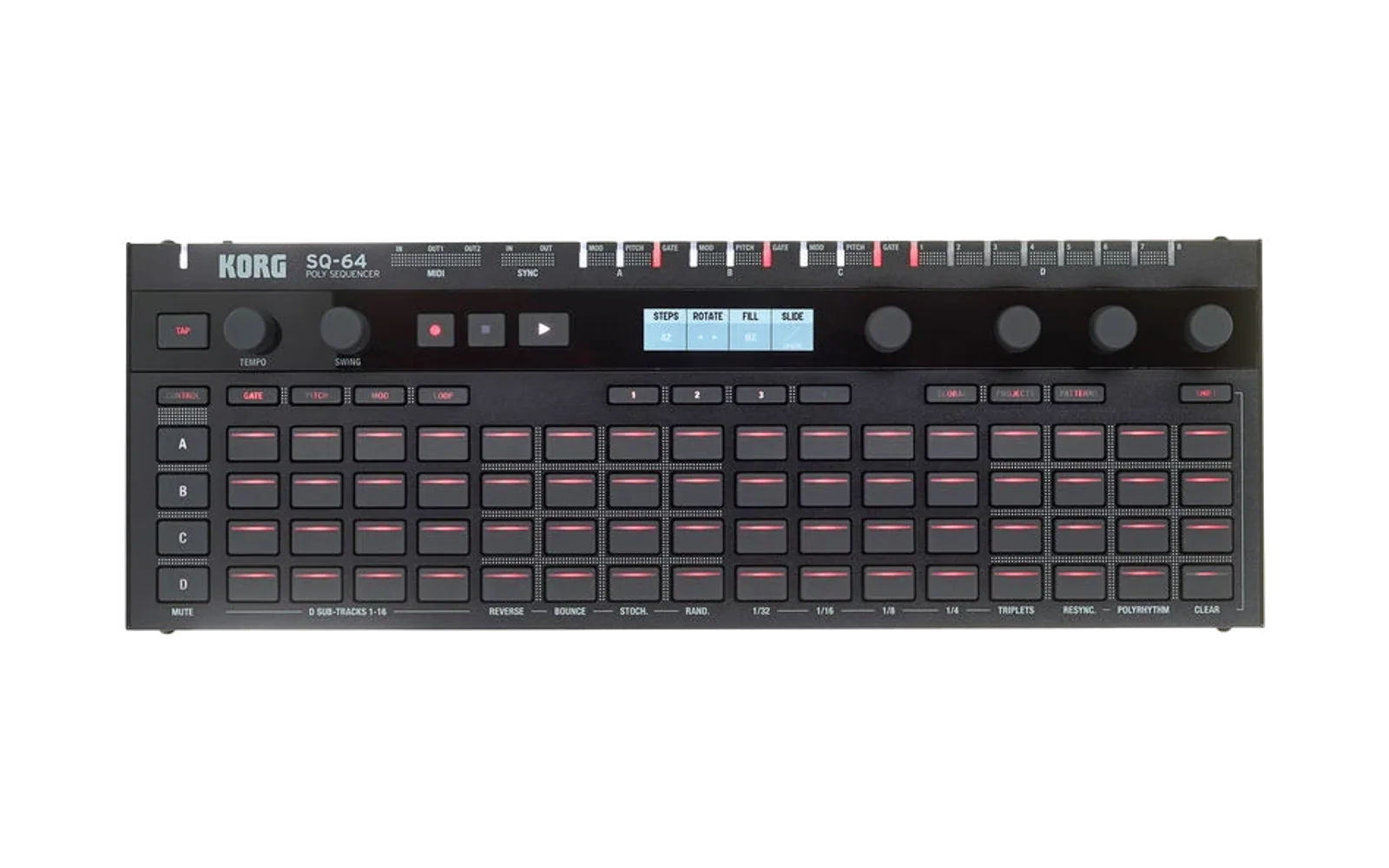
Euclidean — original SQ-64 firmware
A from-scratch firmware for the Korg SQ-64 hardware sequencer that replaces the stock sequencer with a four-track Euclidean rhythm sequencer. It is written entirely from the interface facts published by the independent SQ-64 firmware specification and exercised against the independent SQ-64 emulator. It contains no Korg source code, no decompiled vendor functions, no vendor assets and no bytes copied from stock firmware.
Hardware warning. The specification's board contract is explicitly incomplete: exact MCU part, wiring, electrical limits and protected-storage ownership remain unverified release blockers. This image passes the spec's
imageprofile and runs in the emulator; that is not a certification that it is safe on a physical SQ-64. Flashing real hardware is at your own risk, and power loss while internal flash is being programmed is not guaranteed to be recoverable (spec VUP-008). If you accept that, HARDWARE.md documents the full install / operate / restore procedure.
Features
- Four tracks, each an independent Euclidean pattern E(pulses, length) with rotation, 1–64 steps in four bars of 16 (polymetric against each other), plus a per-track note, gate length, mod CV level and velocity.
- Tracks A/B/C: gate jack, pitch CV, mod CV and MIDI notes on channels 1–3. Track D: trigger jack 1 and MIDI notes on channel 10.
- Tempo 20–300 BPM with tap tempo, swing 50–75 %, MIDI clock/start/stop out, and MIDI start/stop in (external clock sync is not implemented).
- The spec's panel-key requirements (TRACK/MODE/LOOP/BAR/TAP/TEMPO/SWING-001): A–D select the edited track; PITCH, GATE, MOD and CONTROL each toggle an edit mode scoping the pads to that one parameter of the selected track (note, gate %, mod CV level, velocity); keys 1–4 select which 16-step bar the pads, pad LEDs and display lanes address; LOOP loops playback over the selected bar of the selected track's pattern (refused when that bar lies beyond the pattern, clipped or cleared if a later edit moves the pattern end) and clearing it resumes the free-running counter. Selection, mode entry/exit, bar keys and loop toggles alone never change stored data.
- No boot splash is declared (spec SPLASH-001): the display goes straight to the sequencer UI, and the boot chords are honored regardless.
- Pad LEDs show the selected bar of each track's pattern with a moving playhead; the display shows all four lanes plus the edited track's parameters in the active edit mode, and the mode/bar/loop status.
- Settings persist to SPI flash (GLOBAL commits; the power button saves and shuts down cleanly through the PB7 power hold).
- Full project lifecycle over the board contract's 64-slot saved-project catalog (spec PROJECT-001..004): PROJECT enters project mode, where the 64 pads map 1:1 to the 64 slots (bank A pad 1 = slot 0 … bank D pad 16 = slot 63). Pad = load, SHIFT+pad = save, RECORD+pad = delete, SHIFT+PROJECT = new project (workspace back to the declared defaults). Slot LEDs show the catalog; empty and invalid slots are reported on the display and never change the workspace; save/delete confirmations appear only after the stored bytes read back verified. The fitted SPI capacity is probed via JEDEC, and slots beyond it are refused rather than aliased.
- Boot chords per the spec: hold GLOBAL at power-on for version mode, GLOBAL+PATTERN for update mode. In version mode the PLAY indicator is lit, and pressing PLAY continues the normal boot sequence to the ready state (BOOT-004).
- A complete self-updater in update mode (VUP SysEx protocol 1, 1024-byte packets, over USB MIDI or DIN): it buffers the whole 0x38000-byte system payload in RAM, validates geometry, reset vectors and all four region checksums, and only then programs internal flash and the installed SPI regions — from a RAM-resident installer, since programming erases the flash the updater booted from. Any error or interruption before the final packet leaves storage untouched.
Controls (normal mode)
| Control | Action |
|---|---|
| PLAY / STOP | Start from step 0 (or the loop start) / stop (notes off, gates cleared) |
| TAP | Tap tempo |
| A B C D | Select the edited track |
| PITCH / GATE / MOD / CONTROL | Toggle that edit mode (same key again returns to EUCLID) |
| 1 2 3 4 | Select the bar the pads address (pad n = step (bar−1)×16+n) |
| LOOP | Toggle a loop over the selected bar of the selected track's pattern |
| Pad n (any bank) | EUCLID: pulses = selected step. PITCH: note 36+n−1. GATE: 5+(n−1)×6 %. MOD: level n−1. CONTROL: velocity (n−1)×8+7 |
| SHIFT + pad n | EUCLID mode only: set that track's length to the selected step |
| Tempo / swing encoders | BPM / swing |
| Param 1–4 encoders | Pulses, length, rotation, note |
| GLOBAL | Commit settings to SPI flash |
| PROJECT | Enter / leave project mode |
| SHIFT + PROJECT | New project: workspace back to the declared defaults |
| Power button | Save and shut down |
Declared SHIFT combinations (spec SHIFT-001): SHIFT+pad in EUCLID mode (length), SHIFT+pad in project mode (save) and SHIFT+PROJECT (new project). SHIFT alone, and SHIFT with any other control — including pads in the PITCH, GATE, MOD and CONTROL modes — has no effect.
In project mode the pads stop editing patterns and address the 64 saved project slots instead (slot = bank × 16 + pad − 1):
| Control | Action |
|---|---|
| Pad n | Load that slot (an empty or invalid slot is reported, workspace unchanged) |
| SHIFT + pad n | Save the workspace to that slot |
| RECORD + pad n | Delete that slot |
| PLAY / STOP / TAP | Transport keeps working |
A project records the whole workspace: all four track patterns, tempo, swing and the selected track. Loading one replaces the workspace; it does not touch the committed settings until the next GLOBAL commit or power-button shutdown.
Build
Requires the GNU Arm toolchain (arm-none-eabi-gcc) and Python 3.
make            # build/euclidean.elf, .bin and .vsb
make check      # run the spec's seven image-profile checks on the VSB
make test       # headless + browser-engine behavioral tests (see below)
The code is compiled as the ARMv6-M subset so it runs on both emulator
engines (the native engine's stock Unicorn build cannot deliver interrupts
inside IT blocks); make ARCH=-mcpu=cortex-m7 builds Thumb-2 instead.
Every build runs tools/check_blocks.py, which fails the link when any
branch-free instruction run exceeds 80 instructions: the browser engine's
patched TCI
interpreter has a fixed translation budget per basic block (about 120 simple
instructions, fewer for load/store-heavy code) and a longer block traps the
WASM host before it executes (see the spec's contracts page, "Known
browser-engine limit"). tools/make_vsb.py wraps the 64 KiB binary into a
spec-conformant VSB, filling unused payload with 0xFF and balancing the four
region checksums.
Run it
Browser workbench (recommended): in ../../emulator/web, npm ci && npm run dev, open the printed URL, load build/euclidean.vsb in Browser
emulator, and run. Boot chords: double-click latches a button, then press
Power on. Use Send a second firmware image after booting update mode to
exercise the updater; the usual critical flash guards stay active.
Importable demo scripts for the workbench's UI scripts panel live in
scripts/; they walk through every
major function (transport, tap tempo, pattern editing, polymeter, swing,
MIDI remote start/stop, settings persistence, project management, version
mode and a full self-update).
To put it on a physical SQ-64 — including backing up first and getting back to stock firmware — see HARDWARE.md and its warnings.
Native headless:
python -m pip install -e ../../emulator
make smoke      # 2M instructions, report in build/smoke.json
Tests
tools/headless_test.py(native engine): boot, tick interrupts, MIDI start/clock/notes/stop, version and update boot chords, VUP discovery / version / begin, ordered packets, and rejection of out-of-order packets, wrong blocks, and installs outside update mode — with zero flash writes. The edit-key section covers the panel-key requirements headlessly: track, mode, bar and loop keys are selection-only (zero flash writes), and pad edits land on the selected track through the active mode and bar, verified in the committed settings. Project mode runs against this engine's 1 MiB SPI model: the JEDEC capacity probe must confine the catalog to slot 0 (the model faults any out-of-range address), which is saved, loaded back, deleted and re-deleted, while the unavailable slot 1 is refused without a write.tools/browser_update_test.mjs(browser WASM engine): full end-to-end installation — update-mode boot via the panel chord, USB MIDI enumeration, all 224 packets through the firmware's own updater under the workbench's installation context, then byte-exact verification of internal flash and the three installed SPI regions, with no critical hazard tripped.tools/browser_panel_test.mjs(browser WASM engine): DMA panel scanning, pad/encoder/transport input, pattern LEDs, gate/trigger/CV observers, MIDI output, GLOBAL commit, power-button shutdown, and settings persistence across a cold restart. The panel-key requirements run end to end: each edit mode's LED, scoping and exit, mode edits audible in the MIDI note/velocity and mod CV output with zero storage writes, bar windowing of the pad LEDs over a 20-step pattern, a loop over the selected bar proven in the note stream (and silent again once cleared), and a loop refusal beyond the active pattern's bounds. The full project lifecycle runs against the 16 MiB model: saves to the first, middle and last slot with byte-exact untouched-slot guards, exact load-back, empty- and corrupted-slot rejection with the workspace proven unchanged, delete (and repeated delete) confined to its own sector, new-project defaults with no writes, and catalog persistence across a cold restart.
Storage map
| Region | Use |
|---|---|
| Internal flash 0x00200000 + 64 KiB | This firmware (VSB payload 0x00000) |
| SPI 0x00000–0x30000 | Installed-image regions; written only by the updater during a host-initiated installation |
| SPI 0x40000 (one 4 KiB sector) | Committed settings (magic EUC2, FNV-1a checked); rewritten only when contents change |
| SPI 0xc0000–0x1000000 | The board contract's 64 saved-project slots, 0x3d000 apart. A project record (magic EUP2, FNV-1a checked) occupies only the first 4 KiB sector of its slot, written solely by an explicit save or delete in project mode. This is the same catalog stock firmware keeps its saved projects in, so saving over a slot overwrites whatever a stock project left there — back up first (see HARDWARE.md) |
| Everything else | Never written |
A save erases and reprograms one 4 KiB sector; an interruption between the erase and the program leaves that slot observably empty or invalid (reported on load, never loaded), with every other slot, the workspace and settings untouched — save again to recover. Unchanged saves and deletes of already-empty slots skip the erase/program cycle entirely.
Provenance
Original work. Interface facts (container format, update protocol, panel
wiring, peripheral behavior) come from the sibling spec's board.json,
contracts.md and the emulator's independently authored board model — see
src/board.h for the consolidated register map. The 5×7 font and all other
content are drawn from scratch. Licensed under the MIT License (see LICENSE).
Known limits
- The stock backup/restore SysEx transport is not implemented; settings and
the saved-project slots are this firmware's only persistent data. Project
records use this firmware's own compact format (
EUP2), stored at the stock catalog's slot addresses — stock firmware cannot read them, nor this firmware stock projects (a stock-written slot shows as INVALID and is never loaded). - External clock sync (analog sync jack, incoming MIDI clock) is not implemented; incoming start/stop are honored.
- MIDI input notes are ignored; the device is a sequencer, not a sound module.
- Quantitative timing claims (jitter, latency) require hardware measurement and are not made.