Warning: truncated output (original token count: 30050) Total output lines: 1409
Warning: truncated output (original token count: 30219) Total output lines: 1414
Warning: truncated output (original token count: 79905) Total output lines: 3440
JIANT FM
Bio-synthetic operating system for the M-VAVE FM-1 — synthesis, sequencing, mutation, performance.


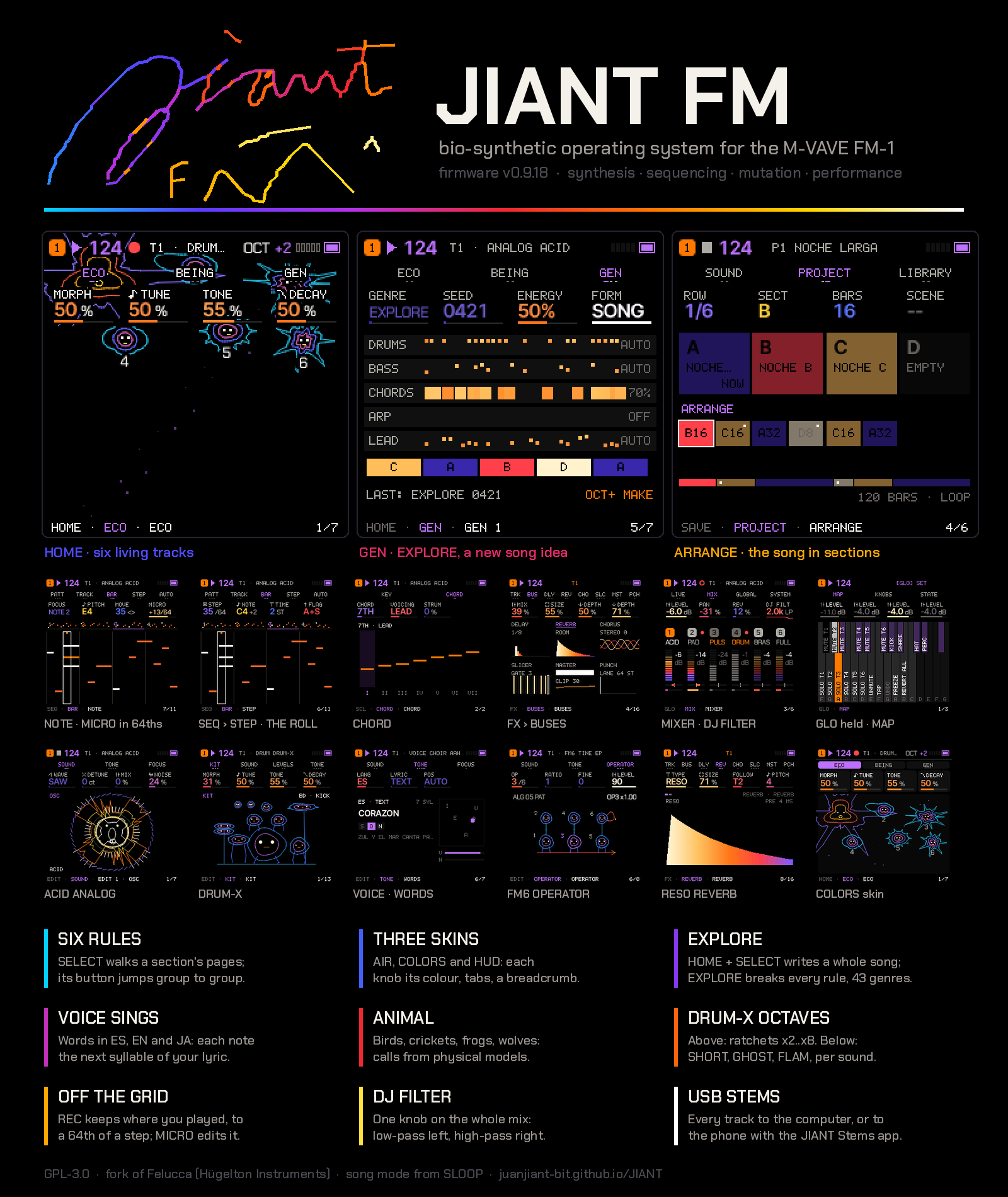
JIANT FM is an alternative firmware for the M-VAVE FM-1, made for playing live and building whole songs without a computer. It is a fork of Felucca 1.1.5.1 by Hügelton Instruments (GPL-3.0) and takes its song system from SLOOP.
▶ Try it in the browser · Interactive manual · Web installer · Web editor: the emulator runs the same code as
the FM-1, with sound, and is played with your computer keyboard or the mouse. The emulator, the installer and the
editor update themselves with every change merged into main.
JIANT FM V10 — 2026-10-30
V10 is the new base of JIANT FM: one version, in both installers, tested on the FM-1. Earlier versions are no longer offered; from here on every update starts from V10.
Install · Emulator · Editor · Beta installer
Installing
- Official V16 (M-VAVE, October 2026; what a new FM-1 ships with): press Install. V16's own boot stage is kept; JIANT runs on it.
- Official V15: press Install.
- JIANT, any version: press Install; your projects stay.
- Felucca, Skiff or another custom firmware: open Return to official first (it saves that firmware's backup), then Install.
- Back to official: Return to official takes M-VAVE's own
FM-1.fwscof V16 (718,196 bytes) or V15 (699,956 bytes), checked byte for byte. It saves a complete JIANT backup first; the editor restores it later.
Chrome or Edge on a computer, or Chrome on Android with a USB OTG cable (iPhone and iPad have no Web MIDI). Use a data USB cable straight into the computer, and keep it connected until the page says Done.
What's in V10
Songs
- SAVE › TIMELINE: the song left to right, its bars the width. A lane for the rows (their section and bars) and one per track. Each row can take any track from another of the song's four sections (FROM) and vary it in that row only (VAR: MUTE, THIN, FILL, HALF, REV, SHIFT, OCT+, OCT−, VAR 1–4, the same row always the same). A track that follows its row is dim, one from another section bright with its letter, a muted one an empty frame. KNOB 1 the row, KNOB 2 the lane, KNOB 3 / 4 the lane's two values.
- 8 songs × 4 sections (A–D), up to 16 rows each, scenes per row, SONG REC, quick chains, the song's END.
Sound
- Engines: DRUM-X, VOICE, ANIMAL, LOFI, ANALOG, FM6, PHASE, WHEEL, NOISE, STRING (Karplus-Strong, with FDBK: guitar feedback, MOVE, bloom, fuzz, the envelope's attack and release) and ADD (additive, ten spectra).
- DRUM-X EDIT › KIT 4 › ACOUST: a synthesized acoustic voicing of the kit, 0–100 %.
- Master: leveler, CLIP, TAPE (drive and wow), a 4-band EQ; FX: delay, reverb (SHIMMER, RESO, CLOUD), chorus, slicer, punch-in effects.
Sequencer and recording
- Piano roll on every SEQ page; step components (SHIFT, CHORD, RATCHET, ARP…); MUTATE; PLAYHEADS; STRETCH.
- REC + A3 undo / redo, REC + B3 quantize on/off, REC + knob 2 REC Q; REC and PLAY independent.
- SEQ + E5 / F5 copy / paste a whole sequence.
- GEN (HOME + SELECT): the song generator by genre; GLO › LIVE: the six sequences as a live board.
Connection
- USB name FM-1, so the apps made for the FM-1 find it; USB STEMS (8 channels: T1–T6 + FX) for recording in a DAW.
The manual (EN · ES) and the cheat sheets below describe V10.
Reporting a crash
If the FM-1 crashes, the red screen now stays 10 seconds (it was 4) and names the core, the VEC, PC and SP, and the bus master that wrote or read where it should not. Take a photo of it, then power on and open MENU > ABOUT, which keeps the CRASH line (VEC / PC / SP / bus) until power-off. Report both, with the version you installed, in a GitHub issue (the bug report template asks for the rest).
Status of
main: the 0.9.18 development line (the text below). The public and beta installers use separately pinned 0.9.9-par revisions: see Current versions above. It builds and passes every test (Felucca's and its own). Back up the flash before installing it. RATCH and ARP spill over the steps (0.9.18) (in the 0.9.1x line, installer: 0.9.17; not yet in 0.9.9-beta4a): RATCH x1–x8 (ECHO folded in: FLAT, FADE, RISE, a pitch step) and ARP one note at a time at its RATE play on past their step; OCT an octave a lap; SEQ › COMP frames the step it edits; the SEQ › BAR page is gone. Every SEQ page is the piano roll (0.9.17) (in the 0.9.1x line, installer: 0.9.17; not yet in 0.9.9-beta4a): the same bars' strip and roll (a kit: the grid) on all the pages, the values on top, each page marking what it does on the notes: PATTERN their GATE and SWING, TRACK the notes moved by PITCH, PLAYHEADS the extra heads as they play, COMP the steps with a component, AUTOMATION and AUTO LIST every record, MUTATE when the next mutation comes. The BOTTOM skin is retired (a saved BOTTOM opens as AIR). DRUM-X, VOICE and ANIMAL first (0.9.9): the FM-1 powers on with T1 DRUM-X, T2 VOICE singing words, T3 ANIMAL's bird, T4 LOFI's bytebeat, T5 ANALOG's bass and T6 FM6's electric piano, and PRESETS lists the engines in that order. A new skin, AIR (0.9.7, the default of new settings): HUD's light look on every page with the knob row on top, the middle of the screen free; HOME's beings over the whole screen. MENU › SCREEN › SCOPE (OFF by default): an engine's EDIT pages give its creature the whole panel. HOME's beings have faces: three isotherms coloured by their own level, eyes that shut on a hit, a mouth that opens with the sound, a look up when MUTATE changes them. 15 KB of flash given back, nothing removed, the sound bit for bit. Every engine draws its own creature (0.9.6): ANALOG a cell whose membrane is its wave, FM6 its operators as little beings wired as the algorithm (also on OPERATOR and OP ENV), WHEEL nine tube worms, one a drawbar, NOISE a swarm, PHASE a snail whose shell is the bent phase, LOFI a caterpillar whose skin is its output and segments its bits (0.9.10: CHIP flattens it into a DIP chip, 1BIT all the way; every knob shows on it). Messages no longer darken the screen (0.9.5): a message is a small pill over the page, which keeps moving behind it, clear of the page's words; a page's hint comes only once you stay on it (never while SELECT walks past), at most twice ever; a layer button's tap no longer says "HOLD [X] QUICK". On JIANT each card's colour follows its value again, as in 0.6. Three engines draw their own creature (0.9.4): VOICE its vocal tract singing, a glowing tube in a ghost of a head (0.9.9; the tongue, jaw, lips and velum move with the phoneme sung, glottal pulses travel up it, waves leave the mouth), ANIMAL a creature that metamorphoses between bird, insect and mammal, DRUM-X its kit as little beings that squash, shut their eyes and shout with every hit. MUTATE can go back (0.9.3): turning MUTATE off asks to return the track to its anchor; SEQ + D5 REVERT, GLO + B4 REVERT ALL, undoable. 0.9.2 is driven by six rules (see Navigation): SELECT walks a section's pages as one chain, the section's button jumps group to group, PRESETS always loads presets, KNOB 1 picks, a button held is its layer, and the tabs and the footer say where you are. Every page, knob and function is where it was; only the way between them changed. The dice starts in EXPLORE (0.8.6): HOME + SELECT opens GEN on a choice that follows no genre and breaks every rule (any tempo, odd metres and polyrhythm, exotic modes, any engine on any role, DRUM-X octaves, PLAYHEADS, MUTATE), each seed a very different piece, still in the key its SCALE and CHORD pages show. RANDOM and the 43 genres follow. DRUM-X octaves (0.8.5): the kit stays on its keys at every OCT; above the centre it repeats in time (0.9.13: once a step, x2, x4), below it plays SHORT, GHOST or FLAM, each sound its own on each step, and live recording keeps exactly what you played. MIDI drum notes outside 35–81 now trigger these variations: see the changelog before installing.
⚡ New in 0.8.3 – 0.9.2: a new look, nine engines, finer timing and a map you can learn in a minute.
- Flat navigation (0.9.2): one chain of pages per section, the groups as tabs on top (a dot a page), the breadcrumb SECTION · GROUP · page n/N at the foot; SCL and ARP two sections; GEN three HOME pages. Clearing a step is SEQ + G5, renaming SAVE + C5: EDIT is always EDIT.
- Three skins, MENU > SCREEN > SKIN (0.8.9; HUD faster in 0.9.0; 0.9.7: a fourth, AIR, the default of new settings; 0.9.17: BOTTOM retired): COLORS (rounded cards, each card its colour, on JIANT its value's heat as in 0.6), BOTTOM (the picture edge to edge, a slim knob row) and HUD (HOME's beings under everything). The LENTE look (0.8.5): tabs, cards and a breadcrumb in a crisp 5 × 7 pixel face, values in Inter Tight. Held layers show the keyboard itself: MAP, KNOBS and STATE (ALGORITHM while held).
- VOICE sings words (0.8.5): ES, EN or JA, each note the next syllable of a lyric you type (or the dice's). ANIMAL (0.8.3), the ninth engine: birds, insects, frogs and beasts from physical models.
- DRUM-X in every octave (0.8.5): the kit stays on its keys; above the centre it ratchets (x2, x4, x8), below it plays SHORT, GHOST or FLAM, each sound its own on each step, recorded as you played.
- The dice starts in EXPLORE (0.8.6): HOME + SELECT opens GEN on a choice that follows no genre and breaks every rule (odd metres, exotic modes, any engine on any role, PLAYHEADS, MUTATE); RANDOM and 43 genres follow.
- A DJ FILTER on the master (0.9.1, GLO › MIXER KNOB 4): low-pass to the left, high-pass to the right, out of the chain in the middle; automatable, saved with the project. REC off the grid in 64ths of a step (0.9.1): SEQ › NOTE's MICRO, −32/64 … +31/64.
- USB audio that keeps its time (0.8.9): no lost half buffers (the clicks under load), no dropped packets, the 48 kHz resampler on the second core. Stems: every track to the computer (MENU > USB > AUDIO STEMS), one channel each, into your DAW.
- Every version's details: the Changelog.
🫶 If you resonate with my work, consider supporting me on Ko-fi (in Argentina: Cafecito). Thanks for all the good energy, hope you enjoy this little beast ✨🎹
Navigation
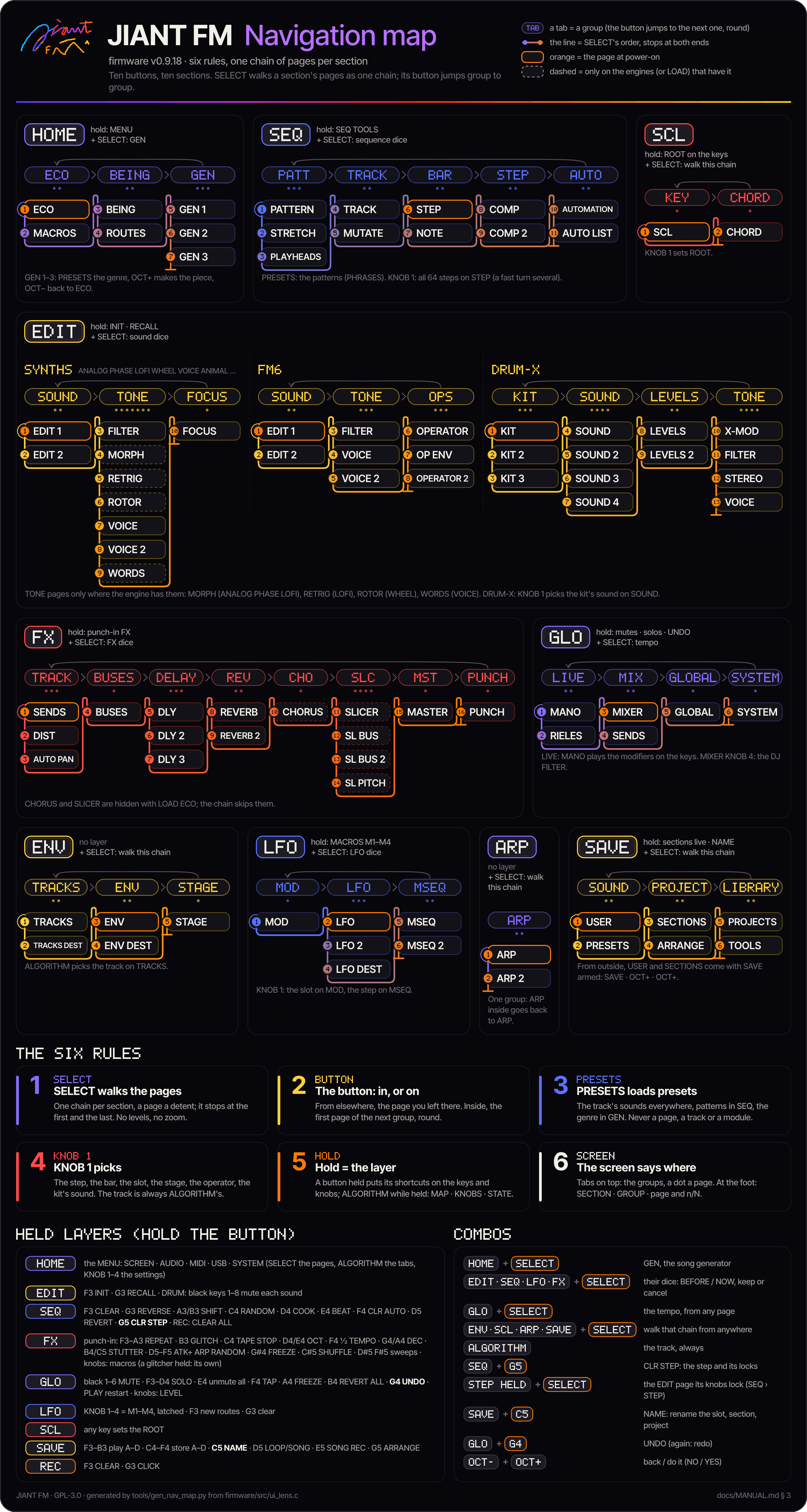
Ten buttons, ten sections, and the same six rules in every one of them (0.9.2). The map shows every section, its groups (the tabs on the screen) and its pages in the order SELECT walks them, with the held layers and the combos. Click it to open it full size (SVG, zoomable · en español).

- SELECT walks the pages: one chain per section, a page a detent, stopping at the first and the last.
- The section's button: in, or on: from elsewhere, the page you left there; inside, the first page of the next group (round). FX › DLY 2 → REVERB; EDIT › FILTER → FOCUS.
- PRESETS loads presets: the track's sounds everywhere, the patterns in SEQ, the genre in GEN; never a page, a track or a module.
- KNOB 1 picks: the step, the bar, the slot, the stage, the operator, the kit's sound. The track is always ALGORITHM's.
- Hold = the layer: a button held puts its shortcuts on the keys and knobs (SEQ + G5 CLR STEP, SAVE + C5 NAME, GLO + G4 UNDO …). Held + SELECT: HOME GEN, EDIT / SEQ / LFO / FX their dice, GLO the tempo, ENV / SCL / ARP / SAVE walk their chain.
- The screen says where: on top the section's groups as tabs (a dot a page), at the foot SECTION · GROUP · page and n/N: FX · DELAY · DLY 2 6/16.
The whole chapter: the manual, § 3 ·
el manual, § 3. The map is generated from the firmware's own chain tables
(firmware/src/ui_lens.c) by tools/gen_nav_map.py.
Manual
What changed in each version: the Changelog, at the end of this page.
The full user manual, every page, layer and setting, with a careful chapter on saving: English · Español.
The interactive manual (Spanish and English): the FM-1 drawn
with every control (touch one: what it does alone, held and in combination, with the firmware's real screen), every
command searchable, step-by-step recipes, the navigation map and what's new by version. Its source is
web/manual (the chains and screens from the firmware, tools/gen_manual.py).
Cheat sheets
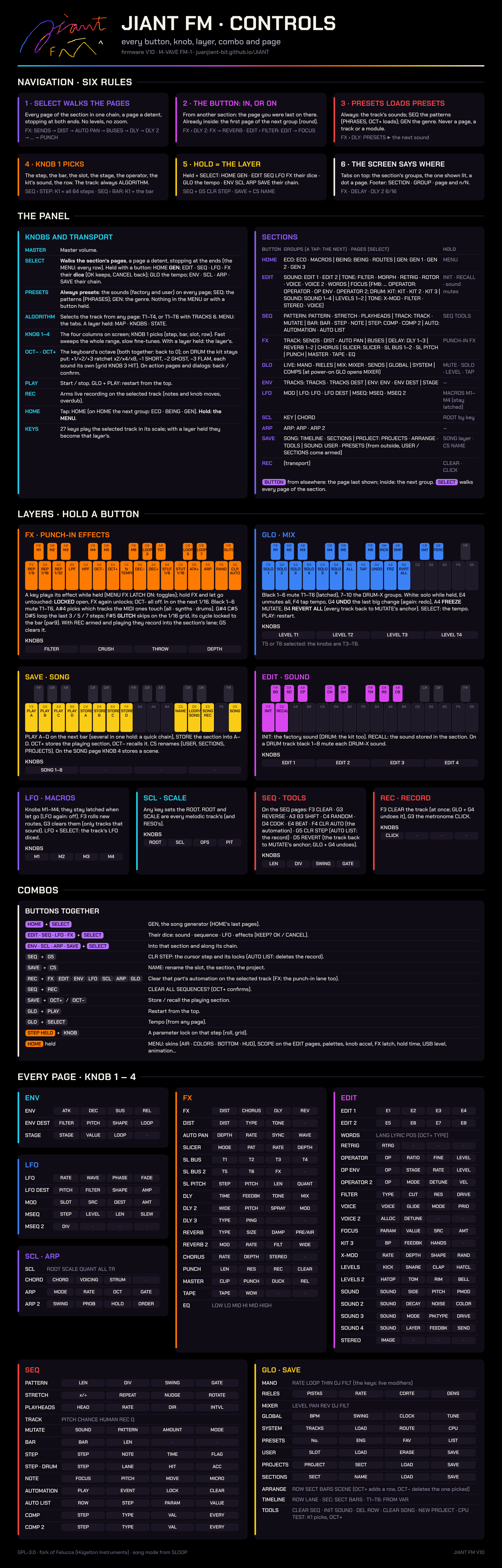
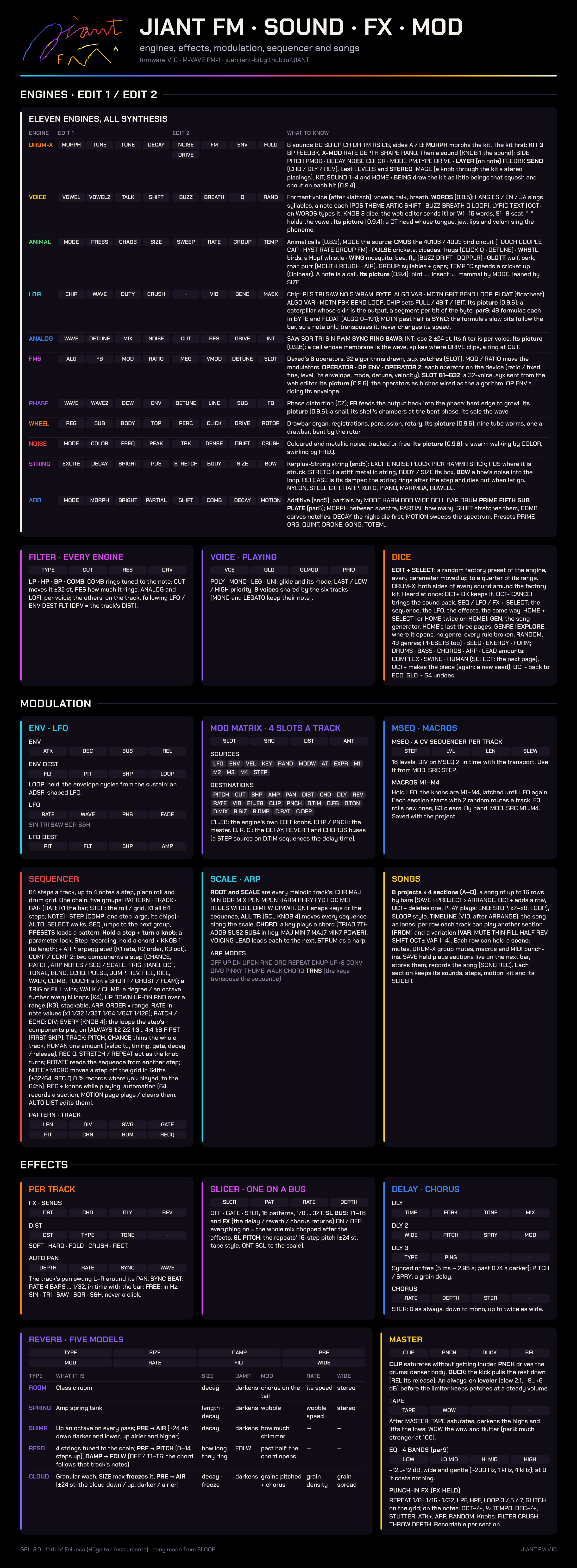
Two printable sheets with everything on the device. Click an image to open it full size, or download the PDF.
| Controls | Sound · FX · Mod |
|---|---|
 |  |
| Every knob and button, the layers with their key maps (FX, GLO, SAVE, EDIT, LFO, SCL, SEQ, REC), the combos and every page's four knobs. PDF | The eleven engines' EDIT pages (STRING and ADD included), FILTER, VOICE, ENV, LFO, the MOD matrix, MSEQ, macros, the sequencer, scales and ARP, songs, and every effect: DIST, the SLICER bus, delay, the five reverbs, the master, TAPE and the 4-band EQ. PDF |
The idea
A pocket synthesizer shouldn't feel like a menu. JIANT starts from a simple question: what if the device behaved less like a tool and more like an organism?
That's why everything in JIANT is alive and visible. The screen works like a thermal camera: colour isn't decoration, it's intensity. Cold is cyan and violet, hot is red, orange, yellow and white. A high parameter burns; a sounding voice glows; silence cools down. Each engine is a being, a protozoan drawn in lines whose shape comes from what you're playing: open the filter and it grows spines, raise the resonance and its membrane vibrates, detune the oscillators and its nuclei drift apart. HOME is an ecosystem: six creatures, one per track, breathing with their own audio. You don't need to read numbers to know what's going on; you can see it.
At the same time, what is technical is shown as technical. The LFO runs at its rate, the envelope shows where the voice is, the distortion draws its transfer curve, the delay its echoes, the reverb its response. The organic invites you to play; the technical lets you understand what you did.
The second idea is that randomness is an invitation, not an accident. Every session starts with macros rolled towards what your sounds have; HOME + SELECT writes a whole piece, EDIT + SELECT dices the sound; macro dice only land on what is playing. The system pushes you to move things and always leaves you near something that works: the dice start from factory presets and vary around them, never from nothing.
The third is that everything is playable and everything is recordable. Effects are played on the keys and land in an automation lane; knobs record their movement; songs are built from bars and scenes, and recorded while you play them. The synthesis engines run in real time on a chip designed for something else.
And the last one is a discipline: lightweight. Every graphic is a handful of lines, every effect fits in the audio CPU budget, the signature shown at power-on is 428 bytes. An instrument that feels big inside a small device.
The system
Both cores (dual core)
Since 0.6.71, experimental. The FM-1's chip (JieLi AC791N) has two processor cores; Felucca and JIANT up to 0.6.70 used one, which ran everything: the sound, the screen, the keys. Now the second one helps with the sound:
- How the work is shared. Every 0.7 ms block, the tracks are split between the two cores by how long each took to render over the last blocks (timed as they play, since 0.6.73). While the first core renders its tracks, the second renders the others into buffers of its own; then they are added together and go through the master on the first core. The drum tracks go together, on one core or the other. Since 0.6.75 the second core also runs the effect buses (chorus, delay, reverb), on the sends of the block before (0.7 ms later, inaudible), so they no longer wait.
- The same sound. The sum is exactly the one-core sum: a test plays a whole six-track song both ways and checks that the output is identical, bit for bit.
- More room. With the second core doing part of the synth work, the load meter stays lower: more tracks, voices, FM6 and heavy reverbs before the clicks and the cut notes start. LOAD LITE / ECO are still there for the heaviest songs. 12 voices (0.9.12, after Skiff): while the second core plays, the tracks share 12 voices instead of 8 (each still at most 8; ECO 6); with one core, 8 as before.
- Units that cannot run it. On some FM-1s the second core now and then reads a word of memory wrong, more often under load (found by the Melodee and fm1-x0x developers). JIANT guards against it: every job carries a check word, and if the second core reads a wrong one, faults or does not answer in time, it is stopped at once and the first core plays every track again, with no crash (at most one 0.7 ms block of those tracks is lost). Since 0.6.76 the effects' output is checked too: far out of range, the block is muted, their lines cleared and the second core stopped the same way. Such a unit then stays on one core until it is switched off, and so does any unit after a crash while both cores ran.
- What it says. MENU > SYSTEM > ABOUT, under AUDIO LOAD: CORES 2, or CORES 1 with the reason: REC AT POWER-ON, BAD READ, NO ANSWER, FAULT, SINCE A FAULT (an earlier one this power-on), NO START.
- One core on purpose. Hold REC while switching the FM-1 on: that session plays on one core, as before.
- Credits. How to start the second core safely on the FM-1 and the guard against misreads come from
Melodee (keremimo) and fm1-x0x
(Charles Vestal), both GPL-3.0; JIANT's version is in
firmware/hal/fm1_multicore.h.
A living screen
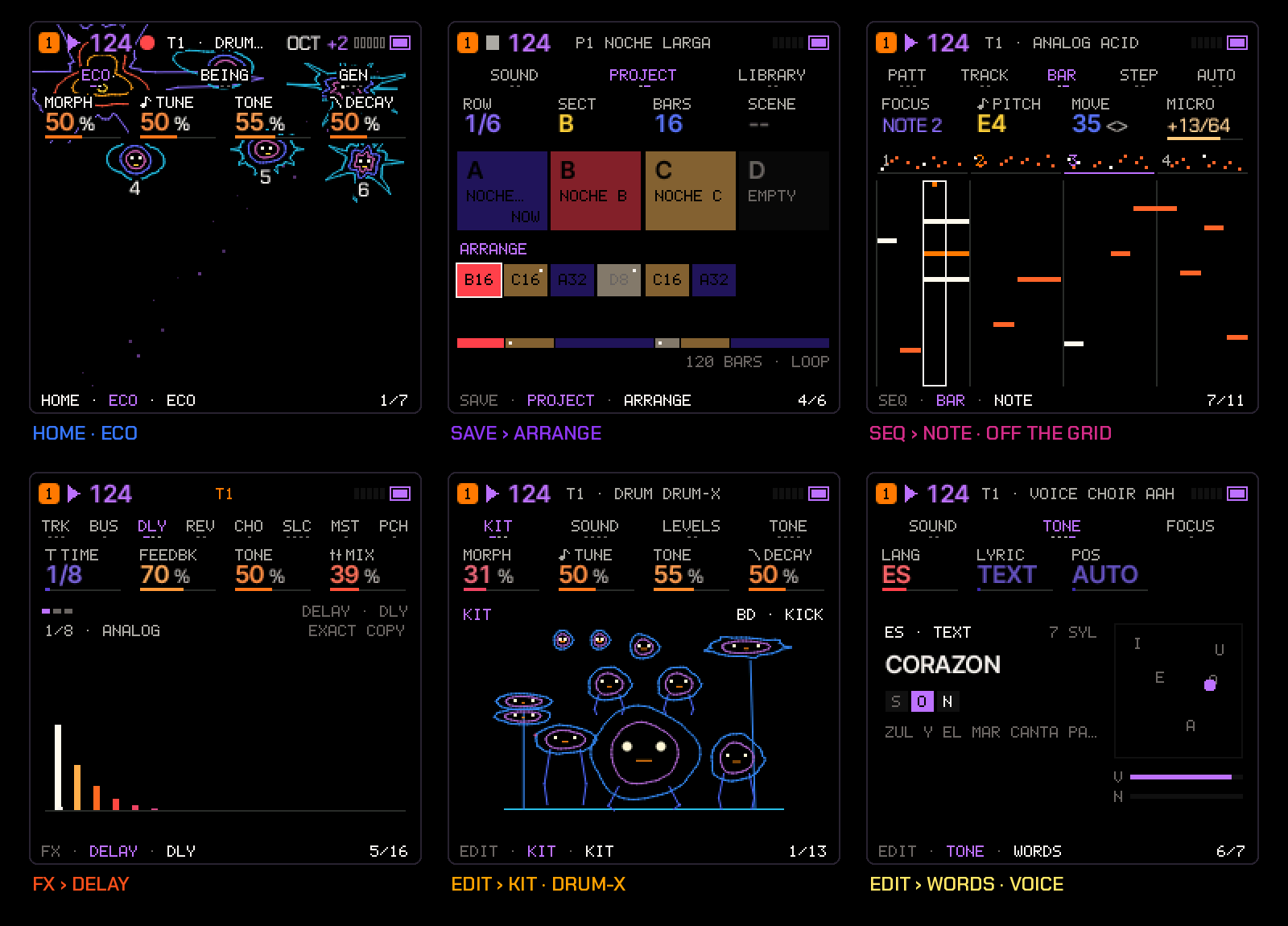
HOME with its six beings, the song in ARRANGE, SEQ › NOTE with a note 13/64 late, the delay, the DRUM-X colony and
VOICE singing its lyric, in the COLORS skin, exactly as the firmware draws them (the renders of tests/ui_render.c).
- Thermal palette: values, curves, steps, hits and notes are coloured by intensity (cyan → blue → violet → red → orange → yellow → white). Selection is violet and active is orange; on JIANT each card's value and gauge are its amount's heat (0.9.5, as 0.6), the other palettes give each knob its own colour.
- Skins (MENU > SCREEN > SKIN, 0.8.9): AIR (0.9.7, the default of new settings: HUD's floating words on every page, the knob row on top under the tabs, the middle free), COLORS (near-black rounded cards on top, a rounded panel) and HUD (HOME's beings swim under everything, the words float over them, the knob row at the foot; on the SEQ pages on top, as AIR's). (0.9.17: BOTTOM, the knob row at the foot on every page, is retired; a saved BOTTOM opens as AIR.) Every skin wears the LENTE layout (0.8.5): the section's groups as tabs on top (a dot a page), the breadcrumb SECTION · GROUP · page n/N at the foot. Values in Inter Tight SemiBold, names, tabs and the breadcrumb in a crisp 5 × 7 pixel face, small captions in Chakra Petch.
- HOME, the ecosystem: one being per track (its species from its engine, its shape from its four knobs). Each one heats up, swells and moves with its own audio; the selected track is drawn bigger; muted ones go dark; in silence they all stay still. (0.9.7) Each wears a little face: its eyes shut on a hit, its mouth opens with its level, it looks up when MUTATE changes it; muted, it sleeps.
- Engine pages: each engine draws its own creature (0.9.4 / 0.9.6, below): VOICE a singing head, ANIMAL a bird / insect / mammal, DRUM-X its kit of little beings, ANALOG a cell, FM6 a colony of operators, WHEEL tube worms, NOISE a swarm, PHASE a snail, LOFI a caterpillar. (Before: the sound's being drawn in isotherms, four contours of the same body, cold edge, hot core, as HOME's ecosystem still shows them.) The being's knobs read as what they are: CUT grows spines (more harmonics, spikier), RES makes the membrane vibrate, DTN/SPRD splits two nuclei, NOIS/RAND/CRSH frays the edge, WAVE changes the lobes.
- DRUM-X, the colony: one being per kit sound, each with its own shape (round kick, spiky snare, fringed hats, clustered clap, star-shaped cowbell) that swells and heats up when it hits (KIT 2, KIT 3, X-MOD); on KIT, SOUND 1–4 and HOME (0.9.4) the kit as little beings with eyes and mouths that squash and shout with every hit.
- Live technical graphs: LFO (the wave runs at its rate, with playhead and current value), ENV (a dot travels the curve with the sounding voice), DIST (transfer curve by TYPE and TONE response), DLY and DLY 2 (the echoes, L and R), REVERB and REVERB 2 (the impulse response, stereo, drawn per model), CHORUS (the three modulated lines), AUTOPAN (the swing across the stereo field), MASTER (clipper curve, PUNCH shape, how much DUCK pulls down), ENV/LFO DEST (bipolar columns under each knob, lit by what they send), VOICE (one cell per voice and the glide curve), GLOBAL (the bar in thermal columns with swing, clock and tuning).
- Load meter: five small bars next to the battery showing the current audio load.
- Power-on: the "Jiant FM1" signature is written stroke by stroke in thermal colours (MENU > SCREEN > ANIMATION OFF: it shows up whole).
Engines
V10 has eleven synthesis engines: DRUM (DRUM-X), VOICE, ANIMAL, LOFI, ANALOG, FM6, PHASE, WHEEL, NOISE, STRING and ADD. The synthesis engines are listed in the order PRESETS shows them (0.9.9-par; the first six are the tracks at power-on, T1–T6).
- ANALOG: two oscillators with INT (an interval of ±24 semitones: fifths, octaves) and DTN; besides SAW, SQR, TRI, SIN and PWM it has SYNC, RING and SAW3 (three saws). Its filter is per voice.
- FM6: Dexed's engine (imports .syx), with its algorithms drawn. Fully editable on the device (from Felucca 1.5): EDIT > OPERATOR (KNOB 1 the operator 1–6, then RATIO or FIXED frequency, FINE, LEVEL), OP ENV (the stage ATK DEC SUS REL, its RATE and LEVEL, drawn as the envelope) and OPERATOR 2 (MODE ratio/fixed, DETUNE, VEL), the operator lit in the algorithm's colony of operators (0.9.6: each a little being wired as the chart was) with its frequency; OP ENV's operator rides its envelope. Editing makes the patch the track's own (SLOT OWN) and it is saved with the project; the macros (EDIT 1 / 2) still act on top. The web editor edits every byte of it too. Voice bank (from Felucca 1.4.1): import a 32-voice DX7 cartridge (.syx) in the web editor's 6-OP FM tab and press Send to the device's voice bank; on an FM6 track SLOT (EDIT 2, KNOB 4) then goes F1–F8, OWN, B1–B32 (empty slots skipped), the voice's name on the chart. A voice loaded is copied into the track: projects and user presets keep it even after you send another bank. The bank lives in its own flash sector, written power-cut safe; the full backup does not include it (keep the .syx).
- PHASE: phase distortion with FB (the output feeds back into the phase: from hard edge to growl).
- LOFI: 1, 4 and 8-bit chip with BYTE (bytebeat: 32 formulas picked with ALGO and mutated with VAR). In
BYTE, MOTN sets the speed of the formula's rhythm, GRIT crushes its rate, BEND folds time and LOOP
repeats a short stretch of the formula: the noise becomes a tone tuned to the note. FLOAT is a floatbeat
generator: 32 formulas of
tmade of sines (rhythm, melody and timbre at once), in the key played. 0.9.9-par6: 48 formulas each (ALGO 0–191), and MOTN past half is SYNC: the formula's rhythm follows the bar, so a note only transposes it. - STRING (0.9.9-snd5): a Karplus-Strong string. EXCITE (NOISE, PLUCK, PICK, HAMMR, STICK), DECAY, BRIGHT, POS (where it is struck); BODY page: STRETCH (a stiff, metallic string), BODY, SIZE and BOW (a bow's noise fed into the loop). RELEASE is its damper: the string rings past the step and dies out when let go.
- ADD (0.9.9-snd5): additive. MODE picks the spectrum (HARM ODD WIDE BELL BAR DRUM PRIME FIFTH SUB PLATE), MORPH moves between spectra, BRIGHT and PARTIAL how many partials, SHIFT stretches them, COMB carves notches, DECAY lets the highs die first and MOTION sweeps the spectrum.
- VOICE (formants, after klattsch), WHEEL (drawbar organ) and NOISE (coloured and metallic noise). VOICE sings words (0.8.5): LANG ES / EN / JA, each note the next syllable of a lyric you type (on the device or from the web editor) or of phrases the dice puts together from each language's word bank; POS and LOOP automate it.
- ANIMAL (0.8.3): animal calls from physical models: a source that oscillates or strikes exciting a resonator, with a call's rhythm on top. CMOS is the owner's 40106 / 4093 breadboard "bird machine" (Schmitt-trigger RC oscillators: a slow one gates and sweeps a fast one, the exponential charge is the chirp's hook), PULSE an escapement into a resonator (crickets, katydid, cicada, frogs, toad), WHSTL a Hopf oscillator whose tone is born as the pressure crosses a threshold (canary, cardinal, dove, owl, peeper, bat), WING flight tones with drift and Doppler fly-bys (mosquito, bee, fly), GLOTT a glottal pulse into two formants with subharmonics and chaos (wolf, bark, roar, purr). GROUP makes chirps and trills, TEMP (°C) speeds insects up as warmth does (Dolbear's law); a note is a call. 24 presets.
- FILTER on every engine (EDIT > FILTER): TYPE LP, HP, BP or COMB (a comb tuned to the note you're playing; CUT moves it ±32 semitones and RES is how much it rings), CUT and RES. On ANALOG it's its per-voice filter, with DRV; on LOFI it's per voice too (its CUT and RES are the ones on this page); on the others it's a filter on the track that follows the LFO and the envelope (LFO/ENV DEST FLT), and its DRV is the track's DIST.
DRUM-X: synthesized drums with morph
An 8-sound kit (BD SD CP CH OH TM RS CB) generated in real time, Microtonic style.
- Each sound has two sides, A and B; MORPH (KNOB 1) moves between them.
- FOLD runs each sound's oscillator through a wavefolder after its envelope: the hit starts bright and the tail returns to the clean wave. FM changes the timbre with harmonic FM in 8 bands; plus TUNE, TONE, DECAY, NOISE and DRV.
- EDIT > SOUND 1–4 (one sound each, KNOB 1 picks it): SIDE, PITCH, PMOD; DECAY, NOISE, COLOR; MODE, PM.TYPE (how the pitch moves: DECAY, LONG like the 808, NOISE, SINE), DRIVE; LAYER, FEEDBK and a per-hit SEND.
- The kit in every octave (0.8.5): the keys play the kit on the same keys at every OCT; above the centre a key ratchets in time (x2, x4, x8), below it plays SHORT, GHOST or FLAM, each sound its own on each step, and live recording keeps exactly what you played. MIDI drum notes outside 35–81 trigger the same variations.
- Group mutes (KICK, SNARE, HAT, PERC) with GLO held and per-sound mutes with EDIT held.
- EDIT > X-MOD (0.5.1): a tempo-synced LFO on MORPH and RAND, which gives every hit its own MORPH and tune.
- Nine kits as the DRUM engine's presets (DRUM-X, 909 CLUB, 808 BOOM, LOFI DUST …); EDIT + SELECT rolls a new kit.
Dice: the system invites you to move everything
- A button held + SELECT rolls that part's dice (0.9.2: SELECT alone walks the pages). EDIT + SELECT rolls the track's sound dice: a synth loads one of its factory presets at random and moves each engine parameter up to a quarter of its range; DRUM-X rolls the A and B sides of each sound around the factory kit. SEQ / LFO / FX + SELECT dice the sequence, the LFO, the effects, each shown BEFORE and NOW to keep or cancel; GLO + SELECT is the tempo. HOME + SELECT opens GEN, the song generator (since 0.6.91; HOME's last three pages since 0.9.2): it opens on EXPLORE (0.8.6: no genre, every rule broken: odd metres, exotic modes, any engine on any role), then RANDOM or a genre among 43 (house, techno, dub, UK garage, funk, post punk, jazz, ambient …), a seed, an energy, a form (a loop, parts, a club song); how much drums, bass, chords, arp and lead; complexity, swing, how human. OCT+ writes the piece from them (OCT+ again: a new seed; a knob turned and OCT+: the same piece with that one thing changed), OCT− is done. Every piece has one key, written to the SCALE page (and the CHORD page set to its chords: the keys play along in key), drums from the genre's priority map, a bass archetype written against the kick, a functional or modal progression with cadences voiced and led voice by voice, a lead composed from a motif in periods and sentences, a sound recipe a role, the genre's kit and space (see v0.6.91, v0.8.3).
- UNDO: GLO held + G4 takes back the last big change (DICE ALL, a sound diced, a clear, INIT, RECALL, a pattern or project loaded); pressing it again goes forward (redo). G4 breathes when there is something to undo.
- Macros M1–M4 (LFO held; they stay latched when released until you press LFO again): every session starts with two random routes per track towards what its sound has. With the macros open, F3 rolls new routes, only on the tracks that are playing; G3 clears them (LFO + SELECT rolls the track's LFO). They can be assigned by hand in MOD (SRC M1…M4) and are saved with the project.
Punch-in FX: effects you play and record
In the 0.9.1x line (installer: 0.9.17), not yet in 0.9.9-beta4a: the sweeps, TAPE STOP, the performance macros and recorded FX lanes below (0.9.15-0.9.17). With FX held the keys become effects that act while hel…8050 tokens truncated…er a pattern of another length they drift across the notes (polymeter, as the OP-Z's). The COMP page marks the lane and where it is. Automatable. Costs nothing on the audio: a copy of the step once per step.
Changelog
V10 — 2026-10-30
- The new base: JIANT FM V10 replaces every earlier line in both installers (no earlier versions are offered).
- SAVE › TIMELINE: the song as lanes; each row can take a track from another section (FROM) and vary it in that row only (VAR: MUTE THIN FILL HALF REV SHIFT OCT+ OCT− VAR 1–4).
- Official V16: JIANT installs over M-VAVE's V16 and returns to it (Return to official takes V16 or V15).
- USB name FM-1, so the apps made for the FM-1 find it.
- From the add15 line: REC undo / redo and REC Q shortcuts, independent REC and PLAY, COPY / PASTE SEQ, the SHIFT and CHORD components, STRING FDBK (guitar feedback with MOVE), DRUM-X ACOUST, ADD kept as engine 13.
v0.6.46
Feedback from users (YouTube, Reddit):
- INIT SOUND is dry: every effect send (DIST, CHORUS, DELAY, REVERB) at 0, so the effects are yours to add. On FM6 INIT is the init voice (OP1 alone at full level, the rates at 99: a plain sine) instead of a factory patch.
- NEW PROJECT (it was INIT SYSTEM: SAVE > TOOLS, 5th row): a clean start, every track its engine's sound, dry, FM6 the init voice, no steps or automation.
- NOISE DUST never silent: at DENS 0 it still crackles softly (DUST is only the crackle).
- FM6 EDIT 1: the chart says the algorithm's number also when ALG follows the patch ("ALG 05 PAT").
- Web installer: pick an earlier version to go back to (the last few stay there), and links to the manual (English, Español).
v0.6.45
- MORPH (EDIT > MORPH) on ANALOG, PHASE and LOFI: the wave slides continuously into the next ones; on ANALOG and LOFI the SHAPE modulation sweeps it too. The page draws the morphed cycle.
- Fix (reported on Reddit): "the sequence pitch drops by itself". It was SCL 2's STRN, a global transpose of every sequence that is easy to turn by mistake next to ROOT. Renamed ALL TR; when it is not 0 the piano roll shows an ALL TR badge and PLAY warns. 0 = off.
v0.6.44
- Punch-in FX latched by default (asked by many): FX LATCH is now ON (turned on once for everyone; turn it OFF in MENU > CONTROL if you prefer holding). Lock: hold FX until its map opens and let go without touching anything: the FX layer stays open ([FX] LOCKED), as the macros latch with LFO; keys toggle effects, knobs are FX's macros, OCT− all off. Press FX again to unlock.
v0.6.43
- MUTATE (SEQ > MUTATE, a suggestion from the community): each track's SOUND and PATTERN change by themselves every 1 to 32 bars, on the bar, in time with the clock; AMOUNT how much; ORBIT varies around an anchor (KEEP: OCT+ on the page) so the music stays itself for minutes, DRIFT wanders on. Never LEVEL, PAN or MUTE, never the kick. FREEZE (OCT− on the page, or GLO + A4) stops it all. The page draws the next 32 bars of every track; on HOME each being gets a ring filling up to its next change.
v0.6.42
- Step components, the second set (SEQ > COMP): RAND (the note at random in the scale), OCT (an octave, every loop or every other one, by turns, at random), TONAL (the rest of the loop moved along the scale), BEND (the note glides over the step), ECHO (repeats, each softer), PULSE (again on the empty steps after it), JUMP (then another step), REV (back to step 1: ping-pong), FILL (only while FX is held) and KILL (cuts what the track sounds). Each with its picture on the page.
v0.6.41
- Smooth engine and waveform changes: another engine fades the old one out (~12 ms) and what is held (keys, the sequencer's notes) goes on in the new engine, fading in, instead of being cut. A list value changed while notes sound (WAVE, CHIP, a type) dips for ~3 ms instead of clicking; the notes go on.
v0.6.40
- INIT SYSTEM (SAVE > TOOLS, 5th row, with a dialog; UNDO brings the music back): everything to zero at once: every track its engine's default sound, no steps, automation or locks, the mix, effects, tempo and SLICER at their defaults, the song empty, macros at 0, the factory DRUM-X kit. Saved projects, user presets, MENU, CLOCK, TUNE and MIDI stay.
- Power-on at zero: the device starts as INIT SYSTEM leaves it. RESTORE LAST (MENU > SYSTEM) is now OFF by default; turn it ON to get the last session back at power-on (if you had set it OFF before, it reads ON once: set it again).
v0.6.39
- Step components (OP-Z style), on a new page SEQ > COMP right after STEP: one per step, picked with KNOB 2. ARP NOTES / SEQ / SCALE turn a step into an arpeggio (its own notes, every note of the pattern, or the scale up from it; UP, DOWN, UP-DN, RND; x2 to x8 in the step; 1 to 4 octaves or 3 to 15 degrees) that goes on over the ties after it. TRIG plays a step only on some loops (1:2 .. 4:4, 1:8, FIRST, NOT FIRST). The step's own CHANCE and RATCH are back here too. The page draws the arpeggio's ladder (the note playing lit) and TRIG's loops.
v0.6.38
- Step recording, chords with a length and arpeggios: on STEP with REC (stopped), hold a note or a chord and turn KNOB 1: it lasts that many steps, written when you let go. Press ARP while holding it: the chord goes into the roll as an arpeggio, KNOB 1 its resolution (1/16 .. 1/4), KNOB 2 the order (UP, DOWN, UP-DN, RND), KNOB 3 the octaves.
- DICE ALL: the lead never goes past G5 on any of its paths (a FRANTIC cell could reach C#6).
v0.6.37
- SEQ pages, lighter: PHRASES and the step CHANCE page are out of the cycle; SHIFT is now the last SEQ page and has a third knob, CHANCE: the whole track's probability (100 % plays every step as written, lower thins it out), automatable like OFFSET and PITCH. Old projects and presets keep playing as they were.
- Films: the presentation video in the landing page's look, with a dark minimal techno track (low FM chords, acid, a cyber line).
v0.6.36
- DRUM-X: FM becomes FM ENV. The old FM knob put a fixed FM over every hit and muddied the kit (the macros' dice liked it a lot). FM ENV strikes the FM with each hit and lets it go with the pitch envelope (a few ms): a beater, a click, a metal edge on the attack, the tail as the kit has it. Projects keep the value; its effect is the new one.
- DRUM-X: EDIT > TONE, a new page after X-MOD: BP, a band-pass on the hats, the rim and the cowbell (OFF or 15 centres, about 1.5 to 9 kHz), and FEEDBK, every sound's oscillator fed back into itself (warm to growl to noise). Saved with the section's kit in a byte it already reserved: older projects open with both OFF, sections no bigger.
- Films: the features film's music is new and darker (E harmonic minor, Em(add9) Cmaj7 Am7 B7, a rolling sub, a low arp, the robot low and spaced) and the camera cuts to HOME's beings every two bars of a long scene; the DICE ALL film shows HOME's beings instead of the mixer.
v0.6.35
- DICE ALL: the drums as before, darker. The chords, the variety and the guard rails of 0.6.34 stay; the drums go back to 0.6.33's, which sounded better: the DRUM-X kit rolled around the factory one through a soft low-pass, the patterns written whole (the energy no longer thins or fills them), and in the night's genres they almost always play. The night's genres come up four throws in five (IDM and DARK IDM still the most).
- Two new films: the DICE ALL film (one minute: a throw every few seconds, an animated die rolling between them,
no names) and the features film updated; thumbnails for both (
tools/video/thumbnails.py).
v0.6.34
- DICE ALL: a generator of pieces, not of conditions. Each throw makes three choices and guard rails keep it
musical inside the chaos (see the manual, chapter 8):
- A genre: the dark ones, plus five new worlds: SOUNDTRACK (enveloping pads, no drums or a heartbeat), HARD TECHNO, INDIE POP, ELECTRO PUNK and NEO CLASSICAL (Reich's pulses and phases, Glass's additive arps, Pärt's tintinnabuli).
- An energy: SPACE (two or three things, long tails: minimalism with cared-for timbres), MID, FRANTIC.
- An orchestration: which roles play; the drums may not play at all (about a third of the throws).
- Guard rails: chords always of four notes, deep basses (from E1), arps in the middle octaves (C3–C5: Alberti, Glass groups, a Reich pulse, a walk), coherent melodies (a motif in steps developed over four bars, ending on a cadence), space between notes, high notes softer and high parts quieter, the lead under G5.
- Seven drum kits built on DRUM-X: 808, HARD, CLICK, INDUS, SOFT, GLITCH, ELECTRO.
- Sounds always fit their role (never a bass sound off the bass); envelopes shaped for the role and the energy.
- A twist in one throw in five: two loops phasing, a comb, the grain delay down, a polymetric lead, a drone.
v0.6.33
- DICE ALL: more IDM, darker, never flat. IDM and a new DARK IDM (slow, phrygian, a drone, in-scale fourths,
a few long notes) come up about 4 throws in 10; IDM's scales and progressions darker (PHRY, HARM; the flat second).
- A filter envelope on every sound (strongest on the bass and the arps, their envelope made a pluck), so each note opens and closes instead of sitting still.
- The filter TYPE changes: LP mostly, BP on chords, arps and textures, the COMB tuned to the note on arps and textures; a slow LFO of its own shape (SIN, TRI, S&H for the IDM arps) on the cutoff; a little drive (SOFT, FOLD) on some basses and leads; the drums through a soft low-pass (the hats not glassy).
- Delay and reverb vary: the delay time (1/4, 1/8, 8T, 16T, 1/16), the GRAIN delay pitched an octave or a fourth down or a fifth up (often on IDM), the reverb type among ROOM, SPRING, RESO and CLOUD, its size, modulation and width; each track its own space, now and then one soaked and one dry, chorus on some chords.
- Measured over 90 throws: brightness 1714 Hz (0.6.31) → 722 Hz, the same loudness.
v0.6.32
- DICE ALL goes dark. "Out of 30 sequences one is OK": the song ideas were shrill, cheesy, too bright and happy.
Now they are night music: DARK MINIMAL, DUB TECHNO, IDM, DARK ELECTRO, ACID NIGHT, COLD WAVE,
BROKEN, HYPNOTIC, DEEP BREAKS, in minor modes only (MIN, DOR, PHRY, HARM, MEL, MPEN; no major,
mixolydian, lydian or blues), no pop progressions.
- A harmony bug fixed: the chords were built from the scale's fifth and the lead from its third, so a v chord sounded over a i bass. Every part now starts from the same tonic.
- Chords with colour: voiced as 7ths, 9ths without the 5th, in-scale fourths or suspended, and led to the nearest voicing in a middle register (no leaps); dub stabs keep one voicing, offbeat after offbeat, into the delay.
- Filtered: every synth's cutoff goes down by role (chords and arps darkest), with some resonance; a slow LFO makes the chords breathe, the envelope plucks the arps. Bright factory sounds (bells, brass, marimbas, organs, chiptune) are never picked.
- Melodies lower and stranger: the lead around C3–C4 in small steps, or a hypnotic euclidean ostinato that turns on itself (Marc Houle, The Hacker), or a few long notes; arps an octave lower without octave jumps.
- Grooves: a rolling offbeat sub and a dub bass, minimal and deep-techno beats with ghosts, rims and chance, velocities a little human; darker delay and reverb (lower tone, more damping, no SHIMMER, CLOUD pitched down).
- Measured over 90 throws: the mix's brightness (its spectral centroid) 1714 Hz → 1376 Hz, the average note an octave lower (65 → 55).
v0.6.31
- The full manual, in English and Spanish: docs/MANUAL.md · docs/MANUAL.es.md. Every page and its four knobs, every layer's keys, the engines, DRUM-X, the sequencer, ARRANGE, the dice and UNDO, effects, modulation, performance, the MENU, MIDI, the web tools and troubleshooting, and a careful chapter on saving: what is saved where, how the autosave really works (10 s after the last change while stopped, never at power-off), quick stores, copying, switching projects, names and user presets.
- SELECT on the MIXER sets the tempo, as on GLO's other pages (GLO's button opens it); it said DICE: HOME / EDIT.
- New README images and presentation video v3: the screens as they look now, taken from the video's footage (song ideas, ARRANGE, UNDO, TRACKS and LOAD, one scale), with the support links at the end.
- README and cheat sheets corrected against the firmware: the autosave, ARRANGE instead of the SONG page, what the punch-in lane records, UNDO on GLO's G4, HOME held for MENU, the reverbs' AIR knob, DRUM-X's labels.
v0.6.30
- LOAD, next to TRACKS (GLO > SYSTEM: KNOB 1 TRACKS 4 / 6, KNOB 2 LOAD ECO / LITE / FULL; also MENU > SYSTEM >
LOAD). TRACKS says how many tracks play, LOAD how heavy the sound may get, so you choose: a lean, ultra-optimised
system to push to the limit, or a slow one full of heavy effects. Everything is swapped only while it sounds; the
project keeps its settings and sounds as saved back on FULL (or on another unit).
- FULL (the default): everything as set.
- LITE: the heavy parts swapped for their nearest light kin: SHIMMER and CLOUD reverbs as ROOM, RESO as SPRING, the GRAIN delay as a plain delay, FM6 two voices.
- ECO: LITE, and every reverb a light SPRING (0.6.70: a shorter chain), no SLICER (its tracks go straight to the mix) and no chorus: their pages disappear until you leave ECO. Every synth track plays at most 4 voices (the drums as ever), 6 between all tracks (8 otherwise), and the load budget steps in sooner.
- Since 0.6.71 the second core takes part of the synth work (both cores): FULL goes much further before LOAD is needed.
- The cards of what's swapped say LITE or ECO under their value.
- Why CPU and not RAM: the firmware reserves all its memory at boot, so nothing can be freed while it runs. What runs out is the audio time (the load meter, the CPU % card next to LOAD), and that's what LOAD gives back.
- 0.6.29's 6 LITE comes up as TRACKS 6 + LOAD LITE. GLO > SYSTEM's USB card is gone (the header shows USB).
- Ko-fi / Cafecito: support links in the README, the web installer, the web editor and the emulator.
v0.6.29
- TRACKS has a middle option: 6 LITE. GLO > SYSTEM > TRACKS (and MENU > AUDIO > TRACKS) now reads 4 FULL (the default), 6 LITE or 6 FULL (the old 6 HIGH). With 6 LITE all six tracks play and the heaviest parts are swapped for their nearest light kin while they sound: the SHIMMER and CLOUD reverbs play as ROOM, RESO as SPRING, the GRAIN delay (DLY 2 PITCH / SPRAY) as a plain delay, and FM6 plays two voices instead of four. Nothing in the project changes: back on 6 FULL (or on another unit) it sounds as saved. The cards that are swapped say LITE under their value.
- Fixed: when a message covered the header while the BPM was rolling, the old BPM could stay half-rolled.
v0.6.28
- "After clearing a sequence it still triggers notes on all tracks" — fixed. The punch-in FX lane (effects recorded by holding FX keys while REC is armed) kept repeating the last notes of the cleared steps with STUTTER and ARP, and ARP played random fills on a DRUM track with no steps. Now a clear ends those repeats and forgets the notes, a DRUM track with no steps gets no fill, and an effect latched with FX LATCH no longer records itself into the lane (only one held by hand does). A section jump or quick chain waiting for the next bar is called off by a clear (it brought the steps back). To erase the lane itself: hold REC and press FX.
- Clears say which track: "T3 CLEARED", and below it "SEQ+REC: ALL TRACKS" (the others play on; SEQ held + REC clears all six).
- T5 and T6 asleep (TRACKS 4) can't go unnoticed: when a note is sent to them (a key, MIDI, their steps) or PLAY starts with steps on them, the screen says T5-T6 ASLEEP · GLO>SYSTEM>TRACKS 6.
v0.6.27
- DICE ALL never repeats itself: the moment you press (the timer's ticks) stirs the random numbers on every throw, and the last 32 pieces are remembered by a fingerprint (every track's steps, engines and the tempo): a piece that matched one would be thrown again. The tempo moves on every throw (at least 3 BPM, inside the style's range), unless MENU > BPM LOCK is on.
v0.6.26
- HOME + SELECT is a song-idea generator. Each throw picks a style with its own tempo, swing, scales, chord progressions, drums, bass, how much silence it leaves, the engines it likes and its delay and reverb: ROBOT POP, ELECTRO, BIG BEAT, ORGANIC, ART ROCK, DUB PUNK, MINIMAL, SYNTH POP, IDM (the screen says which). Every track gets a role (DRUMS, BASS, CHORDS, LEAD, ARP, TEXTURE; with TRACKS 4 the first four), a new engine the style likes for it (FM6 on two tracks at most: its CPU), a factory sound whose name fits the role, moved a little, its voice mode, gate, level, pan and sends, and a part written from one harmony: the bass on the chords' roots (octaves, pumping, acid with slides, walking, drones, blips), chords voiced in the scale (7ths in some styles; held, stabbed, pulsed or sparse), the arp over the chord's notes with holes, the lead a motif repeated with a variation or answered, and whole bars left silent. ORGANIC, MINIMAL and IDM put loops of odd lengths against each other. Drums from each style's bars with fills, ghosts and accents; IDM's euclidean, ratcheted and by chance. No automation and no modulation beyond the macros' routes (nothing that takes RAM). UNDO (GLO + G4) as before.
v0.6.25
- Interface audit, second round.
- SAVE > TOOLS is a list: KNOB 1 (or PRESETS, or any knob) moves the pick down and up, OCT+ does it (its dialog first). It was one knob per action.
- The footer on the song's and the instrument's pages (PROJECT, ARRANGE, TOOLS, GLOBAL, SYSTEM) shows the project and its name, not the track's engine and sound.
- Clearer messages: SAVED (NO FLASH) instead of SAVED (RAM); an empty favourites list says NONE (was --/0).
- Layers: on GLO, a track asleep (TRACKS 4) has its SOLO and MUTE dim and its key quiet.
v0.6.24
- Interface audit, first round.
- The song in one place: SAVE > ARRANGE (SEQ > SONG was the same page twice and is gone from SEQ).
- Readable names: LEVEL, SWING, CLOCK, DEPTH, STEREO, FEEDBK, SPRAY, FOLLOW, PUNCH, TRACKS, ROUTE, SCALE, QUANT, TRANS, OFFSET, PITCH, FILTER, SHAPE, PHASE, ORDER, VOICE, GLIDE, DEST, DETUNE, NOISE, CRUSH, DRIFT, DECAY, COLOR, VOWEL, BREATH, MORPH, MOTION, DRIVE, ROTOR, RATIO... instead of LVL, SWG, CLK, CDP, STER, FDBK, SPRY, FOLW... Library files saved by the web editor with the old names load as before.
- Mixer (6 columns): each sound's name cut to fit (no "..."); a muted track keeps its name, in the accent colour.
- FX in sections (TRACK, SLICER, DELAY, REVERB, CHORUS, MASTER): a tap the next page, two quick taps the next section; the footer counts within the section.
v0.6.23
- ARRANGE: delete a row right there: KNOB 2 (SECT) turned left of A asks DELETE ROW? (OCT+ yes).
v0.6.22
- ARRANGE (SEQ > SONG) redrawn, after SLOOP's arranger: the song as a column of rows, each a coloured section chip (A, B, C, D each its own heat), its bars as blocks that fill as they play, the count on the right and a dot for its scene; a section with nothing stored says EMPTY. Under them + ADD (how many rows of the 16 are used) and END. On the right the whole song as one strip (each row as long as its share of the bars, the play head on it) and the bars in all. KNOB 1 the row, 2 its section (left of A: DELETE ROW?), 3 its bars, 4 its scene.
- END: STOP, x2 .. x8 or LOOP: the song plays once, that many times, or round and round (KNOB 2 on END).
- Tracks asleep (TRACKS 4) in grey: on HOME as a muted being, on the mixer greyed with OFF.
v0.6.21
- HOME + SELECT dices everything (after DICE EVERYTHING?, OCT+ yes / OCT− no): one musical scale for every engine and the effects, each track a new engine, sound and sequence in that scale (T1 a bass; the others a lead, pad or arpeggio; DRUM a beat), the macros' routes and the delay, reverb and chorus. Tempo, levels and mutes stay.
- SELECT by page: the tempo on GLO's pages (GLOBAL, SYSTEM, MIXER), the sound's dice on EDIT only, nothing on the others (it says where).
- UNDO: GLO held + G4: the last big change taken back (DICE ALL, a sound diced, a clear, INIT, RECALL, a pattern or project loaded); again: forward. The transport keeps playing.
- Installer: a warning to return to official V15 first when coming from another custom firmware (a brick was reported going straight from one), with the button right there; Install is enabled once you confirm the FM-1 runs official V15 or JIANT.
v0.6.20
- SCALE is global, strictly: ROOT, SCALE and QNT are one for the whole song. Before, a project, MIDI or automation could leave a track in its own scale; now every melodic track follows the selected one's at once.
v0.6.19
- TRACKS on GLO > SYSTEM (KNOB 2: TRKS 4 LOW / 6 HIGH), next to the tracks: the same setting as MENU > AUDIO > TRACKS, saved. Going to 4, T5 and T6 now fade out (they were cut: a click).
- Less stutter under load (a full check of the last updates):
- the overload guard sheds a voice again only after two overloaded blocks in a row (since 0.6.17 one spike, e.g. a key scan, was enough: a voice cut every 3 ms, clicks and cut tails);
- the load budget is measured on the sound alone, and it only takes tails under -50 dB (was -30: audible);
- a track let go from a black-key mute or a solo no longer keeps the FX layer working every block.
- GRAIN delay without clicks: with a long TIME, a grain's new spray moved the other grain in the middle of its window (a click every grain); and the FX buses' quiet gate now opens and reopens with a short fade (it jumped).
- DRUM-X DRV: several loud hits at once with DRV high could wrap into a full-scale click; held now.
- LATCH: turning HOLD off or ARP on with a key down, SEQ TOOLS CLEAR and REC CLEAR ALL now let the latched notes go (they kept droning and stacked up); a panic also ends them on MIDI OUT.
- MENU > ABOUT's AUDIO LOAD updates live.
v0.6.18
- MENU > AUDIO > TRACKS: 4 LOW (the default) or 6 HIGH. With 4, tracks 5 and 6 sleep: they keep their sound, steps and mix but don't play or cost anything, and the whole CPU goes to T1-T4 (selecting T5 or T6 says so). With 6, all six play and you know you're near the limit: watch the load meter. The setting is kept with the others.
- Release tails ring out again with a sequence running. Since 0.6.16 the load budget took the oldest released voice for every new note once the audio passed 65 %, so with the sequencer playing the tails were cut. Now it only takes a tail that is nearly gone (under -30 dB); otherwise the note is added and the tails ring. The guard at 80 % stays the last line.
v0.6.17
- DRUM-X at half the work: each hit computed at 22 kHz (it is low-passed at ~8 kHz anyway) and brought back to full rate, its noise kept at the same level: the kit costs about 45 % less, the heaviest part of a busy song.
- The guard acts sooner: the load budget from 65 % (was 70), and over 80 % a voice fades after a single overloaded block (was two in a row).
- MENU > ABOUT shows the audio's load (scroll with PRESETS): NOW and PEAK (% of the time the audio took), LATE (blocks that came too late: each one a click) and SHED (voices the guard faded), since power-on. Send a photo of it after a click to tell what happened.
v0.6.16
- Stable under load: the load budget. The device measures how much of its time the audio takes. Past 70 %, the sound may not grow: a new note takes a voice (the oldest released first) instead of adding one, and CLOUD spawns half its grains; under 60 % for a while, back to normal. The overload guard (80 %) stays as the last line. The load stops climbing before the screen lags or the sound clicks, whatever you turn on.
- Mutes and solos cost nothing: GLO's solo and the FX layer's black-key mutes were the sound silenced after being made; now they are MIDI mutes: the track gets no new notes and, once faded, its voices end.
- FM6 plays 4 voices a track (was 6): six operators a voice, the heaviest engine.
- DRUM-X's DRV and knee on the kit's sum (were each hit's): the same glue on the bus, half the work.
v0.6.15
- No hiss at rest with CLIP up: the clipper rounded a tail's tiny negative residue down (-1) and drove it x4: a constant offset with a faint hiss on one side, even with every track off. Now rounded; and the FX buses (delay, chorus, reverbs) fade their own last residue to silence once nothing has been sent to them for a while (1.5 s at -55 dB, 4 s at -36 dB, 8 s at -30 dB), so the tails' rounding never leaves a hum. CLOUD's FREEZE is never gated.
- CLOUD always dies out: past SIZE ~80 its loop rang on for ever (its tail fed back into its own line); now only the grains feed it: a long tail that ends (SIZE 126 stays a faint wash for long, close to FREEZE).
- More headroom: DRUM-X stops computing a hit at -66 dB (was -84), FM6 ends a released note once its carriers are under ~-66 dB (its six operators no longer run for seconds on an inaudible tail), and the overload guard steps in at 80 % of the audio's time (was 85 %): it fades a voice before the sound clicks and the screen starves.
v0.6.14
- No more sharp highs when changing presets: the notes still sounding used to take the new sound's values at once (its filter, its envelope amounts), jumping bright and loud. Now they fade out in ~3 ms with the sound they had (all of it, kept the moment before the change), and the new notes start clean. Also on user presets and sections.
- SEQ TOOLS (SEQ held): each cell shows its key with the octave (F3 CLEAR, F4 CLR AUTO: both read "F" before), and the footer shows REC: CLEAR ALL (all six tracks' steps and automation, OCT+ confirms), which was nowhere on screen.
- Key LATCH: with ARP OFF, ARP 2 > HOLD ON latches the keys: the notes keep sounding when you let go, the next chord replaces them, HOLD OFF lets them go.
- CLOUD costs about a third less CPU: its grains computed every other sample (the line they read is written at half rate anyway), the same sound. First step against the lag and clicks with six tracks busy.
v0.6.13
- AIR on SHIMMER and CLOUD (REVERB's fourth knob, PRE on ROOM / SPRING): ±24 semitones. Down, the reverb goes lower and darker; up, higher and airier, in pitch and in filter at once. SHIMMER's loop climbs octave + AIR on each pass (an octave down to two up); CLOUD's grains move with it. 0 sounds as before.
- CLOUD's graph is a swarm of moving dots: AIR lifts or sinks the cloud, MOD splits it into octave layers, the grains playing now drawn bigger.
- AUTOPAN's graph fixed (SIN came out wrong) and drawn like LFO's: two cycles across, the playhead and a dot on where the pan is now, L up, R down.
- CHORUS STER moves its graph: the three taps fan apart with it, and fold into one line at mono.
- SAVE > TOOLS says what each knob does (CLEAR SEQ, INIT SOUND, DELETE ROW n, CLEAR SONG) instead of "TURN TO PICK"; the page name in the footer is lit, so you always see where you are.
- LOFI BYTE / FLOAT: RETRIG (EDIT > RETRIG, after EDIT 2): RTRG ON starts the formula from the top on every note, instead of carrying on where it was.
v0.6.12
- Projects in SAVE: SAVE > PROJECT now shows the project (1–8, each a whole song) and its four sections A–D, each with its own sequences and sounds for the six tracks. KNOB 1 opens another project (stopped; the music you are playing stays, ready to be stored into one of its sections), KNOB 2 or PRESETS picks the section, LOAD makes it the music, SAVE stores the music into it. Each section shows whether it's saved, NOW on the one playing and the bars it plays in the song; the arrangement sits below in a line (A4>B8>D4>B8).
- ARRANGE, right after PROJECT: the project's song, sections chained by bars as in SLOOP (the same rows as SEQ > SONG; OCT+ plays it). To copy a section, LOAD it and SAVE it into another letter.
v0.6.11
- FM6 voice bank, from Felucca 1.5.1: a whole 32-voice DX7 cartridge (.syx) sent from the web editor (6-OP FM tab, Send to the device's voice bank), picked on the device with SLOT B1–B32 after F1–F8 and OWN (empty slots skipped; the voice's name above the algorithm). Loading a voice copies it into the track, so projects and presets keep it whatever the bank holds later. Its own flash sector (0xE7000), written so a power cut leaves the old bank or the new one, never half; editor commands 74–77 as Felucca's. The full backup doesn't include it: keep the .syx.
v0.6.10
- FM6 fully editable on the device, brought from Felucca 1.5.1: EDIT > OPERATOR (operator 1–6, RATIO / FIXED, FINE, LEVEL), OP ENV (each stage's RATE and LEVEL, drawn) and OPERATOR 2 (MODE, DTUN, VEL), on an FM6 track only. The patch becomes the track's own (SLOT OWN), saved as always; no new format, a few bytes of RAM. An edit keeps the patch's volume trim (0.6.8), so the level doesn't jump while you turn.
- Fix: a card could keep a stale gauge colour or width (or lose its tail with a long label) until the page was redrawn; its cache now holds the whole card.
v0.6.9
- AUTOPAN per track (FX > AUTOPAN, after DIST): DPTH, RATE, SYNC (BEAT: 4 BARS .. 1/32 in time with the bar; FREE: Hz) and WAVE (SIN TRI SAW SQR S&H), through the pan's glide so even SQR doesn't click; its own graph. It lives in the slots of the old per-track slicer (a bus since 0.6.3): no more memory, the project format unchanged, every old project and preset loads with it off.
- CHORUS > STER: the chorus's stereo amount, 0 as it always sounded, down to mono, up to about twice as wide (in a stored slot that was unused).
- Cheat sheets and manual updated.
v0.6.8
Fixes from the first users' reports:
- No more crackles turning knobs. Measured on every engine, a knob turned fast against the same move made smooth:
- FILTER (every engine but ANALOG): going in and out of the chain (CUT at the top with RES 0, the LP open) and changing TYPE now crossfade, the filter starting from the sound instead of a stale state. It clicked each time CUT or RES crossed the open point (FM6's CUT 17x the high-frequency energy, now as smooth as a slow turn).
- LEVEL and PAN glide (~3 ms) instead of stepping at each knob move.
- DIST comes in smoothly from 0: DST 1..8 blend the dry sound into the drive (at 1 it was the full drive, with its low cut, at once).
- FM6: SysEx voices no longer distort. DX7 voices with several carriers at full came out up to 5x louder than the factory patches, and their chords kept the master's limiter about 10 dB down (that was the glitchy, noisy sound). A voice above the level every voice is made for is now trimmed to it, per patch and automatically: its chords sit where the factory patches' do (the limiter about 2 dB, as theirs). Quieter voices and the 8 factory patches are untouched; nothing is ever boosted. Tested with 71 classic DX7 voices.
- SEQ TOOLS: F4 CLR AUTO clears the selected track's automation and parameter locks (every step), the steps stay. It breathes when there is automation to clear. Next to F3 CLEAR (the sequence).
- Video v2 (
tools/video/): every effect, DRUM-X's pages, the modulators, sequencers and automation, a beat from soft to industrial at 132 BPM, fast montage cuts; the captions come from the capture's own script.
v0.6.7
- Cheat sheets in the README: controls, and sound · effects · modulation, as images and printable PDFs.
- Page jump fix: once you turn PRESETS with a page button held, that button's layer (its map) stays off until you let the button go, even if you keep holding past the HOLD time or the first turn came at the very moment you pressed it. Hold it again afterwards and the layer works as always.
- Presentation video tools (
tools/video/):capture.cplays a 60 s demo song on the real engines in the host build and records the FM-1's screen and audio;compose.pymakes a 1080p video from them in the project's look.
v0.6.6
- Jump straight to a page: hold a page button (ENV, LFO, FX, SCL, EDIT, GLO, SAVE, ARP, SEQ) and turn PRESETS to go through that button's pages forwards or back (FX has 13, EDIT up to 16), the title on screen; let go and you stay on that page. It doesn't take anything away: with a button held, PRESETS did nothing before; a tap still goes to the next page, and once you used a layer's knobs or keys while holding, PRESETS stays out of it.
v0.6.5
- RESO (reverb) changes chords now. On RESO, the REVERB page's PRE knob becomes PITCH (the strings' chord 0–14 steps up the scale) and DAMP becomes FOLW: OFF, or T1–T6, the chord built on the lowest note that track plays, so the strings follow your bass line or your chords, gliding from one to the next (the chord stays when the track goes quiet). The pre-delay and the damping were barely used on RESO; ROOM, SPRING, SHIMMER and CLOUD keep them.
v0.6.4
- LOFI FLOAT: DRV is gone, FBK takes its place. DRV had a scaling bug that silenced the engine as soon as it was turned up, and it duplicated the DIST on the FILTER page anyway. FBK (feedback) sends the output back into the formula's time: the floatbeat modulates itself like FM, from a slight shimmer to chaos, a different deformation on every ALGO. Projects saved before keep their values (FBK starts where DRV was).
v0.6.3
- The SLICER is now one slicer on a bus, like a sampler's chop. Its settings (mode, pattern, rate, depth) are the section's, and on SL BUS / SL BUS 2 you choose with seven ON/OFF switches what goes in: T1–T6 and FX (the delay, reverb and chorus returns). Everything ON turns it into a stutter sequencer for the whole mix, after the effects: the reverb and delay tails get cut too. With FX OFF the tails ring free over the cut. The routed tracks enter after their DIST, filter, level and pan; their sends still go to the effects.
- SL PITCH: the repeats (STUT) follow a 16-step pitch sequence (±24 semitones, with the mod sequencer's page layout: KNOB 1 the step, KNOB 2 its pitch, LEN, QNT). Played like a tape (higher = faster), the loop keeps the step's rhythm; QNT SCL snaps the steps to the song's scale. One sample turns into an arpeggio.
- No limit of tracks any more (STUT on four was the 0.6.2 compromise), the same memory as before (32 KB, now a stereo recording of 371 ms), and less CPU: one slicer instead of one per track.
- Each section of a song keeps its own SLICER settings. Projects from before load with their slicer settings turned into the bus's: the first track that had it on gives the mode, pattern, rate and depth, the tracks that had it on go in, FX stays out.
v0.6.2
- SLICER memory shared: GATE works on all six tracks as before; STUT (the one that records and repeats) can run on up to 4 tracks at once. A fifth STUT track plays live without repeats and the screen says STUT: 4 TRACKS MAX; when one of the four leaves STUT, the waiting one takes its place on the next step. Each track keeps its own pattern, rate and depth, and its sends still follow the chopped sound. This frees 16 KB of the big-buffer memory (pool now at 92 %, 25 KB free) for future effects.
v0.6.1
- MIXER: the six tracks at once in the JIANT style, as six thermal columns (number, sound, LEVEL as the heat column with the meter over it, its dB, PAN and REV as two bars underneath). The other styles keep four cards that follow the selected track.
v0.6.0
- Six tracks instead of four. T5 starts on PHASE and T6 on WHEEL (any engine can go on any track, as always), each with its own sequence, sound, effects sends and automation. ALGORITHM scrolls T1..T6.
- Same storage, everything kept: still 8 songs × 4 sections plus the 4 project slots, and the song sequencer (rows of sections with repeats and scenes) works as before, so you can build whole songs with intro, verse, chorus and bridge. To fit six tracks in the same space, sections are now saved compressed: only the steps that have something, and only the parameters you changed, are stored. The music at power-on takes about a quarter of a section; even six tracks with 4-note chords on all 64 steps fit.
- A fill warning: a moment after you stop editing, if the music is near the size of a section the screen says SECTION 90% FULL; if it no longer fits, TOO FULL TO SAVE. Saving a section in that state says SECTION FULL and changes nothing: the section already saved stays as it was. All memory is fixed at build time (nothing is allocated while you play), so a full section can never crash the system.
- Projects and sections from 0.5 load as they were: their four tracks keep their sound and steps, T5 and T6 start empty on their default sounds.
- GLO (held): black keys 1–6 mute T1–T6, 7–10 the DRUM groups (KICK, SNARE, HAT, PERC); white keys F3–D4 solo T1–T6 while held, E4 unmutes everything, F4 tap tempo. The four knobs are T1–T4's levels, or T3–T6's when T5 or T6 is selected. FX (held): black keys 1–6 mute T1–T6.
- MIXER shows four tracks at a time and follows the selected one (T5 or T6 selected: T3–T6). (0.6.1: all six in the JIANT style.)
- HOME: six beings in the ecosystem, a bit smaller.
- Song scenes remember the mutes of T5 and T6 too. Automation (knobs and per-step locks) works on all six.
- MIDI IN: ROUT CH1-6 (was CH1-4): channels 1–6 play tracks 1–6, 7–16 stay free for other instruments.
- Web editor: six tracks in the track selector, the mixer and automation.
v0.5.5
- FLOAT is a floatbeat generator now: bytebeat's sibling in floats. Each of the 32 ALGOs is a formula of
tmade of sines, as in the floatbeat scene:sin(t·(t>>11 ^ t>>13 & 7)), FM whose index walks witht's bits, melodies read from nibble tables, kicks, snares and hats inside the formula, Sierpinski partials, drive and folds, staircase sines, xor'd and dropped bits, risers, polyrhythms, chords whose root walks… rhythm, melody and timbre at once.truns 32 steps per cycle of the note, so every formula plays in the key you hold (and, as in bytebeat, its rhythm runs faster up the keyboard). It shares BYTE's controls: VAR mutatest(8 ways), MOTN runs its slow bits faster or slower, BEND folds it, LOOP locks it into a short window; the new DRV folds the output from clean to wild.
v0.5.4
- FLOAT makes patterns now, not just waveforms. Every ALGO is a step sequencer: 8 patterns (an arpeggio, a
melody, a Sierpinski rhythm, a 5-in-8 euclid, a random walk, a
t>>9 % 13line, a drone with 3-against-4 accents, octave leaps) × 4 smooth timbres (sine, FM that darkens as each note falls, wavefold, hard sync sweeping down). The notes are harmonics of the key you play (just intonation), the steps are the song's 1/16 notes. - New knob, MOTN (motion), on BYTE and FLOAT, in the slot that was empty: the speed of the formula's time. In FLOAT it goes from one step per bar to steps so fast the pattern turns into a timbre; in BYTE it speeds up or slows down the formula's slow bits (its rhythm and melody) without changing the pitch. 64 is as written.
- VAR is drastic now, on every BYTE and FLOAT formula: it mutates the formula's time in 8 different ways (stairs that transpose as they go, xor and or with itself, holes in the rhythm, the phrase backwards, multiplied, scrambled), so each formula gives many timbres and sequences.
- The second LOFI page cleaned up: BYTE shows MOTN · GRIT · BEND · LOOP (GRIT holds samples longer, a rate crusher), FLOAT MOTN · DCY · BEND · LOOP (DCY: from short plucks to legato). The second RES (already on the FILTER page) and the empty slot are gone. Projects saved before keep their sound (MOTN set to 64, GRIT/DCY to 0).
v0.5.3
- A new power-on screen, after feedback from the community: the signature used to be drawn as straight segments (it looked like MS Paint next to the rest of the interface). Now each stroke is smoothed and drawn as a curve with a round pen that tapers at the ends, like ink; the pen's tip is a glowing nucleus; and three small beings (a radiolarian, an amoeba, a hydra) swim in from outside the screen and circle the signature while it is written, warming up as it grows and pulsing once it is done. It costs 16 bytes of RAM, and the splash now runs on the clock (drawing the beings does not make it longer). MENU > ANIM OFF still shows it whole at once.
v0.5.2
- BYTE: new formulas, no silent starts. The 17 most familiar one-liners (
t*(42&t>>10),t&t>>8and friends) were replaced by less obvious ones: rhythms and arpeggios after Tejeez, xpansive's "lost in space", a melody oft>>9modulo 13, textures built fromt%24andt%19, and more. Each formula now starts where it is already moving: 14 of the 32 used to sit silent for up to half a second after the note; now all 32 sound within 30 ms. - FLOAT: 32 formulas (16 new): drifting unison, sub-and-fifth organ, self-FM, glides through partials, gated rhythms, CZ-style phase distortion, formants, breath, harmonic chords, breathing bells, stepped sines, PWM, random held partials, hard sync, three-against-four. CHIP now sets FLOAT's resolution: FULL (smooth, the default), 4BIT, 4B/2, 1BIT, STEP.
- LOFI presets in order: browsing shows the BYTE presets, then FLOAT, then the classic chip sounds.
- Parameter check: NOISE's resonance is now PEAK (it sat next to the FILTER page's RES with the same name).
- Lighter audio interrupt: 0.5.1's X-MOD LFO had been compiled into the audio interrupt's inner path with its divisions (its cost estimate almost tripled); it now runs once per block, outside it, and the interrupt is back to its 0.5 budget.
v0.5.1
- Master no longer smears the mix. The always-on leveler was riding every hit: measured on the demo song, its gain swung about 5 dB inside each beat and the limiter was working 95 % of the time. Now it follows the song's loudness over about a second and a half (0.3 dB of movement per beat) and leaves the limiter more headroom (active less than half as often, and lighter). Same loudness, transients and space come back.
- CLOUD is bigger: 12 overlapping grains instead of 8, each one a few cents off (a chorused shimmer), the grains fed back into the cloud so it keeps building, and a louder bloom.
- RESO rings much longer: the top of SIZE now sustains for many seconds.
- Chorus rebuilt as an ensemble: three voices swept a third of a cycle apart, left, right and centre: stereo even with WIDTH at 0, wider with it.
- New LOFI wave: FLOAT (floatbeat, bytebeat's smooth sibling): 16 formulas made of sines (FM, harmonic arpeggios, folded sines, beating pairs, plucks, pads), tuned to the note; VAR, BEND, RES and LOOP as in BYTE. Three new presets: FLOAT FM, FLOAT ARP, FLOAT PAD.
- New DRUM-X page: X-MOD, a modulator for the whole kit: a tempo-synced LFO on MORPH (RATE from 4 bars to 1/32, DPTH, SHPE: sine, triangle, saw, ramp, sample & hold) and RAND (every hit its own MORPH and tune). Saved with the kit; the A–B bar shows the morph moving.
v0.5
First public release.