HYP-1: hypnotic techno and acid for the M-VAVE FM-1
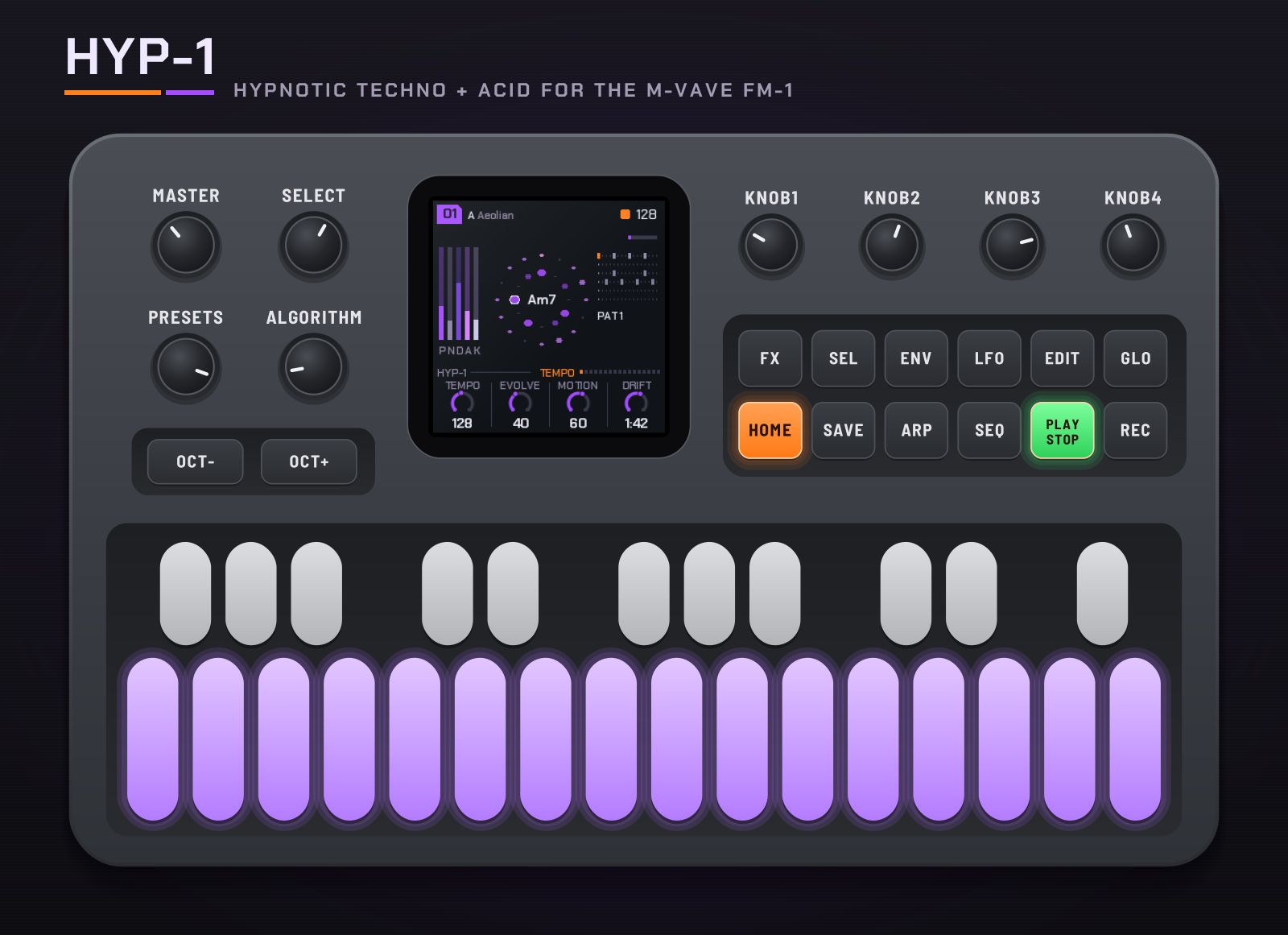
HYP-1 turns the M-VAVE FM-1 into a hypnotic techno and acid machine. It plays from the moment it's switched on: a breathing pad, a deep drone, a generative 303 line and a bed of grain, over drums you sequence. You shape the voices like a small modular, flip patterns on the bar, break it down and build it back up, and record the whole performance into your DAW.
A RedtailWorks project, forked from AMB-1
by Charles Vestal. Current version: 1.5.0 (each push to main builds the next one).
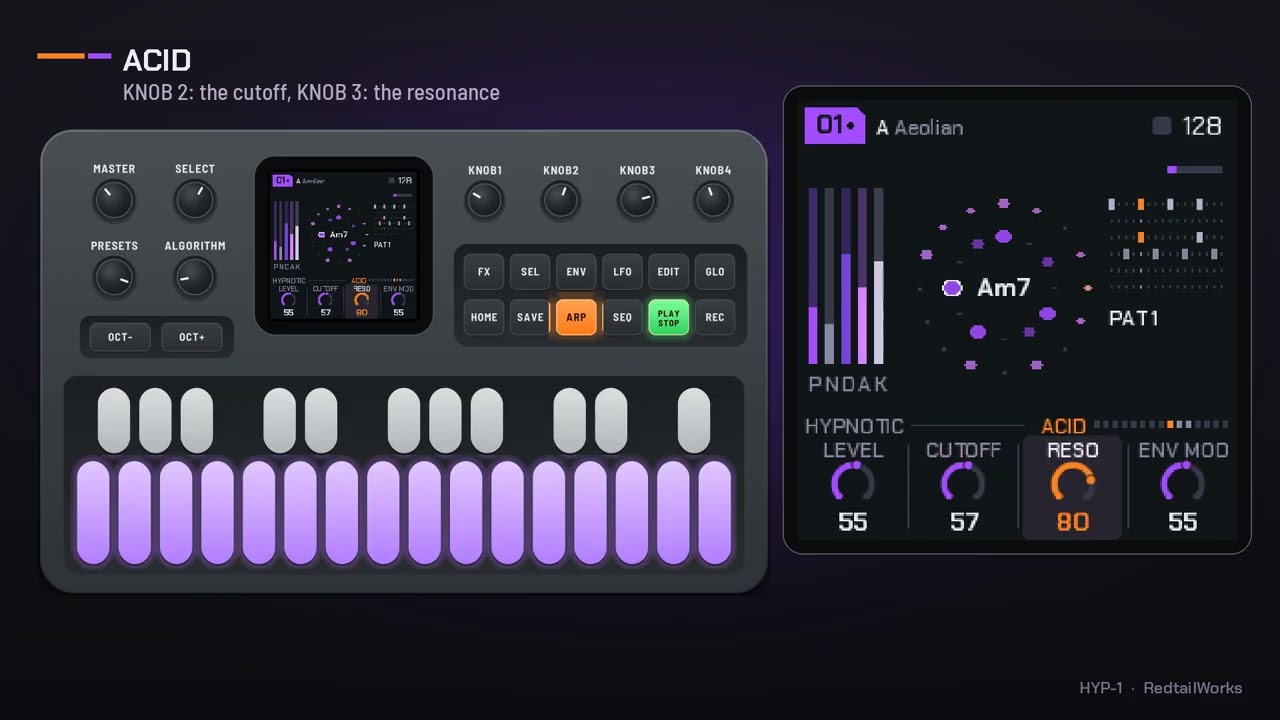
Five minutes played live on piece 01: watch on YouTube.
- All four firmwares (HYP-1, LOF-1, ECO-1, GRAV-1) on one page, with the pack's video: https://rustypawz.github.io/fm1-HYP1/
- OPEN-1, the next idea: an open-firmware synth under $200, with its goals, specs, mailing list and build log: https://rustypawz.github.io/fm1-HYP1/open1/
- Try it in your browser (no FM-1 needed): https://rustypawz.github.io/fm1-HYP1/emu/
- Install it (Chrome or Edge, with the FM-1 plugged in): https://rustypawz.github.io/fm1-HYP1/install/
- Read the manual: https://rustypawz.github.io/fm1-HYP1/manual/, or the printable PDF with every control numbered and every screen lettered
- Watch it: a five-minute live take, and more on YouTube
- The board: feature requests (vote with a 👍) and comments: https://rustypawz.github.io/fm1-HYP1/board/
- Support it: HYP-1 is free; if it's useful to you, buy me a coffee on Ko-fi
- More from RedtailWorks: https://www.redtail.works
Installing it is at your own risk, though it's hard to get stuck: the web installer can put M-VAVE's own firmware back, and an FM-1 that fails to start twice comes up in a safe mode the installer can reach.
Also here: LOF-1 (experimental)
lof1/ holds LOF-1, a second RedtailWorks firmware for the FM-1: a lofi groovebox. You play the
lead on the keys and a tired jazz band follows: it hears which chord your notes imply and the comp, bass
and drums move with it on the beat; an Answer voice replies to your phrases, and when the keys rest a ghost
takes the lead. Under it all, a record, a cassette, a reel or a radio. Twenty lead instruments, a scale of your own set on the keys, ten
presets, chords on the keys, FX on the keys with locks, a drum sequencer, MIDI clock in and notes out. It's
experimental: built and tested in the simulator and the browser emulator, not yet on a real FM-1, and
numbered 0.x until it has been. The same workflow builds it, and the site has it under
lof/: the dropdown at the top of every page switches between
HYP-1, LOF-1, ECO-1 and GRAV-1.
And ECO-1 (experimental)
eco1/ holds ECO-1, a third RedtailWorks firmware for the FM-1: a small plant whose three
leaves fire notes as light and water charge them, a stem that drones beneath, and weather (rain, wind,
gusts, a day and night) that plays it. Eight plants, each in its own place on the screen; MIDI clock in,
MIDI out per voice with the plant's signals as CCs. Experimental and numbered 0.x like LOF-1, built by the
same workflow, and on the site under eco/.
And GRAV-1 (experimental)
grav1/ holds GRAV-1, a fourth RedtailWorks firmware for the FM-1: a star and its planets play
slow, dark, spacey ambient. The star is a bed of coloured noise drawn in its colour; up to six planets orbit
it, each a voice (sixteen instruments, half of them dark) playing a phrase round its orbit, warm near the star and cold far out. A
drum sequencer sets their years and so their orbits, bigger planets swell smaller ones as they pass, dormant
worlds wake in the tides, and dust clouds, asteroids and comets drift through. Ten systems, seven screen
themes, MIDI clock in and MIDI out. Experimental and numbered 0.x, built by the same workflow, and on the site
under grav/.
What it does
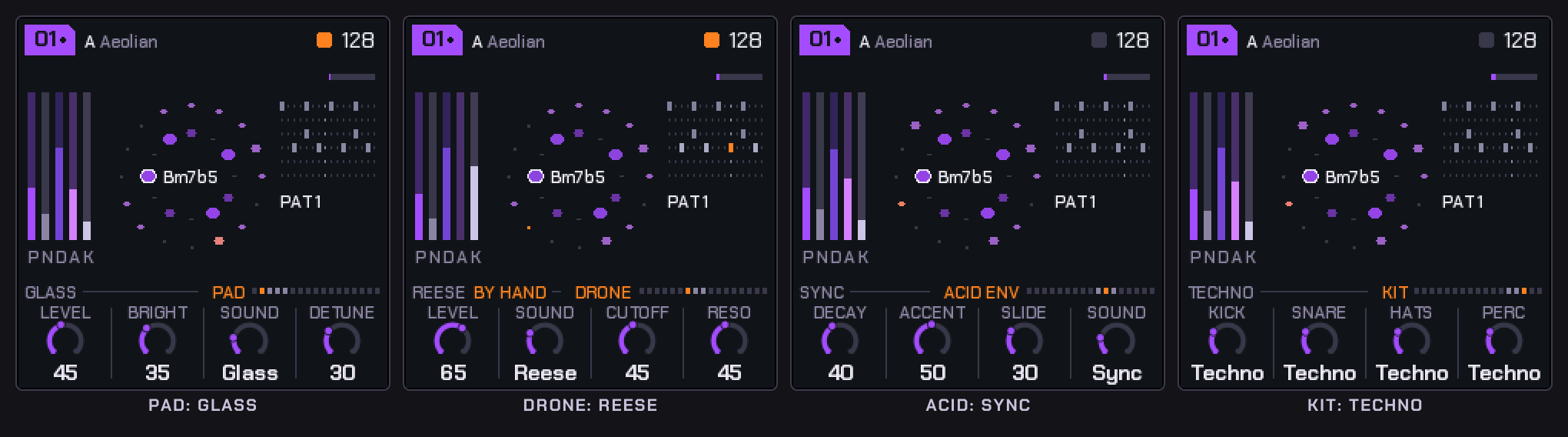
- Pad: four breathing voices playing the chords (Auto, triads, 7ths, 9ths, sus, dub minor 9 stabs, fourths; close or open voicing) in sixteen sounds (Rhodes, sung voices, strings, glass, organ, warm, stabs, dark, dub chords, trance supersaw, poly, hollow, bell and organ stabs, rave stabs, sine) with their own envelope page (attack, hold, release, rest) and LFO page (rate, depth, shape, target).
- Drone: sixteen sounds (saws, warm, grit, dirty, Reese, pulse, FM, organ, rumble, sub, square, hoover, fifths, metal, sync, bright) and a sub through a resonant 24 dB low-pass, with an envelope (on each chord or every 1–8 bars) and an LFO (a 16-bar sweep on the cutoff by default).
- Acid: a generative 303-style line: 1–16 steps of chord tones with accents and slides, resonant filter, envelope, sixteen sounds (saw, square, driven, sync, pluck, PWM, chip, sub, and arp leads: trance, bleep, fifth, bell, organ, laser, fold, soft). Mutate rewrites steps as it plays.
- Noise: eight colours (white, pink, brown, blue, violet, grey, crackle, radio hiss), a tone filter and its own sidechain pump.
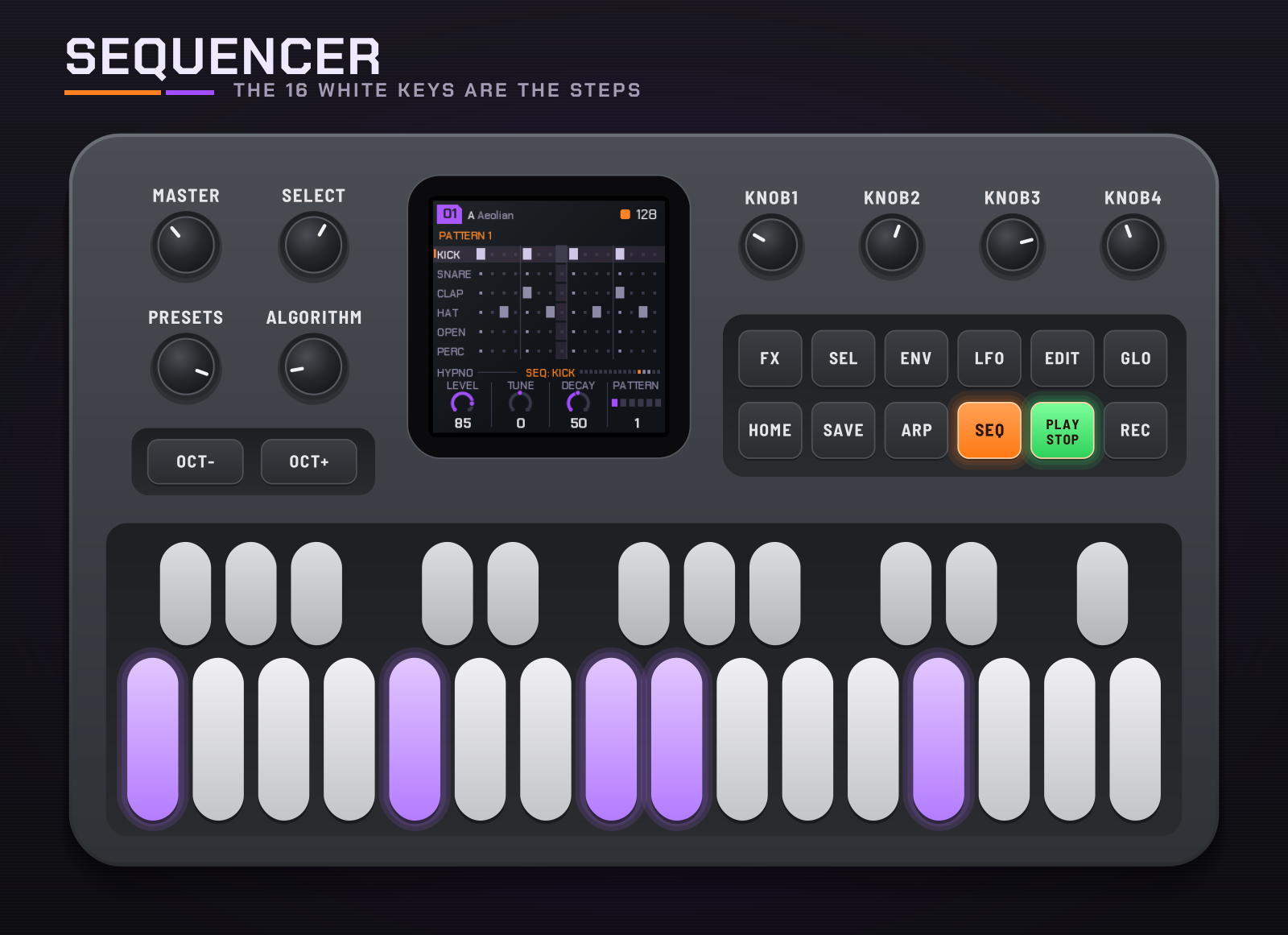
- Drums: a 16-step sequencer with six lanes (kick, snare, clap, closed hat, open hat, perc), six patterns per piece, a level, tune and decay per lane, and a kit: each drum's sound from eight (Hypno, House, Techno, Acid, Break, Minimal, Hard, 808). Hold SEQ: the 16 white keys are the steps.
- Ten pieces (01–10), each with its own settings, patterns and drum sounds. On Global, SAVE stores the piece at once (playing, the music pauses for a fraction of a second while it's written, then carries on where it was).
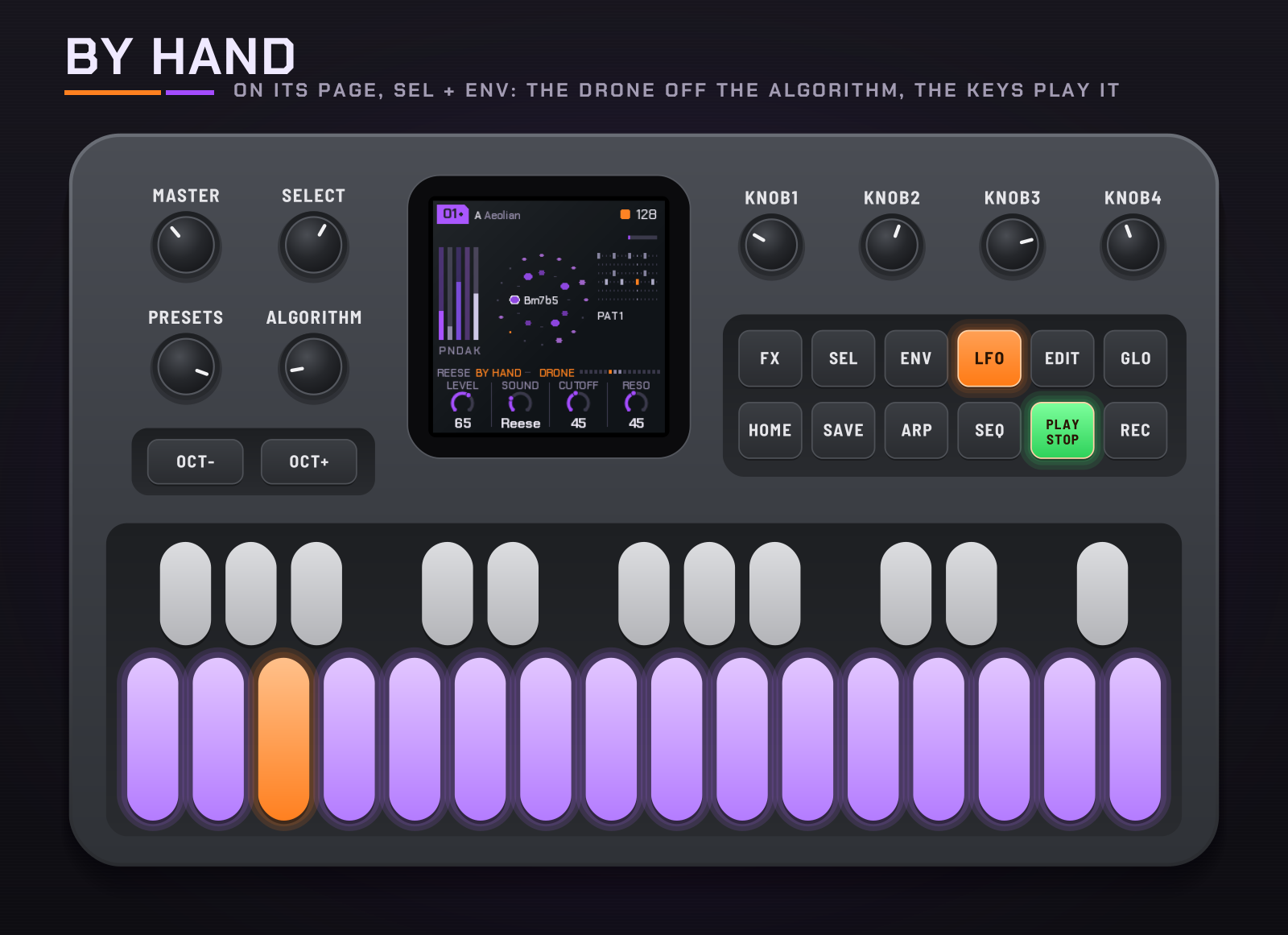
- The keys set the scale, as on AMB-1. By hand: on a voice's page, SEL + ENV takes the pad, drone or acid off the algorithm, and on its pages the keys play it over the song (the pad up to four notes, the drone and the acid one, the acid sliding 303-style); SEL + ENV again gives it back. SEL + ALGORITHM changes the sound of the voice on screen, or the whole kit on the drums' pages. Tempo runs from 70 to 190.
- Links (SEL + SEQ, amounts on the Links page): the drums patched into the voices. Each kick opens the drone's filter, each snare or clap flashes the pad, hats accent the acid, and the perc lane can clock the acid line.
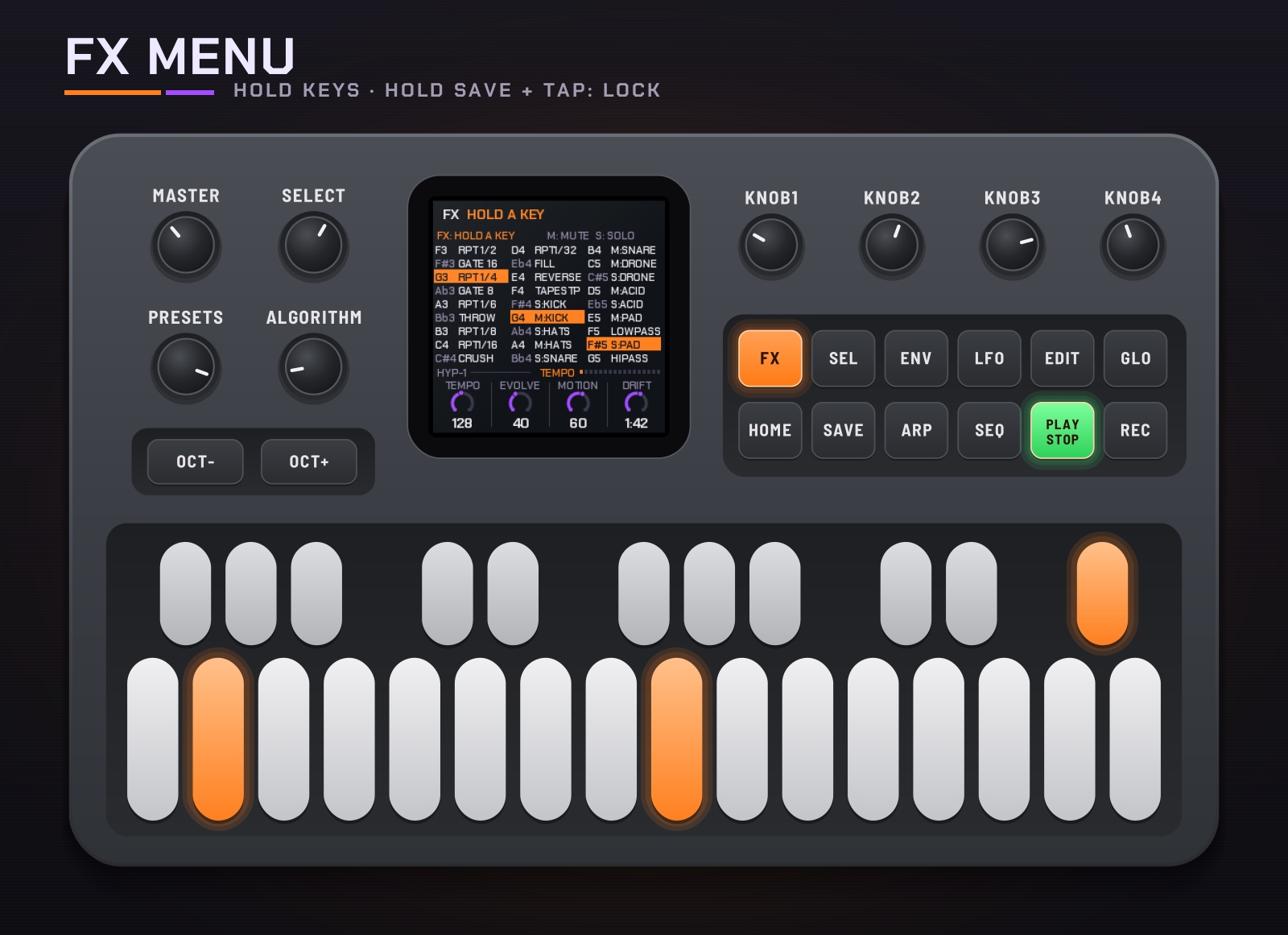
- Performance: SAVE for a breakdown on the next bar, again for a four-bar build and the drop; an FX menu of momentary effects on the keys (beat repeat, reverse, tape stop, mutes and solos, filters, trance gate, echo throw, crush, fill), hold SAVE and tap effects to lock any number on (they keep playing after FX closes); SEL as a shift (patterns on keys 1–6, pieces on the bar, copy, clear and restore lanes).
- Remote (SEL + GLO): plug the FM-1 in and its panel plays HYP-1 in the emulator over USB MIDI, lights and all. With M-VAVE's firmware or any controller, the keys play straight away and MIDI learn maps the rest.
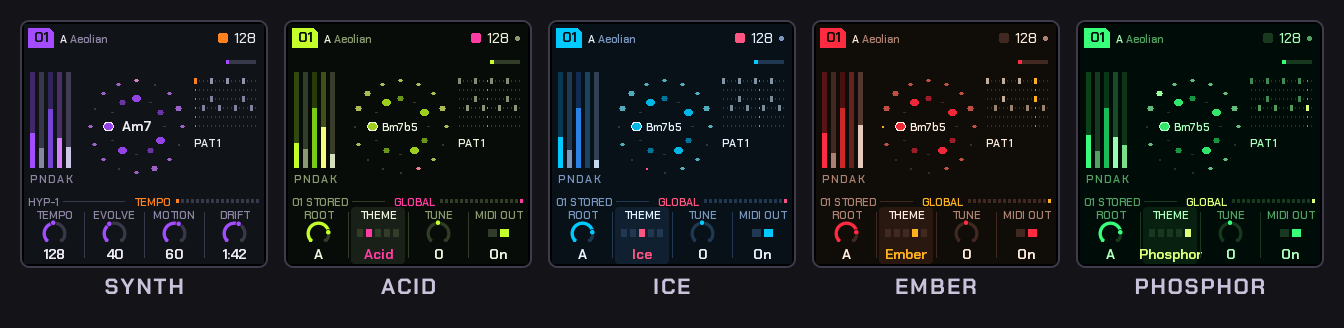
- Five screen themes, a boot sequence (the RedtailWorks card with its pixel red panda, then HYP-1), Chakra Petch (SIL OFL) as the screen's font.
 |  |
 |  |
In short
| SELECT | The pages in order; with HOME held, the tempo |
| HOME · ENV · LFO · ARP · SEQ · GLO | Tempo · Pad · Drone · Acid · Drums (again: Links, then Kit; hold: sequencer) · Global; press again for each voice's env and LFO |
| KNOB 1–4 | The page's four values |
| PRESETS · ALGORITHM | The piece · the mode (with SEL: the piece on the next bar · the voice's sound, or the kit) |
| SAVE | Breakdown / build / drop; on Global, store the piece |
| FX | The effects menu |
| SEL | Shift (SEL + SEQ: the links on and off; SEL + GLO: remote, the panel plays the emulator) |
| PLAY · REC · EDIT | Play / stop · freeze · the next chord |
| Keys | The scale; on the pages of a voice played by hand (SEL + ENV on its page), that voice; in the sequencer the steps; in FX the effects |
| OCT− / OCT+ | ±3 octaves: the page's voice (pad, drone, acid), or the whole song on any other page; in the sequencer, the drum |
Versions
Each push to main is a new build, numbered from the workflow's run: 1.0.1 to 1.0.32, then 1.5.0 on (1.5.N; after 1.5.99, 1.6.0). The installer always offers the latest.
| Version | What came in |
|---|---|
| 1.5.0 | Locked FX play on after the FX menu closes (FX blinks; reopen it and tap a key to stop one). The version moves to 1.5: everything since the first tour (16 sounds a voice, 8 kits, playing by hand, Chords, storing at once, the USB remote) |
| 1.0.32 | Chords page (ENV ×4): the kind of chord (Auto, Triads, 7ths, 9ths, Sus, Dub, Fourths), close or open voicing, with Drift and Root; piece 06 plays dub chord stabs (issue #3) |
| 1.0.31 | A store (Global, SAVE) is written at once: playing, the music fades out, it's written, and the song picks up where it was. The emulator's help no longer says SEL + LFO / ARP |
| 1.0.30 | Twice the sounds: sixteen each for pad, drone and acid (dub, trance and rave chords; rumble, hoover and fifths basses; trance, bleep, bell and laser arps) and three more kits (Minimal, Hard, 808); old style code cleared out |
| 1.0.29 | SEL + ENV on any voice's page (pad, drone or acid, any of its three) takes that voice by hand and back; SEL + LFO / ARP no longer do |
| 1.0.28 | The keys set the scale again everywhere; a voice is played by hand only when taken off the algorithm (SEL + a voice button), which silences its generated part |
| 1.0.27 | The voice bank: eight sounds each for pad, drone and acid, a kit of five sounds per drum (the styles become sounds; stored styles carry over), and the keys play the voice on screen |
| 1.0.25 – 1.0.26 | ECO-1 (experimental) built alongside, with a HYP-1 / ECO-1 dropdown on the site |
| 1.0.22 – 1.0.24 | The board (feature requests, comments); a Ko-fi button |
| 1.0.21 | The documentation brought up to date; the live take on the site |
| 1.0.17 – 1.0.20 | The video tools (sequencer, voices, links, the live take); no firmware change |
| 1.0.16 | One look across the site (the installer restyled), the red panda as its mark and favicon, YouTube links |
| 1.0.15 | Boot: a pixel red panda on the RedtailWorks card, then a HYP-1 card (any button skips) |
| 1.0.13 – 1.0.14 | Remote: SEL + GLO, the FM-1's panel plays the browser emulator over USB MIDI; MIDI learn in the emulator; a vertical tour video |
| 1.0.11 – 1.0.12 | A safety review: the audio's buffers off the interrupt stack, fuzzed storage, sanitizers clean |
| 1.0.10 | FX: tapping a locked effect turns just that one off |
| 1.0.9 | OCT− / OCT+: the page's voice or the whole song, three octaves each way |
| 1.0.8 | Theme, Tune and MIDI out kept across power-off, even when changed while playing |
| 1.0.7 | Links (the drums into the voices) and FX lock mode |
| 1.0.5 – 1.0.6 | HYP-1: styles, ten pieces with their own drums, storing on Global, shift; the site |
Building and testing
Every push to main builds the firmware on GitHub (.github/workflows/firmware.yml): JieLi's
toolchain, the tests, and the site (installer, emulator, manual, download) published to GitHub Pages.
Each build is numbered 1.B.N from the run. To build locally (see BUILDING.md):
tests/run_tests.sh      # the instrument, the platform pieces, the app in a simulator, the web builds
./build.sh              # build/amb.fwsc
python3 tools/fm1_install.py build/amb.fwsc     # install it over USB
build/host/amb_host SCRIPT OUTDIR runs the whole app on a computer from a script
(tests/scenarios/*.amb), with audio and screenshots coming out. web/emu/build_clang.sh builds the
same code for the browser with plain clang. The drum patterns are written as grids in
tools/gen_pats.py; the site's pictures come from tools/site/mockups.py, its videos from
tools/site/video.py (all from the firmware itself, in the simulator). BUILDING.md has
the details.
Credits
HYP-1 is a RedtailWorks project (YouTube). It is a fork of AMB-1 by Charles Vestal, whose generative harmony, voices and platform work it builds on. The reverb is Jon Dattorro's plate ("Effect Design, Part 1", JAES 1997). The platform (hardware layer, USB, update loader, storage, installer) is Felucca's by Leo Kuroshita (Hügelton Instruments), by way of X0X and FoMni-1. The idea of running FM-1 firmware in the browser comes from Groove OS. GPL-3.0-only; see LICENSING.md.
M-VAVE and FM-1 are trademarks of their owners. HYP-1 is not affiliated with M-VAVE or Hügelton Instruments.