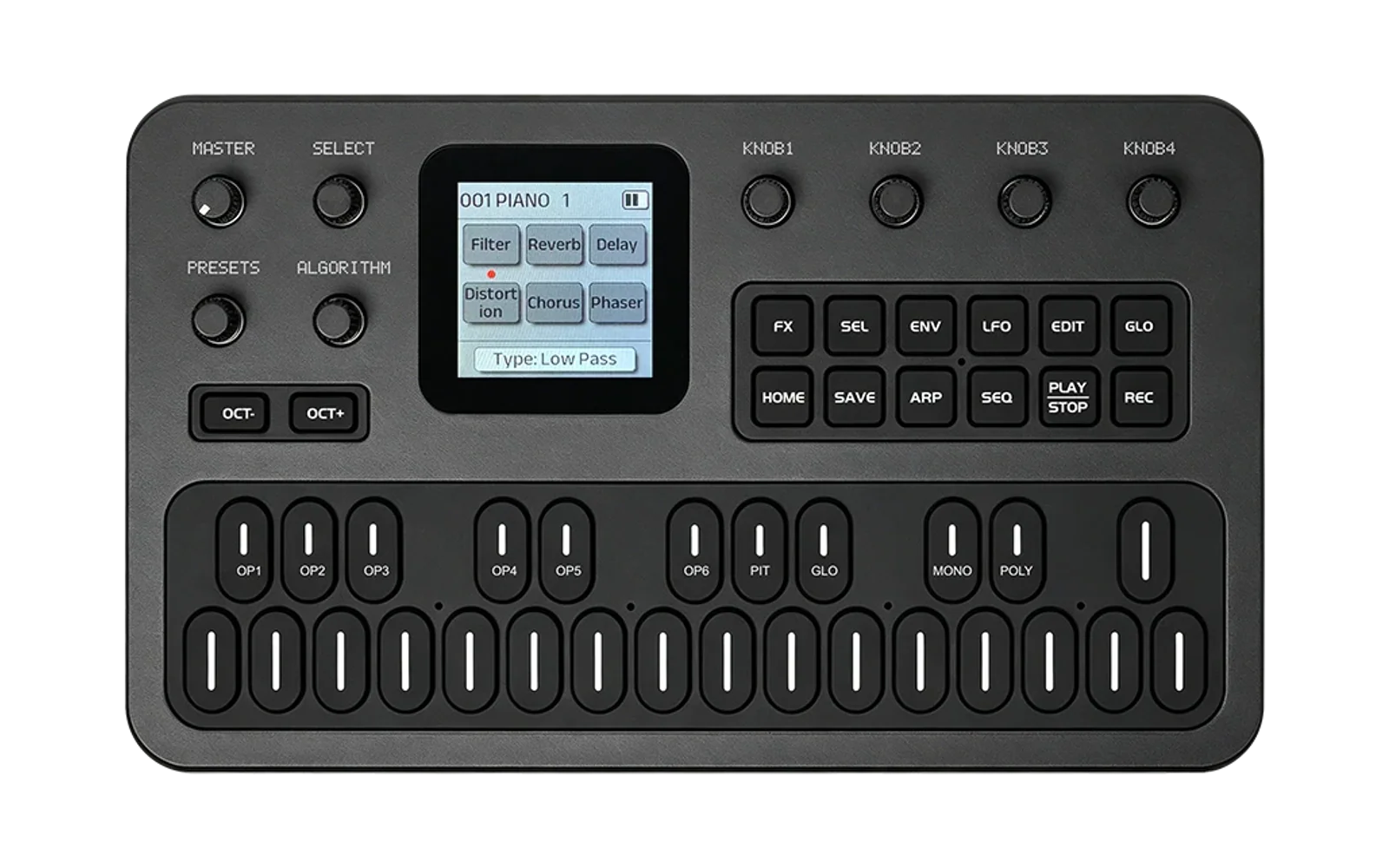
Haunted FM-1
Five generative firmwares for the M-VAVE FM-1 pocket synth, each built around one idea, all of them after the kind of haunted ambient music Burial makes: pitched-down ghost vocals, vinyl crackle and rain, sub bass under detuned pads, swung off-grid percussion, long stretches where almost nothing happens, and arrangements that leave and come back changed.
| Firmware | The idea | SELECT is | ALGORITHM is |
|---|---|---|---|
| MIDNIGHT ROUTE | The song has a shape before it has notes: a route of 16 stations with a density envelope per part | your position on the route | the route's shape |
| VOICEMAIL | A voice that almost says something: formant vocal fragments, chopped, stuttered, reversed, in a call-and-answer | pitch, with the formants held | who is singing |
| UNTRUE STEP | Garage with no grid: every hit is a time in milliseconds with a spread, and the drums leave and come back changed | shuffle, from push to swing | the groove |
| HALF-LIGHT | Harmony as weather: chords move by voice leading every few seconds under a pressure that builds and breaks | the pressure | the climate |
| WORN TAPE | A loop you play once; every pass wears it out and grows something new in the holes | the tape's age, both ways | the medium |
The designs, with every control, are in docs/DESIGN.md. Each firmware has a manual in its
docs/MANUAL.md.
Install
The flasher page (GitHub Pages, built by the workflow from main): open it in Chrome or Edge with the FM-1 on
USB, pick a firmware, press Install. The page also puts M-VAVE's stock firmware back. Any of the five installs over
any other.
From the command line: pip3 install mido python-rtmidi, then
python3 base/tools/fm1_install.py worntape-0.1.fwsc
Installing firmware is at your own risk. An FM-1 that fails to start twice comes up in a safe mode the installer can reach; one that does not start at all is recovered with felucca-bsp's rescue tool.
Build
Everything is built on fm1-base (base/, a git submodule, with
felucca-bsp inside it). Clone with --recursive.
sh tools/get_toolchain.sh          # JieLi's clang for the pi32v2, into ~/.jieli/toolchain
sh tools/get_sdk.sh                # the three JieLi SDK files the package needs, into ~/.jieli/ac79-sdk
pip3 install Pillow                # the fonts are rasterised at build time (PYTHON=... picks the interpreter that has it)
sh tools/build.sh worn-tape        # firmware/worn-tape/build/worntape.fwsc (Docker on macOS: the toolchain is Linux x86-64)
sh tools/build.sh worn-tape --host # the host simulator, then:
sh tools/test.sh worn-tape         # its scenarios (firmware/worn-tape/tests/*.txt), screenshots and audio in build/scenarios/
sh tools/build.sh worn-tape --web  # the browser emulator (needs Emscripten)
The names are the directories under firmware/: midnight-route, voicemail, untrue-step, half-light,
worn-tape. tools/make_site.py --local VERSION OUT assembles the site from local builds.
Layout
base/                fm1-base (submodule): the platform, the host simulator, the browser emulator, the tools
lib/hdsp.h           the DSP the five share: FM and formant voices, Dattorro's plate, a tape echo, wow, beds, harmony
lib/hui.h            the panel and screen helpers they share: input, help cards, the header and knob bands
firmware/NAME/       one firmware: app.h, app.c (the UI and project), dsp/engine.[ch] (the sound, at -O2),
                     fm1.toml, words.tsv, tests/, docs/MANUAL.md, site/landing.md
tools/               build.sh, test.sh, get_toolchain.sh, get_sdk.sh, make_site.py
web/site.html        the flasher page (fm1-base's installer code inlined)
.github/workflows/   build every firmware, run its scenarios, publish the site, release on a tag
Continuous integration
Every push to main builds the five packages on GitHub's Linux runners (the toolchain runs natively there), runs
each firmware's host-simulator scenarios, builds the browser emulators, assembles the site and publishes it on GitHub
Pages (turn on Pages with Source "GitHub Actions" in the repository settings once). A tag vX.Y (matching the VERSION file) also makes
a release with the five packages; the site is deployed from main only. Pull requests build and test without publishing.
Licence
The firmwares and the shared libraries are MIT (see LICENSE). fm1-base and felucca-bsp are MPL-2.0; the JieLi SDK files the package needs are Apache-2.0 and fetched at build time, never committed. M-VAVE and FM-1 are trademarks of their owners; this project is not affiliated with M-VAVE. The reverb is Jon Dattorro's plate ("Effect Design, Part 1", JAES 1997).