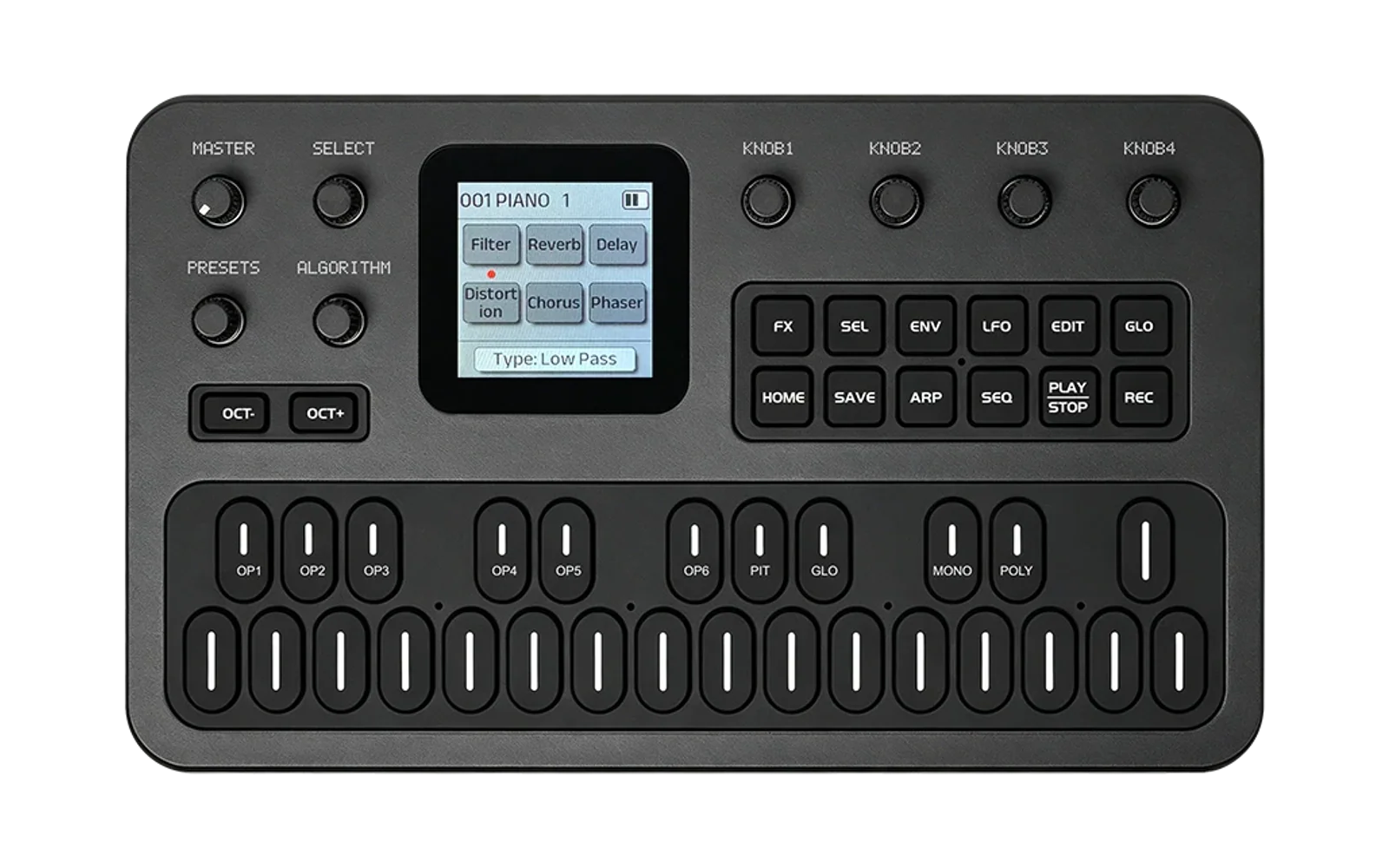
FuMi-1 for the M-VAVE FM-1
FuMi-1 (文) turns the M-VAVE FM-1 into a shigin conductor inspired by the Suiko ST-50, the Japanese poetry-accompaniment instrument. The sixteen white keys are the ST-50's lower row: mi fa la ti do, three times, and a top mi. The black keys are its upper row (fa♯ sol ti♭ do♯ re) or, at the flick of a button, koto ornaments. The key is set in 本数 (水4 to 12本), the tuning switches between 平均律 and the ST-50's 純正律 as measured from recordings, and the sounds are a koto and thirteen more on a 6-operator FM engine, with 余韻 (ring time), vibrato, a trill that plays in pairs like a hand, a sprung pitch bend on the octave buttons, a looper on REC, and a subtle plate reverb.
It is built on FoMni's platform (Felucca's HAL, update
loader, USB, storage, screen driver, installer and browser emulator), which is kept byte-for-byte: all of
FuMi lives in firmware/src/app/ and firmware/src/dsp/.
- Play it in your browser (no FM-1 needed): https://cartesive.github.io/fumi-1/emu/
- Install it (Chrome or Edge, FM-1 on USB): https://cartesive.github.io/fumi-1/install/
- The audition bench: https://cartesive.github.io/fumi-1/bench/
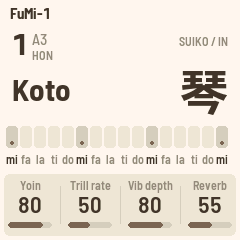
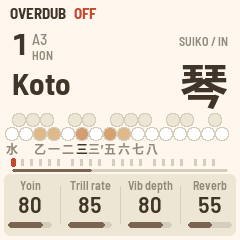
Status (23 Oct 2026): version 1.1.0 (identity FM-1_7010100). It has run on one FM-1, the author's,
since 0.1. What works: the pitch core and the measured tuning, twenty-one instruments with their names in
kanji, the bends, the seven ornament keys (the koto's left hand among them), vibrato, the trill in pairs
with oroshi, 余韻, mono with slide, the voicing stages, reverb, MIDI in with velocity and MIDI out, the
looper, the host simulator, the browser emulator, the audition bench and the web installer. What
is next: a loop that survives power-off and key slide for the shakuhachi. Releases are listed in docs/CHANGELOG.md; the research and the plan are in docs/research/
(00-START-HERE.md is the current truth).
FuMi-1 is quieter than the stock firmware at the same MASTER setting, as the Suiko is a gentle instrument: turn MASTER up. Turn it down again before switching back to another firmware.
Sixty seconds
- Play the white keys left to right: that is the scale, three octaves.
- Tap SEL to hear the tuning change between 平均律 and 純正律.
- Hold a note and press OCT+: the pitch bends up and springs back.
- Turn PRESETS for the other instruments, SELECT for the key.
- Tap REC, play a phrase, tap REC again: it loops. Play over it.
Before you install
Custom firmware is installed at your own risk. The FM-1 has a single copy of its firmware and no recovery button; a failed install can leave it unable to start.
- Be on M-VAVE's official V15 first. FuMi-1, like the other community firmwares, expects it. Check with
python3 tools/fm1_install.py --info: stock V15 reportsFM-1_015. - Download and keep M-VAVE's
FM-1.fwsc(V15) from m-vave.com/download. It is your way back. - Charge the battery, use a direct USB data cable (no hub), use Chrome or Edge, and close any DAW or other tab using MIDI. Do not unplug until the installer says it is done.
- Coming from another custom firmware? Go back to official V15 first, then install FuMi-1. Saved data from other firmwares is not read.
- FuMi-1 has been run on one FM-1 (the author's). Please report what you find in Issues.
Getting back
- To official V15: the installer page's "Back to the stock firmware" with M-VAVE's
FM-1.fwsc(it accepts exactly that file), or M-VAVE's own M-UPGRADE. - Update mode from FuMi-1: hold OCT− and OCT+ together for 5 seconds (a countdown appears after 2 s).
- If FuMi-1 crashes while starting: it restarts; after two failed starts in a row it comes up in a safe mode with no sound and USB on, which accepts an install from the installer page.
- Black screen, and the computer sees a device called WL80UBOOT: the chip is in its own download
mode.
tools/fm1_rescue.py FM-1.fwsc(macOS, no extra hardware) backs the flash up and puts V15 back. Otherwise recovery needs FM-1 Transporter.
Playing
| Control | Does |
|---|---|
| White keys 1–16 | mi fa la ti do × 3 and a top mi. The tonics (1, 6, 11, 16) are lit. 三 is key 6 |
| Black keys | The upper row fa♯ sol ti♭ do♯ re, five per octave. SEQ switches them to ornaments: vibrato, trill, damp, strong pluck (keys 1–4 and 6–9) and the koto's left hand, 押し手 (5), 引き色 (10), 後押し (11); see below |
| SELECT | 本数: 水4, 水3, 水2, 水1, 1 … 12. At 1本, 三 = A3 and key 1 = A2 |
| PRESETS | 音色, the instrument |
| ALGORITHM | The scale: IN 陰 (mi fa la ti do), YŌ 陽 (fa and do raised), MIN'YŌ 民謡 (raised a whole tone) |
| KNOB 1–4 | The four values of the page. HOME: 余韻, trill rate, vibrato depth, reverb. FX: low cut, high cut, character, reverb size. EDIT: bend target, bend down, bend time, slide time. ENV (Loop): BPM, beats, click. Tuning page: tuning, depth, 微調, A. Trill pages: feel, pair gap, ta level, oroshi; first stroke, jitter |
| LFO | ビブラート on / off |
| ARP | トリラー on / off: the held note re-plucked in pairs, ka-ta, the first stroke the hardest and the ta lighter; a new key restarts the pair. On the wood blocks and the taiko, a roll |
| GLO | 単音 / 和音 (mono / poly). Hold: the Trill pages (feel, pair gap, ta level, oroshi; hold again: first stroke, jitter) |
| SEL | Tap: 平均律 ↔ 純正律. Hold: the tuning page (EQUAL, SUIKO, KOTO pure fifths, USER; depth; 微調 ±50 cents; A = 430–445) |
| OCT− / OCT+ | With a note held: the 音程 rocker, a sprung bend down (−40 cents) / up (a semitone, a whole tone or the next scale note). With no note held: octave down / up |
| OCT− + OCT+ held 5 s | Update mode (the platform's; never reassigned) |
| REC | The looper: tap to arm, the first key starts the loop; tap again to close it, it plays; while it plays, overdub on / off. Hold a second: clear |
| PLAY | Stop / start the loop from the top. Hold a second: undo the last layer |
| ENV | The Loop page: BPM, length in beats, click |
| MASTER | Volume and 強弱: play fade-ins on it by hand, as on the ST-50 |
| SAVE | Saves the setup (it also autosaves a few seconds after a change, when quiet) |
MIDI in (USB and the TRS jack) plays the voice chromatically, each note at its velocity (1.0.7), so a MIDI keyboard plays the kotos the way the trill does; key presses go out as notes on channel 1 with their velocities.
The looper
The ST-50's 自動伴奏 section was 記憶, 再生, 停止: record a performance, play it back, play another voice over it. FuMi's looper is that, on two buttons and with no grid: notes are kept at the moment they were played, nothing is quantised.
- REC tap with nothing recorded: armed. The loop starts on the first key you press, not on the tap. REC tap while recording: the loop closes at that moment and starts playing. If you never press REC a second time it closes itself at the ruler's length: 32 beats at 60 BPM, a 32-second loop, by default. REC tap while the loop plays: overdub on; again: off. Each overdub is a layer.
- PLAY tap: stop, or start from the top. PLAY held a second: undo the last layer. REC held a second: clear the loop (the screen asks you to keep holding).
- ENV is the Loop page: BPM 20–240, length 4–256 beats (the knob moves four at a time), a quiet click on the beat, off by default, and the ruler's length as a time. The ruler only decides where the loop ends by itself and where the click falls. At 20 BPM and 256 beats a loop runs twelve minutes. The store holds 1024 events across all layers, about 490 notes: a long loop is a sparse one, and once the store is full further presses are not recorded. A loop is never shorter than one beat: closing it early with REC stretches it to the beat (three seconds at 20 BPM).
- The loop survives power-off (1.1.0). A loop that has been stopped is written to flash a few seconds later, once nothing sounds and nothing is touched, with its layers' instruments, and comes back stopped at the next power-on: PLAY starts it. A cleared loop is written as empty. A loop left playing is not written, so what comes back is the last one stopped. It lives in a flash object of its own, apart from the setup.
- Recorded: the keys, the ornament keys and the bend buttons, with their timing. Not recorded: knob moves, the LFO, ARP and GLO buttons, and MASTER, so your left hand shapes the level of everything live.
- The loop stores keys, not pitches: change 本数 or the tuning while it plays and the loop follows. Notes ringing across the join keep ringing. A note still held when a layer ends is let go in the recording.
- The loop's ornaments act on the loop's notes: a trill recorded in a layer rolls that layer's note, and your own ornament keys act on what your hands play.
- Each layer keeps the instrument it was recorded in. Loop a koto phrase, turn PRESETS to the shakuhachi and play over it: the koto goes on being a koto under your shakuhachi, and an overdub now is a shakuhachi layer. A layer's instrument is the one playing at its first note; a loop holds up to eight instruments at once. The eight voices are shared between the loop and your hands. The loop lives in memory until the FM-1 is switched off; it does not go out over MIDI. REC lights red while recording and blinks while armed; PLAY lights while the loop plays; a thin bar under the keys shows where the loop is. Nothing autosaves while a loop runs.
The ornament keys
Press SEQ and the black keys stop being the upper row and become techniques on the note that sounds. They are momentary: held, they act; released, they stop. The first four come twice, one set per hand position; the fifth of each set and the eleventh are the koto's left hand (1.0.7), the techniques a player presses into the strings behind the bridge.
| Black key | Does |
|---|---|
| 1 and 6 | Vibrato while held |
| 2 and 7 | Trill while held: the held note re-plucked in pairs, the first stroke the hardest. With oroshi set on the Trill page it starts slow and speeds up; the header shows 颪 while it is set |
| 3 and 8 | Damp: every note let go at once, whatever 余韻 says |
| 4 and 9 | Strong pluck: the next notes struck hard |
| 5 | 押し手 oshide: the sounding notes rise a whole tone over about 80 ms while the key is held, and fall back when it is released |
| 10 | 引き色 hikiiro: while held, each new note dips 40 cents just after the pluck and comes back over 150 ms |
| 11 | 後押し atooshi: while held, each new note is pushed up a semitone 200 ms after it sounds |
The left hand's shapes go through the same pitch glide as the bend, so they do not click, and a trill stroke starts them again, so a trill under hikiiro dips on every stroke. Ornaments recorded in a loop act on the loop's notes; your own ornament keys act on what your hands play.
The trill
The ST-50's トリラー repeated the held note like a machine. FuMi's trill (ARP, or the second black key in ornament mode while it is held) plays the way a hand does: in pairs.
- Pairs. Strokes come as ka-ta, ka-ta: a short gap inside the pair, a longer one between pairs. The short gap is 42 % of the pair by default. Every key you press restarts the pair, so the strokes line up with your hand; a little jitter sits mostly on the long gap, so the pair stays tight and the space between breathes. At fast rates the short gap is held above 45 ms so the pair does not smear.
- Accents. The first stroke of a trill, the KA, is the hardest (velocity 127, plus 1.5 dB). Each ta is light (velocity 64, minus 4 dB), each later ka normal. Every stroke differs a little from the last. The strong-pluck ornament key plays the same hard stroke, which now makes a difference.
- Trill rate on HOME sets the average stroke rate, as before; it starts at 85 (1.1.0; 50 before). Trill feel (hold GLO) is one knob from 0, the even machine of the ST-50 with identical strokes, to 100, the full pairs and accents.
- The Trill pages (hold GLO; hold again for the second page) keep the defaults behind the feel knob: pair gap, ta level, first stroke, jitter, and oroshi. They are saved with the setup. Pair gap and ta level read as words, Even to Tight and Same to Faint, the bar beneath keeping the exact position (1.0.7).
- Oroshi (颪, the drum roll that starts slow and speeds up) is a setting for the trill ornament key: None, Short, Medium or Long, the length of the run from slow to the trill rate (about 1.5, 3 and 5 seconds). It starts at Long (1.1.0; None before). A setup saved by an earlier version that was still at the old trill rate and oroshi takes the new ones when it loads; one set away from them keeps its own. With it set, holding the ornament key starts the trill at about a quarter of the rate and each gap is shorter than the last by a constant ratio until it arrives; the first stroke is still the hard KA, and the pairs and the lighter ta come in as it speeds up. Pressing the ornament key again starts it from slow; a new white key under a held ornament key carries on at the speed reached. The ARP button's trill stays plain whatever the setting, so an ordinary trill is always one tap away. On the hyōshigi it is the clapper roll of the theatre (from 1.0.7: before, a sound that had ended by itself stopped the trill after one stroke). In ornament mode the header shows 颪 while oroshi is set.
- Velocity. FuMi's own instruments now respond to how hard they are struck (a light ta on Koto Pluck is 5 dB quieter and a third duller, a hard KA a third brighter), so the accents change the tone and not only the level. The community patches are as their authors wrote them; Koto II responds, Koto only a little.
- A trill recorded in a loop is replayed with the settings in force when it plays, oroshi included.
Why the tuning matters
The ST-50's 純正律 is not a textbook just intonation: measured from two recordings in two keys, fa sits
20.8 cents below equal temperament and do 16.0 cents below, within a cent of each other across the
recordings, and ti♭ about 25 cents below (one recording, less sure). That is what SUIKO plays; EQUAL is
平均律, KOTO is pure fifths and fourths, USER is your own trims. The measurements are in
docs/research/13-audio-analysis-tuning-measured.md and 14-second-recording-tuning-confirmed.md.
| Degree | 平均律 | SUIKO as measured |
|---|---|---|
| mi | 0 | 0 |
| fa | 0 | −20.8 cents |
| la | 0 | 0 |
| ti♭ (upper row) | 0 | −25 cents |
| ti | 0 | 0 |
| do | 0 | −16.0 cents |
Building and testing
See BUILDING.md and docs/dev-environment.md.
tests/run_tests.sh      # the guard, the pitch core, the FM6 core, the instrument and the looper, the click
                        # test, the simulator scenarios, the browser build, the tools' self-tests
./build.sh              # build/fumi.fwsc (Docker, JieLi toolchain)
web/emu/build.sh        # the browser emulator and the audition bench (Emscripten)
web/bench/serve.py      # then open http://localhost:8765/build/bench/
build/host/fumi_host SCRIPT OUTDIR runs the whole app on a computer from a script
(tests/scenarios/*.fumi), with audio and screenshots coming out. It builds on macOS and Linux.
The instruments
PRESETS steps through the built-in instruments; the screen shows each one's name with its Japanese name
beneath, Suiko-style, and a voice slider with a notch per instrument. Fifteen are the owner's picks from
community DX7 banks on patches.fm (each entry in tools/fumi_patches.py names its bank and author; the kokyū
is altered and says so); six are FuMi's own. The order follows the ST-50's voice strip by family: the kotos,
the bells, the winds, the sustained voices, percussion (1.0.8).
| # | Name | 名 | From |
|---|---|---|---|
| 1 | Koto | 琴 | N-KOTO-A5, a community patch. The boot instrument |
| 2 | Koto II | 箏 | KOTO-KOTO, a community patch |
| 3 | Koto Pluck | 爪音 | FuMi's own, found by tools/koto_search.c against the ST-50 measurements |
| 4 | Koto Ring | 響 | FuMi's own, brighter |
| 5 | Koto Warm | 名残 | FuMi's own, rounder |
| 6 | Harp | 箜篌 | FuMi's own |
| 7 | Chimes | チャイム | CHIMES 1, a community patch |
| 8 | Rin | 鈴 | TBTAN BELL by Tim Conrardy: the altar bowl, struck and left to ring |
| 9 | Bell | ベル | MICHEL 2 by Tim Conrardy |
| 10 | Ice Bells | 氷鈴 | Ice.Bells1 by Tim Garrett |
| 11 | Shakuhachi | 尺八 | PAN FL T A, a community patch |
| 12 | Bamboo Flt | 篠笛 | Bamboo Flt, a community patch |
| 13 | Dragon Flt | 龍笛 | ALTO FLUTE, a community patch |
| 14 | Sho | 笙 | Air---*--3, a community patch |
| 15 | Kokyu | 胡弓 | The kokyū, the ST-50's bowed voice: after Viola.Ens by Tim Garrett (TX7-80B), the attack slowed so the note swells in |
| 16 | Clarinet | クラリネット | Clarinet12 by Tim Garrett |
| 17 | Strings | 弦楽 | STRINGS 2 by Tim Conrardy |
| 18 | Fairytale | 御伽 | Fairlyte1a, a community patch: a slow pad that fades as it is held |
| 19 | Taiko | 太鼓 | Timpani.2 by Tim Garrett |
| 20 | Hyoshigi | 拍子木 | FuMi's own: two hardwood sticks, a dry crack, the same on every key |
| 21 | Mokugyo | 木魚 | FuMi's own: the wooden fish, a round pitched tok |
FuMi's own six respond to velocity (1.0.6), for the trill's accents and for MIDI in. A voice written an octave
up or down in its bank has its ratios doubled or halved on import (tools/patchfm_import.py), since the engine
ignores a patch's transpose; the 1.0.8 voices were trimmed into the others' level band.
No Yamaha factory ROM voice is among them (a ROM2B pick was declined). The kanji come from Noto Sans CJK
(SIL OFL 1.1) through tools/gen_kanji.py, which keeps only the characters these names use, in the sizes
each is drawn at.
The SoundFont
Every instrument as a sample set, for a DAW or any SoundFont player: FuMi-X.Y.Z.sf2 sits on each
release beside the firmware, rendered key by key through
FuMi's own engine from that version. One preset per instrument in the PRESETS order; the sixteen scale notes
on the white keys F3–G5 at 1本, black keys silent, the Suiko tuning in the samples so transposing keeps it;
dry; CC BY 4.0. What it keeps and what stays on the FM-1, and how it is made: docs/soundfont.md.
The audition bench
Voicing happens in the browser, on FuMi's real engine (web/bench/, see docs/research/16-audition-bench.md):
patches from any DX7 .syx and FuMi's own, instant switching, A/B and blind A/B, a morph between two
patches, every patch byte on a slider, the voicing stages (low cut, high cut, character, reverb), 本数 and
調律, FuMi's key layout on the computer keyboard, Web MIDI, stock phrases, reference clips from refs/
level-matched, notes and ratings per patch, a session file saved into bench/sessions/, and a .syx bank
of the finalists to load on the FM-1's stock firmware for the speaker check.
It is also online at https://cartesive.github.io/fumi-1/bench/: there the .syx banks and the recordings
come from your own disk (Load .syx…, Load audio…) and stay in the browser; an exported session is a download
to put into bench/sessions/.
Tools
tools/analyze_ref.py: reference-audio analysis (pitch per note, spectral peaks, attack, click, decay, partials).tools/syx_dump.py: dump and diff DX7 voices.tools/fumi_patches.py: the built-in patches, as readable operator settings, intofumi_patches.h.tools/patchfm_import.py: a patches.fm voice (its JSON) as an entry forfumi_patches.py, the octave transposes folded into the ratios.tools/koto_search.c: a search over the engine's settings against the ST-50 koto measurements (how KOTO A and B were found).tools/gen_fm6_tables.py: the FM6 core's tables.tools/guard_platform.sh: fails if any protected platform file differs from upstream FoMni.tools/sf_render.py,tools/sf_bank.py,tools/sf_check.py: the SoundFont (render every instrument through the host, build the bank, check it).
Where to talk
Issues on GitHub, for what you find and what you would like. The roadmap, in short: a loop that survives power-off, key slide for the shakuhachi.
Credits
The platform (hardware layer, USB, update loader, storage, installer, host simulator, browser emulator) is Felucca's by Leo Kuroshita (Hügelton Instruments), by way of X0X and FoMni by Charles Vestal. The 6-operator FM core is Felucca's C port of msfa (Dexed, Google and Pascal Gauthier, Apache-2.0). The plate reverb (Dattorro) is FoMni's. GPL-3.0-only; see LICENSING.md.
Suiko and ST-50 are names of 水光社 (Suikohsha). FuMi-1 is inspired by the ST-50 and is not affiliated with or endorsed by Suikohsha, M-VAVE or Hügelton Instruments. Yamaha DX7 patch data is read by the bench for listening only and is never part of FuMi.