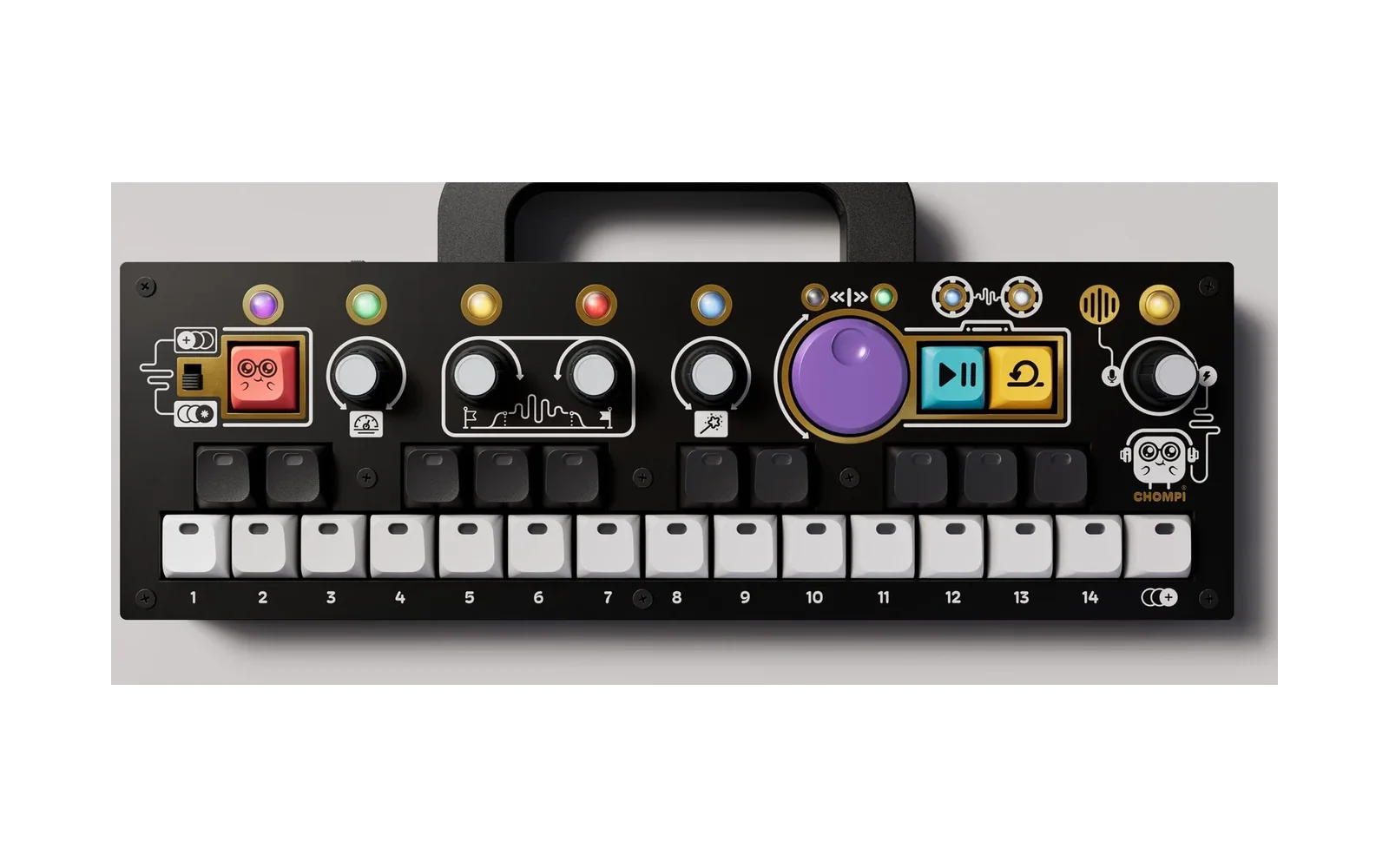
FRIZZ
FRIZZ is an alternative firmware for the CHOMPI. It turns the CHOMPI into a stereo effects box and looper for whatever you plug into its AUX input, for its built-in microphone, or for a computer on USB.
- A looper: free-length loops, or loops locked to whole bars of an incoming MIDI clock. Varispeed in semitones (fifths and octaves with SHIFT), reverse and scrub on the big transport knob.
- Loops from the SD card: your own WAVs, 8 banks of 15, and the recordings you made with TAPE (its cubbis), one on each white key of the Loops and Cubbi pages. They switch at once in time, at the end of a pass or with a scene change, by hand or over MIDI (bank select and program change).
- The Companion, a web page at pumpwerker.de/frizz/companion, that puts your loops on the card over the USB cable while FRIZZ plays.
- Thirteen punch-in effects on the white keys: freezer, pitch shifter, wavefolder, bitcrusher, DJ filter, flanger, phaser (or frequency shifter), resonator, slicer, wow & flutter, tape stop, tempo-synced delay and reverb. Hold a key to play an effect, hold it and press SHIFT to latch it. Knobs 1-4 shape the last effect you touched. A chaos key next to them drops latched effects out at random and scrambles the loop's steps.
- Four FX scenes on the dark keys in the middle: save every effect's settings and latches, recall them at once, drop to them hard on the next bar line, morph to them on the bar line or crossfade by hand on the transport knob, copy and delete them. Kept on the SD card. A fifth key clears every effect at once.
- An input/loop mix between the live input and the loop, plus input gain, output gain and a headphone feed that can carry the input alone, all on the VOLUME knob.
- Three inputs: AUX, the built-in microphone while no cable is in AUX, or a computer on USB, each with its own input gain. Each can go through the effects or past them (a drum machine or a finished song next to your loop), and be monitored on the outputs or only recorded.
- A USB sound card: on a computer, FRIZZ records its master into a DAW and plays the computer's sound as its third input, without a driver; and it lends the SD card to the computer as a drive while it plays.
- A finalizer on its own key, a master section with an input trim, a 3-band EQ, compression and width, and a limiter for loudness; a safety limiter on every output.
- MIDI over TRS or USB: clock for quantized loops and the tempo-synced effects, notes playing the keys, CCs setting every parameter, program changes recalling scenes, a MIDI channel per effect for DAW automation, and the loop lined up with a DAW's Start and Song Position. FRIZZ can send its clock, the loop's Start and Stop, and what you change on the panel as CCs too.
FRIZZ is installed from the SD card like any CHOMPI firmware. It doesn't touch the bootloader, and you can go back to the stock firmware the same way.
Get started
| Install | Put FRIZZ on your CHOMPI, and go back to stock firmware |
| Quick start | Your first loop and your first effects in ten minutes |
| Manual | Every control, every effect, every knob |
For developers
firmware/ | The FRIZZ source. Its README covers the toolchain, the build, the host test harness and debugging |
docs/ | Design notes: the looper spec and an overview of the effects across the CHOMPI firmwares |
reference/ | The original CHOMPI open-source release, kept unchanged: the stock TAPE, TEMPO and WAVE firmwares, the factory SD cards, the bootloader and the hardware files |
How FRIZZ is made
FRIZZ is written with the help of AI coding agents (Anthropic's Claude Code), and most commits
say so (Co-Authored-By: Claude). The design is mine: what FRIZZ does, its controls and
gestures, how it should sound and feel, and what goes into a release. The agents write most of
the code and the tests and propose details, which I accept or change. Nothing goes in on trust
alone:
- On the computer: a virtual CHOMPI (
firmware/twin/) runs the whole firmware, unchanged, and the host checks (firmware/test/) hold it to about 3,400 individual checks in 43 test programs (keys, LEDs, MIDI, timing, the card, the audio), plus 36 scenarios played from power-on and a bit-for-bit comparison of the engine's sound. - On the CHOMPI: every firmware change runs on the device before it's merged, with its CPU load measured against the last one.
- By ear and hand: every release is played with real gear first, from a public
release-test checklist (the issues labelled
release test).
The decisions behind each feature are in the issues and pull requests.
Credits and license
FRIZZ builds on the CHOMPI open-source release by
CHOMPI Club and was forked from its WAVE firmware. It runs on Electrosmith's Daisy platform
(libDaisy, DaisySP), and several effects are ported from Bastl Instruments' Kastle 2 FX
Wizard. The reverb (Rings', with the smear of Clouds), the frequency shifter (after Warps), the
filter's core and the safety limiter come from Émilie Gillet's Mutable Instruments modules (MIT).
Its USB audio and the card drive run on TinyUSB and build on lost-tty's
MIXTAPE, USB audio for TAPE (MIT).
THIRD_PARTY.md has the full list.
Contributors. Thanks to everyone whose code is in FRIZZ:
- lost-tty: the shape of FRIZZ's USB audio, USB MIDI and card drive, and a fix in TinyUSB's USB driver, from MIXTAPE.
- sfaber02: the mono input switch on the 13th white key (#1).
- ugrossek: the CHOMPI launcher's MIDI sender, which FRIZZ's
USB tools use (
firmware/tools/midi_send.py).
FRIZZ is an independent project, not an official CHOMPI Club release. The code is MIT, see
LICENSE. The CHOMPI name and marks are not covered by that license, see
TRADEMARKS.md.