ThisFirmwareDoesNotExist
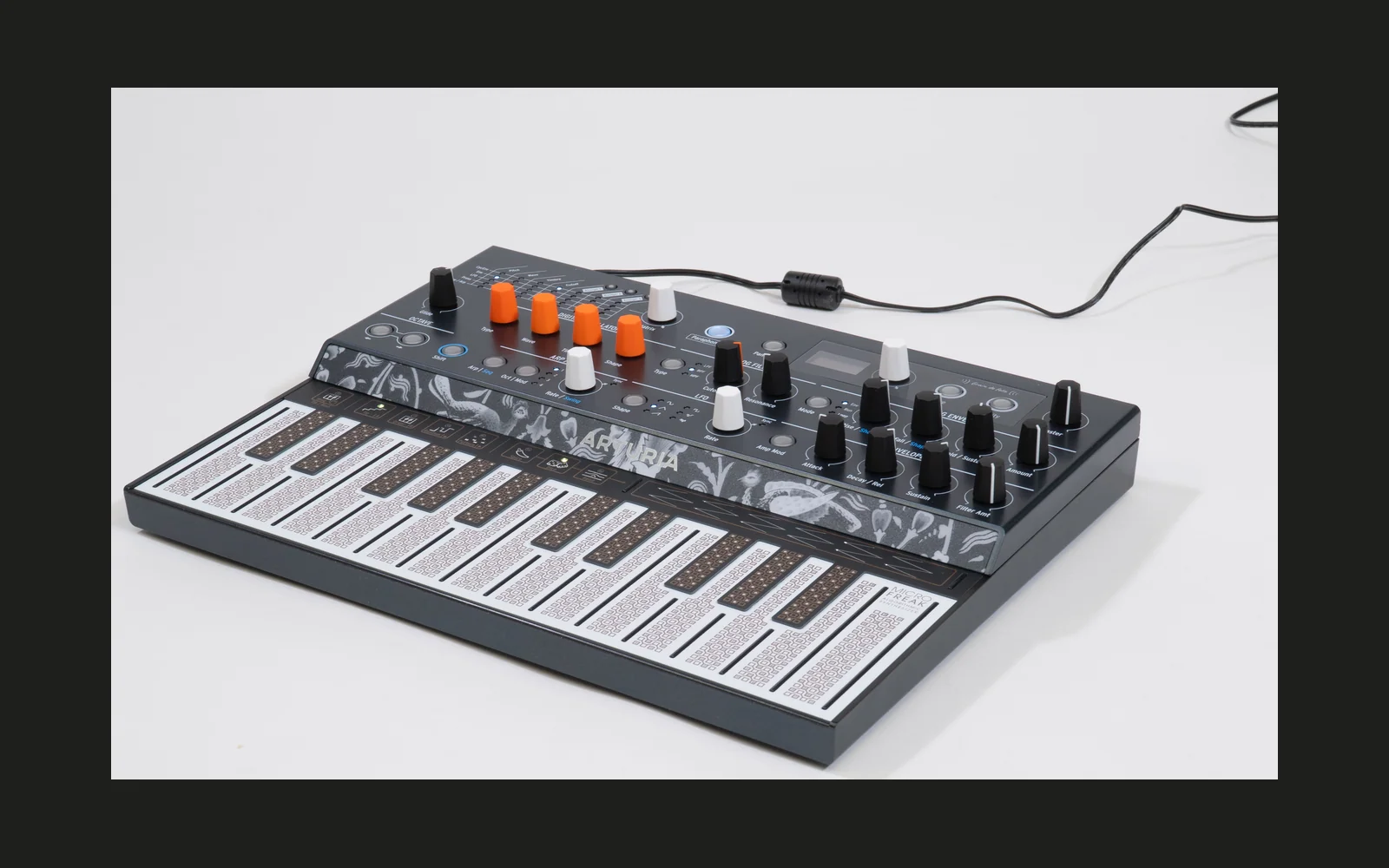
ThisFirmwareDoesNotExist presents freakpatch: community firmware patches for the Arturia MicroFreak. Bring your own copy of Arturia's official update file, and freakpatch hands back a slightly freakier one, on your own computer. Nothing gets uploaded.
Want to go further than one knob? ThisFirmwareDoesNotExist also documents the stock firmware, so you can write your own patches.
Not affiliated with or endorsed by Arturia. Custom firmware is at your own risk, and may affect your warranty (see the fine print). Flashing the official update file always restores stock.
This repository contains no Arturia code or firmware. It holds only ThisFirmwareDoesNotExist's own machine code (with its assembly source), the addresses where that code hooks in, and the SHA-256 of the one official file it accepts. You bring the firmware; freakpatch does the surgery and writes the patched file next to it.
Full Vibe?
Absolutely. Claude Code did all the work. I won't lie. I read the code. Tested it. Understood it, but the work is all Claude Codes over maybe 1-2 sessions with Opus 5.5. If you hate it, fair enough. But I want to be transparent. Firmware is not my day job. But my aim is for this to open up a pool of more intelligent, more creative, and more hardware aware folk to take a stap at doing some fun stuff with the Microfreak.
The patches
The MicroFreak's amp envelope makes one knob, Dec/Rel, do two jobs. Decay and release have been sharing it for years. This patch gives them separate rooms:
- The knob sets Decay only, and the screen calls it Decay.
- Shift + Decay sets Release. The screen shows Release with its own time, in the same envelope popup as Attack, Decay and Sustain, and draws the curve with the Release time.
- Release responds to MIDI CC 72 (MIDI's standard "Release Time") and is sent out on it.
--release-ccpicks another free CC. - Release is saved in presets. Presets saved on stock firmware load with Release = Decay and sound exactly as before. Presets saved with the patch still load on stock firmware, which ignores the extra field. MIDI Control Center backup and restore works.
- Modulation applied to Decay scales Release in the same proportion.
On stock firmware the mod matrix has exactly one MIDI CC. Filter Amt (CC 26), which is really the Env to Cutoff spot in the matrix. The rest of the matrix you can't automate at all. --patch release-matrix fixes that. You get the Release patch plus a CC for the other 34 matrix amounts, in and out.
- CC 0 is -100%, 64 is 0, 127 is +100%. Same math the firmware already uses for Filter Amt.
- Turn a matrix amount on the synth and it sends the CC. Send the CC and the amount changes.
- The matrix LEDs don't update when a CC comes in. You hear the change right away, but the LED won't show it until you scroll over that spot in the matrix. Stock does the same thing with Filter Amt, so I left it alone. MIDI changes the value but never tells the screen to redraw. More on that in docs/matrix-cc.md.
Could it do more? Sure. But thats your job and the point of this repo!
Tested on hardware with 5.0.0.2084 (results).
Matrix CC map
Rows are sources, columns are destinations, same as the panel. Stock doesn't map any of these to a parameter, none clash with Release on 72, and none are CCs MIDI already reserves for something (mod wheel, sustain, bank select, that kind of thing). If one clashes with your setup, open an issue. --release-cc won't let you pick one of these.
| Source / Destination | Pitch | Wave | Timbre | Cutoff | Assign 1 | Assign 2 | Assign 3 |
|---|---|---|---|---|---|---|---|
| CyclEnv | 14 | 25 | 85 | 90 | 109 | 114 | 119 |
| Env | 15 | 27 | 86 | 26 (Filter Amt) | 110 | 115 | 75 |
| LFO | 20 | 30 | 87 | 104 | 111 | 116 | 76 |
| Press | 21 | 31 | 80 | 107 | 112 | 117 | 77 |
| Key/Arp | 22 | 3 | 89 | 108 | 113 | 118 | 78 |
Heads up, this might break the Vocoder. 14 of these CCs (75–78, 80, 111–119) aren't totally free. Stock firmware quietly listens to CC 75–82 and 111–118 for something with 16 slots, and CC 119 sets all 16 at once. My best guess is the Vocoder's 16 bands, but that's a guess. With this patch those CCs go to the matrix instead, so whatever stock used them for won't get them anymore. Untested. Details in docs/matrix-cc.md.
Use
You need Python 3.11 or newer, and something to feed it: the official update file microfreak_Firmware_Update_5.0.0.2084.mff. Download it from Arturia's MicroFreak resources page, or use the copy MIDI Control Center keeps (on macOS: /Library/Arturia/MIDI Control Center/Firmware/).
With uv:
git clone https://github.com/ThisFreakDoesntExist/ThisFirmwareDoesNotExist.git
cd ThisFirmwareDoesNotExist
uv run freakpatch ~/Downloads/microfreak_Firmware_Update_5.0.0.2084.mff
# wrote ~/Downloads/microfreak_Firmware_Update_5.0.0.2084_release.mff
Or install it as a command you can run from anywhere:
uv tool install ./ThisFirmwareDoesNotExist   # or: pipx install ./ThisFirmwareDoesNotExist
freakpatch microfreak_Firmware_Update_5.0.0.2084.mff
Or with plain Python and no dependencies to install:
cd ThisFirmwareDoesNotExist
PYTHONPATH=src python3 -m freakpatch path/to/microfreak_Firmware_Update_5.0.0.2084.mff -o microfreak_release.mff
| Option | Meaning |
|---|---|
-o OUT.mff | where to write the patched file (default: next to the input, named <input>_<patch>.mff) |
--release-cc N | MIDI CC for Release instead of 72. Must be 1–119 and not one of the CCs the stock firmware already uses. |
--patch NAME | release (default), release-matrix (Release plus the mod matrix over MIDI CC), voice-modes (release-matrix plus Delay, Duo, mode notices and cycling-envelope sync, see docs/voice-modes.md), matrix-cc (the matrix alone), or one of the hardware diagnostics diag-region / diag-hook (see docs/writing-a-patch.md) |
--list | describe the available patches |
--version | print the freakpatch version |
freakpatch is a picky eater. It accepts only the official 5.0.0.2084 file (SHA-256 c2b405e3c8565b7b73b4dd06522559458190082a8ba633cc5f1bcc43dc64332c). It refuses anything else, including a file it has already patched: one freaking per file. It also checks its own output: same length as stock, and nothing changed except the bytes the patch declares.
No surprises in the output either: it's deterministic. The default Release build has SHA-256 282ec291a73e89800c52872e4446664e350818978824e1e89003bdadda7d4834, byte for byte the file that passed the hardware checklist (docs/writing-a-patch.md). Building with another --release-cc gives a different hash.
Flash it
- Open MIDI Control Center with the MicroFreak connected over USB.
- Run the firmware update and pick the patched
.mff. - When it's done, turn the knob: Decay on its own, then Shift + Decay for Release. Enjoy the long tails.
Changed your mind? Run the same update with the official file and you're back to stock.
If the synth doesn't start (it sits at the boot logo, looking embarrassed): hold Shift + Arp + Oct while powering on, then update from the official file in MIDI Control Center. No harm done.
The fine print
- Don't share patched
.mfffiles. Share this repository instead and let people patch their own copy. A patched file is a modified version of Arturia's firmware, and Arturia's software licence (chapter 23 of the MicroFreak manual) forbids modifying it "for the purpose of distribution, assignment or resale". That rule is why this repository ships patches, not firmware. Keep it that way. - Warranty. Arturia's warranty doesn't cover problems caused by modification. Flash the official file before sending the synth in for service, or before asking Arturia support for help, so they're looking at stock firmware.
For firmware developers
docs/ is a working map of the stock 5.0.0.2084 main firmware, written so you can build your own patches:
| Document | What's in it |
|---|---|
| Update file format | The .mff container, image headers, checksums, the wavetable image |
| Main image | MCU, memory map, interrupts, audio path, voices, parameters, presets, panel, screen, factory console |
| Free space and dead code | How the image can grow, why "dead" functions usually aren't, which console handlers can be retired for space |
| Writing a patch | The patch format, hooks and edits, building, testing under emulation, flashing safely |
| Flash writes | Every flash writer (calibration, presets, settings), what to avoid, how to check it |
| Oscillator engines | Engine IDs, the descriptor table, engine classes, and how to replace an engine |
| The Release patch | Every address the Release patch uses and how it was derived and checked: a worked example |
| The mod matrix over MIDI CC | The matrix as stock stores it, the six hooks, the CC table, the LED refresh, combined builds |
| Voice modes | Delay, Duo, mode notices, cycling-envelope sync; making new voice modes, chained patches, saving space |
| The screen and LEDs | How the OLED and matrix LEDs are fed, the envelope curve on the OLED chip, and what the patches change there |
| Spice and Dice | How the arp and sequencer randomisers work, and where to dig further |
| Reverse-engineering setup | Headless Ghidra scripts and the raw-byte reference scanner |
| Related projects | Other open-source MicroFreak tools and where they fit |
Repository layout
| Path | Contents |
|---|---|
src/freakpatch/ | The freakpatch CLI and library: mff.py (update container), thumb.py (Thumb-2 branch encoders), patcher.py (hash gate, apply, self-check), cli.py |
src/freakpatch/patches/*.json | Built patches: our code bytes, symbols, hook sites, edits |
patches/ | Patch sources: release.S + release.hooks.json, matrix_cc.S + matrix-cc.hooks.json, the combined release-matrix.hooks.json, the voice modes (delay_voice.S, duo.S, mode_display.S, cyc_sync.S, series.inc, their specs and the combined voice-modes.hooks.json), and the diagnostics diag.S + diag-*.hooks.json |
AGENTS.md | Rules and steps for coding agents (and a checklist for people) |
tools/build_patch.py | Assembles a patch with clang into the shipped JSON |
tools/ghidra/ | Headless Ghidra scripts for exploring the stock image |
tests/ | Unit tests, a Unicorn harness that runs single stock functions (emu.py), and the raw-byte reference scanner (refscan.py) |
Develop
uv sync
uv run pytest                                      # firmware tests need the official file, see below
uv run python tools/build_patch.py patches/release # needs clang with the Thumb target
uv run ruff check . && uv run ruff format --check .
Tests that read or emulate firmware use the file named by FREAKPATCH_STOCK_MFF, or MIDI Control Center's copy on macOS, and are skipped if neither is there. They run the real stock constructor, knob handler, preset saver and parser, and screen code with the patch in place.
Contributions are welcome, especially new patches and corrections to the docs. Please keep the ground rules: derive everything from Arturia's official firmware, never commit firmware or bytes copied from it, never write flash from a patch (flash writes), and keep the main image at its stock length.
Credits
- ThisFreakDoesntExist: project direction, and every flash, recovery and listening test on real hardware.
- Claude Code: firmware analysis, the patches,
freakpatch, the tests and these docs.
License
MIT. The MicroFreak firmware itself belongs to Arturia and isn't covered by this license or included here.