FotonJD990
An open-source editor and librarian for the Roland JD-990 synthesizer module (1993). It talks to the device purely via MIDI System Exclusive and borrows its look from the iconic front panel of the JD-800.
Status: work in progress. Developed and tested on macOS with a real JD-990. Patch editing, librarian and Performance mode work against the hardware; a Linux build is untested, Windows has not been tried. Expect rough edges.
Features
- Every patch parameter (190 of them) editable live: the device follows every fader move immediately.
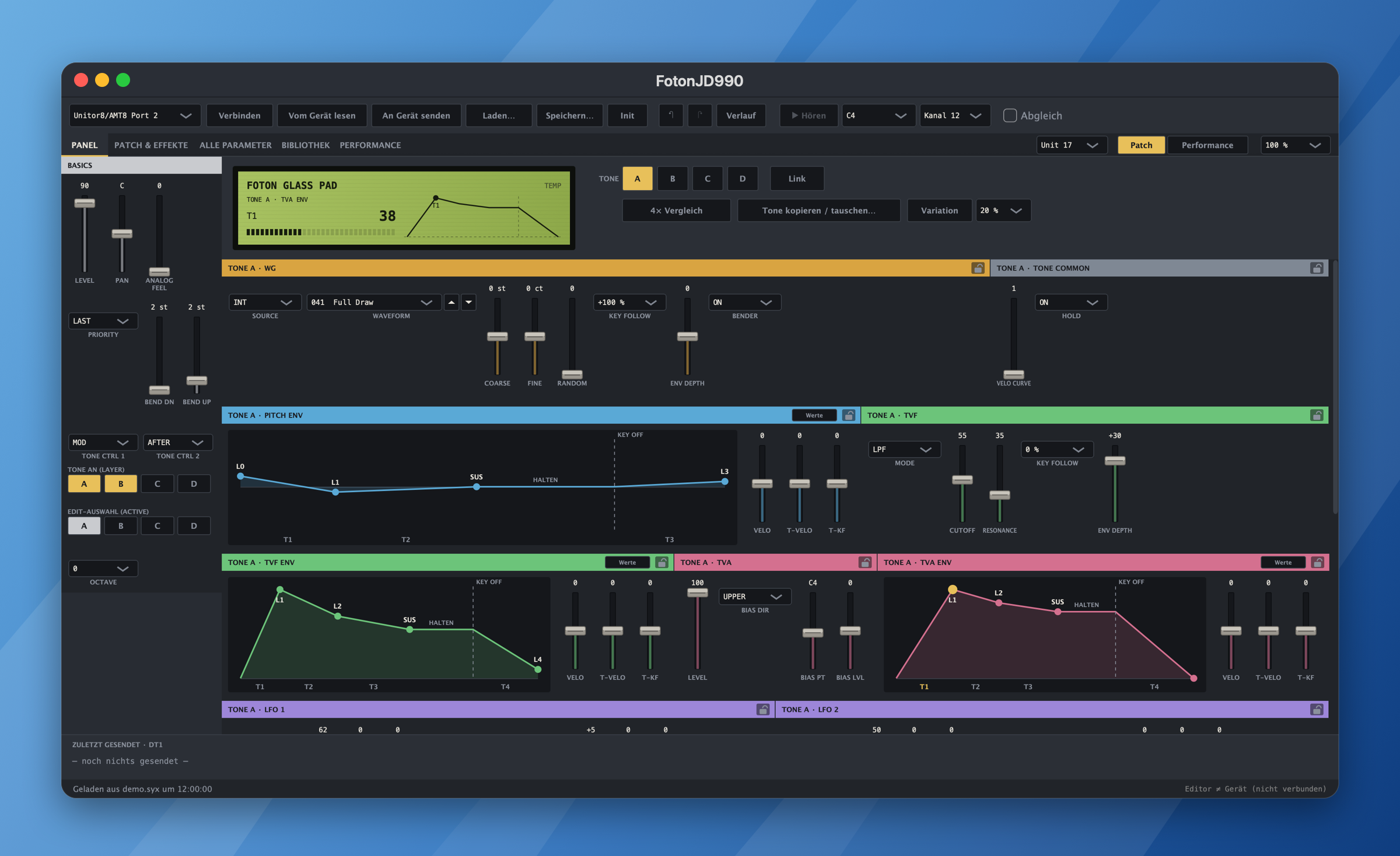
- JD-800-inspired panel with section colours, a green LCD that sketches what you are touching (envelopes, LFO, filter, effects), and an "all parameters" expert view.
- Draggable envelopes for pitch, filter and amplifier: drag points for time and level, ⇧ for fine steps, ⌥ to lock one axis, double-click to reset.
- Effects as a signal chain: reorder group A/B effects by drag & drop, with a small sketch display per effect.
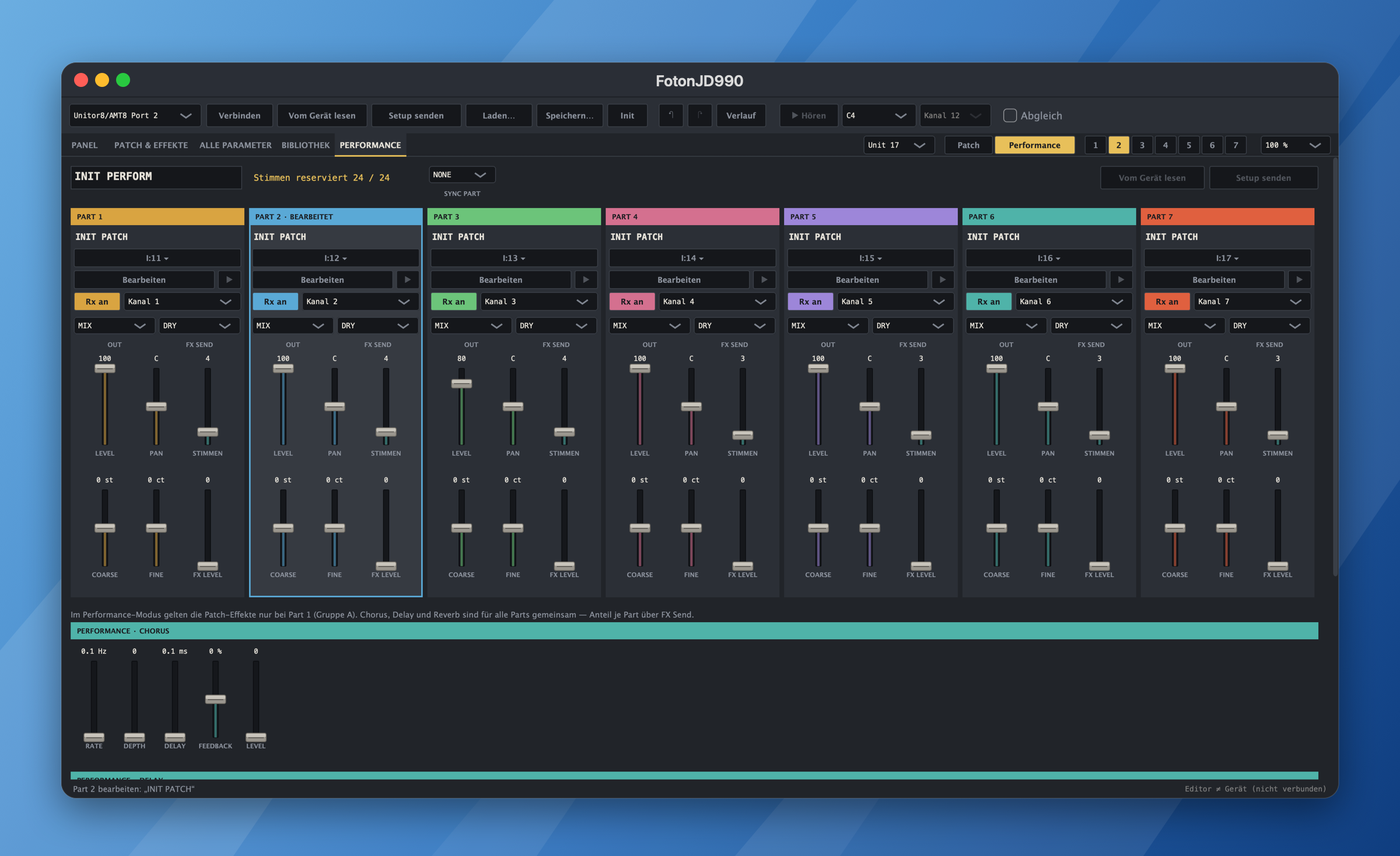
- Performance mode: seven parts with their own patch and MIDI channel, mixer strips, voice reservation (x/24), shared chorus/delay/reverb. Every part's patch can be edited with the full patch editor.
- Librarian: SQLite library with tags, favourites, search, "find similar
patches", A/B compare, morph, weighted random variation, diff between patches,
import/export of
.syxand.mid, bulk read of all internal patches. - JD-800 patch import with conversion to JD-990.
- Undo history with jump-to-step, group locks for variation/morph, tone copy/swap, 4-tone compare view, link mode, UI zoom (80–200 %).
Note on language: the user interface is in German, and so are the design documents in
docs/. This README is the English entry point.
Safety first
The JD-990's patch memory is battery-backed RAM from 1993. The editor therefore never writes to internal memory. It only writes to the device's temporary edit buffers (temp patch, temp performance and the seven part patches) plus the patch/performance mode switch. This is enforced by an address whitelist in both the Rust MIDI layer and the app. Back up your device first anyway:
cargo run -q --release -p jd990-cli -- backup my-jd990-backup # read-only
Building (macOS)
Requirements: Xcode Command Line Tools, CMake ≥ 3.22, Rust (via rustup), and JUCE 9.0.2.
git clone https://github.com/andremotz/foton-jd990.git && cd foton-jd990
git clone --depth 1 --branch 9.0.2 https://github.com/juce-framework/JUCE.git host/JUCE

cargo test                                                 # core, codec, round-trip tests
cmake -S host -B host/build -DCMAKE_BUILD_TYPE=Release
cmake --build host/build -j
open host/build/FotonJD990_artefacts/Release/FotonJD990.app
The CMake build compiles the Rust core as a static library automatically.
Connecting the JD-990
- Connect MIDI in and out; enable Rx Exclusive on the JD-990.
- Pick your MIDI port in the drop-down at the top left. The app reconnects on its own when the interface appears.
- Set Unit # (next to the tabs) to the value on your JD-990 under
SYSTEM › MIDI › Unit # (default 17). It is the SysEx device ID; the editor
remembers it. The command line tool reads it from
JD_DEV(decimal 16–31 = Unit 17–32). - The audition button plays on a selectable channel (patch mode) or on the selected part's channel (performance mode).
Command line tool
jd990 covers backups, file conversion and hardware checks:
cargo run -q --release -p jd990-cli -- show patch.syx          # all parameters
cargo run -q --release -p jd990-cli -- convert jd800.syx out.syx
cargo run -q --release -p jd990-cli -- probe                   # does the device answer?
cargo run -q --release -p jd990-cli -- hil-sweep tvf            # set/read back/verify parameters
Run it without arguments for the full list.
How it is built
| Path | Contents |
|---|---|
spec/ | Single source of truth: every parameter, address and value table as TOML. Codec, validation, UI metadata and tests are generated from it. |
crates/ | Rust: spec parser and codegen, core (patch/performance model, SysEx, device rules, morph, JD-800 conversion), MIDI transport, SQLite library, CLI, C ABI |
host/ | JUCE 9 desktop app (C++), UI reference-image tests in host/tests |
design/ | HTML layout prototype, icon, and the script that renders the README screenshots |
docs/ | Design documents and 22 architecture decision records (in German) |
The parameter map was cross-checked three ways: the official MIDI implementation in the owner's manual, JDTools, and hardware-in-the-loop sweeps that set every parameter on a real JD-990, read the whole patch back and check that nothing else changed.
Tests
cargo test                                        # Rust (no hardware needed)
cargo clippy --all-targets -- -D warnings
sh crates/jd990-ffi/tests/c_smoke.sh              # C ABI
host/tests/ui_snapshots.sh                        # pixel-exact UI reference images (macOS)
License
Copyright © 2026 André Motz.
This project is licensed under the GNU Affero General Public License v3.0 or later (see LICENSE). It uses JUCE under the AGPLv3, and data structures and the JD-800 → JD-990 conversion from JDTools by Johannes Schultz (BSD 3-Clause). See THIRD-PARTY-NOTICES.md.
Roland, JD-990 and JD-800 are trademarks of Roland Corporation. This project is not affiliated with or endorsed by Roland. No Roland factory patches, manuals or panel artwork are included.