Reed


A Wurlitzer 200A, rebuilt in fixed point for the M-VAVE FM-1.
Reed is an open-source custom firmware project for the M-VAVE FM-1. The sound is a physical model ported from OpenWurli: seven modal reed modes, a field-solved electrostatic pickup, a hammer/damper model and the 200A's amplifier character. No samples, no impulse responses.
The engine is portable C99 with no floating point, no libc and no allocation. The same source builds for the host, for WebAssembly and for the FM-1's JieLi AC79 (pi32v2, 360 MHz, no FPU). The firmware layer builds on felucca-bsp, extracted from Felucca.
Live: ograndebe.github.io/fm1-reed · Emulator · Lab (WIP) · Profiles (WIP) · Documentation · Source · Português · Plan
| Engine | v0.1, working — fixed-point voice + behavioural amplifier/speaker |
| Browser emulator | working — the real engine as WebAssembly in an AudioWorklet |
| FM-1 firmware | alpha — builds a bring-up image; not validated on hardware |
| Web installer | planned — no image is published before hardware validation |
| Licence | GPL-3.0-only |
Try it
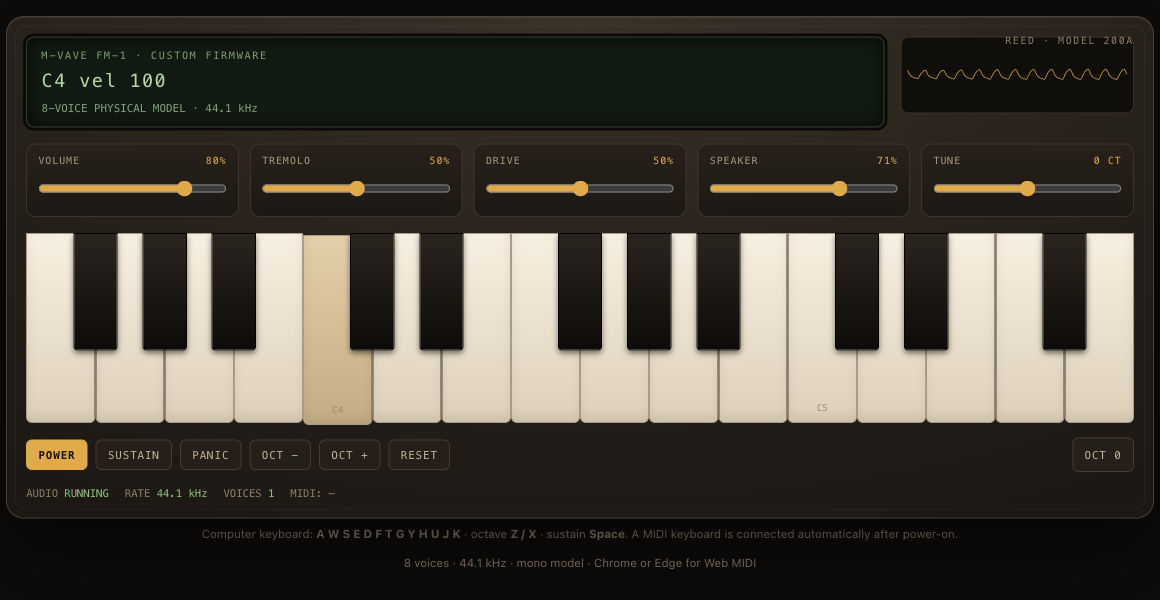
The browser emulator is the shipping engine compiled to WebAssembly. It needs a secure context (localhost or HTTPS):
./web/build.sh
python3 -m http.server -d web 8080
# open http://localhost:8080/try/
Click Power, play the 27 keys (F3–G5), use the computer keyboard
(A W S E D F T G Y H U J K, octave Z/X, sustain Space) or connect a MIDI
keyboard (Web MIDI). The five sliders are the same parameters as the firmware:
volume, tremolo, drive, speaker character and tune.
The site under web/ is plain static HTML/CSS/JS. .github/workflows/pages.yml
publishes it to GitHub Pages at https://ograndebe.github.io/fm1-reed/.
Quick start (host)
make test          # build and run the engine test suite
make reed          # build the offline renderer
./build/reed demo --out demo.wav
./build/reed note --note 60 --vel 100 --seconds 3 --out c4.wav
./build/reed midi --in song.mid --out song.wav
./build/reed note --profile lq32 --note 60 --out lq32.wav
./build/reed bench
Requires a C99 compiler and make. The renderer reads Standard MIDI Files
(format 0/1, PPQ, tempo changes, note on/off, CC64). The engine is 44.1 kHz,
mono, Q20 output.
What is actually inside
modal reed (7 modes) → hammer dwell/onset → electrostatic pickup
        → preamp → LDR tremolo → volume pot → power amp → speaker
- Reed: Euler–Bernoulli mode ratios with tip mass, per-note inharmonicity, decay, air drag, quadrature oscillators. Note-on tables come from OpenWurli's physics, not from samples.
- Pickup: the field-solved capacitance-vs-overlap law for four reed sections, one moving reed against a fixed plate node. The nonlinearity is in the source, exactly as in the 200A.
- Hammer/damper: Gaussian contact dwell, register-dependent onset, attack noise, progressive felt damping.
- Chain: input coupling, asymmetric preamp, Twin-T/LDR tremolo (5.63 Hz), the drawn volume-pot network, 33 Hz feedback shelf, closed-loop power amp with crossover distortion, and the 4×8″ speaker.
- Fixed point: Q30 reed/pickup, Q24 gain staging, Q28 biquads, Q32 phase, 32×32→64 MACs. Eight active voices by default (32-slot capacity), 5 ms steal crossfade.
Fidelity
The voice is a direct port. Before the FX chain was added, C4 at velocity 100 matched OpenWurli's float voice to 0.2 dB peak and 0.3 dB in every spectral band from 20 Hz to 20 kHz, with the same decay curve.
The preamp, power amp and speaker are a calibrated behavioural model in v0.1, not the nine-node MNA/Newton solver. The tremolo uses the real rate, LDR attack/release and depth law with a sine Twin-T approximation. OpenWurli's MLP per-note corrections are off. The exact circuit solver, 2× oversampling and 64 voices are on the roadmap; see docs/PORTING.md and docs/PLAN.md.
Firmware
git submodule update --init --recursive
./firmware/build.sh     # needs the JieLi toolchain and Docker on macOS/arm64
The alpha image is firmware/build/reed.bin (about 84 KB): ALNK0 I2S audio, the
engine in the DMA interrupt, 27 keys + 14 buttons, 7 encoders, the 240×240 LCD,
USB-MIDI input and a boot guard that falls back to UBOOT after two failed boots.
REED_LAB=1 ./firmware/build.sh builds reed-lab.bin with a USB-CDC profile
console and USB audio capture for measurements; see docs/LAB.md.
It has no OTA/installer entry and has not been validated on a physical FM-1.
Do not flash it as a first test. Read firmware/README.md and
BUILDING.md first.
Project layout
| Path | What |
|---|---|
engine/ | Portable fixed-point engine, public API and host tests |
tools/tablegen/ | Rust generator for the OpenWurli-derived tables |
tools/render/ | Offline WAV / MIDI renderer and benchmark |
tools/lab/ | WIP profile capture runner and candidate profiles |
web/ | GitHub Pages site and the WebAssembly emulator |
firmware/ | FM-1 alpha application on felucca-bsp |
bsp/felucca-bsp | Hardware layer (git submodule, MPL-2.0) |
docs/ | Architecture, porting, hardware, plan and firmware notes |
LICENSES/ | Third-party licence texts |
Documentation
- docs/PLAN.md — phased plan and release scope
- docs/ARCHITECTURE.md — engine structure, data flow, Q formats
- docs/PORTING.md — what is exact, what is behavioural, calibration
- docs/POLYPHONY.md — advanced polyphony/quality profiles and hardware risks
- docs/LAB.md — lab image, serial protocol, capture and safety
- docs/HARDWARE.md — FM-1 facts, audio/timer/interrupt layout
- BUILDING.md — host, emulator and firmware builds, recovery
- firmware/README.md — wiring, UI, current alpha limits
- web/docs.html — the same material on the site
Credits
The physics, calibration and Wurlitzer 200A research are OpenWurli's (GPL-3.0-or-later). The FM-1 hardware facts and update path come from Felucca and felucca-bsp (GPL-3.0 / MPL-2.0). The 5×7 font is Adafruit-GFX's (BSD-3-Clause). See CREDITS.md and LICENSING.md.
M-VAVE and FM-1 are trademarks of their respective owners. Reed is unofficial and is not affiliated with or endorsed by M-VAVE, JieLi, Hügelton Instruments or the OpenWurli authors.