FM1 Cartridge — Clipper, Melodee and Felucca on an ESP32-S3
A cartridge with an ESP32-S3 and its own LiPo for the M-VAVE FM-1 running Sloop. The ESP32 is the USB host: it receives notes, clock and transport from the FM-1 over USB-MIDI, renders one of three ported synthesizers (Clipper, Melodee or Felucca) and sends stereo PCM back over USB audio, which the FM-1 mixes into its own output. The cartridge has no DAC. The three synthesizers live in three flash slots, and the FM-1 chooses which one runs from its GLO → CARTRIDGE page.
flowchart LR
    B[Protected LiPo] --> C[ESP32-S3 / USB host / synthesizer]
    F[FM-1 / Sloop / USB device] -->|USB-MIDI notes and clock| C
    C -->|stereo PCM over USB audio| F
    F --> O[Speaker / headphones / audio output]
    F -->|cartridge SysEx: engine, preset, parameters, firmware slot| C
Status
Experimental. The software side builds and passes its native tests; the hardware is a bench prototype (an ESP32-S3 Super Mini with 4 MB of flash and 2 MB of quad PSRAM, on a protected 1S LiPo).
Observed on hardware: the modified Sloop enumerates on a computer as a stereo 44.1 kHz USB audio output and plays a tone from it through the FM-1 speaker; the ESP32 plays a tone and Clipper notes through the FM-1 with a clean sound; the MIDI channel filter keeps the FM-1's other tracks on their internal sound; the CARTRIDGE page shows its handshake with the ESP32; the three firmware slots and the matching Sloop install on the hardware and read back identical.
Not yet verified on hardware: booting and switching the three slots, Melodee and Felucca by ear, the four CARTRIDGE knobs end to end, the cartridge track (sequencer, arpeggiator and takes over MIDI, PRESETS browsing), long-session stability, latency, the render cost of each engine on the ESP32, and the power path (gate G0). The gates and their criteria are in ROADMAP.md.
Safety and risks
Read this before building or connecting anything. The cartridge is an experimental prototype: hobby modules, a lithium cell and a USB connection outside the Type-C power policy, attached to a commercial instrument whose firmware is replaced. A mistake can damage the FM-1, the ESP32-S3 board, a computer's USB port or the cell, and a damaged lithium cell can vent or catch fire. Everything here comes without any warranty (GPL-3.0, sections 15 and 16); build and use it at your own risk.
- The cell. Use a protected 1S LiPo, check its polarity with a multimeter, insulate every joint, and never crush, puncture, heat or charge it unattended.
- Power sources. Never connect the cartridge to a computer or a charger while it is plugged into the FM-1, and connect nothing but the cell and its switch to the board's power pads.
- The USB link. Both boards present themselves as USB sinks; the link works outside the Type-C policy and depends on the cable, orientation and order. No hubs, chargers or other devices in between.
- The FM-1. Its firmware is replaced by a modified Sloop, which can hold the FM-1's charger off through a register bit whose effect is not measured. Back up the FM-1 first; the vendor's firmware can be put back.
- Low cell. On the prototype, a partly discharged cell takes the ESP32-S3 below its minimum supply voltage.
- Volume. A fault can produce full-scale noise: start with the FM-1's volume low.
Details: electrical risks and firmware and flashing risks.
What is included
- Three synthesizers, each the real upstream DSP compiled as one translation unit behind a
common interface (
synth/fm1_synth.h): Clipper 1.3 (23 engines), Felucca 1.7.0 (13 engines) and Melodee 1.5.1 (Prophet, FM6, CZ-1, SID, DRUM). Pinned upstream subsets, generated tables, licences and SHA-256 manifests in third_party/; scope and limits in PORTS.md. - ESP-IDF firmware (firmware/): USB-MIDI host, UAC1 audio out, one profile per synthesizer, a three-slot partition table with bootloader rollback, and the cartridge server. UART console; the USB port is reserved for the FM-1.
- Firmware slots (FIRMWARE_SLOTS.md): the FM-1 picks the slot to boot from the FIRMWARE parameter; a slot that never talks to the FM-1 rolls back.
- Sloop for the FM-1 (sloop-fm1/): Sloop 2.8.4 with USB audio playback into the mixer (ring buffer and adaptive resampling), the USB RETURN gain, the CARTRIDGE page and a charger control; one reproducible patch against upstream in integrations/sloop-fm1/.
- CARTRIDGE (CARTRIDGE.md): engine, preset, parameter and value on the FM-1's four knobs, the running firmware's name in the header and the slot selection, over a private SysEx protocol confirmed by the ESP32.
- Cartridge track (CARTRIDGE.md): the Sloop track on the cartridge's MIDI channel plays the cartridge from its keys, sequencer, arpeggiator and takes, shows the cartridge's names and browses its presets with PRESETS.
- Cartridge manager (WEB_MANAGER.md): a browser page
(
python3 tools/cartridge_web.py --open, Chrome or Edge) that reads the cartridge's slots, backs up its flash, writes any build or image into any slot, installs Sloop on the FM-1, keeps the catalogue of ported and candidate synthesizers and checks every pinned upstream for new releases. Adding another synthesizer to a slot follows PORTING.md. - Simulator and tests: a native simulator with the same DSP and MIDI parser (one executable per synthesizer) writing WAV and JSON, with packet loss, reconnection and clock mismatch; CTest suites with sanitizers; CI workflows.
Using it on the FM-1
- Power the cartridge from its battery and connect its USB to the FM-1, switched on.
- Hold HOME, select the USB section and set USB RETURN to 100%; leave the menu. Keep the speaker volume low but audible.
- Select track 1. Once the cartridge answers, the track on the cartridge's MIDI channel (channel 1 by default, under GLO → MIDI) is the cartridge track: its footer, TRACKS and the PRESETS page show the cartridge's engine and preset, and its internal engine stays silent.
- Play. The keys, chords, arpeggiator, steps, rolls and recorded takes of the cartridge track play the cartridge over MIDI, with GLO → SYSTEM → OUT left at KEYS.
- Turn PRESETS on HOME, TRACKS or the PRESETS page to step through the cartridge's presets; past the last preset of an engine it goes on into the next engine.
Tap GLO and turn SELECT to CARTRIDGE: knobs 1 and 2 choose engine and preset, 3 a parameter and 4 its value. The header shows the running firmware (CLIPPER OK, MELODEE OK, FELUCCA OK) or NO LINK. To switch synthesizer, stop the transport, turn knob 3 to FIRMWARE and knob 4 to a slot: the cartridge reboots into it 2 s later. Each firmware keeps its sound, MIDI channel and edits on the cartridge.
The user guide walks through every step, from connecting the cartridge to switching firmware, with a troubleshooting table.
Build and test on a Mac or Linux
Requirements: a C11 compiler, CMake 3.20 or newer and Python 3. The native build downloads nothing; the sources and tables of the three synthesizers are included.
cmake -S . -B build -DCMAKE_BUILD_TYPE=Release
cmake --build build --parallel
ctest --test-dir build --output-on-failure
mkdir -p out
./build/cartridge_sim --seconds 10 --wav out/clipper.wav --report out/clipper.json
./build/cartridge_sim --seconds 10 --faults --wav out/faults.wav --report out/faults.json
./build/cartridge_sim_melodee --seconds 10 --engine 1 --wav out/melodee-fm6.wav --report out/melodee.json
./build/cartridge_sim_felucca --seconds 10 --engine 4 --wav out/felucca-sample.wav --report out/felucca.json
The WAV plays with afplay out/clipper.wav on macOS. The reports measure simulated logic, not
the hardware's latency, CPU, power or electrical quality. Options in
SIMULATION.md.
cmake -S . -B build-sanitize -DCMAKE_BUILD_TYPE=Debug -DFM1_SANITIZE=ON
cmake --build build-sanitize --parallel
ctest --test-dir build-sanitize --output-on-failure
The upstream DSPs use fixed-point arithmetic with signed wrap and shifts: their targets build
with -fwrapv and two specific UBSan exclusions, while the new modules keep full
instrumentation. See VALIDATION.md.
The ESP32 firmware builds with ESP-IDF 5.3.6 (firmware/README.md); the Sloop package builds with Docker and the JieLi toolchain (integrations/sloop-fm1/). Flashing both devices, with backups, is described in FLASHING.md; the cartridge manager does the same from the browser (WEB_MANAGER.md).
Bench order
- G0: Sloop on a computer with VBUS isolated and its own power; decides whether an extra VBUS circuit is needed.
- G1: the ESP32 receives notes and clock from Sloop, with UART logs.
- G2: the playback in Sloop, with a tone from a computer through the FM-1 mixer.
- G3: the ESP32 sends a UAC tone to Sloop; continuity and latency.
- G4: each synthesizer on the ESP32: CPU and memory, MIDI and audio together.
- G5: the CARTRIDGE page, its knobs and the firmware slots on hardware.
- G6: LiPo, switch, connector and case after the measurements.
Software tests move the implementation forward but do not replace this sequence. Physical results go into BENCH_TESTS.md.
Hardware and limits
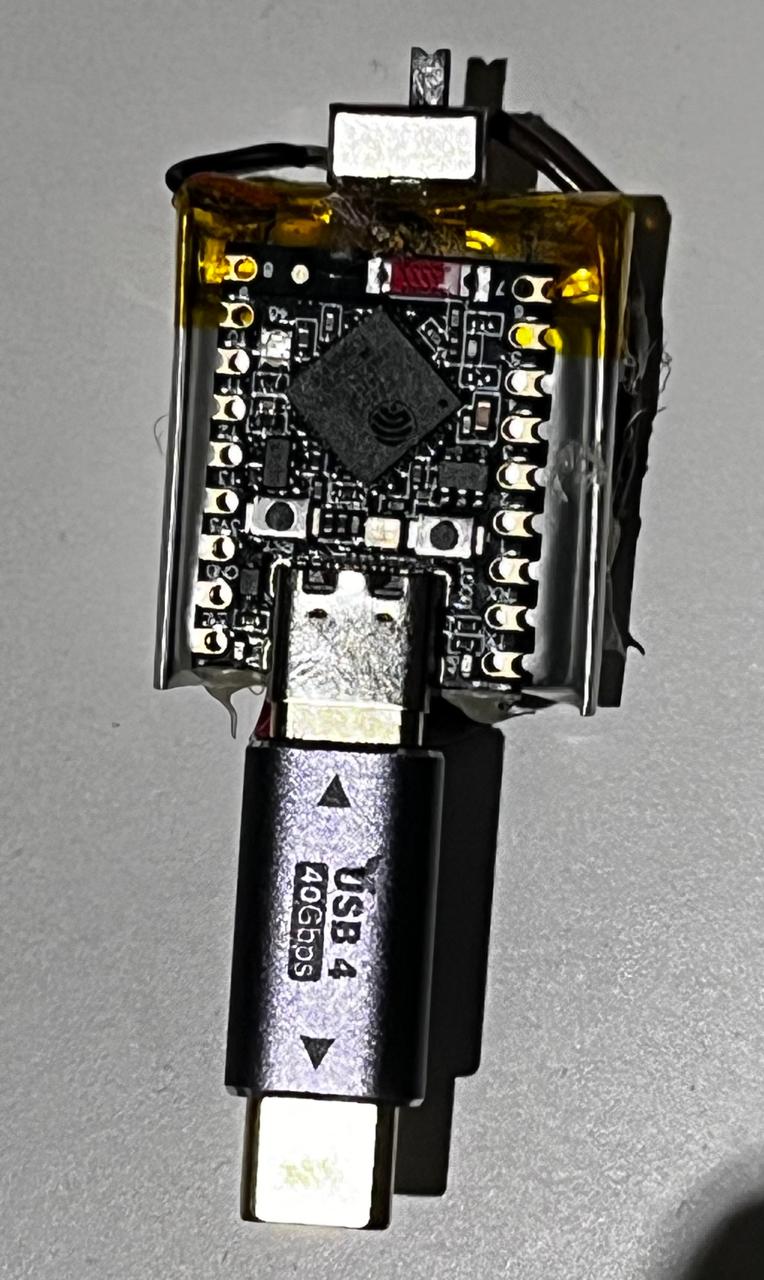
The prototype is an ESP32-S3 Super Mini on a protected 1S LiPo, with an SPDT switch on BAT+, insulation and a small case, plugged into the FM-1 through a USB-C male-to-male adapter (BOM, photos and power notes). The cartridge has no step-up converter and puts no 5 V on VBUS; each side runs from its own battery and the link uses data and ground. That connection is not a universal Type-C host port.
The ports keep 44.1 kHz, one stereo output and each upstream engine's voices (8 shared voices in Clipper and Felucca; in Melodee, the single-core budget: a 5-voice Prophet and a 16-voice FM6). They play one part of each instrument and do not port the original UIs, user presets, editors or CC20/MORPH. The build sets a firmware's first sound; the CARTRIDGE page edits it live, Bank Select and Program Change pick it from MIDI, and the cartridge keeps it.
Not yet understood
Parts of the electrical design are still open, so no circuit here is a proven design (full table):
- the prototype board's model, revision and schematic;
- what holds the connector's VBUS at the 3V3 level, and how much current that path can carry;
- the regulator's dropout point, the battery current and its peaks;
- the Type-C role behaviour across cables, orientations and connection orders;
- how the FM-1 detects and loads the cartridge's weak VBUS, and the real effect of the FM-1 charger bit the cartridge Sloop writes.
Future work
- Hardware: a dedicated board with a proper USB-C source port, a VBUS load switch and a power path without back-feed; battery monitoring on the board (the firmware already reads an optional divider); a regulator that keeps 3V3 in specification over the whole cell range; a tested enclosure (hardware).
- ESP32 firmware: measured voice limits per engine, user presets, MIDI CC mapped to the cartridge's parameters, several parts on different channels, slot updates over the cartridge link (firmware).
- Sloop: HOME knobs mapped to cartridge parameters on the cartridge track, the track's PAN on the return, the cartridge's sound saved with a project, and CART DELAY kept across power-offs once the bench has measured the return's latency.
Repository map
| Folder | Contents |
|---|---|
firmware/ | ESP-IDF project: MIDI/tone/Clipper/Felucca/Melodee profiles, three-slot partition table, slot flashing script |
synth/ | The fm1_synth.h interface, the three adapters and the cartridge server |
third_party/ | Pinned upstream subsets of Clipper, Felucca and Melodee, generated tables, licences, SHA-256 manifests |
sloop-fm1/ | FM-1 firmware: Sloop 2.8.4 with the cartridge profile |
integrations/sloop-fm1/ | The Sloop patch against upstream, its manifest and how to reproduce it |
core/ | USB-MIDI parser, endpoint discovery, the cartridge wire format and a reference audio receiver |
web/ | The cartridge manager (slots, synth catalogue, updates, Sloop install), served by tools/cartridge_web.py |
sim/, tests/ | Offline simulation and tests |
hardware/ | BOM, photos of the prototype, and electrical and mechanical notes |
docs/ | User guide, architecture, protocols, ports, porting, slots, flashing, the manager, bench tests, gates and validation |
Code under GPL-3.0-only, preserving the notices and compatible licences of the upstream
components (see each third_party/*/README.md). An independent project, not affiliated with
M-VAVE, Seeed or the authors of the original firmwares.