Ex-Machina
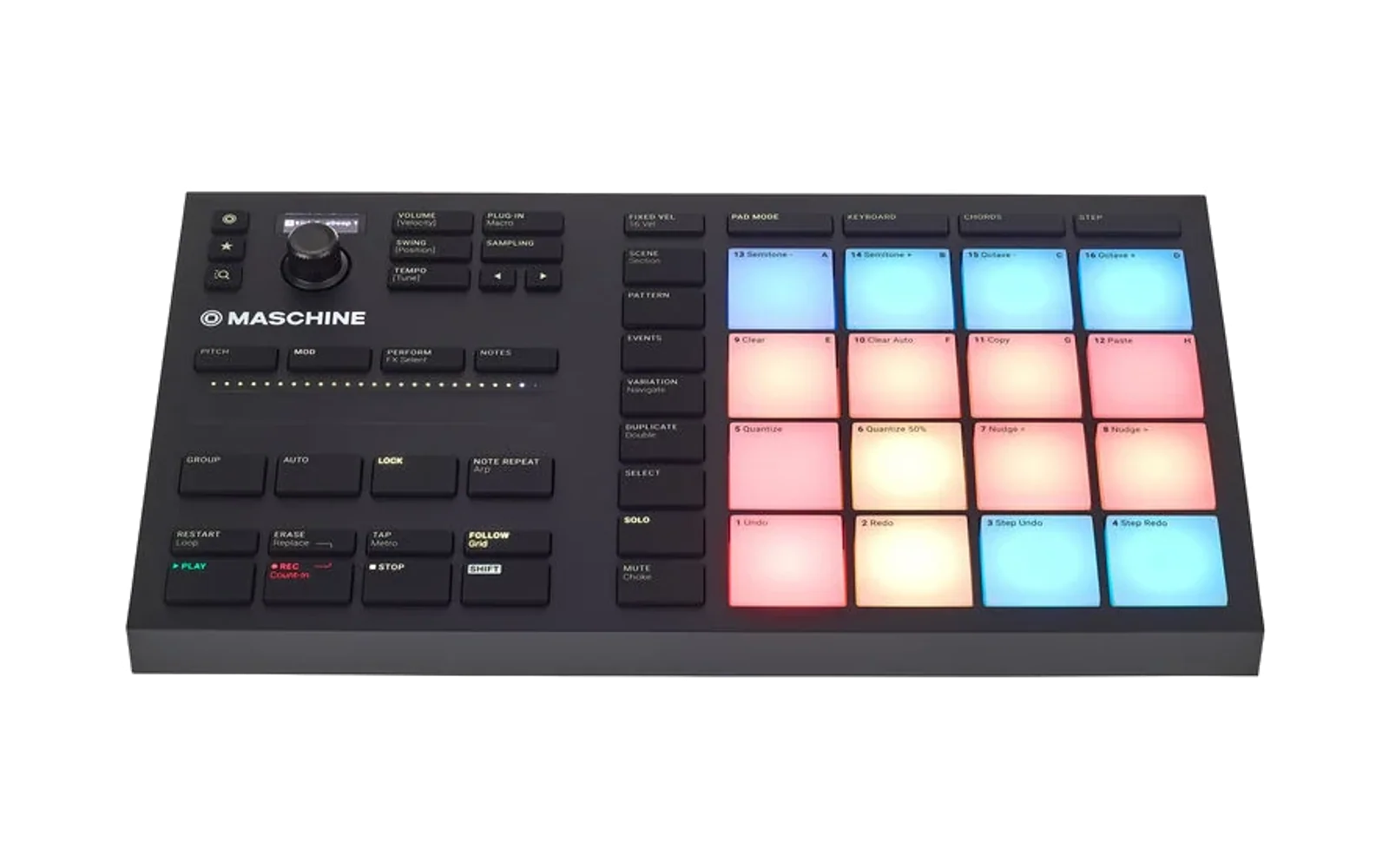
Alternative firmware for the Native Instruments Maschine Mikro MK3: it turns the controller into a class-compliant USB-MIDI device (so it works on iPadOS / iOS and with any MIDI software, without NI's drivers or software), and adds a standalone feature set: remappable buttons with a Shift layer, drum / keyboard / chord pad modes with scales, velocity curves, an arpeggiator with tap tempo and MIDI clock, a 16-step sequencer, mute / solo pads, strip modes, MIDI channel selection, four preset slots stored in the device, on-screen feedback (an idle screen with the firmware name and a live status line, messages, a sequencer grid), and a browser tool to configure and flash it.
Status: version v0, running on a real unit (and an iPad). Hobby project, no affiliation with Native Instruments.
How it works
The firmware is NI's own firmware v1.20 plus a patch: tools/midi_patch/translate.c (C, a few hooks into the stock code, new flash content appended
to the image) is built by tools/midi_patch/build_patch.py into a patched image. NI's firmware is proprietary and is not in this repository:
you supply your own copy (it is inside NI's updater, tools/carve_fw.py extracts it) and the build, or the browser page, applies our patch to it.
tools/ui/patch_bundle.json holds only our bytes and checksums.
The patch is tested without hardware in an emulator (Unicorn, running the real stock firmware and a model of the USB and flash peripherals).
Layout
| Path | What |
|---|---|
tools/midi_patch/ | the patch (translate.c), the image builder, the host-side config library / CLI (mmk3_config.py), and the emulator tests (run_tests.sh) |
integrations/fl_studio/ | the FL Studio device script (docs/fl-studio.md, manual chapter 10) and its tests |
tools/ui/ | the browser tool: mapping editor, presets, flashing and restoring the firmware (Web MIDI + WebUSB; Chrome or Edge) |
tools/emu/ | the Unicorn machine, USB and flash models |
flasher/ | self-contained DFU client for the NI bootloader (Python + WebUSB port), the guarded flash script, its tests and the protocol notes; could be its own project |
tools/*.py, tools/*.sh | the restore script (hash-gated NI image), USB / HID / chip probes, firmware carving |
tools/ghidra/ | helper scripts used for the reverse engineering |
manual/ | the user manual: playing, the button reference, presets and slots, the setup page, flashing and recovery, the command line, the MIDI reference |
docs/ | design notes and the research: reverse-engineering findings, what each source confirmed, the SysEx protocol, hardware plan and results, the chip probe |
proprietary/ | not committed (see .gitignore): NI's manual, updaters, installer image and the unmodified stock firmware, kept locally for the build and the restore path |
CLAUDE.md | working notes for the AI assistant used on this project (commands, constraints) |
To use the firmware, read the user manual. For the design, start with docs/midi-patch.md (design and features), docs/ui.md (the browser tool), docs/remap-protocol.md (SysEx protocol) and docs/fl-studio.md (the FL Studio script).
Getting started
# the tests (needs clang with the ARM target, python with unicorn pyelftools usb-protocol; node for the page's tests)
tools/midi_patch/run_tests.sh <stock firmware image> <work dir>

# the browser tool
python3 tools/ui/serve.py        # then open http://localhost:8765 in Chrome or Edge
Flashing replaces the device's firmware. The bootloader is not touched and NI's original can be restored from the page or with
tools/restore_stock.sh (from your own copy of NI's image), but you do it at your own risk.
License
The code and documentation in this repository are under the MIT License (LICENSE). Native Instruments, Maschine and Mikro are trademarks of
Native Instruments GmbH; NI's firmware, manuals and software are theirs and are not part of this repository or covered by this license.