
v1.5.2
Evander's Music Box
LARP-First Firmware for the M-VAVE (Cuvave) FM-1
Medieval & High-Fantasy Bard Synthesizer · "Mother Melody hears thy song"
Emulator · Web Installer · Manual · Console · Page




Screenshots
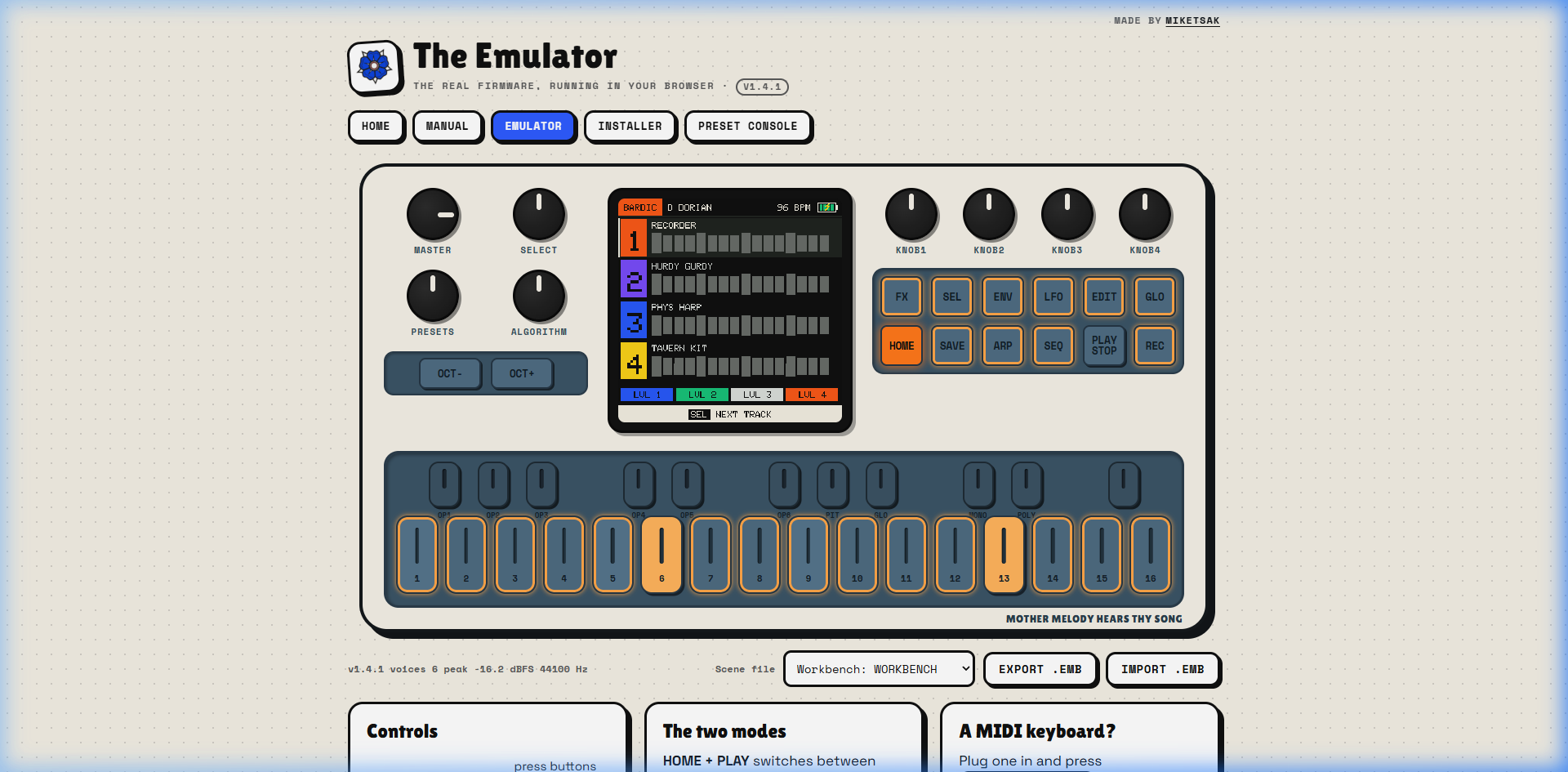
The Web Emulator running the real C firmware in-browser with live hardware controls, active LED feedback, and multi-button latching.
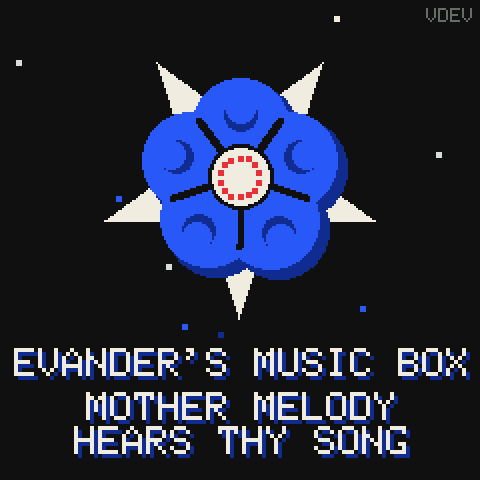
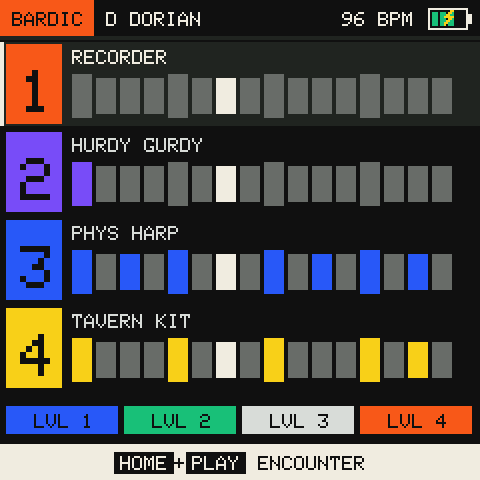
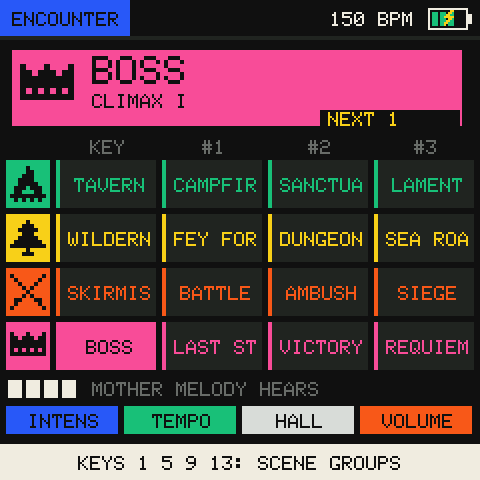
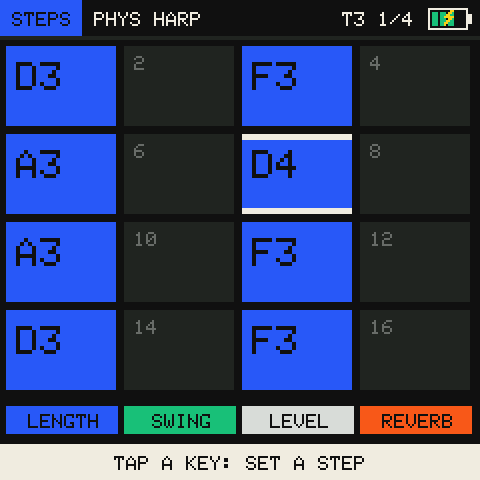
Left to right: Mother Melody sacred boot splash; 4-track Bardic Crafting deck; Encounter 16-scene matrix; 64-step sequencer.
Overview: LARP-First Firmware
Evander's Music Box is custom, open-source firmware designed from the ground up for medieval and high-fantasy Live Action Roleplay (LARP) on the pocket-sized M-VAVE (Cuvave) FM-1 synthesizer.
Most synthesizers belong on a studio desk or a stage stand. Evander's Box was forged for the mud, costumes, leather armor, and campfires of live roleplay. It turns your FM-1 into the sacred relic of Evander, Elven Bard of Mother Melody. By day it scores live skirmishes and boss battles strapped directly to your forearm or bracers; by night around the tavern fire it is a four-track acoustic composition workshop.
Out of the box there are no modern synth bleeps or electronic sweeps. Every voice is an authentic acoustic physical model tuned for historical and fantasy settings: hurdy-gurdy with buzzing trompette, physical harps, lutes, psaltery, shawms, bagpipes, cathedral choirs, and bodhrán war drums. (A bard who knows the secret chord can unlock a modern bank: see Modern Mode.)
It features two distinct operational modes:
- Bardic Crafting. A four-track medieval workshop: war drums, drones, plucked strings and winds. It has a 64-step sequencer with microtiming and parameter locks, live looping, modal scales and historical temperaments.
- Encounter. For live roleplay, with the unit strapped to the forearm. The sixteen white keys are sixteen scenes, from tavern to boss fight; a scene changes on the next bar with a crossfade. Once one is chosen, the eleven black keys bend it: Phrygian dread, a key change, half time, a breakdown, a stinger. Tap SEQ for Freestyle: every key plays a melody over the scene, always in its scale.
Across both modes: a Scale Lock (hold GLO + a key) that keeps every note in one scale like a harmonica, a knob HUD that names what each knob changes, autosave every 30 seconds so the Box wakes where it was left, and USB audio and MIDI with no driver, to record straight into a DAW or Audacity.
The same C core runs on the FM-1, compiled to WebAssembly in the browser emulator, and natively in a host self-test.
Status: early hardware testing. The core, the emulator and the web tools are built and tested (see Testing). On a real FM-1, v1.0 was found to stay dark when started on battery, to skip its boot animation, and to play far too quietly. The current code fixes the last two and hardens the battery start-up (see Boot and power). The battery fix has not yet been confirmed on a unit. Keep the recovery steps below close, and please report back what the boot screen's bottom line says.
Feature matrix
| Bardic Crafting | Encounter | |
|---|---|---|
| Keys | play the selected track, snapped to the mode | white 1-16: the scenes · black: 11 variations of the chosen scene · SEQ: Freestyle, every key in key |
| Tracks | 1 drums · 2 drone · 3 strings · 4 lead, any instrument on 2-4 | each scene is a four-track song |
| Sequencer | 64 steps, 4 notes a step, microtiming ±½ step, TONE p-locks, swing, live record (REC) | plays the scenes |
| Timing | free | changes quantized to beat / bar / 2 bars / 4 bars, crossfade 0-8 beats |
| Control | pages: SANCTUARY, ENVELOPE, MOTION, VOICE, MODES, STEPS | K1 intensity · K2 tempo · K3 hall · K4 music level |
| Safety | HOME + REC (hold 0.4 s): purge the loop, undoable | HOME + REC (hold): silence |
| Switch | HOME + PLAY: either way, the music never stops | |
| Scale Lock | hold GLO + a key: root and scale (same root again: next scale; GLO + ENV: off) (major, minor, Dorian, diminished, pentatonic…); every engine and track snaps | same, scenes and freestyle included |
| Memory | autosave every 30 s: steps, loops, instruments, settings, mode; boots where it was left | |
| Computer | class-compliant USB MIDI + USB audio (UAC1, 16-bit stereo): no driver |
Instruments (20): TAVERN / WAR / RITUAL drum kits, each with bodhrán, frame drum, tambourine, anvil, timpani (tuned), war drum, clack and gong · PHYS HARP, LUTE, NYLON GTR, KOTO, PSALTERY (Karplus-Strong strings with three sympathetic strings per track) · CHOIR, HURDY GURDY (with a trompette buzzing on the "coup" eighths), BAGPIPE, LOW CELLO · PAN FLUTE, RECORDER, SHAWM, WAR BRASS (breath noise, chiff, reed saturation) · ORGANETTO, POSITIVE, CATHEDRAL pipe organs, and the modern TONEWHEEL organ with four drawbar groups and a Leslie rotor that spins up and slows down (EDIT + GLO).
Modern Mode (HOME + FX + GLO, kept through power-off) adds ten more: SAW LEAD, SQUARE LEAD, SUPERSAW, SYNTH PAD and ACID BASS (subtractive, with a resonant filter and filter envelope), FM E-PIANO, FM BELL and FM BASS (two-operator FM), and an ELECTRO KIT for the drum track.
Every voice has details taken from the real instrument:
| Instrument | Detail |
|---|---|
| plucked strings | the click of a quill plectrum, and two body resonances for each instrument's box or soundboard |
| choir | three singers and three formants |
| hurdy-gurdy | rosin scratch on every turn of the wheel |
| bagpipe | a grace-note skirl into each note |
| shawm | a hard double reed with two nasal formants |
| recorder, pan flute | breath scooping up into the pitch |
| small organs | bellows that never blow quite steady |
| cathedral organ | mixture ranks that beat gently against each other |
There are no environmental sound effects (fire, wind, nature). The box is played in real forests and around real campfires, so their DSP time went to the instruments instead.
SANCTUARY reverb: pre-delay, four allpass diffusers and a 4-line Hadamard feedback network with damping and slow modulation. RT60 runs from 0.5 s to about 12 s, with a "cathedral swell" one button away in Encounter.
Loud enough for outdoors. The master bus applies MASTER as makeup gain (up to +9.5 dB), then a peak limiter with 0.73 ms of look-ahead. Peaks are turned down smoothly instead of squared off. The limiter's ceiling is the OUTPUT setting:
| OUTPUT | Ceiling |
|---|---|
| LOUD (default) | −0.5 dBFS |
| NORMAL | −3 dBFS |
| SAFE | −6 dBFS, Felucca's own level, for a speaker that crackles near full scale |
Tuning: eleven scales (Ionian, Dorian, Phrygian, Lydian, Mixolydian, Aeolian, harmonic minor, Phrygian dominant, diminished, pentatonic major and minor). Four temperaments relative to the root: equal, Pythagorean, quarter-comma meantone, 5-limit just. New songs default to D Dorian, Pythagorean, with snapping on.
Reactive LEDs: scale notes glow, roots shine at half light, and out-of-scale keys stay dark. In Encounter the scene keys glow (1 · 5 · 9 · 13 brighter, to count by), the playing scene is lit and a queued one blinks; the sharps wake once a scene is chosen, and a variation's sharp stays lit while it holds. PLAY pulses on the beat. See MANUAL.md.
The screen: flat bold colour blocks on ink, hard shadows, a pixel font and pixel-art sprites for the scene groups. Every screen has these, and the volume card appears whenever MASTER is turned:
| Element | What it shows |
|---|---|
| battery icon | always shown; a bolt on USB power |
| knob strip | four chips in the knobs' own colours |
| tips footer | changes with what you're doing; key names are drawn as keycaps |
| volume card | appears when MASTER turns, and leaves a second after it stops |
| knob HUD | names what K1-K4 change (REVERB DECAY, FILTER CUTOFF…) with the value, for a second |
| lock picker | while GLO is held: the keyboard, with the root or scale each key sets |
The web suite (web/): an emulator of the whole firmware in an AudioWorklet, a WebMIDI installer for the
.fwsc package (resume after interruption, return to official V15), and a preset console (backup and restore,
.emb song files, remote scene cueing for a game master).
Architecture
src/
  emb.h             the core's whole interface: types, controls, the platform hooks
  emb.c             unity build of the core (one compilation unit, as Felucca builds)
  emb_dsp.c         fixed-point voices, sympathetic strings, Leslie, subtractive + FM engines, SANCTUARY reverb
  emb_engine.c      two decks, clock, sequencer, microtiming, live loop, purge, variations, scale lock, freestyle, mixer, limiter
  emb_scenes.c      the 16 factory scenes (pattern strings) and instrument defaults
  emb_gfx.c         240x240 RGB565 drawing, 5x7 font, sprites, battery, the crest, the Blue Rose, the boot
  emb_ui.c          both modes, every shortcut, LEDs, screens, tips, HUDs, autosave, MIDI, SysEx
  platform/fm1.c    the FM-1: boot, ISRs, I2S DMA, key matrix, LCD, flash, USB MIDI + audio, updates
  platform/wasm.c   the browser: exports for the AudioWorklet
  platform/host.c   self-test, WAV renderer, screenshots
upstream/felucca    git submodule, Felucca v1.6.1 (GPL-3.0-only): the FM-1 HAL, USB, OTA, update loader, packager
web/                emulator (emu/), installer, preset console, shared theme and protocol (embmidi.js)
tools/build.py      test | web | fw | all | wav | shots
Hardware layer. The AC791N's register map, the I2S codec bring-up, the 11×6 diode key matrix behind two
74HC595s, the ST7789 panel on SPI1, the SPI NOR driver that runs from RAM, and the USB device stack all come
from Felucca (Hügelton Instruments). None of that was guessed: the FM-1 port includes Felucca's hal/ and
its usb.c, lcd.c and ota.c unchanged, as its own update loader does. It links against Felucca's linker
script (code executes in place from flash, with 72 KiB of RAM and a 360 KiB pool). It is packaged with
Felucca's fm1pkg_make.py and update loader, so the stock M-UPGRADE protocol works as before.
Real-time path. The ALNK0 interrupt fires every 128 frames (2.9 ms at 44.1 kHz). It drains the command
ring, advances the clock in 24 ticks a step, runs up to 24 voices, the per-track inserts and the reverb, and
limits the master. It then writes the result into the half buffer that has just played, scaled to the codec's 24 bits. The main loop never touches audio state: it only
posts commands (emb_post), a single-writer ring. If a render runs past 80 % of its slot, the oldest voice is
shed. Everything is integer DSP with no FPU and no heap. Big buffers are static and go into the .pool RAM, and
a purge clears a track in place. On a desktop core the busiest scene renders at under 1 % of real time.
Two decks. Encounter changes are crossfades between two decks that share one voice pool. The queued scene starts on the next quantize boundary, and the old deck fades over the crossfade length and then releases its voices. Variations wait for the next beat. A variation pressed while a scene is queued waits for that scene and lands on it. Intensity (drone → +drums → +strings → full host) gates track gains with a 25 ms slew, so nothing clicks.
Boot and power
On battery the power switch raises every rail at once. The ST7789 panel ignores commands for up to 120 ms after its supply comes up. Felucca reads its flash store before it first talks to the panel, but v1.0 talked to the panel almost at once. That is the leading suspect for staying dark on battery but not on USB, though it is not proven. A brownout as the amplifier and LEDs switch on is the other one. The boot now does the following:
- waits 150 ms for power to settle
- initialises the panel and draws the first frame before the codec, the amplifier and the LED sweep draw current
- half a second in, re-sends the panel's wake-up commands (sleep-out, colour mode, display on) without a reset, so there's no visible flash, then redraws the whole screen
v1.0 also skipped its boot animation about half the time. Its clock started at ms | 1, which on an even
millisecond lies in the future, so the animation's length check wrapped around and ended it at once. That is
fixed.
If a run ends badly, the next boot screen names why on a pink line:
| Message | Meaning |
|---|---|
LAST RUN CRASHED | the previous run crashed |
LAST BOOT STOPPED AT STEP n | the previous boot halted at that step (1 start, 2 panel, 3 core, 4 audio, 5 USB, 6 interrupts, 7 first frame) |
LAST RESET: LOW VOLTAGE | a brownout |
LAST RESET: WATCHDOG | a hang |
Persistence. The settings, the workbench and the sixteen scenes take one 4 KiB flash sector each, in
Felucca's data area from 0x97000; four more sectors (to 0xAD000) are an autosave ring holding the whole
state with a sequence number. A record is believed only if its magic and checksum agree, so anything another
firmware left there reads as empty and the factory scenes load. Erasing a NOR sector stops the sound for
20-50 ms, so the ring is erased only while the Box is stopped and idle and written (page writes, no gap) into
blank sectors while it plays; only after two minutes of unsaved changes mid-song does it take that gap.
USB audio. Felucca's usb.c is built with its UAC1 interface on: the master output is tapped block by block
inside the audio interrupt into its USB ring, and the isochronous endpoint is serviced from the timer tick even
during a render. The FM-1 then shows up as an audio input and a MIDI port named Felucca on any computer.
Not yet confirmed on a unit.
Flashing
You need Chrome or Edge on a desktop, a data USB-C cable, and a charged FM-1.
- If you run another custom firmware, return to official V15 first. The community advice is to use M-VAVE's updater, or the installer's Return to official V15.
- Open the installer (
installer.htmlon the project site, orpython3 tools/build.py alland servebuild/web/). Tick the box and press Install. - The FM-1 verifies the package, restarts into update mode (
ota-FM-1), and the page writes the image. Do not unplug. If it stops, replug the cable and press Install again: the page finds the waiting loader and resumes. - The box restarts with the crest and the rose. The package identity is
FM-1_777.
From a terminal, Felucca's installer works too:
pip install mido python-rtmidi && python3 upstream/felucca/tools/fm1_install.py build/fw/emb.fwsc.
Recovery
- The firmware runs but misbehaves: use the installer again, or Return to official V15.
- Hold OCT- + OCT+ for 5 s (while running), or send SysEx
F0 22 24 35 7D F7. Either one enters the chip's own update mode, WL82 UBOOT (USB4C4A:8057), wherejl-uboot-tooland the community unbrickers work. - Power on while holding OCT-, or crash at boot repeatedly: the chip's own ROM may enter UBOOT. That
presents a USB disk, not MIDI, so the web installer cannot see it. Use the unbricker tools (see
Learn dark screen.mdfor the Windows 11 fixes). - Hard brick: the RP2040 FM-1 Transporter dongle reads and writes the flash over the JieLi USB key. See
the community hub. The boot head below
0x4000is never written by this firmware or its installer.
Building and testing
See BUILDING.md. In short:
git clone --recurse-submodules <this repo>
pip install ziglang                 # or use any clang / gcc
python3 tools/build.py test         # the host self-test
python3 tools/build.py web          # the emulator and tools: build/web/
python3 tools/build.py fw           # the FM-1 package (JieLi pi32v2 toolchain + AC79 SDK)
Testing
tools/build.py test builds src/platform/host.c and checks the following:
- the fixed-point math: pitch to within 0.05 %, octaves, the divider, decay times, and the temperament tables
- scale snapping and modal remapping
- that all 16 scenes are valid, sound, and stay off the rail
- a bar-quantized crossfade that lands on step 0 and fades out the old scene
- microtiming to sample accuracy
- purge and undo
- the mode chord in both press orders, and that it does not start the transport
- the step editor, the organ toggle, and every page drawing
- the SysEx protocol round trip and factory restore
- the boot animation's full length after an even first tick
- the Encounter key map: all 16 scenes on the white keys, the sharps silent until a scene is chosen, then each a distinct variation, and a variation landing on the scene it waited for
- Freestyle: notes in the scene's scale, the lead track stepping aside, momentary SEQ
- the Scale Lock: every key and scene note in the locked scale, the root kept in the scene's register
- Modern Mode: the chord toggles it, the modern bank is hidden without it, and tracks fall back when it closes
- autosave: a reboot restores the workbench, settings and mode, and no sector is erased while playing
- the volume card and knob HUD: they show on a turn, ignore pot jitter, and leave a second later
- the limiter: at full MASTER on the loudest scene, no sample passes the ceiling
Every melodic instrument was measured in tune (≤ 2 cents; the cathedral and tonewheel organs also sound their
16′ rank, an octave down, as real ones do). Each, the modern bank included, was level-matched to −14 dBFS,
averaged over four notes. The web
pages were checked in Chrome: the emulator plays its boot animation, switches mode, and cues a scene. It also
shows the volume card when MASTER is turned. The installer and console load. tools/build.py wav 13 30 renders
the boss fight to a WAV, and tools/build.py shots writes screenshots.
Credits and licence
GPL-3.0-only (see LICENSE). Copyright (C) 2026 Michail Tsakiroglou <https://miketsak.gr>.
- Michail Tsakiroglou: Concept, firmware architecture, C DSP audio engine, physical modelling instruments, SANCTUARY reverb, graphics & boot animation, WebAssembly emulator, WebMIDI tooling, and site design.
- Felucca by Leo Kuroshita / Hügelton Instruments: the FM-1
hardware layer, USB-MIDI, the M-UPGRADE protocol and update loader, the package format, and the web update
library (
web/vendor/in the built site). GPL-3.0-only. - GHOULBOX by Jason Persinger: the inspiration for the cathedral HALL, the hurdy-gurdy's crank and trompette, and the historical temperaments. No code is copied.
- aroum/fm1-custom-fw: the community's reverse-engineering notes on the SysEx OTA handshake, the flash layout, and recovery.
- Fonts on the web pages: Lilita One, Space Grotesk and Space Mono (SIL OFL), served by Google Fonts.
Not affiliated with M-VAVE, Cuvave or JieLi. This is hobby firmware, flashed at your own risk.