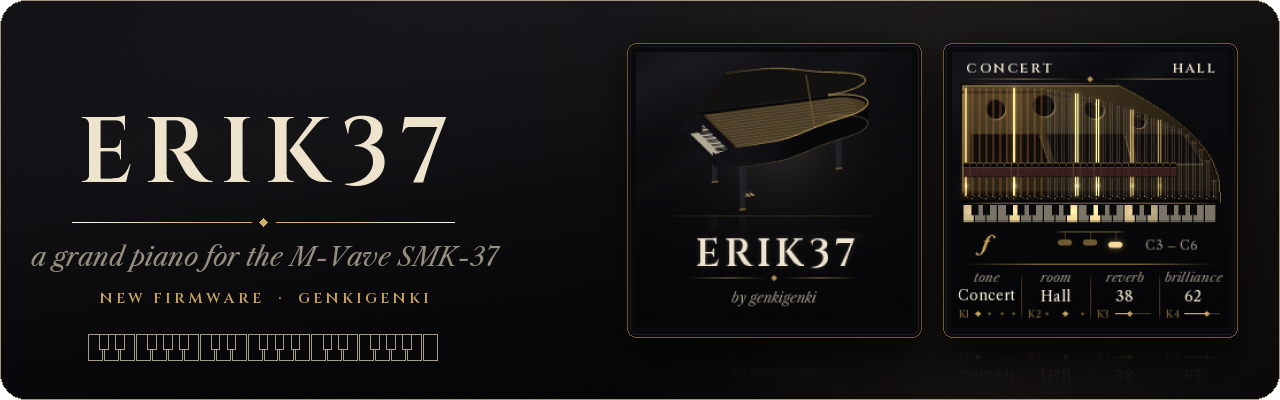
Erik37
A grand piano for the M-Vave SMK-37 (and the FM-1): a sampled concert grand with velocity layers, a key-by-key decay, dampers and their noise, the three pedals, sympathetic string resonance and four rooms. It is its own firmware, built on fm1-base and felucca-bsp.
Status: 1.2, experimental. Played on an SMK-37 Pro. 1.2: the release noise has its own level, SEQ REC is a sustain toggle with its light, only the pedal holds notes by default (the PEDAL jack is read more carefully), a pad light setting, and a cleaner output. The FM-1 build is untested on a unit: feedback welcome. All controls: CONTROLS.md. Video (1.1): https://youtu.be/5yUCB1-OJNE
Install it with the installer at https://genkigenki.github.io/smk37/ (Chrome or Edge), the keyboard on USB.
There is one package per model: SMK-37 Pro (and the Starrykey 37 Play), SMK-37 Elite, MKE-P37 and the FM-1
(erik37-fm1.fwsc). M-Vave's updater takes the stock firmware back at any time.
Playing
| Control | What it does |
|---|---|
| Keys | the piano, with velocity through the touch curve (TONE & TOUCH); C3..C6, OCTAVE- / OCTAVE+ move them by octaves |
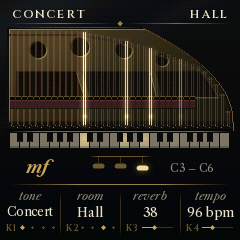
| K1..K4 | the four knobs at the bottom of the screen (below) |
| K5 MASTER | the volume |
| K6..K8 | nothing |
| < / > | the pages: play, TONE & TOUCH, ROOM, PEDALS & PADS, ABOUT |
| PATCH | back to the play screen; held, the audio load and the voices in the header |
| Pads 1-4 | the voices: CONCERT (hall), STUDIO (chamber, brighter), VINTAGE (darker), JAZZ (a small room) |
| Pads 5-16 | the user presets USER 1-12: a tap recalls one; held a second, the sound is saved there ("SAVED USER n") |
| PEDAL jack | sustain; a continuous pedal gives half pedal. Its rest position is learnt once the reading is steady (or set on PEDALS & PADS: open or closed at rest) |
| SEQ REC | sustain on / off (a toggle), its light on while on; the header says SUSTAIN ON |
| CHORD | sostenuto |
| SCALE | una corda (its depth on TONE & TOUCH) |
| Mod wheel | nothing by default; PEDALS & PADS K2: sustain, with half pedal (off at rest and a little above, full near the top) |
| Pitch wheel | pitch bend, +-2 semitones; in tune at rest |
| SEQ PLAY | the metronome (its tempo: K4 on the play screen) |
| BT | save the settings now (they also save themselves once the piano is quiet) |
| FX | every note let go |
| Faders | nothing (every setting is on a knob) |
| USB-MIDI | the keys, pedals and pitch wheel go out (notes, CC 64 / 66 / 67, pitch bend); notes, those pedals and pitch bend come in and play the piano (a note the keys hold is not struck again when the computer echoes it back) |
| OCTAVE- + OCTAVE+ held 5 s | update mode |
SCALE and CHORD: held, the pedal is down while held; a tap latches it (its light on) until the next tap. The sustain is the strongest of the PEDAL jack, SEQ REC, MIDI and (when set) the mod wheel.
| Page | K1 | K2 | K3 | K4 |
|---|---|---|---|---|
| play | tone | room | reverb | tempo |
| TONE & TOUCH | touch curve | brilliance | resonance (down past 0: off) | release noise (0 off .. 100, 40 at first) |
| ROOM | room | size | amount | width |
| PEDALS & PADS | una corda depth | mod wheel (off, sustain) | pedal jack (auto, open, closed) | pad light (45, 60, 80, 100 %) |
| ABOUT | audio load | voices | most voices | xruns |
The play screen is a view into the piano: the strings light up as they sound, the dampers lift. A user preset keeps the tone, room, size, amount, width, brilliance, resonance, release noise, touch curve and una corda depth; the presets survive power-off (in the firmware's own store). The pad lights: a voice dim amber, the one chosen bright gold; a preset pale warm grey when empty, brighter when filled, warm ivory when chosen. The pad light dims the chosen pad to 45 % at the least; the dim levels keep a floor, so each stays visible and apart from the next.
On the FM-1
erik37-fm1.fwsc (identity FM-1_480102) is the same piano for the FM-1's 27 keys (F3..G5, velocity from the keys).
Untested on a unit. It does not run in fm1-emulator yet: the
velocity reads the keys through the chip's converter (rows PA7, PA8 and PA10), and the emulator models only the
converter settings and inputs of the stock firmware (MASTER and PB1), so it stops as soon as the key scan starts
(erik37#2). The SMK-37 packages do not run on an FM-1 or in an FM-1 emulator. Its controls:
| FM-1 | What it does |
|---|---|
| KNOB 1..4 | the page's four knobs (as K1..K4 above; PEDALS has only una corda) |
| SELECT | the pages |
| ALGORITHM | the voices CONCERT, STUDIO, VINTAGE, JAZZ |
| PRESETS | the user presets USER 1-12, recalled as it lands on them |
| SAVE | tap: save the settings; held a second: the sound into the user preset PRESETS points at |
| REC / ENV / SEL | sustain (a toggle) / sostenuto / una corda (held or latched) |
| PLAY, FX, HOME, OCT | as SEQ PLAY, FX, PATCH and OCTAVE on the SMK-37; MASTER the volume |
The sound
- The Salamander Grand Piano V3 (a Yamaha C5): 18 notes across the keyboard in 3 velocity layers, crossfaded in the attack, about 380 KB of block-ADPCM samples (4.25 bits a sample, 22.05 to 32 kHz), looped after the attack.
- Each key's decay is measured from the recording (a fast first decay, then the aftersound), faster in the treble. The top keys have no dampers, as on a grand.
- The brightness follows the velocity and darkens as a note rings. Releasing a key brings the damper down, with its noise (its level on TONE & TOUCH, down to off).
- Sustain with half pedal, sostenuto, una corda (softer and darker, its depth set on TONE & TOUCH).
- Sympathetic resonance: undamped strings ring along while the sustain pedal is down.
- Tones: CONCERT (as recorded), STUDIO (closer, brighter), VINTAGE (darker, the unisons a little apart), JAZZ (round, warm). Rooms: an 8-line FDN reverb, as chamber, hall or church, with a size knob.
- Polyphony: 20 notes, plus room for the ones fading out. The quietest released notes give way first.
- The pitch wheel bends every string (the damper noises stay put), +-2 semitones.
- The phase 1 study (the sample sources, the demos, the engine's prototype) is in
SOURCES.md,LISTEN.mdandtools/.
Building
On Linux or WSL with JieLi's toolchain (base/tools/get_toolchain.sh), the AC79 SDK (for the package's SDK files)
and Python 3 with Pillow and NumPy:
git clone --recursive https://github.com/genkigenki/erik37
./build.sh                          # the four packages into build/erik37/ (and SHA256SUMS), the host simulators
app/tests/run_tests.sh              # the engine, the CPU budget, the flash, the loader, the packages, the screens
app/build/smk37/host/erik37-smk37_host app/tests/screens.txt /tmp/shots   # the simulator: a script, screenshots
app/build/host/erik37_host app/tests/screens-fm1.txt /tmp/shots-fm1       # the FM-1's
base/ is fm1-base (Charles Vestal, MPL-2.0) with felucca-bsp in base/bsp (Leo Kuroshita, MPL-2.0), included here with their SMK-37 board support and two additions for the SMK-37: the keybed's velocity and the PEDAL jack
(plat_keybed_vel, plat_pedal_raw).
Licence
MPL-2.0. The piano samples are the Salamander Grand Piano V3 by Alexander Holm, CC BY 3.0. See LICENSING.md.