DigiTriad
A three-voice rhythmic pitch shifter for the Digitone mk1's audio inputs: three pitched voices from two octaves down to two octaves up, chromatic or in a key and scale from the note a pitch detector hears in what you play, with MICROTUNE, GLIDE and pitch CORRECTION; each voice behind its own division of a delay in time with the Digitone's tempo, in four delay modes (PITCH FEEDBACK, SERIES, DUAL + CROSS, DUAL), with rhythm patterns, HALF SPEED, SWELL, FREEZE and MIDI CCs. DigiTriad is an elekloader mod on fxkit (core-dn1 4.1).
Its MIDI CCs follow the Meris Hedra's published CC chart, so a controller set up for that pedal works with it too. DigiTriad is not affiliated with Meris and uses none of its code.
DIGITRIAD is an entry in core-dn1's Mod Menu (hold a track key). While it is the
active effect, DigiTriad owns the audio engine, as DigiSwarm and DigiPrism do
(fxkit's core_audio owner): the synths are silent, the Digitone's own
effects are off, and what you hear is the inputs through the pedal. NO turns
it off and gives the audio and the screen back. The sequencer keeps running, so PLAY, STOP and
TEMPO still work and the delay can follow the Digitone's tempo. BYPASS
(trig 16) passes the inputs through dry, with the delay's tails.
DigiTriad 0.2 is a beta (a pre-release). It is an effect on fxkit: a MIXER on AMP (the inputs' levels and pans, as loud as the Digitone's own input), two LFOs on the stock LFO page aimed at its controls, p-locks kept in the pattern (RECORD, then hold a trig and turn a control), and MIDI hands the screen to the stock UI for the MIDI tracks while it keeps playing. Presets are gone: the project keeps its controls, mixer and LFOs, and a project saved with 0.1 opens it at its defaults. 0.2 was tested on a Digitone mk1 by its author (built before the effects' rename, which changed only names); it was also checked in digikit's emulator (digiemu) on OS 1.43 and 1.44. Not yet run on a Digitone Keys. Its source is also in elekloader, as mods/digitriad-dn1.
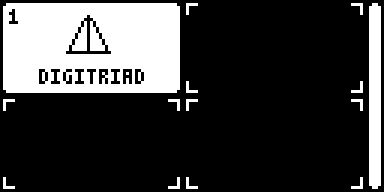
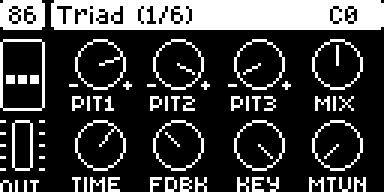
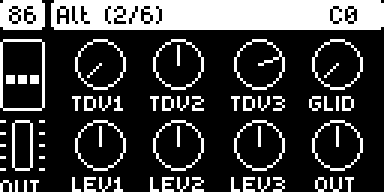
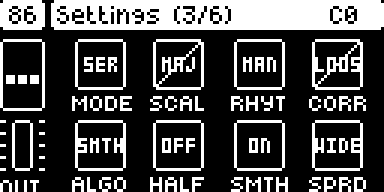
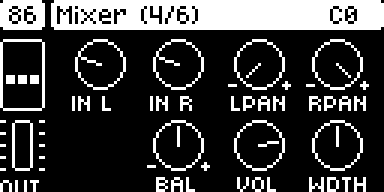
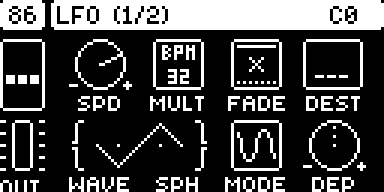
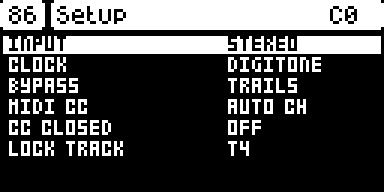
The screenshots are from the emulator, which has no DMA timer 0, so the C
at the top right (the render's share of each block) does not read true
there.
Install
The easiest way is elekloader's web page: tick DigiTriad and the + beside its Needs fxkit; the page takes the core it needs. To build it yourself you need:
- elekloader from its main branch, with Python 3.9 or newer (see
its README). DigiTriad keeps 896 KB of buffers in the
Digitone profile's
bulkarea, which the 0.4.0 app does not know: it refuses DigiTriad. - This mod, fxkit and their core, from
this repository's releases:
digitriad-0.2.elemod,fxkit-0.1.elemodandcore-dn1-4.1.elemodfor OS 1.43, or the three-os1.44files for 1.44. DigiTriad needs core-dn1 4.1 or newer and fxkit; every effect on fxkit (DigiSwarm, DigiPrism, DigiTide, DigiTriad, DigiReel, DigiHoard, DigiHalo) fits in one build with them. - The stock OS file:
Digitone_and_Digitone_Keys_OS1.44.syxor..._OS1.43.syx, from Elektron's Digitone downloads. elekloader recognises the file by its hash.
Build your OS on the command line (or in elekloader's window, run from source: + Install from file... the three files and tick digitriad):
python -m elekloader.patch --stock Digitone_and_Digitone_Keys_OS1.44.syx \
    --mod core-dn1-4.1-os1.44.elemod --mod fxkit-0.1-os1.44.elemod \
    --mod digitriad-0.2-os1.44.elemod \
    --out Digitone_OS1.44-digitriad.syx --version TR02
--version is the 4 characters the unit will show. Flash the .syx with
Elektron Transfer, as for any OS update: connect the unit over USB, select
it in Transfer and Connect, drag the .syx onto Drop files here,
and press YES on the unit. Don't turn it off until the upgrade is done.
Recovery: elekloader never changes the bootloader, so the stock OS
file always restores the unit. Hold FUNC while powering on for the
startup menu, and press TRIG 4 for OS UPGRADE. Then send the stock
.syx with Transfer.
Opening it: hold a track key on its own for the Mod Menu, then pick DIGITRIAD with its trig key (or YES). NO turns it off and gives the synths back.
0.2: on fxkit
From 0.2 DigiTriad is an effect on fxkit (../fxkit-dn1), as every effect in the build is: one at a time is active. Its Mod Menu entry makes it the active effect and opens its page; while it is active it owns the audio, page or no page, and opening another effect's entry hands that one the audio.
| key | on DigiTriad's page |
|---|---|
| SYN1, SYN2, FLTR | its three pages (page 1, 2 and 3) |
| AMP | the MIXER: IN L, IN R (the inputs' levels, as the stock mixer's: 32 unity, up to +24 dB), L PAN, R PAN (where each input sits), BAL, VOL, WDTH (the output's width) |
| LFO | LFO 1, pressed again LFO 2: the stock LFO page (its knobs, WAVE and SPH as one wave, a turned knob's value under it), at the stock rates; turning DEST opens its list (DigiTriad's controls and the mixer's), YES picks, NO closes |
| RECORD | LOCK mode: hold a trig and turn a control, and that step has a p-lock of it (the title bar shows the 16 steps, filled where DigiTriad has a lock); FUNC + a trig clears the step; PAGE the next 16 steps. RECORD again (or NO) leaves it |
| MIDI | the stock UI, for the MIDI tracks and the rest, with DigiTriad playing on; its Mod Menu entry brings the page back |
| NO | DigiTriad off: the synths again |
The p-locks are the pattern's: they are kept in one synth track's lock table
(SETUP's LOCK TRACK, T4 unless you pick another), saved and copied with the
pattern, and play on their steps; that track should play nothing of its own
(no notes, no arpeggiator) in a pattern with DigiTriad's locks, or its trigs go astray. 0.1's presets are gone: the
project keeps DigiTriad's controls, mixer and LFOs (tag DHED, 52 bytes).
The page
DigiTriad's page is drawn like the Digitone's own parameter pages: the tempo in the box at the top left, the page in the title bar (or the state: Freeze, Pitch off, Swell), and on the left the note the detector hears (with a bar under it while it hears one), the three voices (a square each: filled when pitched, hollow while T1 has the pitch off, a dot when the voice is OFF), F, S or H for FREEZE, SWELL and HALF SPEED, B while bypassed, and the output's meter. While you turn a knob the title bar shows its value: PITCH as an interval (+7ST, -OCT, or in a scale +3RD, -5TH, +2OCT), KEY as a note, TIME as the division and its milliseconds. LEFT and RIGHT, or PAGE, move between the three pages; holding FUNC shows page 2. Pushing a knob sets it back to its default.
| Page | Knobs A-D | Knobs E-H |
|---|---|---|
| 1 Triad | PIT1, PIT2, PIT3 (each voice's interval), MIX | TIME (the delay), FDBK (feedback), KEY, MTUN (MICROTUNE) |
| 2 Alt | TDV1, TDV2, TDV3 (each voice's time division), GLID (GLIDE) | LEV1, LEV2, LEV3 (each voice's level), OUT (output level) |
| 3 Settings | MODE (PFB, SER, DX, DUAL), SCAL (the scale), RHYT (a rhythm pattern, or MAN: the TDV knobs), CORR (pitch correction: NONE, LOOS, STRC) | ALGO (CLAS, SMTH), HALF (half speed), SMTH (pitch smoothing), SPRD (WIDE, NARR, MONO) |
| Control | |
|---|---|
| PIT1-3 | -2 octaves .. +2 octaves, OFF at the minimum, unison in the middle, in bands (chromatic, seven-note and pentatonic charts) |
| KEY | in bands, the top CHROMATIC; SCAL on page 3 picks the scale; trig 1-12 set the key C .. B, trig 13 chromatic, trig 14 the next scale |
| MTUN | voice 1 up to 30 cents sharp, voice 2 as flat, voice 3 half of it |
| CORR, GLID | CORR on page 3 and GLID on page 2 (CC 23 does both: correction in its lower half, glide in its upper) |
| MIX, FDBK | the mix; the feedback |
| TDV1-3 | page 2, the time divisions: OFF, a micro range (3-42 ms), 1/6, 1/4, 1/3, 3/8, 1/2, 5/8, 2/3, 3/4, 5/6, 7/8, 1 of the time |
| TAP | trig 15, the tempo (in quarters); or the Digitone's tempo (SETUP's CLOCK); TIME picks the delay as a division of it |
| SWELL | T2 held: a momentary swell; T2 tapped latches it (and CC 31) |
| HALF SPEED | T3, or HALF on page 3 |
| MODE | four delay modes, on page 3 |
| BYPASS, SMTH | trig 16; pitch knob smoothing, SMTH on page 3 |
| Presets | none from 0.2: the project keeps the pedal, and p-locks (RECORD) follow the pattern |
| Expression pedal, MIDI notes setting the voices | not here (see Not yet) |
Track keys
- T1 PITCH: tap to turn the voices' intervals off (they repeat the input at unison, so the delay goes on as a plain rhythmic delay) or back on; hold for a moment's change.
- T2 SWELL: tap to latch the swell, hold for a moment's: each new note starts from silence and fades in over 0.4 s.
- T3 HALF SPEED: tap for half speed: the times double (up to 1 s) and the repeats darken.
- T4 FREEZE: tap to latch, hold for a moment: the delay goes round as it is (no new sound in, nothing fades), the dry carrying on over it.
The voices
Each voice is a pitch shifter on a line of the input (both inputs summed): two (ALGO CLAS, 25 ms grains, the lighter) or three (SMTH, 50 ms grains, the smoother) overlapping heads with Hann windows read the line at the voice's ratio and start a new grain while their window is closed. While the detector hears a pitch, each grain starts a whole number of its periods from the one before, so held notes come out without the comb and warble of a plain shifter; on chords and noise the heads simply overlap, as a plain shifter's do. A voice up reads behind the present so its grain never passes it (on average half a grain times the ratio less one: with SMTH 25 ms an octave up, 38 ms two octaves up, where the grains are shorter; half that with CLAS); a voice down starts each grain at the present (on average 12 ms behind an octave down with SMTH); unison has no latency. Voice 1 is on the left, voice 2 in the centre, voice 3 on the right (SPRD WIDE; NARR closer, MONO all centred).
Diatonic. With KEY on a note, the PITCH knobs count steps of the scale (+3RD is two steps up, +OCT seven, or five in a pentatonic scale), from the note the detector hears: a fixed-point YIN on the voices' input decimated to 12 kHz (a 16 ms frame, its lags spread over 32 blocks: a new pitch every 22 ms, 62 Hz to 2 kHz), with a hysteresis of 0.6 semitones before it calls a new note. The interval is the scale's from that note, so a +3RD over A in C major is a minor third (C) and over C a major one (E). A note outside the scale keeps its offset from the scale note under it. CORRECTION pulls the voices onto the scale's exact pitches when you play out of tune: NONE keeps your intonation, LOOS halves the error, STRC removes it. The scales: Major, Minor, Melodic Minor, Harmonic Minor, Double Harmonic, Lydian Pentatonic and Minor Pentatonic. Diatonic harmonies need one note at a time; for chords and pads use CHROMATIC (KEY at the top).
GLIDE slides each voice to a new interval, from at once (0) to a time constant of 2 s; with SMTH (pitch smoothing) on, changes take 25 ms at least, so turning a PITCH knob sweeps; off, they step.
The delay
TIME is the main delay: with CLOCK on DIGITONE (or TAP) a division of the tempo (1/16, 1/8T, 1/8, 1/8D, 1/4, 1/4D, 1/2), halved until it fits (520 ms in the series modes, 260 ms in the dual ones; HALF SPEED doubles both); on FREE, 20 to 520 ms. Each voice sits behind its own division of TIME (TDV1-3, or the RHYTHM pattern), and the repeats come every TIME after it. Turning TIME or a division bends the repeats as a tape's would (half a frame a frame at most).
| MODE | |
|---|---|
| PFB (series + pitch feedback) | one line; the repeats go back through the pitch shifters, so each climbs (or falls) by the voices' intervals again: +7 makes a stack of fifths. A repeat comes every TIME plus its voice's division |
| SER (series) | one line repeating the three voices every TIME, centred, unpitched |
| DX (dual + cross feedback) | a line a side, 260 ms at most; each side's repeats go to the other (ping-pong) |
| DUAL | a line a side, each repeating its own side |
| RHYTHM | the three voices' divisions of TIME |
|---|---|
| MAN | TDV1-3 (page 2) |
| NONE | all at once |
| STR8 | 1/4, 1/2, 3/4 |
| TRIP | 1/3, 2/3, 1 |
| DOTD | 3/8, 3/4, 1 |
| SWNG | 1/3, 1/2, 5/6 |
| GALP | 1/6, 1/3, 1/2 |
| CASC | 1/4, 5/8, 1 |
FDBK goes to 98% at the top; the repeats darken (7 kHz, 3.5 kHz at half speed) and a soft limit in the loop keeps them bounded. In PFB the feedback is shared between the voices that are on.
MIDI
DigiTriad takes its MIDI CCs (the chart below) that come on the
Digitone's auto channel (MIDI CONFIG > CHANNELS > AUTO CHANNEL), through
core-dn1's ev_midi_cc, while its page is open; with SETUP's CC CLOSED on,
also while it is closed, and with MIDI CC on ANY CH on a track's channel too.
The Digitone does not apply a CC DigiTriad takes; every other CC goes on to
the Digitone. MIDI CONFIG > PORT CONFIG > INPUT FROM has to let them in.
| CC | CC | ||
|---|---|---|---|
| 9 | HALF SPEED: off below 64, on from 64 | 22 | SCALE: Major 0-11, Minor 12-37, Melodic 38-58, Harmonic 59-78, Double Harmonic 79-97, Lydian Pentatonic 98-119, Minor Pentatonic 120-127 |
| 14 | bypassed below 64, on from 64 | 23 | CORRECTION (0-63: NONE, LOOSE, STRICT by thirds; GLIDE off) and GLIDE (64-127) |
| 15 | TIME | 24 | FEEDBACK |
| 16 | KEY (in bands; 120-127 chromatic) | 25-27 | TIME DIVISION 1-3 |
| 17 | MICROTUNE | 28 | TAP (at 127) |
| 18 | MIX | 29 | MODE: PITCH FEEDBACK 0-31, SERIES 32-63, DUAL + CROSS 64-95, DUAL 96-127 |
| 19-21 | PITCH 1-3 | 30 | PITCH SMOOTHING: off below 64 |
| 31 | SWELL: off below 64 |
CC 4 (an expression pedal) and program changes (presets) are not mapped: there is no expression morph here, and core-dn1 passes mods the CCs only.
How it works
The render (dsp.c) runs at interrupt level in core-dn1's render, on each
block of 32 frames: the voices' input (the inputs, with PFB's repeats, and
SWELL's gain) onto its line, the detector's next lags, the three voices,
the delay as MODE has it, MIX against the dry, OUTPUT LEVEL and a soft clip.
Everything is fixed point in C: samples are 16-bit with 6 dB of headroom,
and the lines hold them at half scale. The UI (ui.c) runs in the
Digitone's UI task.
- Memory: the voices' line (1.4 s mono), the delay's (1.4 s stereo) and the
detector's 4 KB: 388 KB of DigiTriad's 896 KB region in the profile's
bulkarea, cleared in two ticks the first time; the code and its state take 25.6 KB of the 128 KB mods share. - CPU: in digikit's emulator, with plucks on the inputs: see Checked. The detector costs the same in every mode (it also aligns the grains); SMTH costs a third more than CLAS. A guard times the whole render on DMA timer 0 every block, and if the unit stays over 93% for 0.2 s it bypasses the pedal at once (no trails) and says so in the title ("CPU full: bypassed"); BYPASS turns it back on.
- Project data: DigiTriad's controls, its latches and SETUP, with fxkit's mixer and LFOs
(
fx_pack), are saved with the project (tagDHED, 52 bytes; mods share 480 there, and the seven effects, GAIN and fxkit take about 470). The p-locks are the pattern's.
Build
With the SDK and a stock OS file:
python -m elekloader.sdk.build . --stock Digitone_and_Digitone_Keys_OS1.43.syx   # out/digitriad-0.2.elemod
python -m elekloader.sdk.build . --stock Digitone_and_Digitone_Keys_OS1.44.syx   # out/digitriad-0.2-os1.44.elemod
It names no firmware address, so its 1.44 port is empty. It needs fxkit and core-dn1
4.1. gentables.py makes tables.h (the PITCH, KEY and time
division charts are there as tables).
Checked
In digikit's emulator, OS 1.43 and 1.44, and with the render's own code
compiled for a computer and fed test signals (tests.sh):
-
On a unit: tested on a Digitone mk1 by its author: it loads and works as expected. It is still a beta.
-
The firmware. A build with the released core-dn1 3.2 and DigiTriad passes every stage of the emulator's check against stock on 1.43 and 1.44, with every screen identical.
-
The page and the keys (1.43): the Mod Menu entry, the three pages, SETUP, a knob turned and its value in the title, a preset saved as P5 and recalled, T1-T4 tapped (each latch on: PITCH off, SWELL, HALF SPEED, FREEZE, the left column showing them) and tapped again (off), T4 held (a moment's FREEZE), trig 3 (KEY D), trig 13 (CHROMATIC), trig 14 (the next scale), page 3's MODE turned to PITCH FEEDBACK, BYPASS, NO (the synths back, the owner off), as screenshots and as the state DigiTriad keeps.
-
MIDI (1.43): each kind of CC in the chart on the auto channel (PITCH, KEY, MIX, FEEDBACK, a TIME DIVISION, SCALE's bands, CC 23's CORRECTION and GLIDE halves, MODE's bands, HALF SPEED, SWELL, PITCH SMOOTHING, bypass and on) set DigiTriad and stopped at core's site; a CC outside the chart went on.
-
Pitch (a 440 Hz sine, all wet, by zero crossings): chromatic +7 659.2 Hz (659.3), -12 219.8 (220.0), +24 1760.5 (1760.0), -24 109.8 (110.0), +19 1318.8 (1318.5), unison 440.0, MICROTUNE at the top 670.8 (+7 and 30 cents: 670.8). Diatonic, KEY C major, +3RD: A in 523.0 (C, 523.3), E in 392.0 (G, 392.0), B in 587.0 (D, 587.3); -5TH from A 293.5 (D, 293.7); KEY A minor, melodic and harmonic minor and minor pentatonic from A 522.8 (C); double harmonic, E +2ND 349.0 (F, 349.2); lydian pentatonic, C '+3' 369.8 (F#, 370.0). CORRECTION with a 445 Hz input (20 cents sharp), C major +3RD: NONE 529.2 (529.2), LOOSE 526.0, STRICT 523.0 (523.3). The detected note reads A4 = 57.01 semitones over C0.
-
Level: every interval from -2 to +2 octaves, both algorithms, holds the input's level within 0.1 dB from 50 ms on (a steady sine).
-
GLIDE, pitch smoothing on and off (no step above a sine's own), T1's PITCH off (440 out, latched and held).
-
The delay (an impulse; the repeats' times): SERIES, a voice on 1/2 of a 500 ms TIME, at 250 ms and then every 500 ms on both sides; three voices on 1/4, 1/2, 3/4 at 125, 250 and 375 ms, left, centre and right; DUAL every 250 ms on its side; DUAL + CROSS alternating sides every 250 ms; PITCH FEEDBACK every TIME plus the division; HALF SPEED twice the times; FREE TIME; the micro division (21 ms); each RHYTHM pattern's three times.
-
PITCH FEEDBACK (a pluck at 220 Hz, +7): repeats at 330, 494, 740, 1110 and 1670 Hz, both algorithms.
-
Feedback at the top in every mode, with plucks for 10 s: bounded (-22 to -14 dBFS rms, no growth). FREEZE (latched, held, in PFB and DUAL + CROSS) holds the level, then decays when let go. SWELL, latched and held; SPREAD; chords, noise; BYPASS with and without TRAILS; the CPU guard's trip (95% sustained).
-
CPU on the emulator's cycle clock: with plucks on the inputs and the synths muted (the Digitone's own render about 17%), the whole render 43.4% of a block at the defaults (three voices, SMTH, SERIES, chromatic), 43.9% in a key, 44.5% at the heaviest tried (PITCH FEEDBACK, SMTH, three voices, a key, feedback up; its worst block 47.7%), so DigiTriad itself takes about 27%. Closed, the stock render again.
Not yet
- MIDI notes setting the voices (tuning them to notes played on a keyboard): core-dn1 passes mods the CCs only.
- An expression pedal's morph between two settings, and 16 presets (the project keeps one).
- Which scale "Double Harmonic" is: the name comes without its notes; DigiTriad uses the double harmonic major (1, b2, 3, 4, 5, b6, 7).
- PFB's repeat time (TIME plus the voice's division) is this mod's reading of repeats recycled through the pitch shifters.
Licence
GPL-2.0-or-later, as the rest of elekloader (LICENSE).