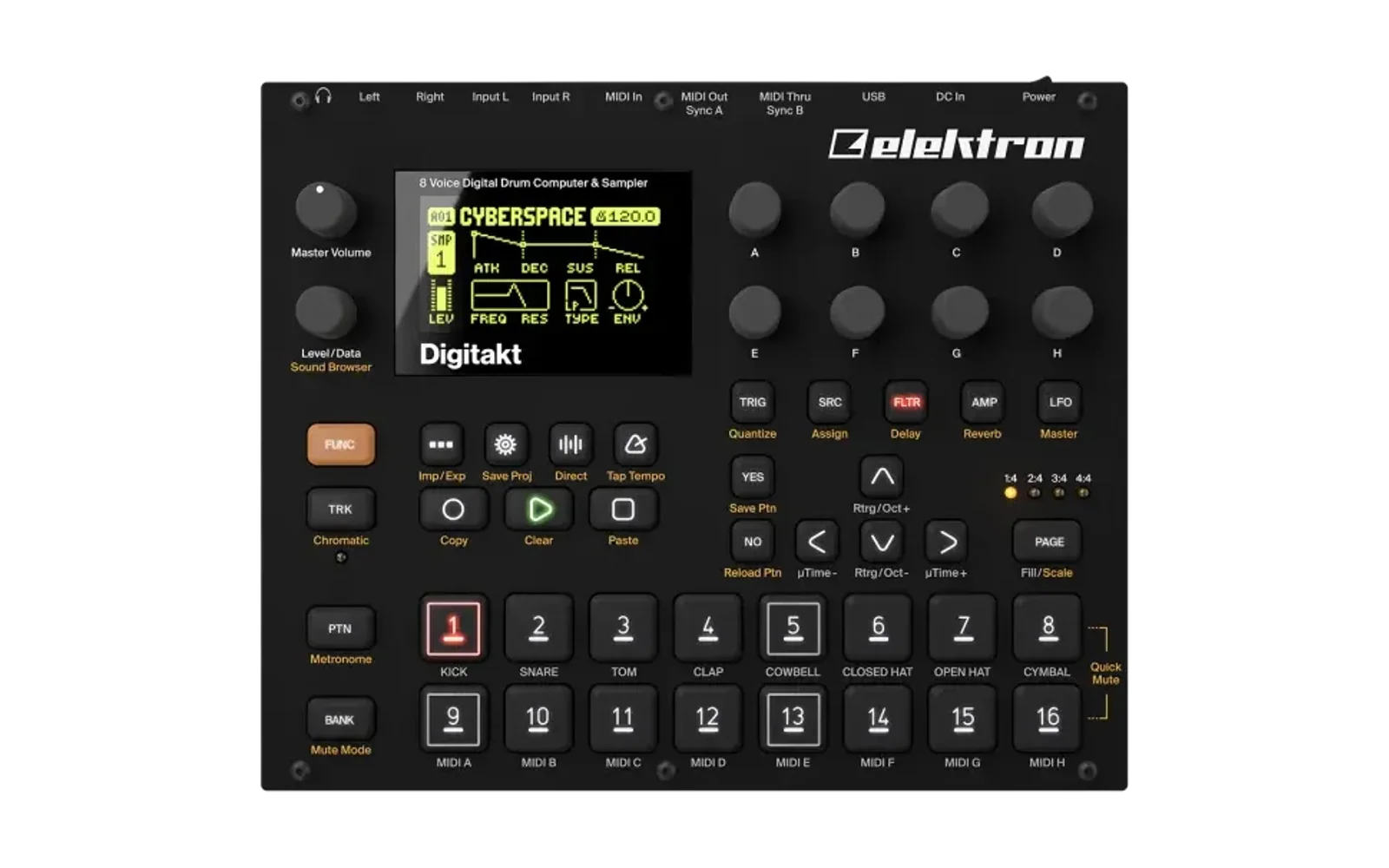
STRING for Digitakt
STRING is a Karplus-Strong plucked string SRC machine for the original Digitakt (Mk1), OS 1.53 and 1.54. It is an elekloader mod: a new machine in the SRC menu whose audio goes through the Digitakt's regular AMP, filter, mixer and effects path, like any stock machine.
Website, with a demo you can listen to: alez22.github.io/digistring
Get the current .elemod files and release notes from the
v0.8.0 release.
From 0.9.0 STRING is built on machine-pages, the shared framework that draws the SRC and LFO pages of added machines and gives them a place in the render. STRING patches no firmware bytes itself, so it combines with the other machines built on machine-pages, such as RAM Machines. machine-pages, and so STRING 0.9.0, cannot be installed with digichain, which owns the same places; digimono and digipoly need digichain. Use STRING 0.8.0 if you need those.
USE AT YOUR OWN RISK. This modifies your instrument's firmware. Back up your projects and sounds, and keep your stock OS file for recovery.
Controls
STRING stores its values in SLICE's eight parameter slots, so they are saved, p-lockable and reachable by MIDI CC/NRPN like any stock parameter. Each control has STRING's own range and default.
| SRC knob | Control | Range | Default | What it does |
|---|---|---|---|---|
| A | TUNE | stock | 0 | Pitch |
| B | EXC | 4 icons | PLUCK | Exciter: BOW, HIT (mallet), NOISE, PLUCK |
| C | STIFF | 0–127 | 0 | Stiffness: from an ideal string to a bell-like, inharmonic tone |
| D | – | – | – | Blank: STRING plays no sample |
| E | POS | OFF, 1–64 | OFF | Pluck position, from the bridge to the middle of the string |
| F | SOFT | 0–127 | 0 | Darker, softer attack |
| G | TONE | 0–4 | 0 | Damping inside the string: 0 warm, 3 bright, 4 open and metallic |
| H | DECAY | 0–127 | 100 | How long the string itself rings: 0.07 s to about 17 s, endless at the top |
- EXC is drawn as an icon instead of a knob. BOW keeps exciting the string for as long as the note is held; the other three are one-shot.
- The AMP page controls the note envelope as usual. DECAY sets how long the string resonates; the AMP decides how long you hear it.
- DECAY is a time (T60, the time to fall by 60 dB): the same setting rings as long on a low note as on a high one.
- TONE is a lowpass inside the string whose cutoff follows the note, so a setting sounds alike across the keyboard. As in Rings, the cutoff also rises with DECAY: long notes stay bright, and darker TONE settings shorten high notes somewhat. On high notes with a long DECAY the filter opens completely, so TONE 3 and 4 can sound the same there.
- Retriggering a ringing string plucks it again: the new excitation adds to the vibration, as on a real string.
- Pitch: an untransposed note plays C4 at 261.6 Hz, and the keyboard follows equal temperament up to about 12 kHz.
- Low notes: below F#1 (47 Hz) the string no longer fits its delay line and runs at a lower internal rate instead, down to about 1.5 Hz, without octave jumps.
- STIFF keeps the fundamental in tune up to about 880 Hz. Above that, high STIFF values make very high notes slightly sharp (about +8 cents at 1760 Hz).
- LFO destinations show STRING's names, grouped as
STRG.
Install: no compiler required
You need only the prebuilt STRING mod for your OS,
elekloader, and your
own stock Digitakt Mk1 .syx. You do not need ColdFire tools, Python or a
source checkout.
| Your OS | STRING | STRING-fast (below) |
|---|---|---|
| 1.53 | digistring-0.8.0.elemod | digistring-fast-0.8.0.elemod |
| 1.54 | digistring-0.8.0-os1.54.elemod | digistring-fast-0.8.0-os1.54.elemod |
- In elekloader, select your stock OS with Change stock firmware.
- Choose Install from file and select the
.elemodfor your OS. Enable STRING; core 2.1 must be enabled with it. Other mods can be enabled too. - Set the four-character OS version, then choose Build Firmware and
save the generated
.syx. - Send that
.syxto the Digitakt with Elektron Transfer. Do not power off during the update.
The .elemod holds only this project's code, not Elektron's firmware.
Neither the stock nor the modified OS file belongs in this repository.
STRING-fast: more tracks with FAST AUDIO
STRING-fast is the same machine, same sound and controls, for people who also run digihealth. While digihealth's FAST AUDIO is on, STRING's per-sample loop runs from the Digitakt's fast on-chip memory; when it is off, STRING runs as usual.
On one Digitakt, five STRING tracks played without crackles at about 95% DSP load with FAST AUDIO on, on OS 1.53 and on 1.54.
- Install either STRING or STRING-fast, not both: elekloader refuses the pair.
- STRING-fast needs digihealth (GPL, not part of this project). Two
builds exist:
- digihealth 1.0.1 from Sophie's repository: a diagnostic build where FAST AUDIO starts off; switch it on in SETTINGS > FAST AUDIO.
- the original irpina/digihealth, where FAST AUDIO switches itself on after boot.
- FAST AUDIO copies OS code into on-chip memory the OS does not use; digihealth checks the copies and falls back if anything overwrites them. Treat it, like the rest, as use at your own risk.
Install it as above, choosing the STRING-fast .elemod for your OS (see
the table) and also enabling digihealth.
Build from source (developers only)
You need Python 3.9+, a source checkout of elekloader, the ColdFire cross toolchain and your stock OS 1.53 or 1.54 file. On Debian or Ubuntu:
sudo apt install binutils-m68k-linux-gnu gcc-m68k-linux-gnu
Test and cross-compile from this repository:
make test          # DSP and UI tests on the host
make cross-check   # compile for the Digitakt's ColdFire (MCF54418; built with -mcpu=54455, same ISA)
Build the mod, check it against your stock OS and write a firmware, from the elekloader checkout:
STOCK=/path/to/Digitakt_OS1.53.syx
python3 -m elekloader.sdk.build mods/core --stock $STOCK
python3 -m elekloader.sdk.build mods/machine-pages --stock $STOCK
python3 -m elekloader.sdk.build /path/to/digistring --stock $STOCK
# The .elemod files the three builds wrote:
CORE=mods/core/out/core-<version>.elemod
PAGES=mods/machine-pages/out/machine-pages-<version>.elemod
STRING=/path/to/digistring/out/digistring-0.9.0.elemod
python3 -m elekloader.lint $STRING --stock $STOCK --with $CORE --with $PAGES
python3 -m elekloader.patch --stock $STOCK \
    --mod $CORE --mod $PAGES --mod $STRING \
    --out Digitakt_OS1.53_STRING.syx --version K005
For OS 1.54, build from the 1.54 stock file: the SDK picks each
mod.json's 1.54 port and writes -os1.54 files, such as
digistring-0.9.0-os1.54.elemod; use those together.
Add --mod lines (and the same files as --with to lint) for Sophie,
digihealth or any other mod to build them into the same firmware; lint
exits 0 only when the whole set links. STRING-fast is built from
variants/fast, whose mod.json compiles the same sources with
-DKS_FAST; it needs digihealth in the firmware.
How it works
| File | Role |
|---|---|
karplus.c | Fixed-point Karplus-Strong engine at 48 kHz: delay line, fractional allpass tuning, note-tracking lowpass, stiffness allpasses, T60 decay, exciters, sleep |
digitakt.c | OS 1.53/1.54 adapter: reads pitch, controls, triggers and AMP state, renders each STRING track into its source buffer |
ui.c | Machine descriptor, menu icon and the SRC page machine-pages draws: names, ranges, defaults, value texts, EXC icons, LFO group |
cm_ui.h | The machine-pages page layout STRING uses (MIT) |
ks_loop.inc | The per-sample loop; STRING-fast compiles it a second time into .fast |
variants/fast/ | STRING-fast's manifest: same sources, -DKS_FAST, needs digihealth |
scripts/gen_tables.py | Generates ks_tables.inc (allpass coefficients) |
scripts/gen_icons.py | Generates ks_icons.inc from ASCII-art icons |
- Audio: STRING renders from machine-pages'
ev_render_voicesevent (order 20), right after the stock playback and before the buffers reach AMP and filter. Each STRING track gets 32 samples per block. - Memory: each track's delay line is 2 KB, all statically allocated: about 17 KB of RAM in total, small enough to share elekloader's 128 KB mod RAM with large mods such as digislicer.
- CPU: the per-sample loop has no divides. digihealth's DSP readout shows the load on the instrument; see STRING-fast above for a measurement.
- Pages and ranges: machine-pages owns the SRC page, LFO page and
range lookups once, and answers them from the
cm_uipage that STRING's descriptor points to. The engine still clamps every value itself.
To change the EXC icons, edit the ASCII art in scripts/gen_icons.py and
run python3 scripts/gen_icons.py > ks_icons.inc.
All addresses are for Digitakt Mk1 OS 1.53 and 1.54. Five of STRING's
firmware addresses differ in 1.54 (the AMP state, the pitch table, the
Bitmap vtable and the blit routine). mod.json's 1.54 port builds the
sources with -DDIGISTRING_OS154, which picks them; the 1.53 build is
unchanged.
Credits and license
STRING is MIT licensed. DECAY's T60 curve, TONE's note-tracking cutoff and the slower loop for very low notes follow the String model of Mutable Instruments Rings by Emilie Gillet (MIT), rewritten in fixed point. The Digitakt RAM addresses, the pitch lookup and the SRC page hooking approach come from Sophie for Digitakt by soejrd (MIT), and the machine slots from elekloader's core mod. STRING is independent of, and not endorsed by, Elektron. It contains no Elektron firmware or samples.