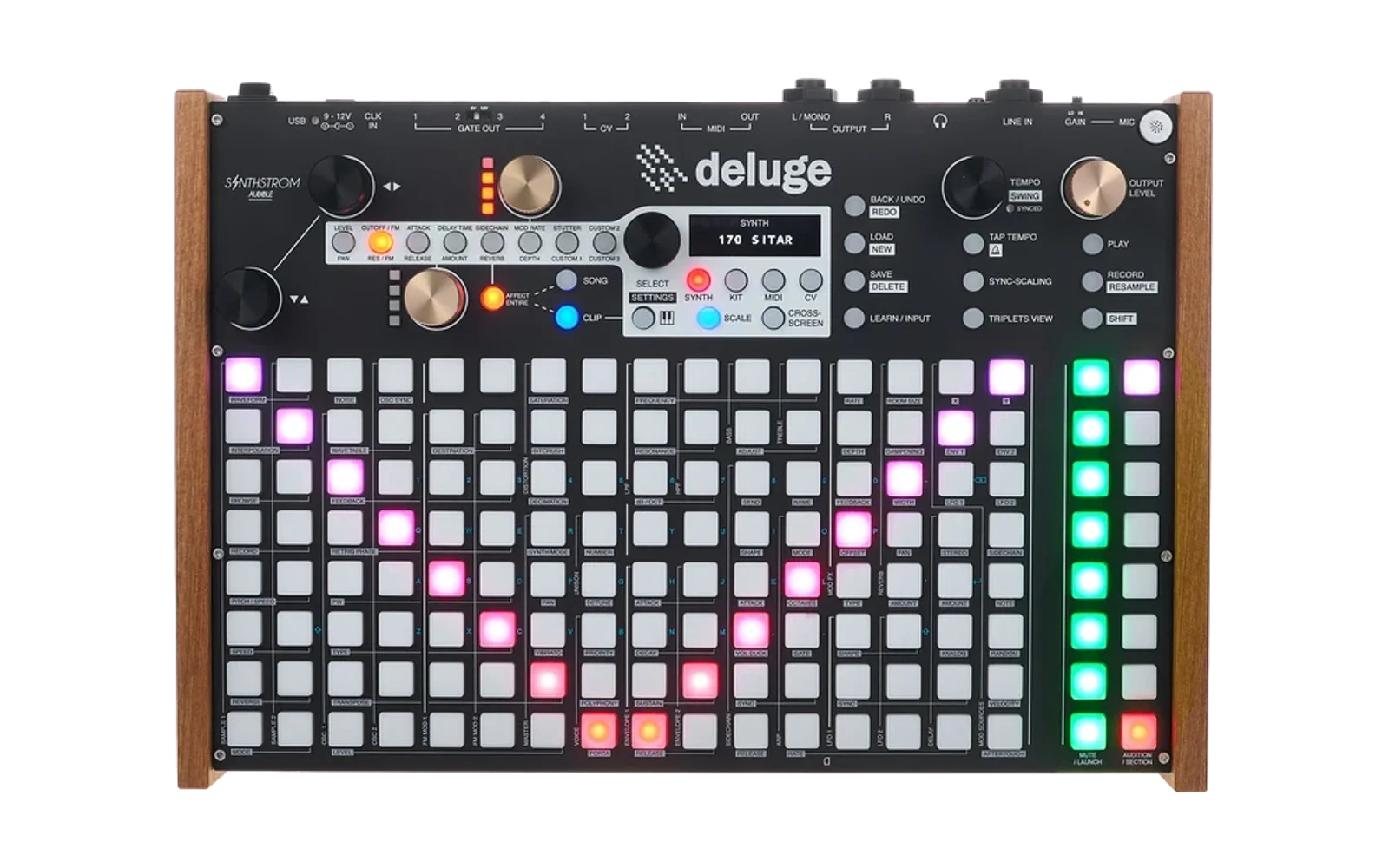
DelugePal
Write music for the Synthstrom Deluge by describing it in words, and load it onto the device over USB — no SD card shuffling.
prompt  →  library  →  XML  →  SysEx  →  you open it and listen
                                              ↓
        reload as        ←   edit   ←   "the bass is too static"
        a new version         ↑
                    RE-DOWNLOAD from the Deluge before touching it
Target firmware: community 1.3.0-beta (build 2d7cdf8, 2026-08-12). It does
not support, and does not try to support, the official firmware.
Language. This README is in English; the documentation and the library API are in Italian. See Language for what that means in practice and for what is already bilingual.
What actually works
Everything below has been verified on the device, not merely produced as a file that parses. That distinction is the spine of this project: a Deluge song can be flawless XML, round-trip byte-for-byte, and still fail to load — or load and be invisible.
| Read and rewrite | byte-exact round-trip, both surgically and by rebuilding from learned format rules |
| Tempo, notes, clips | changing the tempo of an 8577-line song touches exactly 2 lines |
| Writing over USB | songs deposited into SONGS/ with the Deluge powered on, ~60 kB/s, hash-verified by read-back |
| Instruments from scratch | a synth or kit instantiated from the device's empty preset, with oscillators, FM, filters, envelopes and modulation all designed programmatically |
| Synthesised drum kits | a kit drum is a full <sound> node, so drums can be built from oscillators and noise instead of samples |
| Modulation | patch cables — lfo1 → lpfFrequency for a wobble, lfo1 → pitch for a dub siren, envelope2 → oscAPitch for a kick's pitch drop |
| Automation | parameter curves, in the firmware's own packed format, decoded |
| Arranger | clip instances placed on instrument tracks, including "white" (detached) clips |
| Removing and transforming | delete a track or just a stretch of it; transpose chromatically or diatonically; half and double time |
| MIDI import | dependency-free Standard MIDI File reader, validated note-for-note against mido |
Run python tests/test_all.py for the authoritative count. Tests that need a
corpus of Deluge songs skip cleanly when that private material is absent — see
Bring your own corpus.
Feature coverage
The table above describes the proven core workflow, not every feature of the
Deluge. The canonical capability matrix is
docs/COPERTURA_DELUGE.md. It tracks each feature
separately across reading, lossless preservation, authoring and verification
on the device, and assigns a priority and next experiment to every gap.
The regression suite validates the structure of that matrix. A high test count therefore means the implemented behavior is well protected; it does not mean that all Deluge features are implemented.
The constraint that shaped everything
The Deluge firmware does not write valid XML. 255 songs out of 378 are rejected by a conforming parser:
&is never escaped — confirmed in the firmware source, wherewriteAttributeescapes nothing, ever- duplicated attribute blocks on
<audioClip> - a legacy format with two root elements
So xml.etree is unusable, and this project has a tolerant parser written for
the job that keeps byte offsets into the source. Because of that an unmodified
node is re-emitted by copying its original bytes, which is what makes
surgical edits possible and provable.
The formatting table — which attributes go inline and which get their own line — is learned from a corpus rather than derived from rules. That is not a shortcut: the firmware source shows formatting is a boolean decided at each individual call site, so there is no rule to find.
The method
Three levels, and confusing them is how this project has repeatedly hurt itself:
Documentation says what should be true. Files say how it is written. Only the device says whether it works.
There is a second ordering, for where to look first, and it runs the other way:
1. community docs → 2. official guidebook → 3. firmware source → 4. local files
Local files are the last place to look, not the first. Starting there is
reverse engineering without a model, and it has produced — all documented in
docs/ — statistical analysis of things explained in one sentence of the
manual, four consecutive wrong models of clip-view scrolling that every test
agreed with, and a demolished hypothesis about MIDI rows inside kits.
Search top-down. Decide bottom-up.
A corollary learned the hard way: a corpus of songs is not a specification. A feature absent from someone's songs is usually absent because they never used it, not because the firmware lacks it. The firmware's own parameter enum lists 56 modulation destinations; the corpus that taught this project used 37.
Quick start
Python 3.13. The library itself has no dependencies.
python tests/test_all.py
Describe a song in musical terms:
python tools/dsong.py info yoursong.XML
tools/delugexml/musica.py is the layer a language model is meant to call. It
never writes XML itself — it calls library functions that are covered by tests:
from delugexml import parse_file, musica as MU

doc = parse_file('yoursong.XML')
print(MU.racconta(doc))                       # describe it in words

MU.scrivi(doc, clip, MU.passi('x...x...x...x...'), dove='KICK')
MU.scrivi(doc, clip, MU.melodia('re2 fa2 la2', durata='1/8'))
MU.trasponi(doc, clip, gradi=1)
MU.togli(doc, strumento)

assert not MU.verifica(doc)     # the gate: nothing is uploaded if this fails
verifica() blocks; avvertenze() informs. Nothing reaches the device
while verifica() is non-empty. It has already stopped files the Deluge
rejected, one of them with a crash.
Talking to the device needs mido and python-rtmidi in a virtualenv:
python -m venv .venv
.venv/bin/python tools/dsysex.py --in "Deluge 0" --out "Deluge 1" get /SONGS/YOURSONG.XML out/YOURSONG.XML
put refuses to overwrite, and always verifies by reading back: on a channel
that loses messages, a transfer is not assumed good without proof.
Bring your own corpus
refs/ and corpus_versions/ are nearly empty here on purpose. They held
around 130 songs written by the author's device, plus presets from paid sample
packs — neither is ours to publish. out/format_table.json is a derived
artefact and contains no musical content, so it ships.
This is not only a precaution. It is how the project is meant to work: the format table is learned from the corpus you have, and the corpus that matters is your own.
To populate it, copy from your SD card:
refs/songs/       songs written by your Deluge  — this is what most tests need
refs/kits/        kit presets
refs/synths/      synth presets
refs/synths/TEMPL.XML is included: it is the device's empty synth — two
square oscillators, filter wide open, effects at zero — which is firmware
defaults rather than anyone's sound design. It is the chassis every generated
instrument is built from.
Tests that need material you have not supplied print SKIP with the reason.
They are not failures.
Turn on the push guard
A Deluge song embeds the full parameters of every instrument it uses, so
publishing one publishes the paid presets inside it. .gitignore is
deny-by-default, but it only looks forward: a file added and later removed
stays in the history. hooks/pre-push refuses a push whose history would
carry corpus material, checking every commit in the range and not just the tip.
Git does not install it for you — it runs the hooks in .git/hooks/, which is
not versioned. One line, once per clone:
git config core.hooksPath hooks
If you know what you are doing, git push --no-verify bypasses it.
Language
The documentation and the API are Italian, and translation is not currently planned. The prose alone is around 50 000 words, and the Python docstrings are essays about why something is the way it is rather than descriptions of arguments — that reasoning is the most valuable thing in the repository and the most expensive to move.
What is already bilingual is the part you are most likely to touch: the musical vocabulary. Note names work in either language, with sharps and flats.
MU.altezza('re2')  == MU.altezza('D2')
MU.altezza('sib3') == MU.altezza('Bb3')
A glossary, if you want to read the source:
| Italian | English |
|---|---|
altezza | pitch |
passi | steps — a drum pattern, one character per sixteenth |
melodia, accordi | melody, chords |
scrivi, togli | write, remove |
trasponi, sposta | transpose, shift in time |
verifica, avvertenze | the gate (blocks), warnings (inform) |
racconta | describe in words |
destinazione, origine | where to save, where to read from |
Layout
tools/delugexml/      the library
  parser.py           tolerant parser, keeps byte offsets into the source
  writer.py           serializer + format table learned from a corpus
  notes.py            note blob encoding
  song.py             tempo, clips, notes, scales, scroll geometry
  sound.py            sound parameters and patch cables
  structure.py        synthesis structure, rejecting values never observed
  automation.py       parameter automation codec
  kit.py              kits and drums
  arranger.py         clip instances on the timeline
  midi.py             Standard MIDI File reader, no dependencies
  musica.py           the natural-language layer
tools/dsong.py        CLI
tools/dsysex.py       SysEx client: ping, get, put
docs/                 the reasoning, with numbers and proofs
tests/test_all.py     regression suite
Reading order, all Italian:
docs/ARCHITETTURA.md— the conceptual model, from the official guidebookdocs/FINDINGS.md— the schema derived from real files, with countsdocs/SYSEX.md— the USB MIDI channeldocs/MUSICA.md— composition knowledge, by genreHANDOFF.md— current state and what to do next
Known limits
The complete and current inventory is
docs/COPERTURA_DELUGE.md; the bullets below are
only the small set of format cautions worth seeing during onboarding.
- The corpus teaches only what it contains. An element never seen falls back to a heuristic, which has always worked in leave-one-out testing but is not guaranteed.
previewis a cached thumbnail and is not recomputed on load, so generated songs show the wrong picture in the file browser until the device re-saves.- Open questions remain: what
inKeyScrollOffsetanddrumsScrollOffsetactually govern, and the section colour table. Independent note-row length is generated and verified on the device with 5/7/11-step cycles. Euclidean rows are now generated with the firmware's exact distribution formula;EUCLID01has transferred to and back from the Deluge byte-identically and the generated 5/16, 4/13 and 7/11 rows were confirmed working. The device re-saveEUCLID01 2preserves every cycle, note position, duration and velocity exactly. - A green test suite is not a substitute for listening. Four successive wrong models of clip-view geometry were each covered by passing tests, because a test written by someone holding a wrong idea confirms the wrong idea. They were only caught by looking at the device's screen.
Licence
GPL-3.0 — see LICENSE.
Credits
The Deluge is made by Synthstrom Audible. This project is not affiliated with them and learns the community firmware's file format by observation. Built with Claude Code.
Musical corpora
The measured musical knowledge in docs/MUSICA.md and docs/repertori/ is
derived from two datasets. Neither is redistributed here — they live outside the
repository — but the numbers derived from them are published, which is what
the attribution is for. How each licence was read, and the one clause that
differs between them, is in docs/FONTI.md.
Groove MIDI Dataset — CC BY 4.0. Source of the velocity scale and the groove templates.
Jon Gillick, Adam Roberts, Jesse Engel, Douglas Eck, and David Bamman. "Learning to Groove with Inverse Sequence Transformations." International Conference on Machine Learning (ICML), 2019. https://magenta.tensorflow.org/datasets/groove
Weimar Jazz Database (WJazzD) v2.1 — The Jazzomat Research Project (c) 2012-2017. Database under ODbL 1.0, individual contents under DbCL 1.0. Source of the measured swing and the harmonic grids.
Pfleiderer, Martin; Frieler, Klaus; Abeßer, Jakob; Zaddach, Wolf-Georg; Burkhart, Benjamin (eds.) (2017): Inside the Jazzomat — New Perspectives for Jazz Research. Schott Campus. https://jazzomat.hfm-weimar.de/