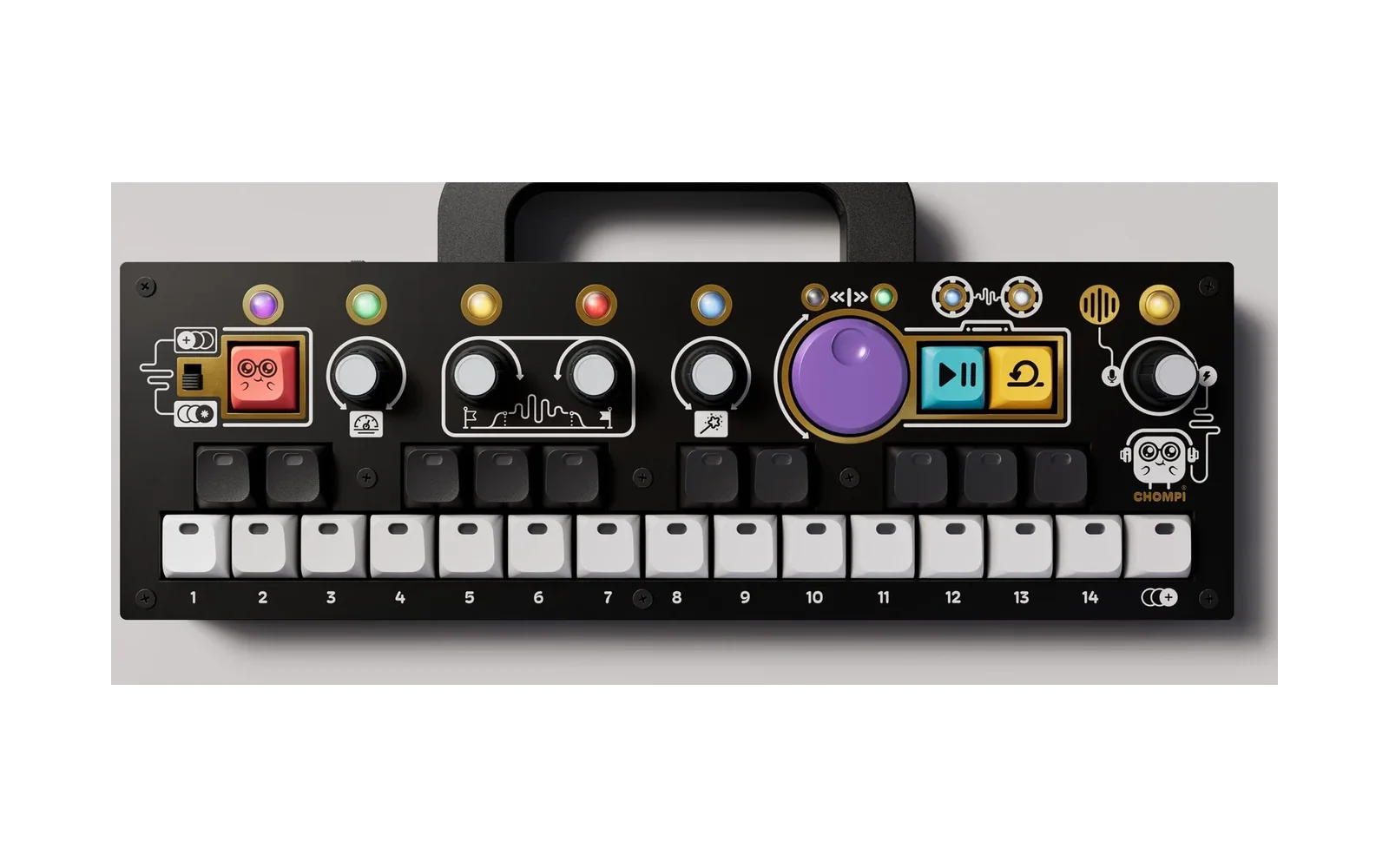
CHOMPI-PIPES (chompi-pipes)
Polyphonic organ firmware for the CHOMPI hardware: 6 voices x 4 pipe registrations (8', 4', 2 2/3', 2') with per-pipe levels, per-pipe tonewheel-style Character, Hammond-style percussion on the Play/Pause key, fuzz distortion with a tone control, a rotary-speaker stage, a warm stereo BBD-inspired delay, a compact vintage-1960s-inspired plate reverb, global 5 Hz pitch vibrato, a Modulation Mode that drifts each pipe's volume and Character and pitch slowly and independently, and 15 SD-card preset slots. Included is also a simple recorder where you can record jams directly to the SD card as 48kHz, 16 bit *.wav files.
Two audio routings are selectable, in Normal Mode only (SHIFT = the CHOMPI key):
- Normal routing (boot default): SHIFT + Black 6 (C#4, the 6th black key from the left). Stereo AUX IN is mixed with the organ on the headphone and master outputs and included in SD recordings. AUX bypasses the organ effects; the master volume controls the combined listening level, with no separate monitor mix. Set the AUX level on the connected source and lower it if the combined output clips.
- Send FX routing: SHIFT + Black 7 (D#4, the 7th black key). The master (line) output carries only the dry organ at a fixed pre-master-volume level - a send into an external stereo effects unit whose output you patch back into AUX IN. The headphone output then carries ONLY the AUX return (the effected audio), scaled by the master volume knob, and SD recordings capture only AUX IN too. The AUX return is never sent back out the line output, so the loop cannot feed back. With nothing patched into AUX IN the headphones and recordings are silent - that is the point: set the external unit to 100% wet.
The selection is session-only (boots on Normal, not stored in presets). The active routing is shown in pink on its black key's LED: Black 6 (C#4) pink = Normal, Black 7 (D#4) pink = Send FX. A note held on that key and the full-keyboard bar/mode views take priority; the pink returns when they end. In Playback mode the routing is always forced to Normal, so takes stay audible in the headphones; the selection resumes when Playback mode exits.
Controls
The hardware toggle switch next to the SHIFT (CHOMPI) key selects the mode: DOWN = Normal Mode (all controls below), UP = Modulation Mode (shared drift-amount destination, see the Modulation Mode section). The switch changes what the four pipe encoders turn/push and what their knob LEDs show, and Modulation Mode adds its own SHIFT key gestures; preset management and octave selection are Normal-Mode-only. Everything else behaves the same in both modes.
Every active rotary parameter uses 32 accepted encoder ticks across 33 positions (0 through 32), with no acceleration or wrap. MIDI addresses this same 0..32 grid. Pipe length retains all positions while snapping the sound to five octave settings, so some ticks advance without changing pitch.
Pipe encoders - Normal Mode (physical knobs 1-4, left to right)
Each pipe encoder has three independent pages; press the encoder's push switch to cycle that pipe through them 1 -> 2 -> 3 -> 1 (pages are per-pipe, not global, and are preserved across mode changes):
- Page 1 - pipe level (white knob LED): 32 steps, gain = (step/32)^2. Boot default is step 16 (50%). The white-key bar shows the level with a green/orange/red position gradient.
- Page 2 - Character (blue knob LED, brightness tracks the amount with a floor so the page stays visible at 0): 32 positions of tonewheel-inspired harmonic coloration. Step 0 is the exact clean sine; step 32 is clearly aged but still organ-like. On the 8' pipe the added harmonics are progressively boosted below ~400 Hz (full at 150 Hz), so low notes gain extra grit and definition as Character rises - the same low-end reinforcement real organs get from quint ranks. The white-key bar is uniformly blue.
- Page 3 - pipe length (yellow knob LED, brightness tracks the |octave| with a floor so the page stays visible at the default): 32 positions span two octaves each way from nominal, snapping to five sounding octaves at positions 0, 8, 16, 24 and 32. Position groups 0-3, 4-11, 12-19, 20-27 and 28-32 select -2, -1, 0, +1 and +2 octaves respectively. Positions are retained per pipe, so ticks within a group still count and SHIFT broadcasts the resulting position. The pipe reaches 16' and 32' turning left, 4' and 2' turning right. The white-key bar shows the offset as a 3-key yellow group: keys 1-3 = -2 octaves, 4-6 = -1, 7-9 = the default length, 10-12 = +1, 13-15 = +2. Held notes move to the new pitch click-free, the 20 kHz foldback applies after the offset (like a real organ), and the percussion follows the 2 2/3' pipe's length. Pipe lengths boot at nominal footage and are stored in the SD-card presets; CC 90-93 address all 33 positions.
The attack and release times are edited in Modulation Mode: select the attack or release destination there (see the Modulation Mode section) and the pipe encoders edit the actual envelope times - 32 log-spaced steps from 5 ms (step 0, boot default - the original fixed timing) to 10 s (step 32); the 5 ms release floor keeps the release click-free. The white-key bars are uniformly purple (attack) / yellow (release).
Each pipe has its own gate envelope, so pipes fade in and out at different rates - e.g. let the 2' pipe swell up seconds after the 8' fundamental speaks. A voice stays allocated until every pipe's release has finished; voice stealing keeps the fixed 5 ms steal fade. Attack and release boot at step 0 (5 ms), are stored in the SD-card presets (see the Presets section) and use CC 78-85.
Each pipe has its own Character amount, applied to that pipe across all six voices; adjusting one pipe never changes the others' amounts or spectra. Voicing varies subtly and deterministically by note and pipe (+/-15% harmonic strength), so repeated pitches on a pipe sound identical regardless of which voice slot renders them. Character is pickup/ tonewheel-inspired coloration - it is not an accurate physical Hammond model and does not simulate neighboring-tonewheel leakage. Muted pipes and finished envelopes stay silent; there is no idle background tone.
Character amounts boot at step 0 (the exact clean sine) and are stored in the SD-card presets (see the Presets section).
SHIFT adds two pipe-control gestures on the pipe encoders:
- SHIFT + press toggles that pipe's mute (the page does not cycle). A muted pipe is silenced click-free (its level step is preserved and restored on unmute), and its knob LED goes solid red, overriding the page color. Mute boots unmuted, is stored in the SD-card presets and has no MIDI CC; level CC 70-73 still edits a muted pipe's step, which stays silent until unmuted.
- SHIFT + turn sets the value for all four pipes at once, per the turned pipe's current page: page 1 sets all four levels to the same value, page 2 all four Character amounts, page 3 all four pipe lengths. The white-key bar shows the value all four pipes now share.
Pipe encoders - Modulation Mode (toggle switch UP)
In Modulation Mode PIPES drifts on its own: each pipe's volume, Character and pipe length slowly and independently wander around their Normal Mode settings, and the distortion drive wanders around its set level too, giving PIPES a living, organic movement. The four pipe encoders all edit ONE shared destination, selected with SHIFT + a physical black key (the black keys are numbered left to right):
- Black key 1 (C#3) - attack time (purple): the actual pipe attack envelope time, 32 log-spaced steps from 5 ms to 10 s.
- Black key 2 (D#3) - release time (yellow): the actual pipe release envelope time, the same 32-step 5 ms..10 s log mapping.
- Black key 3 (F#3) - volume modulation amount (white): 32 steps, 0-100% (~3% per click), clamped, no wrap.
- Black key 4 (G#3) - Character modulation amount (blue): 32 steps, same mapping.
- Black key 5 (A#3) - pipe-length modulation amount (yellow): 32 steps, same mapping. The pipe's pitch drifts in a symmetric window of up to +/-20 cents (at 100%) around its set length. Each pipe drifts at its own rate (8' slowest, 2' fastest), so the four pipes never move in step.
- Black key 8 (F#4) - distortion modulation amount (red): 32 steps, same mapping. The distortion is shared by all four pipes, so this is ONE global amount, not per pipe: only the leftmost pipe encoder adjusts it (the other three knobs do nothing), and SHIFT + turn behaves the same as an unshifted turn. The drive drifts around the level set on the volume encoder's overdrive page; at 0% drive the window slides up, so the distortion drifts in and out of audibility.
Black keys 6, 7, 9 and 10 select nothing. Volume modulation is selected at boot; the selection is remembered across mode changes until reboot and is not stored in the presets. The per-pipe modulation amounts use CC 94-105, with global drive and delay amounts on CC 115-116.
The six destination keys are always lit in Modulation Mode - the selected key at 100% of its destination color, the other five at exactly 75% - with or without SHIFT held, during value bars and during the distortion-tone display; every other black key stays dark, even while its key plays a note. A turn adjusts the selected parameter for that pipe and shows the matching white-key value bar in the destination's color for 500 ms. The knob LEDs use the selected destination's color with brightness = 0.2 + 0.8 x that pipe's value (the floor keeps the encoder visible at 0%); a muted pipe's knob LED stays solid red. Unshifted encoder presses do nothing in Modulation Mode. SHIFT + turn applies the delta to the turned pipe and broadcasts the resulting value to all four pipes, like in Normal Mode. SHIFT + press still toggles the pipe's mute in both modes.
With SHIFT held in Modulation Mode the white keys still play notes (preset load/save and octave changes are Normal-Mode-only); without SHIFT all 25 keys play as usual.
the modulation works in each parameter's normalized domain: volume x = level/32 (the squared gain curve is applied to the modulated value), Character a = position/32 (mapped to the shaper's 0..64 DSP range before its smoothstep easing), drive d = step/32 (shared by all pipes). The amount scales a window around the user value: at 100% the window is +/-20% (40% total); the window slides - never clips - to stay inside 0-100%, so a 95% center swings 60-100% and a 0% center swings 0-40% (a silent pipe becomes audible). Pipe length instead drifts the pitch directly: a symmetric window of up to +/-20 cents (at 100%) around the set footage, phase-continuous and click-free. A muted pipe stays silent. Amount 0 is exactly the unmodulated sound.
Each of the thirteen modulators (4 pipes x volume/Character/pipe length, plus one global instance for the distortion drive) is a slow, free-running raised-cosine swing: every half-cycle draws its own random 2.5-10 s duration, so a full bottom-to-top-to-bottom cycle takes 5-20 s, is asymmetric, and never repeats in lockstep with the other pipes. The modulators run continuously regardless of mode or amount - flipping the switch or turning an amount never restarts them; the modulation amounts only scale how much of the ongoing drift reaches the sound.
All modulation amounts boot at 0 (PIPES sounds exactly like Normal Mode until amounts are raised) and are stored in the SD-card presets. Per-pipe amounts use CC 94-105; global drive and delay amounts use CC 115-116. The Normal Mode bars and MIDI CCs keep showing the un-modulated center values.
Transport wheel (ENC_5)
The wheel controls one of two effects; pressing the wheel toggles the assignment (boots on rotary). The two LEDs at the wheel show the selection steadily until the next toggle: left LED purple = rotary, right LED pink = vibrato. Turning the wheel changes only the selected effect and shows its white-key value bar for 500 ms.
- Rotary-speaker amount: 32 steps; 0 is an exact bypass and boots at 0. Purple bar.
- Vibrato depth: 32 positions across 0-50 cents peak deviation from one shared, free-running 5 Hz LFO across all voices (depth 50 = one semitone peak-to-peak); 0 is an exact bypass and boots at 0. Pink bar. The depth is stored in the SD-card presets.
- Vibrato note-on delay: with vibrato selected on the wheel, SHIFT + turn sets 32 positions across 0-5 s (clamped, no wrap). When a note is pressed from an all-notes-released state the vibrato stays off for the delay time, then fades in over a fixed 250 ms ramp up to the set depth; notes pressed while other notes are held do not restart it. Pink bar. 0 (boot and init patch) starts the vibrato with the note. Both controls are stored in presets and addressed by CC 1 / 106.
Volume encoder (ENC_6)
Push cycles four pages: master volume (page 1, gradient LED) -> distortion amount (page 2, red LED with brightness floor; 0 is an exact bypass) -> stereo delay mix (page 3, yellow LED with brightness floor) -> plate-reverb mix (page 4, blue LED with brightness floor). Turning or pressing the encoder shows the current page's white-key value bar for 500 ms.
Page 2's distortion is a fuzz with a tone control. SHIFT + turn on page 2 changes the tone through 32 positions across 0-100% (no wrap); the amount is not changed. The tone sweeps the cutoff of the fuzz's post low-pass - two identical cascaded one-pole stages with an approximately 12 dB/octave stopband roll-off - logarithmically from 500 Hz (0%, dark) to 10 kHz (100%, boot default). The mapped frequency is the per-stage cutoff; the combined response's -3 dB point sits lower, and 100% is intentionally a little darker than the previous single-pole fuzz. Counterclockwise darkens, and 0% is not a mute. Tone changes are smoothed click-free (~10 ms). While SHIFT + turning, and for 500 ms after the last click, the tone shows as a red bar across the 15 white keys (none lit at 0%, eight at 50%, all fifteen at 100%); the tone bar takes priority over any pipe value bar while it is active, and in Modulation Mode the destination-key LEDs stay visible. Holding SHIFT on page 2 in Normal Mode shows the preset slot overview like on any other page. The tone boots at position 32 and is stored in presets; CC 109 addresses its 33 positions.
To keep the perceived loudness even at any distortion amount, an automatic output leveling trims the fuzzed signal after the rotary and before the plate reverb, so the leveled level also feeds the reverb. The fuzz is a hard limiter - its output level is nearly constant at high drive - so a fixed trim cannot match every registration: instead, the dry and fuzzed signal levels are measured per audio block, smoothed over ~50 ms, and the fuzzed level is matched down to just above the dry level (+1.5 dB headroom, so the damping reduces that much less; never boosted, never more than -30 dB, exactly unity for the clean sound). Quiet single notes get a deep trim, loud full chords get barely any; clean and distorted sounds keep the same power. The trim is folded through the fuzz's own wet/bypass fade, so it ramps click-free and is exactly unity at settled bypass; it introduces no user control, and the main-volume value and display are unaffected.
Page 3 adjusts the stereo delay with one combined mix/feedback control: 32 positions across the existing 0-100% curve, with position 16 at the 50% pivot. The lower half of the bar (0-50%) sweeps the dry/wet mix from 0% to 50%: 0% is exact dry (a linear complementary crossfade with a ~10 ms click-free ramp). Above 50% the mix locks at 50% and the delay feedback rises from 35% to 120%: around 100% the echoes ring for many seconds, and past that (the top ~12% of the bar) the delay self-oscillates - a bounded, dark feedback drone whose pitch follows the delay time, with plenty of sweet spots to play. Turning back down dials the feedback back to 35% and below the 50% point goes back to controlling the mix. The white-key bar is uniformly yellow: no keys at 0%, half (8 keys) at 50%, all 15 at 100%.
SHIFT + turn on page 3 adjusts the delay time across 32 positions from 40-500 ms (boot default position 15, 256 ms), shown on the same yellow white-key bar while turning (40 ms = no keys, 500 ms = all 15). Time changes slew the read position smoothly, giving the pitch-gliding transitions of an analog BBD clock change; the echo history is never cleared.
The delay is a fixed BBD-inspired voicing apart from the feedback: two independent delay lines with a subtle fixed +/-0.5% left/right timing difference plus slow independent clock wobble, so the stereo image is preserved and gently widened - stereo, not ping-pong. Repeats run through a darkening low-pass (each repeat darker than the last), with a DC blocker in the loop and a gentle bounded saturation. The feedback is 35% by default and rises to 120% in the upper half of the page-3 control: past ~100% the delay self-oscillates into a drone that never decays until the feedback is turned down; the bounded saturation keeps even that from running away. There is no hiss or clock noise. The buffers keep running at 0% mix and across page/preset changes, so tails ring out naturally and old echoes survive a mix reopening; loading a preset ramps the mix/time without clearing them.
The delay mix/feedback value and time boot at 0% / 256 ms and are stored in the SD-card presets; CC 113-114 address the shared 0..32 grid.
Page 4 adjusts the reverb mix in 32 steps (one per click, the same granularity as the overdrive amount): step 0 is exact dry and step 32 is wet only (a linear complementary crossfade with a ~10 ms click-free ramp). The white-key bar is uniformly blue: no keys at 0, half (8 keys) at step 16, all 15 at step 32.
SHIFT + turn on page 4 adjusts the plate decay: 32 log-spaced positions from 0.2 s (boot default) to 20 s, shown on the same blue white-key bar while turning. The wet level and tank headroom are normalized across the range, so the decay changes the tail duration, not the loudness.
The plate is a fixed voicing apart from the decay (no tone/predelay controls): a stereo-input Griesinger/Dattorro tank adapted from chompi-wave's reverb. Each channel gets its own send and allpass diffuser chain (different lengths per channel) and excites its own side of the tank, so the rotary speaker's left/right movement survives in the reverb; the tank's decay-scaled cross-feedback then progressively couples the two sides into one diffuse field (well separated at short decays, blended at long ones). Voiced dark (~4.5 kHz damping) with subtle slow modulation and a ~120 Hz low-cut per send. Plate-inspired; not an accurate physical EMT emulation. The tank runs continuously, so tails ring out naturally after note release and survive page changes; turning the master volume to zero silences dry and wet alike (the reverb sits before the master gain).
The mix and decay boot at 0% / 0.2 s and are stored in the SD-card presets; CC 110-111 address their 0..32 positions.
SHIFT + turn = fine tune (+/-50 cents across 32 positions, center 16) on page 1 only (page 2 adjusts the distortion tone, page 3 adjusts the delay time, page 4 adjusts the reverb decay). The fine-tune bar centers on white key 8: exactly centered is that key alone in green, and any offset spans red from the center toward the offset (left = down in pitch, right = up; all seven keys on that side at +/-50 cents). Boot default volume is 50%.
Keys
25 playable keys (C3-C5). SHIFT + C#3/D#3 = octave down/up (+/-2, Normal Mode only - the octave never changes while the switch is UP). KEY_28 (LOOP) toggles the key latch on release; while latched, re-pressing a key releases its note. SHIFT + LOOP does not toggle the latch - it starts the init-patch hold (see the Presets section). KEY_26+27+28 held at power-on enters shipping mode. With SHIFT held in Normal Mode the white keys become the 15 preset slots (see the Presets section); in Modulation Mode SHIFT + a black key selects the modulation destination and the white keys keep playing.
KEY_27 (Play/Pause) toggles the percussion on release, in both modes; the key's LED is solid amber while percussion is enabled. Holding PLAY + LOOP records to the SD card (see the Recording section).
Percussion (KEY_27)
A Hammond-inspired percussion voice: while enabled, a short decaying burst of the 2 2/3' pipe (the third-harmonic-like registration) is added to every sounding voice - a fixed, fast pluck with a ~1 ms attack and a 60 ms half-life exponential decay (gone by ~600 ms). It uses the existing pipe oscillator tapped before its level, Character and envelope, so it adds almost no CPU cost and is completely independent of the pipe levels, mutes, Character amounts and the long pipe attack/release settings; it still follows pitch, fine tuning, foldback, vibrato, velocity and the master gain, and passes through the fuzz, rotary, delay and reverb like everything else. Hammond-inspired, not a complete B3 circuit emulation.
The triggering is the classic Hammond single-trigger: the decay only restarts on a note-on when every note was released - legato notes and extra chord notes share the remaining tail instead of restarting it. Latched and MIDI-held notes count as held, so releasing physical keys while the latch sustains them does not rearm the percussion; voice stealing and long release tails do not rearm it either. Toggling percussion on while notes are held does not synthesize an attack - the next note after a full release gets the ping. Toggling off fades the burst out in ~5 ms.
Percussion boots off, is stored in the SD-card presets (older presets without the field load as off) and uses MIDI CC 112. While it is enabled the dry mix is normalized for the extra voice content (about 1 dB of attenuation, ramped click-free with the toggle); settled-off renders exactly like the percussion-less firmware.
SD-card presets
PIPES keeps 15 preset slots on the SD card (folder PIPES/, one
small P01.json .. P15.json file per slot, ~300 B, human-readable).
All 15 slots are cached in RAM: loading, saving, copying and deleting
act on the cache instantly and never wait for the card, and the
background writer does one small step per main-loop pass, so nothing
freezes or glitches the audio. A save is written as a .tmp file that
is then renamed over the old file, so a power loss mid-save can corrupt
at most the slot being written. PIPES always boots on its factory
defaults; a preset is only applied when you load it.
Preset schema version 2 stores rotary controls as 0..32 positions,
including retained pipe-length positions. Version-1 files (including files
without a version field) are converted in RAM to the nearest position and
are not rewritten or marked dirty by loading. A future unsupported version
is left unloaded and its slot blinks red in preset selection. An explicit
save or copy writes version 2. Back up the PIPES/ preset folder before
upgrading: older firmware cannot safely read version-2 files, so downgrade
requires restoring the version-1 backup. Existing automation retains the
same endpoints and approximate proportions, but values quantize to the new
33-position grid.
Gestures (SHIFT = the CHOMPI key). Load, save, copy, delete and their confirmations are Normal-Mode-only: entering Modulation Mode cancels any unconfirmed selection, while an already-confirmed write finishes in the background without taking over the Modulation-mode LEDs.
- Load: hold SHIFT and press a white key (C3-C5 = slots 1-15). A filled slot applies instantly and becomes the current slot; an empty slot does nothing. Held and latched notes keep sounding - every change is ramped or phase-continuous.
- Save: SHIFT + KEY_25 enters save select (pressing KEY_25 again cancels). Press any white key to choose the slot, then release and press SHIFT to confirm. The current engine state is captured, the SAVING animation shows for ~1 s and the slot becomes the current slot.
- Copy: SHIFT + KEY_24 enters copy select (pressing KEY_24 again cancels). Press a filled source slot (it turns green), then a different destination slot, then release and press SHIFT to confirm.
- Delete: SHIFT + KEY_23 enters erase select (pressing KEY_23 again cancels). Press a filled slot, then release and press SHIFT to confirm. Deleting the current slot clears "current".
- Init: hold SHIFT, then press LOOP and keep both held for 2.5 s. A yellow bar fills the 15 white keys while you hold; releasing either key early cancels. At 2.5 s the init sound is applied live (held and latched notes keep sounding) and the CHOMPI key LED blinks white for ~1 s. Init needs no SD card. Init values: pipe levels 16 (50%), Character 0 (clean sine), pipe length position 16 (nominal footage), attack and release 0 (5 ms), mutes off, volume/Character modulation 0, vibrato depth and note-on delay 0, rotary and drive 0, distortion tone position 32 (100%), reverb mix 0, reverb decay 0 (0.2 s), percussion off, delay mix 0% and delay time position 15 (256 ms) - the same sound as power-on. Not touched: master volume, fine tune, octave, latch state, page selections and the wheel mode. After init no slot is "current" (no white slot in the SHIFT slot view).
While a selection mode is active the keys select slots only (no notes, no latch changes); notes held before entering keep sounding and release normally, and the encoders, wheel and MIDI keep working throughout.
LEDs, while SHIFT is held or a selection mode is active:
- The 15 white keys are the 15 slots: filled = purple (solid in save select / copy-destination select, blinking dim in erase select / copy-source select), the current slot = white (solid in save / copy-destination select, blinking in erase / copy-source select), empty slots blink dim grey in save select / copy-destination select and stay off in erase select / copy-source select, the selected slot = blue (save / copy destination) or red (erase target), the copy source = green.
- The three top black keys show the operations: delete (KEY_23) = red, copy (KEY_24) = green, save (KEY_25) = blue; during an operation only that operation's LED is lit.
- The CHOMPI key LED is purple while SHIFT is held, blinks red once a slot is selected, and blinks white during the ~1 s SAVING / COPYING / ERASING animations.
With no SD card the white keys show red while SHIFT is held and all
preset gestures are inert; PIPES stays fully playable. Removing the
card mid-session disables the presets; re-inserting it re-mounts the
card and fills still-empty, untouched slots from it. A card pulled
mid-write can leave a stray .tmp file, which is ignored.
Saved in every preset: per-pipe level, Character, pipe length, attack, release, mute and volume/Character/pipe-length-modulation amounts, plus vibrato depth and note-on delay, rotary amount, fuzz amount and tone, the global distortion modulation amount, reverb mix and decay, percussion on/off, and delay mix and time. NOT saved: master volume, fine tune, octave shift, latch, page selections, the Modulation-mode destination, the wheel's rotary/vibrato selection and the audio routing selection.
Recording to SD
PIPES records the full organ audio chain - pipes, fuzz, rotary, delay and
reverb - plus dry stereo AUX IN to 48 kHz / 16-bit stereo WAV files on the SD card
(PIPES/RECORDINGS/Recording 01.wav, Recording 02.wav, ...). The
tap sits BEFORE the master volume knob at a fixed -6 dB level, so
takes land DAW-ready no matter where the knob is; the headphone and
master outputs are unchanged. With Send FX routing selected (see the
routing section above) the recording captures ONLY stereo AUX IN - the
effected return from the external unit - at the same fixed -6 dB level.
- Start: hold PLAY + LOOP together for 2 s (Normal Mode only, no SHIFT). A red bar fills the 15 white keys while you hold; releasing either key early cancels. Then a 4 s countdown runs on the first four white keys (all four light white; every 1 s the next one turns red) - a fresh PLAY or LOOP press during the countdown cancels. Recording then starts and the instrument returns to normal play.
- While recording the CHOMPI key LED blinks red. SHIFT keeps working normally (the LED stays purple while SHIFT is held), and PLAY/LOOP still toggle the percussion and the latch.
- Stop: hold PLAY + LOOP together for 1 s (works in both modes).
The percussion and latch toggles moved from the press edge to the release edge so the chord is deterministic: a completed chord never toggles anything, and an aborted hold longer than ~0.4 s is not two quick presses either.
Takes are numbered with the next free number - Recording 01.wav ..
Recording 99.wav, then plain Recording 100.wav, 101.wav, ... up
to 999 - and an old take is never overwritten. One take can be ~6 h
long (the 4 GiB FAT32/WAV limit stops it automatically). A power cut
mid-take loses at most ~1 s of audio: the take is synced to the card
once per second, and only a clean stop patches the final length into
the WAV header (tolerant players still open an unpatched file). With
no SD card the chord just flashes the four countdown keys red and
stays inert; a full card, a failed write or every take number taken
blinks the CHOMPI key LED red fast for ~2 s and nothing is recorded.
Recordings are session-scope: no preset stores them and there is no
MIDI control.
Playback mode
Playback mode plays the SD takes (PIPES/RECORDINGS/Recording NN.wav)
straight from the card, one at a time - pure playback: the take
bypasses every FX stage (it is injected after the record tap, just
before the master volume knob, so the volume knob still scales it),
all 25 keys are inert as notes, MIDI In is ignored, recording is
fully blocked and the audio routing is forced to Normal (a Send FX
selection resumes untouched when the mode exits).
- Enter/exit: hold PLAY for 2 s (PLAY alone, Normal Mode only - PLAY + LOOP stays the record chord). A blue bar fills the 15 white keys while you hold; releasing early cancels. Entering silences every note, clears the latch and stops a running take. Exit with the same gesture again, or flip the toggle switch either way. With no SD card (or no takes) the white keys flash red for ~1 s and the mode stays off.
- Take selection: the newest 15 takes sit on the 15 white keys, C3 = newest. A white-key press directly selects its take; the selected key's LED is blue (solid while paused, blinking while playing), the unselected takes glow dim white, empty slots stay off.
- Transport: PLAY taps pause/resume (the PLAY key LED mirrors the transport in blue), LOOP taps loop the take (the LOOP key LED is solid blue while the loop is on). With loop off a finished take advances to the next-newer one and wraps from the newest back to the oldest of the 15. Take switches and the loop are gapless.
- Knobs: the master volume knob keeps working (on every page); every other knob is inert.
A take that fails to open or is not a PIPES WAV is skipped with a brief red flash on its slot; if every take fails, or the card is pulled mid-playback, the mode exits with a ~2 s red flash.
MIDI (channel 1, DIN and USB)
Features a full midi implementation for all preset parameters. read more in midi.md
Signal flow
pitch vibrato (shared 5 Hz LFO at the oscillators) -> sine -> Character shaping (per pipe) -> pipe gain -> voice envelope/velocity -> voice mix (the percussion taps the raw 2 2/3' pipe sine before Character/gain/ envelope and joins the mix through its own shared decay) -> fuzz distortion (tone-controlled) -> rotary speaker -> stereo BBD-style delay -> plate reverb -> master gain (with the automatic fixed fuzz output trim) -> headphone + master stereo output pairs. Stereo AUX IN joins the bus after the plate reverb (bypassing the organ FX); with Send FX routing the AUX return instead goes ONLY to the headphone pair (x master gain) and the master pair carries the dry pre-master-gain organ alone. Character 0 exactly bypasses shaping; the clean-sine engine is bit-identical to the previous firmware's sine-only sound. Reverb 0% is bit-exact dry; vibrato depth 0 is an exact bypass; delay 0% is bit-exact dry; percussion off is an exact bypass with the original 1/24 mix normalization.
Building on Windows
You need:
- MSYS2 (https://www.msys2.org) for a shell and GNU Make.
- Arm GNU Toolchain 10.3-2021.10 (
arm-none-eabi-gcc10.3.1), installed toC:\armgnu\10.3-2021.10. Use exactly this version: the prebuilt libraries and the SRAM budget are tuned to it, and newer compilers can overflow SRAM.
Everything else is vendored in this repo: libDaisy, DaisySP and coreJSON
live in code/libs/ (with the prebuilt libdaisy.a/libdaisysp.a
committed), so a fresh clone builds with no other checkouts.
Open an MSYS2 UCRT64 shell, then install Make once:
pacman -S --needed make
In each new shell, put the toolchain on the PATH, then build from
code/src:
export PATH="/c/armgnu/10.3-2021.10/bin:$PATH"
cd /path/to/CHOMPI-Pipes/code/src
make check-toolchain   # prints GCC 10.3.1 if the toolchain is right
make -j4 DEBUG=0 OPT=-O3
For the audio-CPU meter build (peak block load on PTH LED 0: green < 70%, amber 70-85%, red > 85%):
make -j4 DEBUG=0 OPT=-O3 PIPES_CPU_METER=1
The output is code/src/build/CHOMPI_PIPES_1.0.bin (BOOT_SRAM app type). The
build links the prebuilt, committed code/libs/libDaisy/build/libdaisy.a
and code/libs/DaisySP/build/libdaisysp.a. To rebuild those libraries from
source instead, run make once in code/libs/libDaisy and
code/libs/DaisySP (with the same toolchain on the PATH).
To install it, copy CHOMPI_PIPES_1.0.bin to the root of the SD card
(deleting any other .bin), put the card in CHOMPI and power on; do not
flash the bootloader. If the board has never had the CHOMPI bootloader,
install it first with make program-boot from code/src (this flashes
bin/CHOMPI_Bootloader_V6_2_0.bin via DFU).
Tests
Native mapping, preset, engine and DSP tests live in code/tests/:
make -C code/tests test
They need only a host C++ compiler (no MCU/Daisy dependencies). The Character tests cover step clamping/guards, exact clean endpoints, ramp convergence and retargeting, voice-slot-independent voicing, cycle-mean DC, 2nd/3rd harmonic content, amplitude bounds, and high-frequency anti-alias suppression. The reverb tests cover deterministic initialization (garbage-prefilled delay buffer), bounded decaying impulse response, mix clamping, ramp convergence/retargeting, bit-exact dry at 0%, wet-only 100% against a reference instance, long-silence stability, and the stereo tank behavior (distinguishable L/R paths with decay-scaled cross-coupling, decorrelation of identical L/R content, approximate L/R symmetry, and bounded anti-phase response). The distortion tests cover the fuzz's tone control (endpoints, monotonic darkening, click-free ramps), a bit-exact regression of the two-stage low-pass cascade against an independent reference implementation, the measured frequency response against the analytical digital cascade magnitude (2-4 kHz roll-off at 48 kHz and 32 kHz), exact dry bypass at every tone, and the input-referenced fuzz output leveling (dry-matched loudness with +1.5 dB headroom, -30 dB floor). The drift-modulator tests cover the sliding-window math (including the amount-0 exact-center guarantee), the 2.5-10 s random half durations and 5-20 s cycles, per-block continuity, modulator independence across the 8 seeds, and fixed-seed determinism at 48 kHz and 32 kHz. Parameter-step tests exhaust MIDI inputs and 33-position round trips. Preset tests cover v1 migration and v2 JSON round-trips, defaults for missing keys, clamping of out-of-range and garbage values, unsupported-version rejection, the 15-slot bank's save/copy/erase and dirty tracking, engine capture/apply against a fake engine, and the init-patch values. The Modulation-mode UI tests cover the physical black-key destination mapping, the boot default and remembered selection, the exact 75%/100% destination-key intensities and colors, the three-page Normal-mode cycling, the encoder press behavior, and the SHIFT broadcast clamping. The percussion tests cover the helper timing (sample-rate-independent 60 ms half-life, 1 ms attack, 5 ms fades, exact settle-to-zero) plus real OrganEngine integration renders: single-trigger rearm across all-notes-released only, legato/chord tail sharing, latch-style held-note bookkeeping with duplicate events, no attack when enabled under held notes, release/steal/toggle gate fades, the 2 2/3' harmonic content, independence from pipe level/mute/ Character, the 24 -> 27 mix normalization, bounded full-scale output and bit-exact settled-off equivalence. The delay tests cover buffer clearing and deterministic reinitialization, mix/time clamping and defaults, bit-exact dry bypass, wet-only behavior with no dry feedthrough, mix-ramp and time-slew convergence/retargeting, echo arrival time, ~35% repeat decay with progressively darker repeats, stereo (non-ping-pong) separation, ring wrap at 500 ms, history surviving bypass and time changes, in-place processing and bounded no-self-oscillation behavior. The recorder tests cover the float-to-16-bit conversion clamping, the record ring's wrap, full-refusal and SPSC ordering, the next-free-take-number rule with the 99 -> 100 rollover and the take name formatting, the canonical WAV header bytes and patched sizes, and the per-take byte-limit auto-stop. The player tests cover the 16-bit-to-float round-trip against the recorder's converter, the stereo deinterleave, the WAV header validation accept/reject table (foreign files are refused), the newest-first take window with gappy numbering and the slot mapping, and the next-slot advance with the wrap at the newest take.
Notes from the creator
While wanting to create a real instrument this was also an experiment to fully "vibe code" with Github Copilot in VS Code. It therefore comes with all the "downsides" vibe coding generates (code that is sometimes hard to read and maintain and tons of comments in the code)
Also, I also want to give a shout out to the wonderful people of CHOMPI Club for making CHOMPI firmwares available for the public to explore.